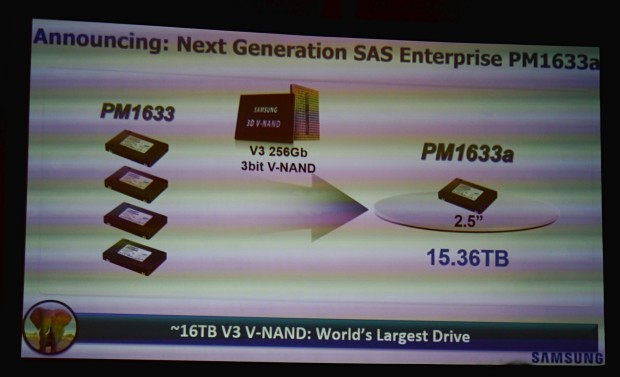
Samsung unveils 2.5-inch 16TB SSD: The world’s largest hard drive
Third-generation 3D V-NAND is now up to 48 TLC layers and 256Gbit per die.
Ars Technica
292 points · by twsted · 11y ago · 166 comments
When I see that a company can now create SSDs with ~16x more capacity than the best consumer option, I feel like something fishy is going on that is artificially slowing the pace of larger capacity drives making it into the hands of consumers at a reasonable price.
In the SSD market there are lots of brands, but only a few flash chip makers - so it's the same lack of competition but better hidden to the consumer.
From what I have read, Toshiba's 2.5" consumer/enterprise and 3.5" enterprise HDD business was acquired from Fujitsu [1] and has nothing to do with WD/HGST. WD had to transfer some/all (reports diverge) HGST 3.5" consumer HDD assets to Toshiba on the insistence of the EU Commission.
The Toshiba/HGST thing is a little opaque to me: HGST still sells a few DeskStar HDDs, notably DeskStar NAS, and newer Toshiba 3.5" consumer HDDs (MD-series 4TB+) look more like the enterprise HDDs that Toshiba has been selling for a while [2], not like the DT01ACA... models that were relabeled HGST DeskStar 7K3000 [3], although there are also pictures of the very same MD models that do look HGST-style [4]. Makes me unsure what to buy 3.5"-wise when I want the Hitachi reliability that I am used to (buying IBM/HGST for over a decade and never had a failure).
Then again, maybe I'm just naive and Toshiba is more dependent on WD than I think.
[1] http://www.cnet.com/news/toshiba-buys-fujitsu-hard-disk-driv... [2] https://www.alternate.de/p/o/a/Toshiba_PX3009E_1HP0_4_TB__Fe... [3] http://cdn1.goughlui.com/wp-content/uploads/2013/02/IMG_4989... [4] http://www.toshiba.eu/hard-drives/internal-hard-drives/sata-...
"We don't have a price for Samsung's 16TB PM1633a, but we can't imagine that it'll be cheaper than £5,000."
Based on that, you could reasonably say it will cost $7800 or more per current GBP->USD exchange rate.
What's the marginal price on a part you can only make successfully one time out of ten?
Having seen the move from 5.25" HDDs to 3.5" HDDs, then the move from desktops to laptops, and now seeing SSDs becoming extremely common in laptops, tablets, and phones, I have to believe that the author predicted the future when he wrote the book.
Since PC sales have dropped, people are not buying as many HDDs, and buying more SSDs, usually indirectly. Cloud infrastructure has likely gobbled up the existing HDD supply.
But even there, SSDs are preferred for many applications, such as databases, since they're faster overall, storage limitations be damned.
And now we're seeing the first SSD that has a capacity greater than HDDs, in a similar sized package. And no current HDD company has an SSD offering worth mentioning.
It's disruption happening right before our eyes. History seems to repeat itself all too often!
"In fact, Seagate Technology was not felled by disruption. Between 1989 and 1990, its sales doubled, reaching $2.4 billion, “more than all of its U.S. competitors combined,” according to an industry report. In 1997, the year Christensen published “The Innovator’s Dilemma,” Seagate was the largest company in the disk-drive industry, reporting revenues of nine billion dollars."
and:
"Between 1982 and 1984, Micropolis made the disruptive leap from eight-inch to 5.25-inch drives through what Christensen credits as the “Herculean managerial effort” of its C.E.O., Stuart Mahon. (“Mahon remembers the experience as the most exhausting of his life,” Christensen writes.) But, shortly thereafter, Micropolis, unable to compete with companies like Seagate, failed."
Note that he published his book long after this stuff had been shown to be hopelessly wrong, without making any corrections.
Many of his examples are similarly terrible. And those are the ones he cherry-picks to back his thesis.
http://www.newyorker.com/magazine/2014/06/23/the-disruption-...
I found The Innovator's Dilemma to be infuriating. It's a classic 20/20 hindsight -- just vague enough to apply to everything but excuse itself from any conspicuous counter-examples (Apple, say). Like most management fads, I guess.
(Prediction: wait until electric, self-driving car tech becomes practical. Ford and GM will crush the "nimble" disruptors like bugs. Well, unless it's Apple. Then all bets are off.)
Now, the hard disk makers may well be going under, but let's set aside Clay Christensen's over-rated terminology.
Samsung is hardly a small startup "disrupting" big, slow stalwarts. Samsung dwarfs the hard disk makers -- it's more like Google "disrupting" libraries, or Walmart "disrupting" local businesses.
BTW in Christensen's terms, this new disk is a "sustaining" innovation -- it's a better, faster, more complicated, harder-to-manufacture iteration of an existing, successful product.
Samsung has focused on SSD storage ever since...
A lot of 1 unit rack servers can fit about 8 2.5" drives. 128TB of storage in 1U is pretty crazy storage density.
Everytime they reveal a larger capacity drive I just wonder what the backup strategy is going to be. Longer tapes?
https://en.wikipedia.org/wiki/Linear_Tape-Open#Generations
looks like LTO-10 is planned to be 48TB per cartridge.
The chief benefit of LTO is that it still remains the cheapest and does in fact have huge sequential read/write speeds. Random read/write is even worse than discs but for backup purposes, sequential is king.
If you are limited to the write rate allowed by the SSD interface, then that will serve to limit the heat dissipation as well.
EDIT: I should have specified `backup to an SSD storage array.` Disk is just embedded in my brain.
When I look at all the moving parts in an HDD, I'm shocked they can still be produced for less.
Did you know that a silicon wafer is a perfect crystal, structured like a diamond? Silicon is right underneath Carbon in the periodic table, which means it shares the same outer electron shell configuration. Making that ain't cheap.
And if one atom is in the wrong place, you have to throw away the chip.
That kind of core expense doesn't exist in a hard drive factory. The disks in a hard drive don't have to be perfect crystals, for example. It's a LOT more expensive to produce chips.
Multiply all the distribution and sales costs, and you'll understand why it's so expensive.
this is certainly the case for CPU
but DRAM & NAND ? this is the typical case of designs where you can add redundancy to accomodate for manufacturing defects.
If it helps any just think of the costs as buying diamonds.
"Wow that's 16TB of diamonds!"
or:
"this GPU uses a bigger diamond than that GPU"
Why is that?
Humans are pretty damn good at making small precise mechanical movements.
Or look at internal combustion engines. The two absolutely critical technology improvements that changed things from WWI to WWII were "merely" refinements in those and radios. WWI IC engines were so rough they pretty much required wooden frames, and engine power was anemic, as WWI tanks show. Fast forward not very many years and we have much smoother and reliable powerful engines, and had developed the seeds of today's jet engines before the first transistor was demonstrated in 1947.
My bet is by the end of next year, SDDs will be cheaper than their equally sized HDDs. HDDs are certainly on their way out.
Hetzler et al. have calculated that the industry would have to spent over $800B to build enough fabs to replace hard disks with SSDs. http://storageconference.us/2013/Papers/2013.Paper.01.pdf
"The later capacity is accomplished using 8 stacked and thinned (< 75 um) NAND chips in a 1.2 mm package"
The samsung one has 48 layers per the article. So that's a 6x improvement.
Or automotive engines. We have all sorts of technology tacked on around the basic ICE gasoline engine to make them better- the combustion chamber is just a tiny piece of the machine, which is tended by countless devices managing temperature, airflow, fuel flow, air velocity, etc. Tremendously complex compared to electric motors- but in the end, they are still more popular than electric motors because of the fundamental problem of batteries.
Samsung has designed the PM1725 to cater towards next-generation enterprise storage market. This new half-height, half-length card-type NVMe SSD offers high-performance data transmission in 3.2TB or 6.4TB storage capacities. The new NVMe card is quoted with random read speed of up to 1,000,000 IOPS and random writes up to 120,000 IOPS. In addition, sequential reads can reach up to an impressive 5,500MB/s with sequential writes up to 1,800MB/s. The 6.4TB PM1725 also features five DWPDs for five years, which is a total writing of 32TBs per day during that timeframe.
[0] http://www.storagereview.com/samsung_announces_tcooptimized_...
It's also $3.25/gb for 800GB vs the Samsung PM1725's $2.15/gb for 800GB.
Hopefully there is a P3710 waiting in the wings that is competitive with Samsung's new offerings. I have had infinitely better luck in terms of reliability and performance consistency with Intel than any other SSD brand, and I think I'm not alone on that front.
~10K cycles sounds good
A compressed LTO6 is 6.25 TB, right? Let's just go with 3 of them.
So, I figured out how many carts we need. You calculate the fractional station wagon part. My math was never _that_ good ;-)
That is likely to be cheaper than a 16 TB SSD for a very long time to come. Tapes aren't going anywhere.
I'm off to research the weight differences, and see if the wagon's suspension factors in to this...
2,000,000 / 48 = 41,666.66… IOps
45k IOps for 16TB limits its use cases a bit. I don't know enough about storage to make an educated guess, but anyone know what the constraint there might be? Aren't there controllers that can do 1MM IOPS on single EFDs? 45k is still a ton of operations, but I expected more somehow.
I'm sure there's a market there, but I don't know how big it is. This is denser than current hard drives, but total cost is probably heavily in favor of hard drives for most use cases.
I find it particularly confusing that Samsung (seems) to have gone for a SAS SSD versus NVMe. NVMe would allow them to do a PCIe card form factor, which would surely be easier from a physical space perspective. And it's not like anyone has a PCIe flash product at 16TB either -- Fusion-io tops out at 6.4TB.
NVMe also might allow them to improve the iops. Intel's P3500 NVMe is 430k iops at 2TB. Night and day compared to this Samsung drive. So in one 2U chassis you could have any of:
  24x2TB Intel P3500
  = 48TB
  = 10,320,000 iops (read 4k)

  24x1.6TB Intel S3500
  = 38TB
  = 1,572,000

  24x16TB Samsung PM1633a
  = 384TB
  = 1,000,000 iops

  (meanwhile HDD would have far lower iops, but also probably a lot cheaper)
Really? I've got a couple of 128GB SDHC cards here -- and while they might be less performant than SSDs... I just tried to stack them on the back of a 2.5" hdd -- and I guesstimate that you'd at least be able to fit 6x6=36 of them (plastic frame and all) on the back of a 2.5" drive -- and stacking them 5 high would still be way below the width of a 2.5" hdd.
And that's not just 128GB of storage, but including 36x5 controllers etc? (Not to mention lots of plastic).
I'm prepared to be dead wrong -- but "fitting" 16GB flash into the behemoth size that is a 2.5" hdd -- doesn't seem like much of a challenge?
It has 16 NAND packages, the controller, two 1GB DRAM chips and capacitors. No idea if the Samsung drive includes capacitors, but I sure hope it does.
The Intel board fits in a 7mm enclosure, but 2.5" enclosures can go up to 15mm. To be generous, lets say that Samsung fit two double-sided circuit boards into the enclosure and also squeezed another 4 NAND packages in per-board. The NAND dies are 256Gbit vs Intel's 128Gbit, so with similar NAND packages that gets them to 10TB.
So now you either need to fit more NAND per-package -- no idea what die size they are -- or add more packages. Maybe their packages are physically smaller or maybe they're able to get >256GByte per-package. Either would help tremendously.
But regardless, that is a lot of packages for your controller to handle and if you're constrained on physical space you aren't going to be able to put additional DRAM chips on the board. You could replace the 1Gbit chips with 8Gbit chips in a similar footprint and maintain your 1,000:1 ratio of NAND:DRAM, but those chips will obviously cost a substantial amount more. I feel like this drive is going to really blow minds in terms of cost.
I'm not an expert on this, but my impression is that a lot of organizations that need a lot of space would be much happier with larger-capacity-but-slower drives because those drives can be so much cheaper than trying to build out more space.
With the Samsung 16TB SSD, I could fit 384TB in a 2U chassis and a total of 8.8PB in a rack (of 23 hosts). That's $10.6mm in disks in that one rack.
Or I could go with hard drives (8TB, 7200rpm, enterprisey, $700) and fit 288TB in a 4U chassis and 3.1PB in a rack. I would need three racks instead of one rack to equal the storage capacity. However, it costs me $832,000 in disks.
There's really no way that your fixed costs for 2 racks can make a dent in $9.7mm, even factoring in the differences in power utilization between the two. So you'd have to get a substantial benefit from the performance differential between a HDD and this SSD, but not to the point where you need the 82x performance improvement of a faster NVMe drive (such as the Intel P3500).
The hard drives would have ironclad firmware that keeps the RAM refrehsed until its battery goes down to 15% (or whatever the conservative 10 minutes of power is), at which point it takes the ten minutes to dump the contents of that RAM to SSD, and reverts to having that drive also be SSD until the power is reconnected long enough to charge battery back up to 80%. Then it reads it back into RAM and continues as a Lightning Fast 64 GB + Very fast 16 TB drive.
You would store your operating system on the lightning-fast drive.
The absolute nightmare failure state isn't even that bad, as even though the RAM drive should be as ironclad as SSD, in case it ever should lose power unexpectedly through someone opening the device and disconnecting the battery or something, it can still periodically be backed up, so that if you pick up the short end of six sigma, you can just revert to reading the drive from SSD rather than RAM and lose, say, at most 1 day of work.
thoughts? I bet a lot of people would be happy to pay an extra $800 to have their boot media operate at DIMM speed, as long as the non-leaky abstraction is that it is a physical hard drive, and the engineering holds up to this standard.
There is a lot of software out there that is very conservative about when it considers data to be fully written - it would be quite a hack for Samsung to hack that abstraction by doing six or seven sigma availability on a ramdrive with battery and onboard ssd to dump to.
It would be very interesting to see a similar product being introduced using contemporary technology, though. One question is what sort of interface it would communicate over to leverage the higher transfer speed.
I think it is fine not to have any higher interface to leverage the transfer speed. RAM latency and speeds can obviously saturate disk interaces, but I doubt SSD's come close. So it should be a large jump in performance regardless.
Relying on a drive controller might seem the right way to go but especially for corporate installations I would believe it would be beneficial to have the fine grained control a dedicated server could provide.
http://ieeexplore.ieee.org/xpl/articleDetails.jsp?arnumber=6...
In 2012 they list the density of magnetic disks as 750 Gb/in^2 and nand flash as 550 Gb/in^2. I'm not sure how the numbers have changed with 2d nand, but 3d nand probably pushes the density way over magnetic.
MicroSD is 15x11x1 (165 mm^3), max size 200G
MicroSD is less than 0.5% the volume of 2.5" HDD, but 5% of the capacity. So MicroSD is an order of magnitude more dense than 2.5" HDD.
MicroSD still has to fit a little controller in there, so the comparison isn't particularly fair on flash. I expect heat management to be a problem scaling up though, apart from any manufacturing difficulties.