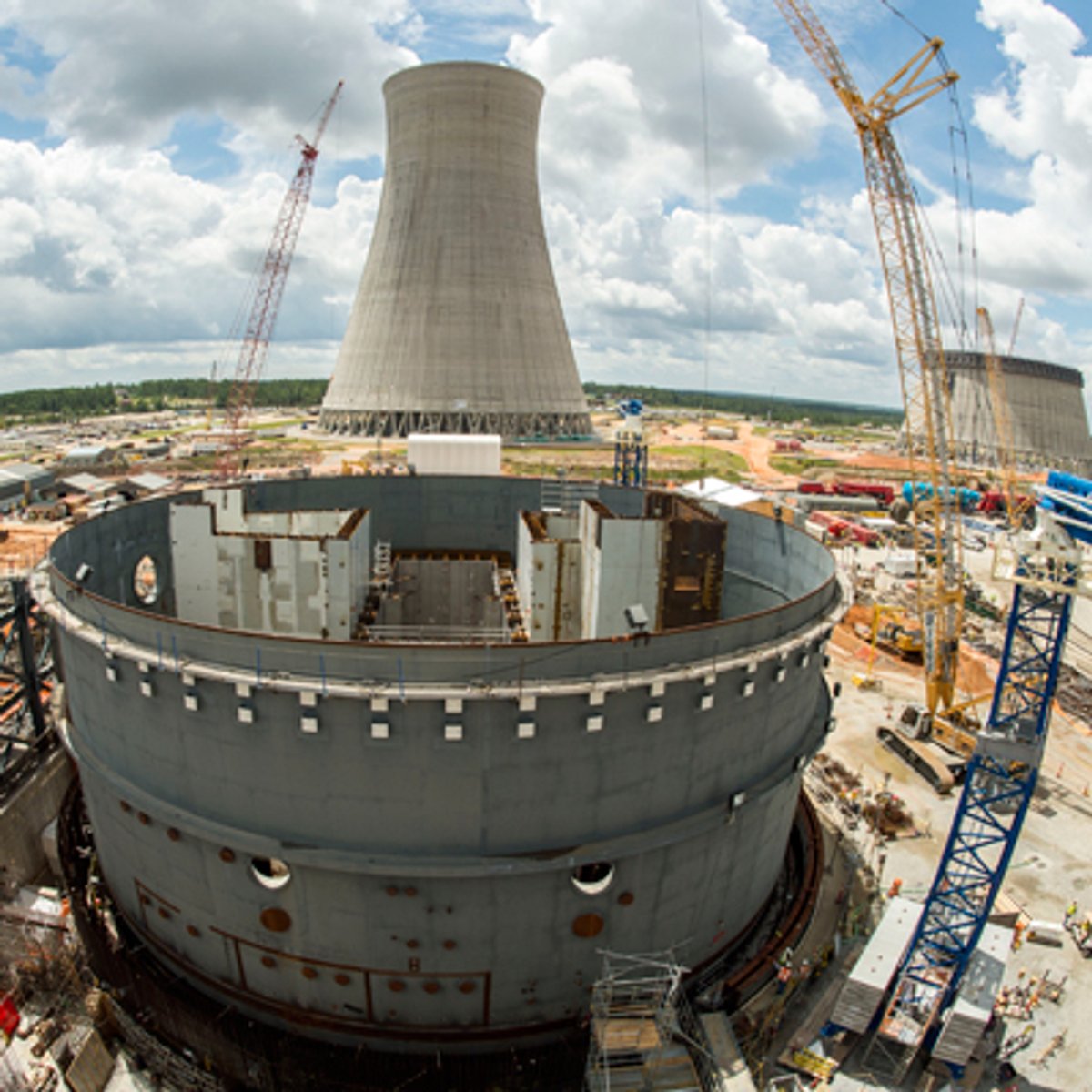
The World Really Could Go Nuclear
Nothing but fear and capital stand in the way of a nuclear-powered future
Scientific American
58 points · by tdaltonc · 11y ago · 109 comments
Well, exactly. The most noisy and alarmist aren't interested in producing energy at all. They are only interested in de-industrialisation and de-population.
Of course nuclear fission is the answer to large scale energy. It always has been. Weapons proliferation can be addressed with new designs and materials. Safety can be addressed with passive systems.
The technical answers are simple compared to fusion or elaborate harvesting of diffuse energy such as sunlight, wind or tides.
The logical conclusion is that the people making the most noise are not in it for the solutions, but for the noise and attention. I'm not the only one to think this, but expect the groupthink to smite my comment anyway.
Do you want to talk about nuclear energy on HN, or do you want to talk about how you feel about talking about nuclear energy on HN? The former topic seems much more interesting than the latter.
Don't think he meant it as a dismissal, just as a preemptive nudge to discourage actual groupthink.
For countries that already have nuclear weapons, I don't even see a valid argument against nuclear power. Agree, the only think holding us back is politicians who are afraid to use the word "nuclear."
* Serious, INES 7 nuclear incidents can render whole regions uninhabitable.
* Health impact from nuclear incidents can be insidious, revealing themselves only in long-term statistics, which can make risks hard to gauge.
* Waste containment remains an unsolved problem.
There are probably many other valid arguments.
I think people underestimate the impact of coal, and de-industrialization is totally unrealistic and would almost certainly do far more damage to more people than nuclear would. But to suggest that nuclear isn't fraught, or that the only concern was proliferation... that doesn't seem intellectually honest.
What shocked me more than anything about the accident, is that when things go horribly wrong with Nuclear, we literally have no plan. We have no way of getting inside to stop things getting worse, or to contain what has already happened. We literally stood around watching, waiting, to see what would happen. When the highly contaminated water flowed into the ocean, the response was "where else did you think it would go?".
I'm aware that new reactor designs mean things going that badly is very unlikely in the future, but I still think it's scary we can build a machine with such immense power, and it can get to a point where we just stand back and watch it go bad.
What was your reaction when the Deepwater Horizon spill happened? We had no real plan then, either. And the aggregate impact of that incident was arguably larger than that of Fukushima. (For example, the "highly contaminated water" released into the ocean from Fukushima is probably going to do a lot less ecological damage than the oil released by Deepwater Horizon. The contaminated water will just get diluted to the point where it's indistinguishable from other ocean water. The oil, not so much.)
> we can build a machine with such immense power, and it can get to a point where we just stand back and watch it go bad.
First of all, a nuclear reactor that produces 1 Gw of electricity doesn't have any more "immense power" than a coal, oil, or natural gas plant that produces the same electrical power output.
Second, we have every right to insist that, before a nuclear reactor gets built, we have a contingency plan in case something goes wrong. But, to be fair, we should insist on that for all sources of energy. Want to drill for oil? What's your contingency plan if there's a leak in the well? As I commented to someone else upthread, nuclear power appears to be the only energy technology where everyone focuses on the worst case; other energy sources seem to get what amounts to a free pass in this regard.
Stop putting those control rods in there and see how much energy it will generate.....
Nuclear power plants produce a lot of power very cheaply for many years. But companies can't help but push the boundaries to boost profits, extending plant life past spec and skimping on maintenance and safety measures, with just a bit of regulatory capture to smooth the process.
I'm still pro-nuclear. We just need to follow through on the regulation. Maybe we can start by not being so damn secretive about nuclear stuff. Anyway, we have to build new ones to take on the capacity so we can shut down old ones. Which means we can't be so scared of building them, since not building them is what's unsafe.
The contamination might kill a few hundred, and has resulted in an exclusion zone.
IMO, the biggest problem with nuclear is how unacceptable disasters are. One old reactors built in high risk zone has a little meltdown, and the entire world freaks out over it. This is a major practical impediment to nuclear - you won't get costs getting driven down (for better or worse), because people see the risk as completely taboo.
It's like people worrying about tall buildings, because of 9/11. There's always risks.
And how many of those can we afford to have in the world?
How much liquid contaminated waste can we put into the ocean?
This is what I don't understand. The earthquake and tsunami that caused Fukushima's problems killed 20,000 people, and created an almost unimaginable amount of devastation. No one has died from Fukushima's radiation, and no one is expected to die. How horrible would the disaster have to be for a 1,000 people to have died from radiation? Would there have been 1,000,000 other deaths?
> I still think it's scary we can build a machine with such immense power
...this nails it on the head. It seems like most of the thoughts about nuclear power seems to be in the category of "we've created something unnatural, and we're worried that we'll anger the gods, and they'll release the invisible evil spirits as punishment". Not that I'm saying that we shouldn't have to take aspect of human nature into account.
http://myths.e2bn.org/mythsandlegends/textonly562-pandoras-b...
What is important is that we be proactive. Nuclear plants are reaching end of life, and will either be replaced with more nuclear or replaced with coal. Those are the choices. Coal mining kills more people than nuclear ever has.
Life is risky. By all means make sane decisions on risk but the current policy of sitting on our hands and hoping for a miracle is just wrong. Replace old plants with better designed, safer, new plants.
I'm not convinced restarting nuclear makes sense today though. Solar seems to be on an economically winning trajectory and building nuclear plants is very expensive, apparently even for countries that are good at it, like France.
In his book Storms of My Grandchildren he strongly advocates nuclear power, especially GenIV designs. In particular he talks about the Integral Fast Reactor.
Plenty of other prominent environmentalists are advocating nuclear these days; the documentary Pandora's Promise highlights several of them. And James Lovelock, who invented the "Gaia" concept, has advocated nuclear for years.
cough waste management cough
We're talking about megayear timescales when it comes to nuclear fission waste.
Humans have been around for how long? What's the age of the oldest building around? What's the usual timescale for modern age buildings to deteriorate?
Russia has two fast reactors in commercial operation right now, one since 1980. The U.S. had the Integral Fast Reactor almost complete in the mid-1990s, when the Clinton administration shut down the program.
The rest of the waste is fission products. Encase them in glass and bury them, they're back to the radioactivity of the original ore in a couple centuries. That's a human timescale. When I lived in Germany, we had a brewery in town that had been continuously operating for 800 years.
Not every transuran is viable fuel. Some of the stuff is actually actively getting in the way of an efficient fission chain reaction.
The key benefit of fast breeder reactors is, that you can fuel them with stuff that's more abundant on Earth, so you're not getting into a fuel shortage (our supplies of U235 are quite limited, some 70 years or so, using conventional fission reactors). So you need to either go through a fast U238→Pu239 or a Th232→U233 process if you want to make use of the abundant stuff.
Oh, and most of the fission products are not very pleasant either and you can't efficiently burn them in any way whatsoever. Burner Accelerators? I've got a few things for you to look up: Penetration epth, Bragg peak, small volume active zone.
> The rest of the waste is fission products. Encase them in glass and bury them, they're back to the radioactivity of the original ore in a couple centuries.
Unfortunately not. The generation zero of nuclides will decay in that timeframe. But all the other stuff to follow, less radioactive, but still dangerous, takes much more time to decay; and those daughter generation nuclides is where the headaches start. And it's not just the physics that's a problem, it's also chemistry. Some of the elements that are born are quite aggressive, chemically.
No, we're not. Anything with megayear halflifes is effectively not radioactive.
There's a lot of great answers. None of them are politically feasible because instead of thinking of it as an engineering problem, people think of it with the Sealed Evil In A Can memeset [1] and treat it like it is eternally a baleful evil demon that smites everyone that so much as thinks about it for too long, by magic.
It is, literally, a small problem, as in, literally, we're not really talking about very much stuff volumetrically.
It's only a problem because paradoxically people treat it with such fear that it stays a problem, because we're so fearful that nobody is even allowed to try to solve the problem because to our fearful brains it would basically be poking the baleful evil spirit with a stick. If it were just legal to stick it in glass bricks and stack them up somewhere, as has been studied, we could be done thinking about it, but instead we have to leave it in a more dangerous form. It is frankly difficult for me not to see this as a problem that people in charge make sure to deliberately make sure stays unsolved because it suits them, not because I'm really prone to conspiracy theories but simply because while not necessarily "trivial", it's just not that hard of a problem. You should fear your local garbage dump a lot more than you fear a pile of glass bricks piled in a mountain in Nevada.
[1]: http://tvtropes.org/pmwiki/pmwiki.php/Main/SealedEvilInACan
Yes, we are. You've to consider the daughter and grand^n-daughter nuclides as well. Makes for a very nice undergrad tutorial on coupled differential equations. Fun times.
One mountain can be used to bury the waste. That is a tiny footprint compared to other, conventional means.
Even a single small hydro dam - itself a great way of making power - covers a far larger area of the earths surface than all the nuclear waste ever made, combined. Compared to coal waste and even the mining waste for rare earths, it is a tiny amount of waste.
No. They are actually interesting in assuming power in the society by foregoing the standard societal ascension mechanisms.
Sure, it's cheap in theory, but nuclear power projects bring with them enormous project management risk. If you complete 90% of a wind farm installation, you get 90% of the power out. Completing 90% of a nuclear reactor gets you no power at all, and unexpected cost overruns can add up to billions of dollars. When a reactor shuts down for repairs, they sometimes take decades to complete. As of today, it can be argued that many countries' nuclear power programs were a financial mistake.
Then, once in a while, you find out that the original cost-benefit analysis was wrong. After the Fukushima accident left $200 billion of real estate uninhabitable, nuclear power plants across the world have revised their risk models, and now are spending more money for safety upgrades.
Finally, emerging technologies like wind and solar are showing immense promise, but predicting their future cost is equally difficult. All the best minds can only put together a very educated guess.
Yes, if we had started focusing on nuclear power 40 years ago -- and if we had done it carefully and properly the first time -- it would have been the right decision.
But we got it wrong, and the today risks of getting it wrong again are bigger than ever.
To answer this, you need to ask "compared to what?"
The article's implicit assumption is that the comparison should be between a possibly quite expensive future with nuclear power, and a possibly even more expensive future with climate change that is extremely costly to deal with. If you agree with the second possibility being a realistic one (I personally don't, but that's really a separate discussion), then the first one can look cost-effective, simply because it's cheaper than the alternative.
If, OTOH, you're comparing nuclear power with cheap fossil fuels, in an environment where even safe nuclear reactors have to undergo years of legal challenges on the NIMBY principle, whereas a new coal, oil, or natural gas plant gets up and running quickly, then of course nuclear power isn't going to look cost-effective. (People who favor the previous comparison, with the "expensive climate change" alternative, would probably say the "cheap fossil fuel" alternative only looks cheap because it doesn't take all the costs into account.) But that could change if fossil fuels get more expensive (whether because they simply get harder to extract, or they face increasing regulation based on other factors like climate change).
> if we had started focusing on nuclear power 40 years ago -- and if we had done it carefully and properly the first time -- it would have been the right decision.
Now you seem to be making a different implicit comparison, between what we have now and what you think we would have if we'd focused "carefully and properly" on nuclear power from the start. But we arguably haven't focused "carefully and properly" on fossil fuels either; for example, coal dust has killed far more people by causing respiratory problems than nuclear power has, yet it took decades for "clean coal" to even be a talking point. Why should nuclear be the only technology where we have to do it "carefully and properly" or not at all? If you're going to compare them fairly, you have to compare them at equivalent levels of risk.
http://spectrum.ieee.org/energy/nuclear/the-forgotten-histor...
In particular, simple molten-salt reactors like those designed by Terrestrial Energy and ThorCon look very promising.
Seriously, solar is already at cost parity and the economics are getting better with time. Plus externalities are minimal. Compared to nuclear power which gets less economic over time and has very open ended externalities.
Nuclear power in Canada is a complete success. We generate at 6 to 7 cents per kilowatt hour in the first 30 years, and the amortized cost continues to decrease after that. Yes there are maintenance costs, but do you know what else there are? Medical isotopes that the world desperately needs to keep our diagnostics working.
You can make nuclear cheap and safe. The problem is cultural, not scientific. If a society is too greedy and corrupt or too deferent to authority, then nuclear won't work. But in places like Canada, Sweden, and France they work very, very well.
Also, Thorium reactors are much less likely to cause problems and they are part of the fifth gen reactor designs.
We need both nuclear and solar.
As a load following, top-up power source for peak daytime usage, or for charging storage based devices like cars, it's great. But you cannot compare solar and nuclear because they are entirely separate classes of energy production.
The entire series is a gold mine for people who actually want to talk about energy generation and climate change on an informed basis rather than just making guesses to suit their particular world view.
With that said, one of my favorite futurists, Ramez Naam, who is a big proponent of Wind and Solar (See: http://rameznaam.com/2015/08/30/how-steady-can-the-wind-blow... and http://rameznaam.com/2015/08/10/how-cheap-can-solar-get-very...) still thinks we should invest in nuclear, as it has an important role to play in regions where renewable resources (Solar/Wind/GeoThermal/HydroElectric etc...) are not available, and as a hedge against storage (which is critical for solar/wind) technology not advancing to where we need it for 100% support of base-load power.
Though he also talks about Storage here: http://rameznaam.com/2015/04/14/energy-storage-about-to-get-...
Also, there's the usual argument that with proliferation of a technology you gain efficiencies and costs drop (precipitously sometimes).
>>> Yes, if we had started focusing on nuclear power 40 years ago -- and if we had done it carefully and properly the first time -- it would have been the right decision.
Pushing the problem down the road because the solution isn't perfect probably is not the best idea at this point.
[1] https://en.wikipedia.org/wiki/List_of_countries_by_electrici...
And that doesn't even account for the cost of the reactors...
That is really not the most basic problem though. Cost is a non-issue if the alternative is green house gas emissions which will eventually cause an apocalyptic global warming effect. What good will all the cost savings do at that point?
Putting that aside, I agree with you completely.
Financial mistake or not, not being dependent on Petrol for your electricity production is a huge win. It solves many other (political) problems.
To make matters worse, most nuclear reactors in the United States were built in the 1960s and 1970s and they were only designed for a lifespan of 40 years, which means most of them should be shut down. However, since a lot of money is at stake with how much reactors cost, regulators rewrite the rules and extend the useful life of the reactors and put us all in danger. That is what bothers me and that is why I am against nuclear reactors - because when money is on the line, all bets are off.
From the data I'm able to find, coal energy results in about 170,000 deaths per trillion kilowatt-hours globally, compared to about 90 deaths per trillion kilowatt-hours generated from nuclear.
That would mean that burning coal for energy is nearly 2000x more dangerous than nuclear power.
Is there something more to the opposition's argument than safety? Or is this just a case of the public being misinformed?
Are you saying that running a gaming PC for 2 hours results in 170k deaths?
and the US rate is 15,000 or 1/10th of that.
http://www.forbes.com/sites/jamesconca/2012/06/10/energys-de...
http://www.forbes.com/sites/jamesconca/2012/06/10/energys-de...
- The corporations building these things are hyper-corporations, many in the defense industry. Corporations, especially at that scale, are at best amoral. To meet environmental, safety, disposal and cost concerns, they will go part way, but when they hit the knees of the various curves, they will convince Congress and citizens through advertising, co-opted scientists, and bribed members of Congress that everything is great and it's been taken care of.
- Waste. After however many decades, where is all the nuclear waste? Are we finally implementing the long range plans, to take care of wast and make future generations safe? At least out hundreds of years I would expect. I think the answer here is effectively no. I think we're still just studying it, and all involved are hoping someone else will deal with it later. There will never be enough Senators to vote for specific locations in their states, and transportation through their states. "On site" will magically be found to be perfectly fine after all. And it will end up being Hanford and Rocky Flats, with leaks into the water table, and shit stored next to shit that shouldn't be.
- Safety. What happens when we finally experience a catastrophe, because the corporations and governments kicked the safety can down the road so that these things could be built? It's going to happen, they're corporations and they must above all make a buck. What hyper-corporation could resist turning uranium into gold?
- Environmental. These things need to be cooled. They're next to rivers and oceans because of that. Ecosystems dwindle and die, because downstream temperatures will always be "within acceptable levels" that were set by agencies suffering from regulatory capture that are funded by bribed Congressmen. No one wants to be the single point of failure on the money pipeline.
- Cost. Balloon. Corporations make money no matter what. Even if a corporation is fined in proportion to its overrun, even if they refuse to pay and people are jailed (ha!), that money is still lost.
The only thing above that I'm inclined to give on is safety, it's probably an engineering possibility. But that's mere technical possibility, in the face of amoral corporations with a drive for profits stronger than the human drive for reproduction.
Color me sceptical.
Lots of people posting and reading this work for corporations.
Do bad actors exist? Sure. Are all corporations at scale amoral? You make them sound like machines programmed by megalomaniacs, not places created by, worked at and invested in by ordinary people. Every 'corporation' I have ever worked at has been filled with people trying to do a good job under whatever circumstances they find themselves in. Brushing off the majority of good that large companies do as an argument is not correct.
I'm talking about hyper-corporations and billion dollar contracts. That many people, chasing that much money ... no one who's gotten to the point that they could with authority say "Nah, we shouldn't do this, it's wrong," ever would say that. No one at that level of accomplishment and tenure has it in them to say "Oh, and are the fish in that river really safe?"
Ahem.
http://www.nytimes.com/2015/09/19/business/volkswagen-is-ord...
https://news.ycombinator.com/item?id=10240001
At best, corporations are amoral.
Today, with the rapid decline in the cost of solar energy, I'm far less convinced this would be a wise move.
Also, isn't Sweden supposedly phasing out nuclear power?
Based on my reading, I decided that the arguments in favor of nuclear power were significantly better than the defenses of renewable energy. So I made the strategic decision to write affirmatives about uranium enrichment and targeted procurement of nuclear-powered vessels.
That was how we won the national championship.
In other words: Even when the best debaters in the country have a year to prepare their counter-arguments, nuclear energy still tends to come out on top. Like facts, energy density is a stubborn thing.
I'll add that we especially are risking other people's lives. While most people reading this have reaped the benefits of fossil fuels, likely we and our decendents mostly will survive while people in poor countries die.
China has 13 nuclear stations under construction, with 61 reactors and a total capacity of 40 to 75 gigawatts.
Fukishima killed zero (https://en.wikipedia.org/wiki/List_of_nuclear_and_radiation_...). Chernobyl will kill about 4,000 when all's said and done (http://www.who.int/mediacentre/news/releases/2005/pr38/en/).
We lose more than that directly via coal mine accidents every year. Add in the deaths from pollution and the math gets even better in nuclear's favor.
Hell, hydroelectric killed 170k in 1975.
> The United Nations Scientific Committee on the Effects of Atomic Radiation (UNSCEAR), released a report on the Fukushima accident April 2, 2014. It stated that the scientists have found no evidence to support the idea that the nuclear meltdown in Japan in 2011 will lead to an increase in cancer rates or birth defects.
985,000 isn't such a feel good number, after all.
http://www.globalresearch.ca/new-book-concludes-chernobyl-de...
We need to start with the premise that nuclear is safe, and work back from there. We can redefine terms and ignore any research that doesn't fit with our agenda. Then when people question whether its a good idea we can setup a straw man and compare it to something obviously worse, like coal mining, and thus claim by relativity everything is great!
Right from the reputable source link I provided:
"He explains that there have been 4000 cases of thyroid cancer, mainly in children, but that except for nine deaths, all of them have recovered. "Otherwise, the team of international experts found no evidence for any increases in the incidence of leukemia and cancer among affected residents.""
Something similar is happening with nuclear energy vs fossil fuel.
I wish this could be reframed somehow, but maybe it's just how humans deal poorly with risk.
I have yet to see waste from solar or wind mismanaged, or a solar or wind plant not be cooled properly after a fault, causing a meltdown.
Everyone comes to Hacker News comment threads like this to expound that nuclear is the way, while solar and wind continue their march towards domination. A nuclear plant takes ~10 years and at least $1 billion USD to come online. Solar and wind are going to be even further along by then.
http://www.bloomberg.com/news/articles/2015-06-23/the-way-hu...
http://www.bloomberg.com/news/articles/2015-01-30/seven-reas...
http://www.npr.org/2015/09/10/319535020/coal-gas-nuclear-hyd...
Except it's not really true. You get solar and wind power when you get it, not when you want it, so it's far less valuable. Once you add storage costs it's more expensive than nuclear.