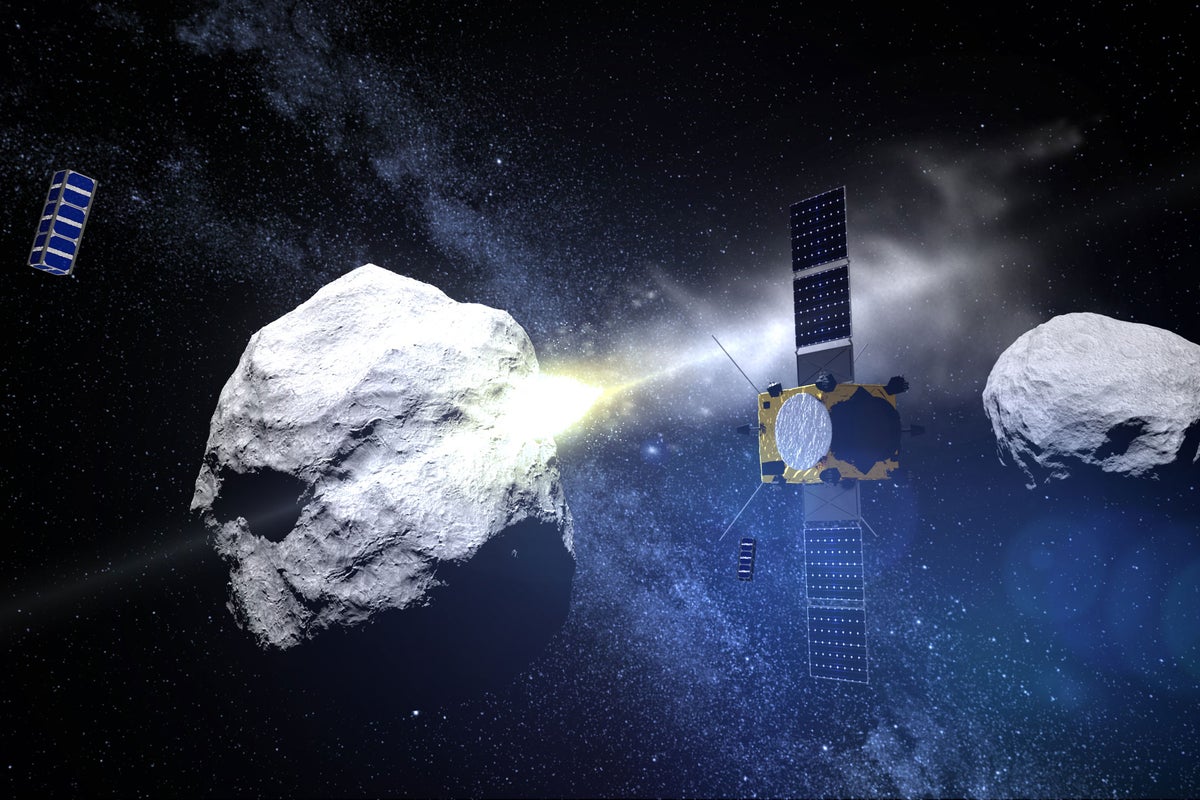
Scientists to nudge asteroid off course to protect the Earth
US and European officials will work together to send up two spacecraft, one of which will smack into the rock
The Independent
143 points · by hliyan · 11y ago · 64 comments
Looks like some experts agree w me: http://www.space.com/21333-asteroid-nuke-spacecraft-mission....
Let's assume that you did blow up an asteroid, and the constituent parts loosely reassembled. Wouldn't they they break apart again as soon as they started to experience the turbulent effects of the Earth's atmosphere? And once they did, the surface area to mass ratio of the asteroid matter would be an order of magnitude or higher, pretty much guaranteeing all of the mini-asteroid parts would burn up.
No doubt I'm wrong. I'm a programmer, not a physicist or an astronomer. So I'm seeking to get 'educated' more than I am to argue with you.
On top of that, nudging it out of a collision trajectory is going to require a lot less energy than disintegrating it, particularly if you can arrange to do the nudge a long way off. What's easier, pushing a runaway shopping cart so it doesn't bang into your car, or tearing the cart into parts small enough that they don't do any damage when they hit?
Neal Stephenson's latest novel, Seveneves has some discussion of this (on a much larger scale, granted).
If you look at the numerous things that went wrong with the Philae lander...
https://en.wikipedia.org/wiki/Philae_%28spacecraft%29
you wouldn't want any of that to happen on a life-or-death mission. Also... a landing either requires enormous amounts of fuel or between months and years of manoeuvring time.
Bear in mind that if most of the fragments still hit earth, the net energy delivery would still be about the same. This could actually be worse for the planet as a whole than a single hit. Finally, whether such a bomb could be effective would also depend on the structure of the asteroid or comet. This is due to the bugsplat effect, army slang for the fact that when a bomb hits a building or vehicle, the energy seems to be expended very asymmetrically. If you crush a bug with your boot, one part of the exoskeleton will weaken before the others and the insides get sprayed out in that direction. Similarly, if a bomb hits a vehicle often the majority of the explosive effect tends to get directed primarily in one direction. There are cases of people close to one side of a vehicle surviving unharmed, while people much further away in other directions get incinerated or hit by fragments. Similarly if the internal structure of the asteroid is asymmetrical, you could end up with material on one side of the asteroid (perhaps made up of already loose boulder material and dust) being thoroughly fragmented while larger more dense parts of it on the other surviving. Instead of many similarly sized fragments, you might well end up with a large percentage of the object remaining intact and all you did was scrub off looser material.
There is another very similar video, maybe of the same slides with a inset of the speaker, but I can't find it atm.
Maybe you could fire a rocket in the opposite direction the whole time, but that increases fuel requirement even further.
No, actually not that funny.
Don't get me wrong... I do agree with you that all of these scenarios are extremely unlikely (space is really big) and I do think the experiment is worth doing. But still, there are failure modes and unintended consequence opportunities that should at least be thought about a bit, even if a very little bit.
I think it's highly likely that the people responsible for these projects will realize this. Do you disagree?
- Douglas Adams
Chances of anything striking anything as a result of human intervention are quite slim. Effectively nil.
This whole comments section is making me want to read some scifi about this. Anybody have any recommendations?
"Thirty years before the First Interstellar War, a meteorite from Klendathu System was deviated from its star during the Operation Fedmil, the first contact in Klendathu. Thirty years later, the meteorite reached and hit Earth, destroying Buenos Aires, capital of Argentina, killing over 8.7 Million, and wounding a further 12.5 million."
"However, the United Citizen Federation claimed that the Arachnid launching a "Bug Meteor" by Bug Plasma from the Klendathu system towards Earth and destroyed the city of Buenos Aires."
There's some rock throwing in this latest book in the Expanse series. You'd want to read the earlier books beforehand though. (They are worth reading anyway.)
suspended animation interspersed with patiently building a habitable environment out of asteroids & comets.
If we can nudge it into a collision course, surely we can nudge it out of one.
Definitely a serious risk even if not the most pressing right now. It is however more dangerous than terrorism in America, and plenty of money is being spent on that!
Actually, what would be a good reason NOT to do it ?