Should we rebuild lost ecosystems through trophic rewilding?
Most of our rewilding efforts have been accidental, but they may guide future work.
Ars Technica
17 points · by nols · 11y ago · 12 comments
There are many past ecosystems we could choose to attempt to restore. Certainly Yellowstone had its wolf population. But it also had a native human population, whose practices affected the ecosystem.
Do we want to "rewild" to before European settlement, so re-introduce Native American land clearing practices? That would certainly help restore the quaking aspen population. Remember, there was 11,000+ years of humans as one of the top predators in that ecosystem.
Or do we return it to pre-human habitation era at the end of the last ice age? That's what truly "wild" means, no?
Ars Technica appears to have forgotten. They write: "So when they disappear—largely because of us—there are myriad negative effects, culminating in a lack of biodiversity."
Who exactly is this "us"? It can't mean "humans".
To really rewild to pre-human times would call for a return of the megafauna like the American lion, the short-faced bear, and the other animals that disappeared some 11,000 years ago.
But that's not what most people mean when they talk about rewilding in the Yellowstone context.
It's not clear what to use in its place for 'natural' areas, but perhaps it's sufficient to divide the world into 'non-industrialized' and 'industrialized' (in which I would classify agricultural and urbanization as industry, too)
This is an old debate in regards to artifacts. Should an old building be preserved? Restored to some earlier state? And if so, which state?
Even there, we use the word "restore" when it doesn't fully replicate the original structure. Eg, the older building probably contained old-growth wood and didn't have any power or running water, or was handicap accessible or met modern fire codes. It certainly didn't have the same isotopic composition, given how we've added petroleum-based carbon (less radioactive) and nuclear fallout to the building, and ecosystem.
Similarly, one might be restored to health, but it's not the same heath as before, if only because of increased age.
So I don't think that people mean to 'completely eliminate all human involvement' when they speak of rewilding, and I don't think that's how it's usually interpreted.
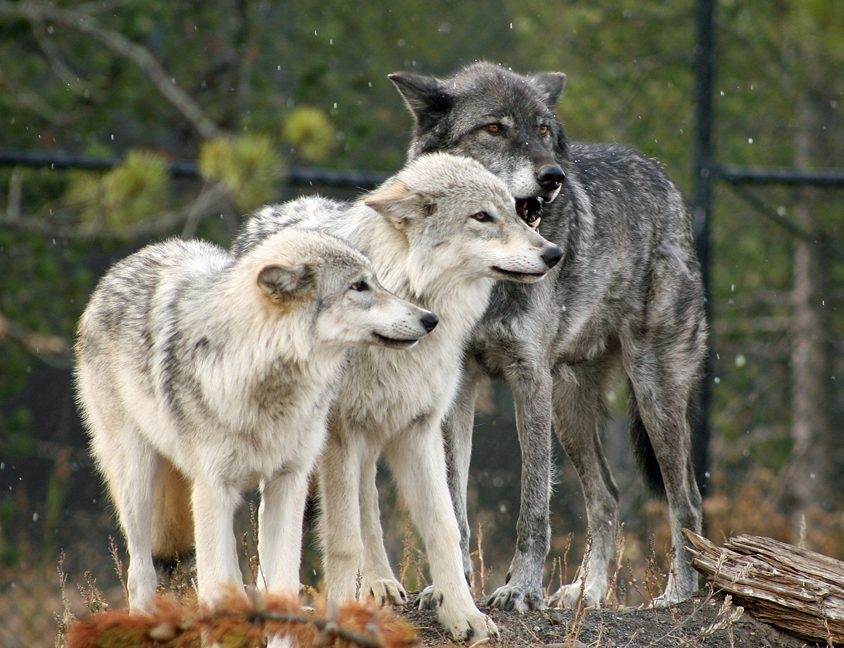
For example, this piece says "The best-known example of trophic rewilding was the reintroduction of wolves into Yellowstone National Park in the mid-1990s." Since there is still all matter of human presence in the park, it can't mean that rewilding means to get rid of human involvement.
Obviously the easiest (and probably safest) way to do that is to study earlier times where the biodiversity was higher in the specific environment, and see if you can identify some of the causes, which in many cases turn out to be the presence of apex predators.
That easy confusion is why I don't like the term "rewild".
BTW, just now I researched some of the history. http://academic.evergreen.edu/curricular/MES/rewilding.pdf from 1998, which Wikipedia's "Rewilding (conservation biology)" describes as a refinement of the idea, by conservation biologists Michael Soulé and Reed Noss, characterizes the two eras of human involvement in the North American continent; the megafauna extinction from 11,000 years ago, which killed off 50 species of large mammals large in North America, and the post-Columbus wave.
That ends with:
> Sooner or later it is necessary to find the resources to incorporate wilderness and the entire pre-Columbian set of carnivores and other keystone species into reserve designs. Absent these, the long-term success of the continental conservation network in North America is doubtful.
So it's goal is to restore the pre-Columbian era ecology, but says nothing about the involvement of the one species which defined the character of that ecology - humans - other than to argue that it should be minimized.
You commented, "which in many cases turn out to be the presence of apex predators." My point boils down to the observation that humans were one of the apex predators.
Yes, but did they increase or decrease the surrounding biodiversity?
"Wild me, Sandfella." (Logan's Run)
"She like to do the wild thing" (lyrics, Tone Loc)
Yeah, another term might be a good idea.
Why not emphasize ecological robustness in farming practices? Using ecology as the basis for designing food production systems promote biological diversity and resilience with the added benefit of healthy, clean food that doesn't harm the climate.