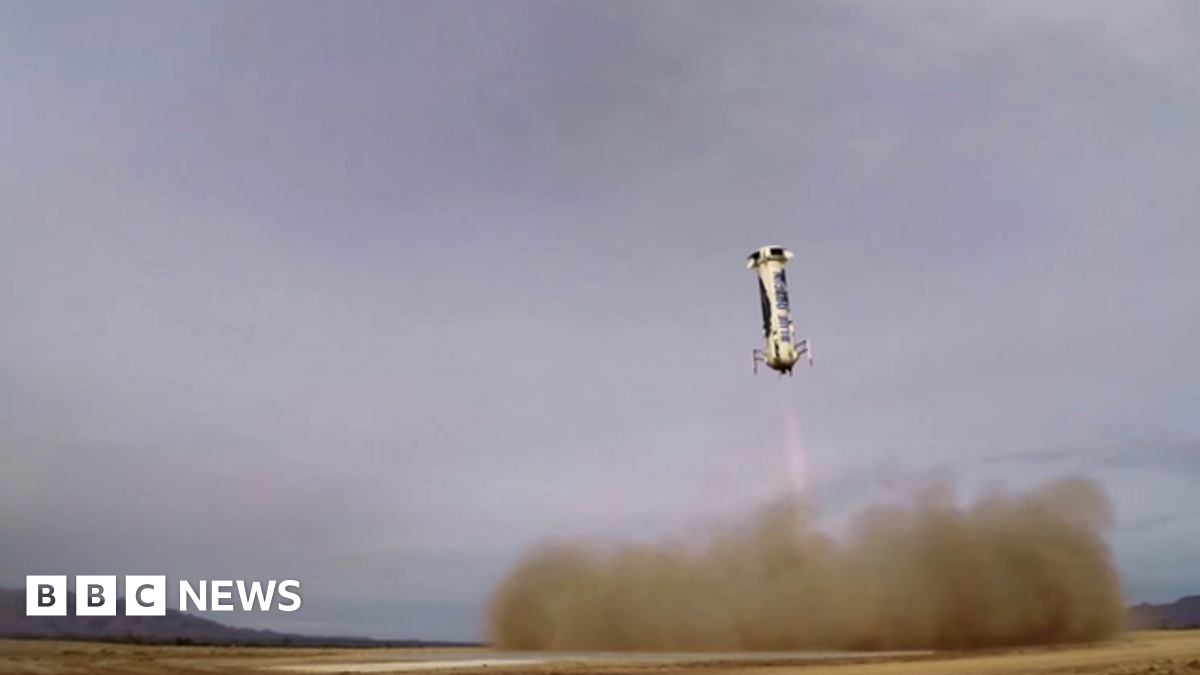
New Shepard: Bezos claims success on second spaceship flight
The Amazon.com entrepreneur Jeff Bezos flies his New Shepard spaceship again, and this time proclaims a complete success.
BBC News
333 points · by lentil_soup · 11y ago · 223 comments
"Congrats to Jeff Bezos and the BO team for achieving VTOL on their booster
  It is, however, important to clear up the difference between "space" and "orbit", as described well by https://what-if.xkcd.com/58/

Getting to space needs ~Mach 3, but GTO orbit requires ~Mach 30. The energy needed is the square, i.e. 9 units for space and 900 for orbit."
It does come off as sour grapes and it absolutely wasn't important for Musk to point this out. His PR team needs to deal with this, not him. He can send out congratulations and rah-rah for another amazing achievement for humanity, but his PR needs to get on the ball and show what the differences in goals and achievements BO and SpaceX have. They also should look at this as a failure to explain what the whole landing phase means for both companies. He can stay above the the whole thing. Its not like Bezos is beloved (the whole Stark / Hammer comparison is not far off).
To your second point, if you watch the video, you can see the booster descending under power, without parachutes.
It was significantly longer earlier today, but it contained a factually inaccurate comparison.
Here are a couple more examples:
Wired: "Jeff Bezos just accomplished the near impossible: one-upping Elon Musk"
Link: http://www.wired.com/2015/11/jeff-bezos-brags-on-rocket-land...
Engadget: "Jeff Bezos beats Elon Musk's SpaceX in the reusable rocket race"
Link: http://www.engadget.com/2015/11/24/blue-origin-reusable-rock...
https://www.youtube.com/watch?v=ZxKWh7kLDzw
But expecting journalists to even google something during their fact-checking these days is hopelessly optimistic. (Reminds me of Jon Stewart's recent inverview of Fresh Air when he was asked how the Daily Show is able to do such a great job of fact-checking and digging up contradictory statements -- Google and Lexis Nexis.)
Edit: I see the Musk posse has arrived at this comment.
Anyway, let's hope that SpaceX manages to land the next time they put something in orbit, that would be a big step forward, I'm seeing a lot more practical value in SpaceX than in BO.
Reddit has a nice delta V chart: http://i.imgur.com/SqdzxzF.png (source: https://www.reddit.com/r/space/comments/1ktjfi/deltav_map_of...)
There's also the linked NASA version: http://trajbrowser.arc.nasa.gov/traj_browser.php?NEOs=on&NEA...
There's nothing magical about 100 km that makes Blue Origin's rocket more useful. 100 km is just a round number. It's not useful until it's literally 100 times more powerful so it can get to orbit. Implying that Blue Origin's achievement is comparable to what SpaceX is attempting is disingenuous. But, predictably, that's exactly what the news media is doing.
In that sense, this is exciting news for Blue Origin, as it gets them one step closer to the insane-but-possible goal of profitable space tourism---with the world's money being as disproportionately allocated as it is, one can imagine actually being able to find six people willing to pony up enough cash to get launched into the edge of space purely for the delightful view.
http://www.engadget.com/2015/11/24/blue-origin-reusable-rock...
If you actually read his tweet, copied in full in the post you are responding to and in the article, you'll see that he did exactly that.
Ok, fair cop. It looks like he didn't do just exactly that. The article I saw only gave his first tweet. My apologies.
Either way, a vertical landing is pretty neat.
Thats not his style. Plus I'm pretty sure SpaceX is pretty pissed at BlueOrigin for allegedly stealing staff. So can't say I'm surprised at the snarky response.
If they wanted to make a valid criticism then they could have simply said 'but we could already do this with Grasshopper' and left it at that.
People with basic scientific backgrounds will make the link with SpaceX and think: "wow, they've just done something that SpaceX hasnt been able to do so far, with less funds and less attempts..."
While this is comparing apples to oranges ofcourse.
Big congratulations to Jeff Bezos & Team, but it's still quite a big difference indeed
I feel still a bit unclear on this though: hasn't SpaceX been trying to land just the first stage module (which presumably doesn't try to achieve that Mach 30)? If so, what is the main difference -- just the size of the payload, or is the 1st stage of SpaceX itself already going a lot faster than the BO rocket? (or perhaps both).
That adds a lot of difficulty just in terms of getting rid of that speed without destroying your hardware. Plus you need to aim from a lot farther away. The Falcon 9 includes hypersonic grid fins to steer towards the landing site, for example. (Failure of these due to running out of hydraulic fluid is what caused the first landing attempt crash.)
Just getting to that state requires a lot more of the rocket as well. If getting to that altitude is the equivalent of going mach 3, then the Falcon 9 first stage is putting in the equivalent of mach 9, so that's 9x more delta-v, which means the rocket needs to carry vastly more fuel and be vastly lighter.
All in all, the Falcon 9-R is trying to optimize for two things at once, which is always difficult. Landing a rocket vertically is not that difficult. Landing a rocket vertically while having that exact same rocket also be useful as the first stage of an orbital launcher is way harder. It's a bit like building a flying car: there are good cars, and good airplanes, but trying to build a machine that's good at both is far more difficult. Hopefully SpaceX's effort works out better than flying cars have.
EDIT: some observers claim that the New Shepard is hovering. If so, that does two things: first off, it indicates that either the stage is ballasted, or Blue is taking advantage of their engine's very deep throttle range. (SpaceX's first stage can't hover, as even fully throttled-down thrust of one engine exceeds weight of the stage at landing; so long as an engine is firing at all, the stage is accelerating up.) Second, it obviously makes the targeting problem much easier. (Note that the ballast could just be extra fuel; they've clearly got extra to burn in the landing maneuvers...)
This flight confirms they have achieved that goal, correct?
But SpaceShipOne achieved that back in 2004.
Is the extra fuel needed to make such a landing a big part of going to orbit? No.
The extra weight a enerby needed to land vertically has nothing to do with a 900 factor. Musk's tweet is thus equally disengenuous. It makes it sound like vertical landing a booster for a rocket going to orbit is tremendously harder than what BO did. It is not, it's the same ball park.
compared to a bigger, much heavier toy which goes Mach 30 and into actual orbit :-)
Orbital velocity is in the vicinity of 7500 to 8000 m/s. At that speed your KE is 1/2.m.v^2 which is about 32e6 Joules/kg.
Orbits are, conveniently, at about 320 km, so your PE is m.g.h, or about about 3.2e6 Joules/kg.
In other words, the energy to get to orbit is ten times the energy to get to the altitude of orbit, and this exercise only got to 1/3 of that. So the energy involved was about 1/30 of that required to put something in orbit.
It's still a fantastic achievement, and an important - nay, critical - step on the way to properly reusable rockets, but it does lend some perspective to it.
Blue Origin did a soft landing from above the Karman line. SpaceX is trying to do that from orbit. The former involves speeds 10x less and energies 100x less than the latter.
Still a hard thing to do no matter how you look at it, but the two goals are not trivial to compare.
The best numbers I can find say that the Falcon 9 stage separation is at around 80km and 2km/sec (2.8 MJ/kg of total energy), and the Falcon 9 has so far failed to land under power.
But what I see on video is Bezos landing a rocket and Musk blowing up a rocket.
I understand the technical differences, but in terms of media, this is a pure win.
Let's try comparing those on more than just media, shall we ?
Financially speaking, between the two goals, there's enough money concentrated in private individuals' hands that you might be able to find six people willing to shell out for space tourism.
Government funding supplies the ISS. A laudable goals, but there's a grim realpolitik view that suggests it's not as guaranteed sustainable of a market as space tourism.
On the other hand, SpaceX's goals also allow for deployment of orbital payloads... Now that's lucrative.
You make a very good point about public perception. But your opening line seems sarcastic and aggressive. I think that's why your comment is light grey.
Parallel parking a Prius vs. parking a dragster is different. But as you said, you understand the technical differences.
The Falcon 9 first stage, if I recall correctly, is incapable of either hovering or slowly decending. The engine has simply too much power. A Falcon 9 first stage, stopped mid air has two choices, keep the motor on and go up, or turn the motor off and fall - and I don't think the motor has too many extra restarts available.
Because of this inability to hover the Falcon 9 first stage, SpaceX is attempting to have the rocket's vertical velocity reach zero at the exact moment the rocket reaches the pad. This is why when you watch the grasshopper or other SpaceX landing videos, you always wonder for a split second if the rocket has just smashed into the ground. In order for this to work, all nine axis (three each of position, rotation, and velocity) must be brought to zero at exactly the same fixed time. This is insane level control theory here.
Now this type of landing is theoretically possible - and I think it has been tested on the grasshopper at lower speeds, but it scares the willies out of me. There's almost no room for error nor for the chaos of the universe.
New Shepard on the other hand, comes to a hover about 100? feet above the pad, moves horizontally to be above the pad, stops, then lowers itself down. This is tremendously simpler since the rocket only really cares about one or two set of axis at a time, it does not have to be nearly as precise, and you have time to fix anything that's not lined up.
I'm still curious to see if SpaceX can pull off their landing style, or will instead change so that their first stages will be able to hover.
The important difference between this New Shepherd flight and those Falcon 9 tests is that the Falcon 9s launched payload to orbit. They burned all their fuel, leaving them with the incredibly difficult slam-landing manoeuver to manage at the end. They have gone close, very close, but have not yet got things entirely right.
So, although this was an impressive technological demonstration, it's a long way from demonstrating a relaunch capability. I look forward to seeing new developments.
The notion that Blue Origin has accomplished something SpaceX hasn't quite worked out is quite a laugh.
If you had a JavaScript rocket simulator, with clean position, rotation, and velocity data, you could probably code a hover in five or six lines. Now it's not quite that easy in practice, but the theory is still simple.
The Apollo lunar modules were capable of hovering, using only a portion of a 0.001Ghz 16 bit computer.
That said, it's clearly possible.
From purely a process standpoint, I think that trying to tightly control 3 axis to this degree of precision is a daunting task. The need to do it this way could be entirely built into the architecture of the system, but from a "first make it work, then make it work better" stand point, the ability to hover or throttle trajectory would be an easier step one.
Outside of this single piece (reusability) and all of the vectors surrounding it, the rocket still has other challenges (e.g no launch since last failure is concerning) which need to be overcome.
SpaceX is scaling too fast and is doing an amazing job at complex coordination, however they don't seem to have the talent bandwith nor the time to tackle every problem 100% and the way they have structured reusability makes it really difficult to be successful even at ~98%.
Of course, we can apply the same "make it work, then make it work better" stand point to the Falcon, where "work" is delivering payloads to orbit and "work better" is reusability :)
The genius of SpaceX's approach is that their launcher is perfectly viable as an expendable rocket. They are basically being paid by their customers to test the landing technique. That means they don't need a technique which can be pretty certain to work the first time, but instead they can go through a lot of build/test/crash/refine cycles without bleeding away investors' money.
If it ends up that the Falcon 9 has a 10% crash rate when landing even after tons of refinement and practice, well, that's still great! No problem, cost of access to space has still been brought down tremendously.
It's definitely hard. It's also the fuel-optimal solution (referred to as a "suicide burn", http://space.stackexchange.com/questions/10307/what-is-a-sui...).
So while it's a very difficult control solution to accomplish, being able to do it reliably translates to a significant savings in fuel cost and therefore one step closer to sustainable reusable rocketry.
It would seem that SpaceX remains in a totally different league. By only going vertical, this is a very limited "spacecraft", more akin to the Virgin spaceplane than SpaceX's launch vehicles. For proper access to space, rather than tourist hops, everyone wants to see a reusable launch vehicle --> a craft to actually boost something towards orbit rather than an altitude record. That means returning to some sort of landing after huge downrange progress. So while this is an impressive achievement for space tourism (roller-coasters for billionaires) I still see SpaceX's efforts as the more revolutionary.
Essentially, it's the same goal as SpaceX' Falcon9, just a different approach (prove reuseability first, then make an orbital rocket). We'll see which turns out to work better in the long term.
You obviously haven't been hanging around wealthy people. Even just being a student in London you witness nights out costing spoiled kids more than that.
Ok, slight hyperbole. But there is no shortage of nouveau riche in this world ready to spend on some high-status thrill.
Highest altitude followed by a powered landing by Blue Origin: 100,500 m
Moreover, SpaceX has gotten close to a powered landing from space a half dozen times, but has mostly failed in the last 100m. You could argue that Blue Origin just did the hard part that SpaceX hasn't been able to do. Obviously the difficulty doesn't really scale linearly like that, but I wouldn't be so quick to dismiss this accomplishment.
You missed one critical difference. New Shepard (and Grasshopper) can hover. The fact that Falcon 9 (during its landing phase) has a thrust-to-weight ratio > 1 means that their "hard part" is _much_ harder than New Shepard's "hard part".
To jump in with the inevitable SpaceX comparison. Worth noting is you see the Blue Origin booster: fall, slow, hover, correct any drift, descend then land. The SpaceX booster cannot hover, it has more thrust than it weighs.
Hover ability comes from having a rocket engine that can throttle down enough to match the weight of the almost-empty rocket. Blue Origin's BE-3 can throttle down to 20% of its design thrust, possibly lower.[1] SpaceX's Merlin 1D can throttle down to 70%.[2] Apparently, even with only one of the nine engines firing, it's enough to lift the almost-empty Falcon 9 first stage.
1. https://en.wikipedia.org/wiki/BE-3
2. https://en.wikipedia.org/wiki/Merlin_(rocket_engine_family)#...
For a single-engine booster, 25% is still way too much thrust if you are shooting for orbit. A modern booster is 90+% fuel. So the empty or near empty returning booster will need an engine running at around 10% of launch thrust at the moment of landing. That's pretty much what SpaceX is doing by shutting down 8 of 9 engines and throttling the last to 80ish%.
SpaceX plans to solve it by extremely accurate timing so they don't need to hover.
The landing footage begins at 1:40.
someone did that at my wedding, it got on my hair and my suit. it was on me all day. it's sticky.
SpaceX, by now, should have enough people with strong applied math backgrounds to tell them, given a formal specification of the control systems on the rocket, whether what they're even trying to do is possible (within probability bounds).
I'd be interested in seeing their calculations. I just hope they're not throwing more computation at a problem that's totally dependent on how fine they can a) sense their position and momentum, and b) do something to adjust it.
There's probably an analogy to a drinks can too: when full they're difficult to squeeze, but when empty they crumple easily. By the time the Falcon 9 attempts a landing, its fuel tanks are mostly empty.
Larry Ellison; Oracle: http://www.superyachtfan.com/larry_ellison.html (including his Americas Cup yachts)
James (Jim) Clark; Silicon Graphics, Netscape: http://www.superyachtfan.com/sailing_yacht_athena.html
Paul Allen; Microsoft: http://www.superyachtfan.com/paul_allen.html (3 very large vessels)
And more recently:
Larry Page; Google: http://www.superyachttimes.com/yachts/details/333
Now you need a rocket! OK, Paul Allen did go there first, as far as I can tell.
https://www.reddit.com/r/spacex/comments/3u2gwm/apparently_b...
Pretty cool times for space; I'm stoked for what comes next!
Consider the alternative of burning less than 1G of acceleration, you'll fail to slow down although you'll descent acceleration will be somewhat lower. At exactly 1 G it'll keep falling at a constant speed till it runs out of fuel, then impact.
Or if you're asking why performance is so much more spritely at the end of mission, unlike boats or cars the fuel in the tanks is like 95% of the mass of the rocket, so something that barely waddles off the launch pad with full tanks weighs practically nothing at landing when the tanks are nearly empty.
The deceleration is high because the atmosphere gets thick pretty quickly, so you end up losing all that speed quickly, which means a high acceleration.
They could use the rocket to slow down --- but to do that, they'd have to carry fuel up, which makes the whole thing much larger. It's vastly more efficient to let atmospheric drag do it for you for free.
Is this gonna turn into a price war ?
Obligatory: https://what-if.xkcd.com/58/
As the great philosopher Mike Tyson once said: I'm a dreamer. I have to dream and reach for the stars, and if I miss a star then I grab a handful of clouds.
https://www.youtube.com/watch?v=9ZDkItO-0a4
The New Shepard went much higher though (100.5km vs 744m).
It is, however, important to clear up the difference between "space" and "orbit", as described well by https://what-if.xkcd.com/58/
Getting to space needs ~Mach 3, but GTO orbit requires ~Mach 30. The energy needed is the square, i.e. 9 units for space and 900 for orbit.