Judge: There’s no proof Yelp manipulates reviews
Claims that Yelp punishes non-advertisers fail to persuade yet another judge.
Ars Technica
109 points · by pavornyoh · 11y ago · 109 comments
The judge in this case was basically concluding that plaintiff -- a Yelp investor -- could not adequately allege in his complaint that Yelp or its executives made a false statement of material fact in connection with the sale of a security. And plaintiff had an extremely high burden to survive such a motion to dismiss because of the Private Securities Litigation Reform Act (https://en.wikipedia.org/wiki/Private_Securities_Litigation_...).
So, in short, there is very little that one can conclude about Yelp's actual practices (for better or for worse) from learning that a securities lawsuit like this was dismissed.
I understand the benefit Yelp provides to some excellent establishments but it unjustly hurts so many along the way.
Unfortunately, Yelp's current model seems to encourage extortion at the hands of these third parties, and is also incapable of punishing them.
What I think happens / Paraphrase of what I'd imagine a 3rd party call to be like:
"Hi, this is Yelp. Pay us and we'll boost your rating/visibility and hide bad reviews. If you don't pay, your Yelp ratings will suffer."
Then they just manipulate ratings and review visibility with fake accounts. Add good reviews and hide bad ones if the owner paid, and add bad reviews and hide good ones if they didn't.
(Also I'm aware that there are plenty of "legitimate" businesses that provide this service and don't misrepresent themselves as Yelp itself)
I'm a Google Trusted Photographer in Houston and I visit and talk with businesses that get targeted every single day. I'm loosely affiliated with Google and I have to make that clear. They get calls twice a day from "Google" and "Yelp" about their pages and reviews. This is their #1 complaint when I call them or walk in their door. Being local helps.
Now, looking at such things from a common sense perspective makes it quite obvious what's going on. But proving the same in a court of law, which often will have a much higher requirement of proof, may not be so easy.
I wouldn't believe him if he told me it was pouring rain outside. I would check first and make sure it wasn't just a drizzle.
If you decline, the Yelp sales person could simply have their friend visit your business, have a "1-star experience" and then write a review.
Seriously though, I'd agree: you'd think at least one of these shady sales people would fess up for the publicity alone.
Sure they do, it's just too convenient to look the other way and maintain deniability.
This phone call may be recorded for training or quality control purposes.
I usually dive into reviews and see what people are saying, not just go by a star rating. It adds to the hilarity when you read a 1-star review for a restaurant because they "are scumbags who serve lion" (actually, a menu item had dandelions on the side) or because someone drove by and saw a balkan restaurant "roasting a dog on a stick" (actually, it was lamb, but I had a great laugh).
You read a LOT of Yelp blackmail stories (or I have). But it isn't clear what legitimate product they're actually selling to businesses, since they'd at least need a cover.
PS - I am surprised any business has less than five reviews. If I ran a small business, I would create fake reviews just to get the ball rolling, no matter how immoral that is. Just makes good business sense.
If someone is looking at coffee shop A, they would show ads for my coffee shop.
As much as you need to be a very good business man to build a business that Yelp is, you need to surround yourself with good people, and recently, plenty of good people have left Yelp, and realistically, there aren't many out there.
If the excuse is poor search quality, it seems too convenient.
But there is, at best, a critical mass of unethical salespeople, because I've heard far too many reports of pressured selling.
Either way, they've got a really big problem. Big picture, it's hard to imagine how a site like this can remain neutral or useful long-term. It's just a playground for mischief on all sides, and eventually consumers will catch on.
Dated a girl. Her father was an eye doctor in a small town. There were 2 eye doctors on main street. He was convinced the other doctor had someone leave a bad review (which out of his ~8 or so reviews) which made him a 2 star "offering".
He was my eye doctor and I _did_ like his work, so we made an account, and left a review. My review was "untrusted" because my account didn't have any other activity.
Now it became a game. Everywhere we went we'd leave a yelp review to try and get my account to be "trusted". This went on for about 3 months and we had about 10-15 reviews. My account was still untrusted. We decided to stop and just let it be. About 3 months after that, my user was trusted and he now has a 5 star rating.
The woes of yelp in a small town.
For all its various biases, I find Yelp OK given some critical mass of reviews. And reading some reviews can be as useful as looking at the overall rating. It's not great but, in an area I don't know, it's better than throwing a dart at the wall.
I don't know if you need both, but proof of patronage alone might not be enough to trust a review (See Amazon verified purchases).
That's kind of an ersatz proof of patronage.
Biases baked into the platform are one problem for a review site. But you also just need critical mass.
I've heard about it all N-th hand, so I'd imagine that Yelp's team is very careful about wording it such that it's some sort of legit promotion that they're offering.
I'm actually sure this has happened, since it's essentially impossible to prevent thousands of salespeople from deviating from an approved script when pushing hard for a sale, but surely it can't be commonplace.
Business travel takes me all over the country and Yelp is incredibly reliable. I've lost track of the number of times that someone recommends a place, Yelp says it's a 2-3 star place, we go anyway, and yup, it's average at best.
I hear and see the complaints of restauranteurs about Yelp. Yet my experiences at places usually match what's seen in reviews. There's a restaurant in my hometown where the owner, a friend of mine, constantly complained about Yelp reviews where the the sentiment was that his food was too expensive and not of consistent quality (I agreed with the reviews). A few weeks ago he decided to close the place because of declining revenues. Had he listened to the reviews, settled for a bit less margin, and worked with his staff to produce a consistent product he'd still be in business.
Edit: I neglected to add that it's really important to read reviews for context. Sometimes you just have people bitching because they're a gluten-sensitive nut-allergic vegan and the place didn't cater to their highly specific needs.
So, if your willing to spend a while going over them it's better than nothing. However, actual restaurant reviews are more accurate, take less time to use, and your less likely to read 10 reviews and learn nothing. IMO, Yelp way over hyped for how little value it's actually providing.
Could we stop shutting down opinions using the sample size argument? It's one of the weakest arguments you can make:
'I think different so your opinion isn't valid because anecdote!' 'Oh you don't agree with my opinion? Well that's not valid either because anecdote!'
Not every discussion is capable of having prior polling as evidence (polling has its own issues with bias anyways). A highly voted on comment has >> 1 people who share the same sentiment and the beauty of sites like these is highly up-voted comments bubble to the top.
I reserve the right to shut down my own opinions, especially the anecdotal ones. I have known my anecdotes to be 91.3% bullshit.
Regarding upvotes as a proxy for "me too": an upvote doesn't mean "me too" in many cases, it means "this comment was something I thought contributed to the discussion in a meaningful way." Thus using upvotes as a proxy for a sample size counter, isn't even remotely accurate because upvotes do not necessarily correlate to me or anyone else sharing your sentiment. They only correlate to someone saying that your posting added value.
I upvote things all the time with which I disagree because the commenter made a strong argument and it added to the quality of the discussion. I downvote things with which I sometimes agree because perhaps the point was badly made, inflammatory or otherwise not enriching to the discussion. And then, I also downvote comments that use trendy I "haz cheeseburger" level diction. Of course, given my own guidelines, I probably ought to downvote myself.
I have noticed this as well, but if you read the reviews you get a good idea of what is happening in SF: tourists.
Joe and Jane Honeymooners come to SF from Tulsa/KC/Duluth/DesMoines and have the "best meal/coffee/pastry/brunch EVER".
Good for them.
Also, the implication that everything is better in SF/NYC compared to Tulsa/KC/Duluth/DesMoines and thus the opinion of Joe and Jane Honeymooner isn't as useful is really rather snobby.
But since we're stuck with the five star system...here is how I leverage Yelp review data when it comes to selecting a small business to patronize:
1. Normalize for the true Yelp rating scale of 4 - 4.5 stars. Filter out anything below a 4 star rating. If a small business is unable achieve 4 stars on Yelp, then something must be really wrong.
2. Quantity of reviews is important. For starters, you need a significant sample size of review data for the star rating to be meaningful. Further on the review quantity front: massive review numbers relative to other similar businesses in that given city is a good signal of popularity (though not necessarily quality).
3. You need to supplement your Yelp findings from points 1 and 2 with other sources, ideally critical reviews (e.g. Eater, Serious Eats, Time Out, NY Times, Chicago Mag, etc).
4. The content of individual Yelp reviews should be taken with a grain of salt. Your individual priorities and tastes might be radically different so there is limited value in an individual's rating. I've come across some truly great restaurants with 1-star reviews because the reviewer tried to dine at the restaurant on a Monday...when it was closed.
But the modern convention is 5 stars as "good", and getting too many 4s is a failure.
My experience is that higher star ratings on Yelp equate mainly to presentation over taste and that higher prices tend to mean a better rating (Out of a few average Chinese food places, the higher priced one will be rated the highest).
If you assume an efficient market, they presumably wouldn't be able to charge a higher price if people didn't like them better. Of course, the average rater may care more about presentation than you do. A lot of people do go to restaurants more for the "experience" than for the food.
But, I think in the long run it doesn't matter. It just seems consumer based reviews are useless overall and people should stop relying on them.
I run the restaurants team at TripAdvisor and we're working to solve problems in finding the best place to eat. If you think you can do better, you may be right; come prove it!
Drop me a line, especially if you're excited to work on big piles of data, NLP, ML, a heap of phone stuff and crazy stuff like using word concreteness scores to analyze review value.
You get restaurants that would be a solid 3-stars (maybe even 4!) anywhere else in the country, but because they are competing against all the hot new places that food snobs like me love, they are only 2-3 stars max.
IIRC the highest rated restaurant on the site is 4.62 (I might be off but it's not 5.0) Most restaurants are in the 3.0 to 3.6 range.
A curious difference in culture to Yelp
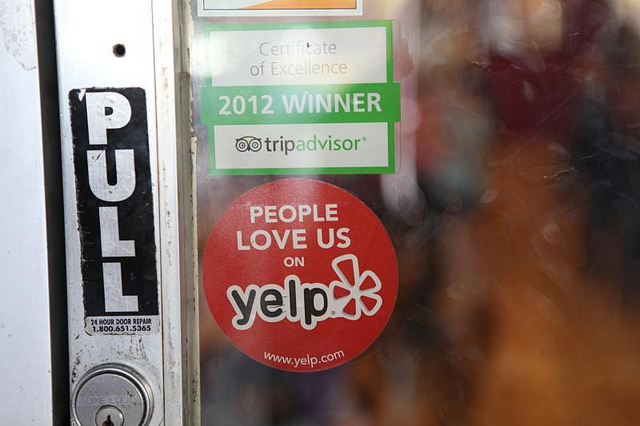
And these days, it seems average restaurants are sporting the "TripAdvisor Certificate Of Excellence", so now that's meaningless too. I've seen it on one genuinely top-class Indian restaurant, but recently saw it on some distinctly mediocre places in Singapore.
Stereotypically most negative reviews are about booking issues (e.g. lost booking, someone arrived too late and the booking was given away, etc). Or moaning about the free food or free/paid WiFi.
I don't think management replies add anything, unless they're being a jerk/dismissive. It is better just to say nothing than to be a jerk, since others reading the reply will assume that they will be treated the same way.
In my experience, TA seems to have a larger self-reinforcing effect than Yelp: Top 10 places get more great reviews, stay top 10, even if they're dropping off in relative value or weren't that great to begin with.
So, they managed to disappear all the reviews I left. They did it on a technicality and it was well within their terms of service. However, I view this as vote manipulation. They're pushing really hard now to say they don't do that. They burned me once though and now I actively avoid the service.
What obviously DOES happen is that they sort reviews differently and make the bad ones hard to find.
Then they come out and say 'we don't delete reviews, we don't manipulate them' but it's easy to find companies that have reviews sorted so that the negative ones are buried and on a completely separate page from the main reviews.
It might be to reduce the amount of work, but I still don't like it, and would rather they let me use my already-existing web browser to access their web site.
It's easy to behave this way when you're a monopoly.
"Monopoly" is not synonymous with "successful."
They had $377mm in 2014 revenue. Their biggest competitor is Angie's List who's now facing competition from Thumbtack.
Has this ever been substantiated? It seems like it would be a pretty easy thing to document.