You Can Buy an Abandoned South Dakota Town For $250,000 | Fortune
Complete with a bar and haunted house.
Fortune
45 points · by prostoalex · 10y ago · 90 comments
It's a few acres of prairie with some buildings that need to be torn down. I'm not up to date on land prices in western SD, but I can't imagine good pasture land is worth more than $2k/acre, even with the surge in beef prices recently.
It's also worth noting that the Pine Ridge and Rosebud Indian Reservations are located in the poorest counties in America. I've visited a couple times and it really is striking that such poverty exists in America. The one stat I can remember from a volunteer trip several years ago was that an 18 yr old boy had a <50% chance of living to 25. When I was in high school we would play football and basketball games there on occasion - our bus always had police escorts in and out of town.
About the poverty: When I was in college in the mid-90s, I went on spring break work trips to the Rosebud reservation, and they cited a 90% adult male alcoholism rate.
I volunteered with the Habitat chapter near there. They could not build on the res because any houses under construction would be stripped of their copper wire and plumbing before they could be completed. What they really need is a big employer to set up shop there: rising tide floating all boats, etc.
The casinos on some reservations have had a positive impact. At least there is a good employer in the area for those wanting a regular life. In my opinion (as an outsider) the best thing for them is to go to college off the reservation.
You want to explain that, particularly the genetic component?
This doesn't pass any sniff test I can think of.
The life expectancy for males in the county (whole reservation) is 71-72 years. If 50% are dying in their "stupid nearly adult years" they are going to have to have bunch living past 100 to bring the average up.
What?
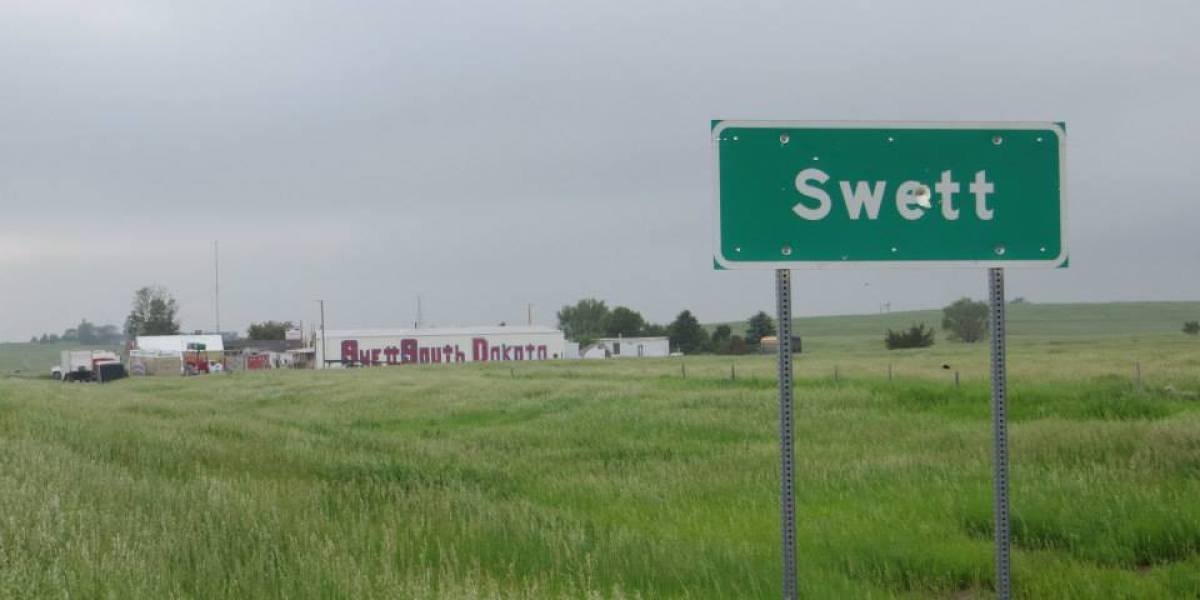
It seems so: "The South Dakota real estate agent said one Nebraska man said he want to buy the Swett ghost town and bring 2,000 Russian women and 600 convicted felons to live in the town. He wanted to build acrylic houses for the new residents to live in and set up cameras to run 24/7 and film the interactions, Syracuse.com reports."
The problem is upkeep and finding something useful to do with the place.
I know in Germany some of the NATO military towns have been repurposed.
http://www.nytimes.com/2014/01/20/us/arkansas-towns-new-owne...
On a side note, I was driving through rural South Dakota around ten years or so ago and stopped to eat at a small town diner. I checked out their bulletin board and was floored that someone was selling a house for $10k. So maybe the area could be a good deal for someone looking to get away from it all. :)
However, keep in mind that at that price point, you're usually forgoing things like reasonable Internet, neighbors closer than a mile away, and any kind of nearby amenities whatsoever. Oh, and the house usually needs a ton of work, and the basement is guaranteed to be damp at best, if not moldy.
$250k for a 6 acre plot of land with only one good structure on it seems overpriced for the region. I bought a 5.5 acre farm with a good house, garage, workshop, and sturdy fencing for $70k. Later sold it for $100k.
We are at a point in time when the wealthy are extremely wealthy. The billionaire club is substantial but even below that, personal wealth in the tens or hundreds of millions exists. What do people want to do with that wealth? It's more than can really be spent on comfort, entertainment, sex and such. Once upon a time money was power, or could be converted to it. Roman Consuls put personal wealth into political enterprises. They were the system of government and the wealth was intertwined with it. But, the main point was they had social, societal and military ambitions.
Where are the people today who would like to create a 1,000 person community? Where are the wealthy who would like to try a bold experiment in communalism, anarchism, feminism or whatnot?
Flippant answer is that the two groups—"the wealthy," and people interested in that sort of thing—have almost no overlap.
But I don't really think either of these are true. Bill Gates has some big "political" goals, societal scale ambitions. Elon Musk too, though he seems to like for profit companies as a vehicle. Some charities get substantial endowments and many in the leaser classes dedicate a lot of their time, attention & money to them.
* Experiments that have been tried (like anarchism and some kinds of communalism) and don't need repeating
* Obviously terrible ideas (anarchism again, communism, some others)
* Beyond the ready scope of purely legal changes (feminism)
And this is even before you start addressing the problems of getting 1000 people going in an environment with meaningful infrastructure. Or having it function economically without being a gaping money pit.
I suspect smart and wealthy people interested in changing society tend to realize that there are more ways to break society than there are to improve society. Therefore, smaller changes that do not individually break society are preferable to changing everything at once and praying you didn't introduce a killer bug somewhere in your batch of a million changes.
As a result, you get more people like George Soros than you do Lenin. For which we may want to consider being thankful.
Note that I'm talking about communism as a way to structure societies, which Wikipedia describes as 'a socioeconomic order structured upon the common ownership of the means of production and the absence of social classes, money, and the state.'.
Now, some kind of Platonic ideal of Communism may work perfectly. It's certainly possible, in the sense that the possibility exists in a realm of pure abstraction. However, history shows that getting there isn't very practical and requires oceans of blood. A perfect system that you cannot get to is useless.
Previous work on this avenue of experimentation suggest remarkably strongly that it should not be attempted again.
Of course anyone can go down the path of "well that wasn't real communism" and that goes for any ideology where humans are involved. You won't achieve the utopian ideal put forth in a book. And that's really part of the failure, not the reason to explain it away.
The fact is some people work harder than others, are more ambitious than others and sacrifice more. And the reason people appreciate a capitalistic society is not only can those types of people get rewarded, those same people motivate others to aspire. And we also know that it's easy to deflate the ambitions of people when they feel like the extra work won't get them any further.
Which in my view is why these communist countries develop the fantastic religion around their leaders and at the same time take on the violent means to force their people into working harder. Respect through fear, intimidation and in the case of NK a fantasy of motherly love by the dear leader. Yes I said motherly that wasn't a mistake.
But we're talking about countries here, when if you want to talk about communism from a smaller scale, I'm sure I'd have little to argue with, other than that you don't exactly see a lot of what I would call technical progress coming out of communities, at least none I've ever heard of.
When was wealth never not power? Pretty sure that always and still is the case. Rather than serve in the senate (though some millionaires do of course - the senatorial class in the US is extremely wealthy compared to their constituents), the ultrawealthy just setup and donate to PACs as well as use their money to drive propaganda efforts (e.g. Rupert Murdoch). And then of course you have people like Peter Thiel who want to create an offshore libertarian paradise.
Also you would be surprised on how much can truly be spent on sex and entertainment. Multimillionaires go broke all the time due to drugs, partying, and overwhelming decadence.
There are similar experiments happening on a smaller scale. I would argue that you wouldn't want to fund these communities through wealthy benefactors, otherwise it creates a sense of deference and obligation, it's far better to have a more egalitarian community IMO.
Basically the type of person willing to give up current access to family, friends and job to go there are predominantly weird.
The exception is young people chasing jobs and education ie college towns, San Francisco, SoHo
Or tax havens.