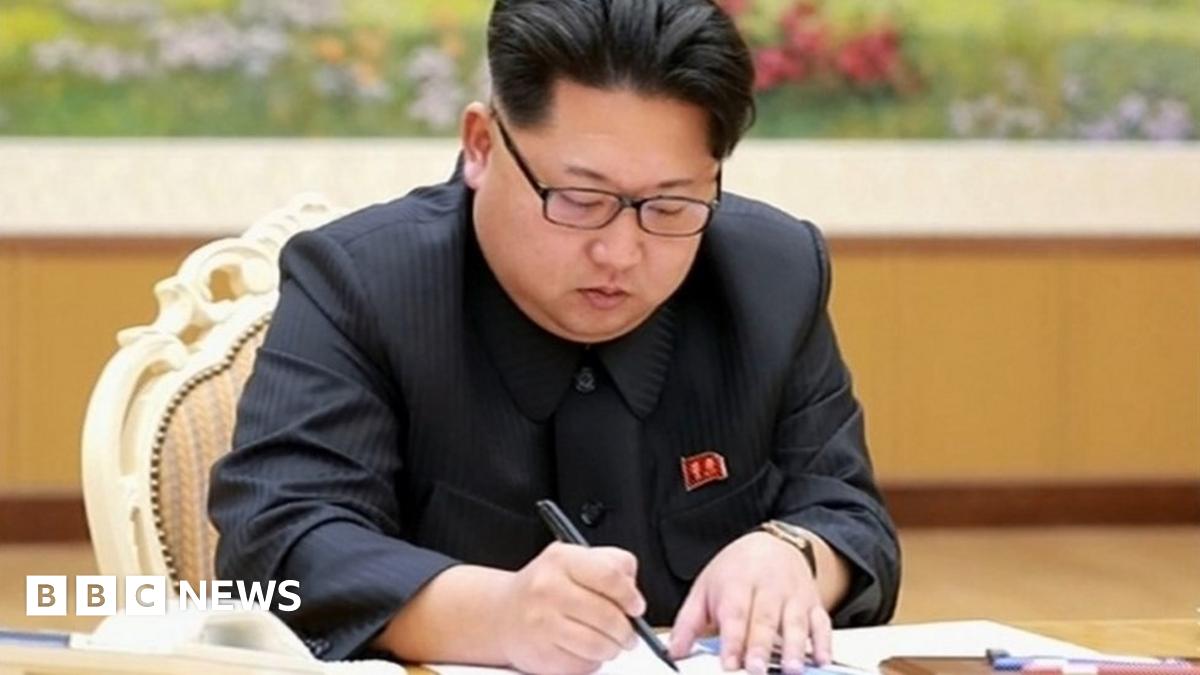
North Korea nuclear: State claims first hydrogen bomb test
North Korea says it has successfully tested a hydrogen bomb which, if confirmed, would represent a huge advance in its nuclear capabilities.
BBC News
229 points · by forgingahead · 10y ago · 168 comments
Meanwhile, CNN is proclaiming "N. KOREA TESTS H-BOMB" on their front page, which is a pretty far cry from them claiming to have tested one.
https://twitter.com/ArmsControlWonk/status/68457996242311987...
Natural: http://ds.iris.edu/ds/nodes/dmc/tools/event/5169662
but is it still a proof of h-bomb? maybe just ordinary (if you could call it so) nuclear bomb test?
The colon I guess denotes that what is to the right was said by what is to the left. Perhaps thats a tricky way to say it.
and cnn is as usual profiting off FUD
That being said, 44kT is still way below what one would expect for a fusion bomb, and low even for a boosted fission bomb.
1: https://en.wikipedia.org/wiki/Moment_magnitude_scale#Nuclear...
http://nuclearsecrecy.com/nukemap/?&kt=44&lat=37.7564509&lng...
I selected London, England and it immediately centered the blast on the Houses of Parliament. How sentient is that!
Earthquakes virtually always develop over both time and space -- the "epicenter" of an earthquake is the center or origin of the movement. Some quakes occur over very long rupture zones -- the 2004 Boxing Day quake off the coast of Indonesia involved several hundred km of fault line, and moved along that fault at several hundred km/hr (this is among the reasons why major quakes can be felt over several minutes -- the rupture is literally happening over that duration, and, depending on the location of the observer, the seismic waves have to travel back to them).
An atomic blast begins and ends within a few thousands of a second -- at the seismic scale it's both instantaneous and a point event.
A bomb will vent radioactive fission/fusion products and their decay products, many of which are radioactive, and have signatures specific to the type of weapon and design used. Even underground blasts will typically vent detectable quantities to the surface and atmosphere.
[1] https://twitter.com/drrocks1982/status/684616925079552000
http://theaviationist.com/2013/02/18/wc-135-nuclear-sniffer/
Were they actually able to produce a 9MT weapon, it would be more than half as strong as the largest weapons test the US ever conducted.
Whereas the UK just plain lied and continues to be evasive about the matter to this day - probably because the exercise was mostly aimed at the US.
Bear in mind that this was in the context of the British feeling betrayed by the Americans on nuclear research - from https://en.wikipedia.org/wiki/Atomic_Energy_Act_of_1946 :
"Implementing the McMahon Act created a substantial rift between United States and Britain. The new control of 'restricted data' prevented the United States' allies from receiving any information, despite the fact that the British and Canadian governments, before contributing technology and manpower to the Manhattan Project, had made agreements with the United States about the post-war sharing of nuclear technology. Those agreements had been formalized in the 1943 Quebec Agreement. In the case of the United Kingdom, these were developed further in the 1944 Hyde Park Agreement, which was signed by Winston Churchill and Franklin Roosevelt"
[0] https://en.wikipedia.org/wiki/Operation_Grapple#Grapple_X
It had to be an h-bomb. The korean people have been told that the regime already has nuclear weapons. So any test has to be a marked improvement. The only way up from nuclear is thermonuclear. Whether that H contributed anything meaningful to the force of the blast is very much secondary (pun intended).
Antimatter. Thankfully we have no idea how to make them yet.
If Saddam really had nuclear weapons, there would have been no Iraq war and no ISIS today.
Nuclear weapons are far from the only thing that can be used as leverage.
Totally agree with you about the Iraq war and ISIS though.
Would it be enough to take out North Korea's nuclear capability and cripple troop encampments on the DMZ enough that they can't immediately launch a massive counterattack on South Korea?
You could move the government, but it wouldn't matter. Seoul would still completely dominate South Korea. Their entire economy and around half their population is based in the Seoul metro area. It's only a mild exaggeration to say that Seoul is South Korea.
There are better ways to deal with this. Diplomacy ... perhaps
NK falling is considered terrible by all parties. South Korea can't absorb it. China can't absorb it. It's a hot potato no one wants.
It's not worth it to the U.S. or anyone else to invade, lose 30K-100K soldiers and then have to rebuild the country, and it never has been. The nuclear arms race serves partially as a deterrent against possible invasion, and partially an attempt to get people to the negotiating table for some resources by scaring Japan and N. Korea enough that they want to deal with this.
But if they had the capability, they still don't have the desire to use it as a first strike since that would give every country around + the U.S. a reason to bomb them to the ground.
What definition of "worked" are you using? Serious question.
That said, if Japan decided it _wanted_ nuclear weapons, it can almost certainly produce them itself very quickly (order of 6-12 months according to most estimates I've seen). They have the raw fissile material due to their longstanding nuclear power plant program, and the general knowhow and infrastructure. https://en.wikipedia.org/wiki/Japanese_nuclear_weapon_progra... has some more data.
"Oooo a present! What is it?"
"It's a T-shirt with a giant logo reading "FUCK YOU CHINA", with a red bullseye painted on the back. Like it?"
The problem is, they have hundreds (thousands?) of artillery pieces buried in mountain bedrock and pointed at Seoul. Even if we dropped paratroopers on Great Leader's palace and captured him in the first two hours, it is simply not possible to find, let alone knock out, all of the artillery within a few days, which is how long it would take for them to level Seoul.
...If any of them still work. An awful lot of NK's military equipment hasn't been maintained for decades and has rusted solid where it sits. So the artillery could be one big bluff, for all we know. But can we risk it, with South Korea's largest city at stake?
Update: apparently I wasn't the only person to think of this: http://www.nknews.org/2014/07/how-israels-iron-dome-could-he...
You can see the Sausage in the pics on the Wikipedia page:
For civilians, we generally think and worry about bombs targeting cities, but most nuclear weapons are actually aimed at military targets. The primary targets are the enemy's own nuclear weapons, military assets and infrastructure come second and population centres last of all. The point of nuclear deference isn't that if we have a war mum and dad will be killed, it's that everyone will be killed.
The fact is we have vast amounts of direct testimony from US and Russian military personnel and leaders, both at the time and in subsequent interviews books and testimony, that deterrence was the primary consideration in their defensive and offensive planning.
Humbug:
"“The authors developed a plan for the ‘systematic destruction’ of Soviet bloc urban-industrial targets that specifically and explicitly targeted ‘population’ in all cities, including Beijing, Moscow, Leningrad, East Berlin and Warsaw,” Burr pointed out. “Purposefully targeting civilian populations as such directly conflicted with the international norms of the day, which prohibited attacks on people per se (as opposed to military installations with civilians nearby).”
But other contemporary sources make it abundantly clear the Pentagon saw any person tied to a war effort as a viable military target. A now declassified 1952 U.S. Navy film on chemical and biological warfare specifically states a goal “to incapacitate the enemy’s armed forces and that portion of his human population that directly supports them.” With similar thoughts in mind, the U.S. Army had looked into radiological warfare and built deadly dirty bombs."
(http://warisboring.com/articles/this-cold-war-study-is-a-cat...)
Civilians have always been targets and always will be.
nevertheless the fact remains that most nuclear weapons are tactical or mid-range and therefore not primarily suitable for population attack. The primary reason Russian tank divisions didn't swoop through Germany in the 1950s wasn't because atom bombs would rain down on Moscow (although they would) it was because atom bombs would rain down on the tank divisions.
Is that some sort of minimum for a quake, or did they dig down 10,000m to fire this thing off? That seems rather deep even for a large bomb, which this wasn't.
The 10km was interesting since if it held up, it would have likely ruled out a test, but it turns out that the first readings were wrong.
http://earthquake.usgs.gov/earthquakes/eventpage/us10004bnm#...
http://www.cnn.com/2016/01/05/asia/north-korea-seismic-event...
Its profitable to be a kingpin in the NK chain of command. Its what the dick waving of nuclear arms is - look, we have a bomb, give us more free shit.
And it isn't even the threat of war. Its a threat of jumping the shark so they have to be conquered, leaving the region with 25 million destitute refugees to somehow deal with. Just for comparison, the EU is having huge trouble dealing with 11 million Syrian refugees and only 4 million have fled the country.
http://anti-imperialism.com/2014/08/14/western-dprk-propagan...
It's important that there be Mutually Assured Destruction between North Korea the imperialist US-backed South Korea.
We have nuclear weapons. Who are we to say that North Korea shouldn't have them? That just wouldn't be fair.
Any regime which systemstically implements slave labor, mass starvation, and utter lack of human rights should not be allowed to have a nuclear weapon.
We do not want mutually assured destruction, especially with a nation controlled by a non-rational actor. The principle won't operate.
Unfortunately, it is now too late. North Korea has a fusion bomb. Once second closer on the doomsday clock.
Rational actors believing they are proceeding in the best interests of their countries can allow a situation to escalate and cause the mutual annihilation of their civilizations. This was the case when John F. Kennedy and Nikita Khrushchev were heads of their respective states.
No one should have these weapons.
But North Korea not having them is so much more important that even mentioning other countries in the same discussion is ludicrous.
Absent the risk of escalation, I find it unlikely that the various crises wouldn't have escalated too, at least, the take over of west Berlin (and thus probably a subsequent land war in west Germany).
Can we hurry up and create strong AI already, before someone gets everyone killed?
EDIT: Somehow I didn't expect that offhand ha-ha-only-serious comment to kick off a massive discussion about the capabilities of AI. Fun, but not my intention.
North Korea not having a nuclear weapon is so much more important than nobody having one, that the two discussions have virtually nothing to do with each other.
It's not one is just a slightly greater degree than the other, they are so different they are not even in the same ballpark.
And what does having just one planet have at all to do with nuclear weapons? I'm not seeing the connection. All the nuclear bombs on earth would do nothing whatsoever to the planet, and barely anything to the inhabitants except for a minority of them.
And then the sudden jump to strong AI? Hu? That came out of nowhere.
You imply that strong AI has some sort of connection to "everyone killed", first of all, how exactly would everyone get killed anyway? Humans don't have the ability to do that, not today.
And strong AI would, if anything, make it easier to do that, not harder.
So your post really is quite perplexing if you actually read it.
Five countries detonated 2,000 nukes over 35 years. You could simultaneously set off every existing nuclear warhead inside of Wyoming and it would have a negligible health impact on most of the rest of humanity. You couldn't come even remotely close to killing everyone with nukes, unless the global arsenals were vastly expanded; the US alone has 27,000 cities. Russia's entire stockpile could kill at worst 1/3 of all Americans, assuming they all worked properly and hit their targets. The notion that nuclear war could end the human race, is entirely a myth (which is not to downplay the actual damage such would cause).
North Korea could probably kill a sizable chunk of the 25 million people living in the metro area of Seoul, but would otherwise not be able to inflict harm on the US, at least not yet. And we would be their nuclear retaliator if they attacked anyone - we know all their military bases, and a nuclear attack on South Korea would see instant retaliation upon all their installations.
While China does not want to deal with the refugee crisis that would result from a post-NK scenario, they would definitely never fight the US directly because they know full well that doomsday scenario would play out in nuclear war with the US.
This is an n-body problem, and one of those particles is a borderline insane government.
[1] http://uskoreainstitute.org/research/visiting-scholars/past-...
[2]http://www.theguardian.com/world/2015/oct/13/why-do-north-ko...
This sort of stuff would be really really bad to fabricate IMO, considering the scale of known-true suffering going on in North Korea.
There's no way they can destroy America. In the most lucky(??) case, they might be able to destroy a city or two before getting wiped out.
I doubt they could destroy even South Korea. (Sure, they can kill millions, but South Korea is kinda democratic enough to survive that, and you can bet my ass that the North Korean regime will be wiped out.)
http://cdn.citylab.com/media/img/citylab/legacy/2012/12/18/n...
Since they simply take what they want from the rest of the populous, the desires of the rest of the people simply don't matter enough.