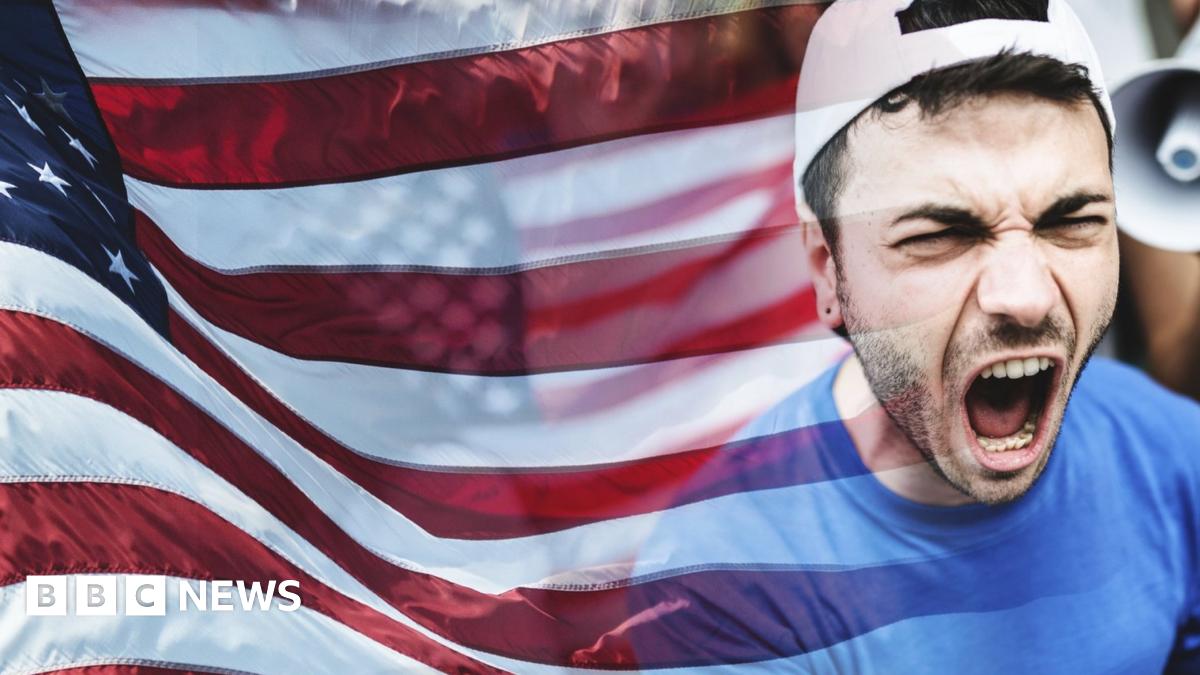
Why are Americans so angry?
Americans are generally known for having a positive outlook on life, but with the presidential election now well under way, polls show voters are angry. Why are they so cross?
BBC News
95 points · by elorant · 10y ago · 213 comments
Plus, would the responses to the surveys be different if the word 'disappointed' was used instead of angry? And would the perception of the responses be different?
Secondarily, and this is far more anecdotal, but I am friends with a fairly wide swath of people via social media, from conservatives to libertarians to liberals to progressives. The key takeaway that I have from watching all of their posting and all of their interactions is that people are angry at others. And people have always been easily angered by others, it's just that the modern American landscape allows for a) easier access to others and b) easier access to well-written, rational condemnation of others than can be easily shared. But reading through my feed,
Maybe Americans aren't actually angry, but since it's easier to construct understandable stories using language like anger, Americans feel like they should be angry?
[1]http://edition.cnn.com/2015/12/29/politics/cnn-orc-poll-full...
It's a problem if they're badly sampled, but the sample size you need is doesn't really change as you increase your population, as long as your population is a lot bigger than your sample size. If 1000 people would be OK for a population of 1M, then it should be just as good for a population of 100M.
I don't think this really invalidates your point, it's just a misconception I see a lot.
For instance, maybe your sampling ignored a particular region of the country or socioeconomic strata etc.
It's not the population size that matters; it's the variance in the underlying population.
Mathematically, the sample size needed to construct an n% confidence interval for a normal distribution is independent of the population size (the first derivative is zero).
"You're depending on the answers from 1018 people to be statistically relevant, and they may not be because by the end of the survery people just hurriedly say whatever to get the survey over with, and I'd bet that 50% of the answers should probably be discounted, so you're depending on what may not be a statistically relevant survery, since America is a big, big country, to drive your thinking on that country."
Assuming an normal (or similar) distribution. It seems plausible to me that we're in some sort of multi-modal period in our history. It may not be sophisticated enough to just take a mean or group opinions into five buckets on a one-dimensional graph.
Questions were asked, but there were no answers beyond "We asked the wrong people."
But my greater skepticism comes from basing policy or expectations of a country on simplifications. Again, I wonder if they asked the same number of people if the same questions and subbed out disappointed for angry if they would get a significantly different response?
Consider that the Democrats want no restrictions on ultra-late-term abortions. I think there's plenty of blame to go around here.
Note: I say this as the grandchild of someone who attempted to abort my mother after being raped by my grandfather. My grandmother's life was basically ruined when she was forced to marry her rapist after the then-illegal abortion failed. My mother, and transitively, me, would not exist had safe, legal abortions been available in 1940. Even with this intensely personal connection to the abortion issue, the issue has zero influence on how I vote. It boggles my mind that those with almost no personal connection to it let it influence their votes to the degree that they do.
Abortion is not a Democrat or Republican issue Don't fall into that lie. The Republicans had the White House and both Houses and did ZERO over the years they had this. The Connecticut Republican Platform is Officially Pro-Choice if a party wants to say they are lying for your vote. With Obama and a divided house the number of abortions are at a all time low since Roe v Wade as well as Teenage pregnancy.
There are 3 Republican US Senators who and 4 Republican Representatives who get 100% funding from the Republican Party. Where I live Charlie Dent is (R) and is Pro Chose and got everyone's backing when he ran against a Pro-Life Democrat. Think that will happen here is we will have a Pro-Life Democrat running for US Senate and he will have zero support from "Pro-Lifers" even though his record is much better then his opponent.
I am a Pro-Life Democrat and we have a Pro-life Democrat Senator and a Pro-Choice Republican. My "Pro-Life" friends supported the Pro-Choice candidate due to the Myth that Republicans are Pro-Life.
You don't want it? Don't do it.
I find your selection of topic really interesting. I'm not a US citizen, but I'm on good terms with a lot of smart and reasonable people in US from all the political spectrum, from Bernie to Trump, and I've noticed a curious thing: the issues these people are talking about are different. Even if they are sometimes related (like taxes and government spending), red/blue teams don't make the connection.
When a friend of mine (highly intelligent developer at Facebook, btw) explains why he would vote for Trump, he doesn't mention any of these. He and others like him talk about gun laws, about foreign policy, macro-economics and capital flight.
If both parties weren't as polarized, I think they would be able to come to some compromise about these issues, allowing the adversary to get his way on some stuff that is just not as important for them. But the rhetoric I see is always polarized and absolute. People aren't ready even to ask the question about why would the other side think otherwise and assume good will even for a second. Instead, they immediately conjure racist/anti-american/anti-poor/communist strawmen.
(it presents a very compelling theory as to why people separate into political left and right)
I've taken lately to becoming a Trump contrarian in social settings full of ideological group think which are students I hang out with for an Advanced Calculus by Sternberg and Loomis study group where afterwards the conversations always devolve into politics. Not that I would support any current politician let alone Trump but he was the easiest candidate to find blatant media misrepresentation, and I do find it an interesting social experiment to witness normally friendly people go into witch trial mode for daring to challenge their ideology.
I FORGOT to say minimum wages I just find it crazy that we provide the safety net for low wages for large profitable corporations and that they want to continue supplying workers for them on the backs of tax dollars.
Governments have never been as powerful, influential, or pervasive as they are now. Even at the height of the Roman Empire, the machinations of the Senate and the Caesar had less impact on the average citizen's life than today.
It's fairly natural to assume that as the scope and influence of government grows, the more personal politics will become, as it affects our lives to increasing degrees.
This schism will only get worse as governments become larger and more intrusive.
Because that's politics. I wouldn't let someone like that near my children at Christmas because of potential memetic contagion, much less enjoy having a conversation with them.
Lesser degrees of disagreement are lesser degrees of disagreement, but political positions are personal beliefs about the philosophy of how we cooperate with each other and what we should be doing, not simply different teams to root for at the big game every four years.
When we think that either A or B are not super important beliefs, or we are observing from such a distance that the differences between A and B seem small, then we feel the people are narrow minded and prejudiced if they strongly hold on to their belief and are openly discriminatory against the other.
However, when we personally and strongly think that one of the beliefs is completely evil or unacceptable, then we feel that the distinction is justified and that it's okay to not just oppose it, but also feel confident enough to do so openly and with pride.
TLDR; It's much easier to be non-discriminatory if we (or our belief system) don't (doesn't) have any skin in the game.
I find this comment interesting. I think that most people, or perhaps most people just a few years ago, tolerated such ideas because they knew they didn't stand a chance in the battleground of ideas; you didn't have to worry about your children picking it up because it was so obviously wrong.
This, on the other hand, implies that ideas can be so dangerous people (especially children? only children?) must avoid exposure to them lest they be swayed.
Clearly too many of us have become fond of identifying ourselves through membership in Party X. Shaping my world view around a political agenda by wholeheartedly embracing their entire platform is unnatural and illogical. But to take the next step and label nonparty folk as unbelievers and infidels creates a problem that's impossible to fix through rational discussion, much less leading to the design of workable policy. At best it's bad policy.
But party-based exclusion really isn't politics. It's just gangsterism.
I would probably be unhappy about that. But - as you say, lesser degrees of disagreement are lesser degrees of disagreement.
I don't think that it's always making politics too personal, to be upset about the political opinions of your child's spouse. I do think that if those political opinions are held by ~50% of the country, then that does seem to be making politics too personal.
I think the solution goes back to an old civic ideal that's central to a successful democracy. Duty. If Americans dutifully studied the issues, civilly discussed the alternative policies (knowing there must be tradeoffs and delays as different solutions are tested and refined), and participated constructively in the process as if their children's future depended on it, we wouldn't have time to bitch and moan. And we'd rightly shame those who do for being childish and useless.
That's not my understanding of 20th century politics at all. You'll need to elaborate on what qualifies as "much difference". Roe V. Wade, for example, happened right in the middle of the 20th century.
I's not a political problem , it's a societal one. Even in Israel , where there's has been no consensus and there has been quite a bit of political polarization ,most people don't take it that personal.
Anecdata and all that, but I still get along well with my parents, and my wife, hers. We avoid religion and politics (though if it comes up we kinda stay quiet while the other rants, no arguing).
I consider myself Moderate and really don't like the "foam at the mouth" extremes on either side, to be honest, I don't understand the need to go to that extreme, and to fight and argue so passionately about it.
My longterm girlfriend is Canadian and I am American. I'm a mechanical engineer with work experience. I have yet to find a realistic way for me to just "move to Canada".
http://www.cic.gc.ca/english/immigrate/skilled/apply-factors...
Canada isn't Utopia - it can be hard to find engineering jobs, housing is expensive in big cities and cost of living is higher than the US. There's a reason why so many Canadian engineers end up moving to the US.
http://www.cic.gc.ca/english/work/special-business.asp#nafta http://www.nafsa.org/_/file/_/amresource/8cfr2146.htm
I think the primary source of Americans' anger is the disrespect for other peoples' opinions that's spoon fed into us 24x7 by the mass media, who cares much less for civil discourse than a good fistfight that attracts more viewers.
The rise in America's anti-populism starts with the rise of broadcast hate speech, IMHO.
There was never an American consensus. There is just a dominant culture that tries to erase a history of conflict and astroturf it with a false narrative of unity.
[1] http://www.africa.upenn.edu/Articles_Gen/Letter_Birmingham.h...
Both precepts have merits depending on your general outlook on life, but they are diametrically opposed in terms of how you think people should act in the large and small.
[1]http://www.gallup.com/poll/1669/general-mood-country.aspx
There's a lot of angry people in this world. I remember quite a bit rioting in France, revolting in Syria, revolting in the Ukraine, etc.
> When asked if they trust the government, 89% of Republicans and 72% of Democrats say "only sometimes" or "never" . . .
I'm in the never group and for obvious reasons. Governments abuse the power we give them. And that doesn't make me angry, but smart.
https://en.wikipedia.org/wiki/List_of_countries_by_intention...
1. I'm 31 years old and not even halfway through paying off my student loans.
2. I can have anything taken away from me at any time with little to no legal recourse.
3. My constitutional right to privacy and to refuse unreasonable searches no longer exists.
4. If I am ever charged with a crime, I will face a justice system that is entirely stacked against me, and regardless of the crime or my guilt I will be coerced into agreeing to a plea bargain.
5. A cop could shoot me in the back in broad daylight, on film, with witnesses, and most likely only wind up with a paid vacation as punishment.
6. If I ever become suspect in a crime of national security I will likely be tortured, physically and psychologically, for years at a time.
7. My government is torturing people right now, and the most I can ever hope to do about it is to eventually elect someone that will put a stop to it.
8. My government is supporting the monopolization of internet services and suppressing initiatives to make internet service fair and reasonably priced.
9. Every new copyright law is designed to further suppress fair use.
10. Institutionalized bribery and corruption at every level of government means that without money, my voice will likely never be heard.
Why did you take them?
Disclaimer: I'm not an american, and this is an honest question. I always see that about US and don't understand why people get angry at someone else for their own decision.
Kids were told over and over that a college degree would ensure their future success, that they'd be practically guaranteed to get a career that made paying their student loans trivial, on top of a nice house and a car because that's the American Dream, isn't it?
It's easy as an adult to look back on it and say "wow, that was a big mistake", now that I know how jobs and the economy actually work, but first we had to unlearn everything our parents, teachers, career counselors, and college financial advisers told us in the first place.
It is clearly someone expressing their opinion/reasons why they are angry.
Whether or not you agree with all the listed items is another matter?
3. https://en.wikipedia.org/wiki/Edward_Snowden#Global_surveill...
4. https://en.wikipedia.org/wiki/Plea_bargaining_in_the_United_...
5. https://en.wikipedia.org/wiki/Death_of_Eric_Garner
6. http://www.theguardian.com/world/2012/mar/12/bradley-manning...
7. https://en.wikipedia.org/wiki/Guantanamo_Bay_detention_camp#...
8. https://en.wikipedia.org/wiki/Municipal_broadband#Legal_issu...
9. https://en.wikipedia.org/wiki/Trans-Pacific_Partnership#Inte...
1) No warfare destroying their homes
2) Low corruption in day-to-day needs
3) Plenty of food and clean water
4) Children able to grow up without disease
5) Warm shelter
etc
And our ancestors would be impressed too.
Not all fears are justified and proportional, but it's easy to turn them to anger.
The US is rather more "right wing" than places like the UK so perhaps that leads to more fear?
And as the wee green beastie said:
"Fear leads to anger, anger leads to hate, hate.. to suffering ..."
Edit: I think this is it:
http://www.motherjones.com/politics/2014/07/biology-ideology...
"political conservatives have a "negativity bias," meaning that they are physiologically more attuned to negative (threatening, disgusting) stimuli in their environments."
If you believe that human nature is malleable, perfectible and essentially good, then you tend to assume that the span of human potential is very large, i.e. the gap between the best of us and the worst of us is large. Sowell shows how this leads through basic logical deduction to left wing views.
On the other hand if you believe that human nature is essentially fixed, unchanging over time and flawed, then you assume that the span of human nature is not very large, and the gap between the best and the worst is not that big. This leads by logical deduction to right wing views.
So it's perhaps not so much that right wing people are more "afraid" per se, but rather, that they tend to be quicker to assume that as there's no way to fix 'enemies' by raising their human nature to a higher level, you may as well put in place systems that protect society from them. Whereas people with more left wing views may tend to assume that you can in fact negotiate and debate people away from being your 'enemies' and thus, they appear to be less fearful.
The above description makes left wing views sound superior to right wing views, which was not my intention. In fact Sowell's book lays down an extremely fair and balanced description of both right and left wing beliefs and assumptions, with IMHO no discernable bias between them.
It certainly wouldn't be Sowell's intention (you don't get to be a Hoover Institute fellow with that kind of attitude.)
> In fact Sowell's book lays down an extremely fair and balanced description of both right and left wing beliefs and assumptions, with IMHO no discernable bias between them.
As I understand it, A Conflict of Visions is the first part of a trilogy whose overall thrust, as I understand, is an attack on the "unconstrained" vision (the one you ascribe to the left wing -- not sure how accurate that reflects Sowell); though the first volume is mostly stage setting and the serious attacks are in the other two volumes.
From your description, it may be fair and balanced (though, given everything else I've seen from Sowell, I wouldn't expect that except in the Fox News sense of "fair and balanced"), but it doesn't seem at all accurate of the difference between the left and the right (it might better explain some of the difference between the libertarian and the authoritarian -- though I would not describe it, even there, as the dominant or sole basis for either view -- and certainly its not unheard of for right-libertarians, especially American right-libertarians, which Sowell certainly is, to conflate the left-right and libertarian-authoritarian axes.)
http://thelastpsychiatrist.com/2008/09/either_conservatives_...
How cognitive biases affect our interpretation of political messages [2] "There is considerable evidence that people presented with balanced arguments place weight on those they already agree with, exhibiting what is termed confirmation bias."
[1] https://en.wikipedia.org/wiki/Biology_and_political_orientat...
[2] http://users.ox.ac.uk/~chri3110/Details/P460%20Cognitive%20b...
"Socialism never took root in America because the poor see themselves not as an exploited proletariat but as temporarily embarrassed millionaires." Steinbeck
That worked for decades because people truly believed it, but they're seeing behind the curtain now that it's not getting better -- it's getting worse. That future, that they assumed would reach them too, somehow, someway, is gone. The reaction, for some, is anger.
Isn't it a good thing that people see themselves as temporarily embarrassed millionaires? How is that any different than seeing yourself as a temporarily embarrassed rock star, or astronaut, or breakthrough scientist, or famous artist, or successful entrepreneur? Is it such a bad thing that we're a nation of dreamers? Go ahead and tell a child that they shouldn't have big dreams because it's silly to believe they might come true, because that's essentially what Steinbeck is doing to the poor in this quote. See how smug you feel then.
Or should we do like the Europeans do and set low expectations rather than suffer the pain of not meeting higher ones? They say that the Danes are the happiest people in the world because they nave notoriously low expectations. I'll take naive optimism over pragmatic pessimism any day of the week.
I think there's a implicit understanding with this quote that Americans not only have that "American dream", but we also don't expect to work for it. If it was merely a matter of Americans dreaming big and working towards it, then great! But it's not, imo. It's Americans dreaming big, and working their low end 9 to 5, expecting the dream to come true. It's more Dream than Reality. It's a daydream.
Part of dreaming big is understanding that you have to work towards it, or it won't happen. I don't feel like this is happening in America. (As an American)
What kind of person worries about raising taxes on the rich that cannot pay back taxes and is underemployed? A temporarily embarrassed millionaire. I've lost track of how many people I've met who can barely make ends meet or are deeply in debt and yet hold onto this philosophy.
Isn't it a good thing that people have hope? Yes. But is it a good thing to live in a fantasy world and make decisions based on that fantasy while failing to live up to your obligations in your every day life? No, I think it is a terrible thing. A significant portion of Americans seem to live in a state of delusion. It's stupid for people who are un or under-employed and have no capital to vote for and advocate for those making millions because they themselves think they will get there eventually. This seems to happen quite a bit in America and nowhere else.
Not everyone will become a cosmonaut... Or a rock star. That's just a fact. The problem isn't the dreaming - the problem is acting against your own best interests, and spending your political power on chasing lottery tickets.
See: The 2008 election's obsession with Joe the Plumber, and his concern for taxes on people making over $250,000/year. He didn't make anywhere close to $250,000...
And never will.
In Freaknomics they have a chapter titled "Why Do Drug Dealers Still Live with Their Moms?"[1] - the issue isn't that people are aspirational, it's that they treat success as a gladiatorial contest where there's only one winner and everyone else has to die for you to win. As opposed to "socialism" where everyone can succeed somewhat.
[1]http://freakonomics.com/books/freakonomics/chapter-excerpts/...
No, it's not. Because that's what helps the current millionaires to single them out and make them act in a way that's contrary to their interest.
Its not a criticism of the American Dream.
> Isn't it a good thing that people see themselves as temporarily embarrassed millionaires?
No; it might be good if people saw themselves as aspiring millionaires, and acted sensible to achieve that aspiration.
The whole thrust of the "temporarily embarrassed" quote is that the subjects see their condition as an inherently temporary condition that will resolve itself, and therefore act as if there interest were the interest of what their fantasized "normal" condition would be once that "temporary embarrassment" resolved itself.
This, however, actively inhibits the realization of that condition -- which is not a "normal" condition to which things will resolve on their own.
That's what the quote is about.
According to my alarm clock app, they also get the most sleep of any nation on Earth.
No, because it implies that the only way to better your situation is not just to do well, but to get on top, and make a killing. That is, literally: to have access to wealth and security that is (greatly) disproportionate to what most other have.
Which (by definition) is unobtainable, for the vast majority. And which contributes to what we might call the "hollowing out of the middle." All structural factors (which others have cited as exacerbating factors to income equality in recent decades) aside -- the bottom line is that the middle class life not has not only come under pressure -- it just isn't valued as a goal, or a position to have in society.
How is that any different than seeing yourself as a temporarily embarrassed rock star, or astronaut, or breakthrough scientist, or famous artist, or successful entrepreneur?
Nothing wrong with wanting to achieve something great. If what interests you is the achievement in itself.
But if the only way out of poverty (or middle class stagnation) is to become a "rock star" of some form or another -- that suggests that something is very, very wrong with the incentive and reward structure in a society -- like ours -- that implicitly holds that value structure.
That is a completely ridiculous statement with absolutely no basis in reality.
Which is totally fine, because the American Dream has been dead for a long time.
http://www.alternet.org/economy/7-facts-show-american-dream-...
>>Is it such a bad thing that we're a nation of dreamers?
Insofar as those dreams actually help you achieve your goals, no. The problem with the American Dream is the narrative: that anything is achievable if you work hard for it. This could not be further from the truth, and continuing to believe it is actively harmful.
'temporarily embarrassed ___' != 'dream of being ___'
Why would it be embarrassing to dream of being an astronaut? its only embarrassing if you feel you are ENTITLED to being an astronaut.
So yeah, i mean if you feel like entitlement is a positive and cornerstone piece of our society then you should continue disagreeing with the quote...
The reason "socialism" never took root in America is because of the way our Constitution separates political powers. Socialism is 100% incompatible with the 10th amendment because you cannot have socialism if wealth is not distributed in an apportioned manner. If States get the authority to legislate on all matters not explicitly defined in the Constitution, then there is no way for socialism to take hold in the US.
Socialism: means of production as property of the people.
I don't see a contradiction.
Socialism doesn't require that the decisive nexus of power be the national government. Socialism as a model could still take root with the main nexus of public action being at the State level.
Also the expansion of the commerce clause "the switch in time that saved 9" also contributed when used in concert with the 16th amendment see
> because you cannot have socialism if wealth is not distributed in an apportioned manner
States are fully capable of re-distributing wealth.
Socialism never took root exactly because of what Steinbeck alludes to. Cultural incompatibility.
There was a time when the labor movement was strong, Eugene V. Debs was a serious presidential candidate (even being pardoned by the then-POTUS Warren G. Harding over his sedition charge) and radical syndicalists like the IWW were influential.
These proclivities were largely staved off through sleights of hand like Wilson's New Freedom and later the New Deal, which appeared to achieve socialistic ends, but largely through statist and corporatist means that didn't pose much of a threat to the establishment. An interesting example is that the National Recovery Administration part of the First New Deal was originally proposed by the then-president of General Electric, Gerard Swope.
Steinbeck and people of his era had the gentle and naif conceit that something can be done about this. We DID many of those things, and this is the result.
The behavior of our Corporate Overlords is one millionth of the behavior of each of us.
I suspect we do this to ourselves.
Also the news, especially local channels, is so over the top. They had a report on a car that drove off a bridge (it didn't hit any pedestrians), and they then had a "passer by" saying she was now too scared to walk outside.
I had the experience of ... "commuting" between Montreal and Texas in the early '00s ( home was in Texas ) and at that time, TV was enough different that I finally saw it. I knew it was there, but coming home, the television was beyond annoying.
And, of course, I set about finding television that wasn't that way. This means CSPAN, a handful of series in the mold of "The Sopranos" and a few documentaries now and again. Which is nice. But I have a feeling that if everybody does that, it'll collapse.
The "how" is like what Scott Adams talks about with Trump's use of Master Persuader technology. Throw in "The Hidden Persuaders" and the collected work of Marhsall Macluhan too.
Oh, and with vanishingly few exceptions, the popular Internet media are the same or in cases, worse. This site to the exception of course.
The culture is to make people feel constantly needy, so that solutions can be easily sold... there's also very few mental health resources in the US, so the neediness easily festers into a pathology.
The parent is clearly in Oregon, so it's not exactly super duper weird that they mentioned a recent, relevant action in their own back yard.
The dysfunction of current capital accumulation is driving roiling discontent: witness the 'unlikely' (not) success of Trump and Sanders.
Prediction: it's going to get worse before it gets better.
The drama IMHO this go around is that last time we had a populist backlash (100 yeas ago), it was not actively monitored and suppressed by a comprehensive suite of behavior analysis and sentiment management professionals.
I predict the existence of those things now is going to keep the lid on the pot a lot longer than previously. When it does blow off, it might be a lot more destructive. Where we once had a boiling pot, now we have a pressure cooker.
As with other systemic ills (e.g. climate change), the individual players are trapped in the necessity of maximizing for their perceived local best outcome... unable, even when very aware of it, to accept short term or proactive losses in the service of avoiding a catastrophic systemic failure...
Interesting times, etc. :(
In fact, I'd say that we have a major cultural battle going on in the US. The media has seen fit to assign cultures to races, but that's just for convenience at great cost to the rest of us.
Even worse, I fear that many of the cultures at war want the exact same thing, but don't agree how to achieve it. In any event, the media is doing a fine job of radicalizing people based on race and income, neither of which represent cultural beliefs.
For example, I think we need to teach everyone how to speak English properly and you may think that's aimed at Hispanics. But it's not. It's aimed at people who speak gangster, girls and boys who can stop saying "like" every other word, and yes, all manner of other people who can't speak proper English.
Just like the Internet has common communication protocols, so must citizens for our nation to succeed. We all want our nation to be healthy, which is our common cause, and this is one thing I think would help.
When framed in this way, it's not about "those Mexican immigrants speaking Spanish" it's about everyone who can't participate in our economy because they're communication skills are lacking.
They key point they are missing out on though is that because the corruption and cronyism is more blatant, more Americans are starting to realize how pervasive it has become and that justice isn't being served on behalf of the people.
08 crash and libor scandals are a perfect example. People should have been in jail, companies nationalized, assets frozen and investigated for frauds, the SEC pumped up, and a AG and various DA's should have gone into frenzy attack mode... but they didn't, because they were part of the insider group!
By undermining justice, and hence, our Constitution, the public will increasingly become agitated because without justice there can be no peace.
Here is the danger though (warning, put your tinfoil on), I think that what is being done is a systematic corruption of our countries constitution in order to pave the way for the global governance model. When things get worse, and puppets for the elite will start talking about how America is a young country and had it's chance and it's model is failing and therefor it should just join a EU model supranational government structure, thats when you will know that the state of our country is only half due to incompetence, hubris, or apathy, and that the it is a deliberate strategy being employed by the AngloSaxon dominance group who honestly I don't think ever forgave America for the revolution.
Britain isn't the ally we think she is, mark my words.
Lost is the fact that both American parties are fairly far to the right. Also lost among the message of anger is the point that they glossed past. The 'Washington' (DC) insiders /are/ the political parties.
Bottom line is change hasn't helped the middle class wallet. It's no wonder people are backing Trump and Sanders. The establishment just doesn't get it.
One, we are terrible at handling relationships, and emotions in general. A lot of psychological research is basically ignored, and we're talking basic stuff--things like how depression happens, how to handle anger, what a bad relationship looks like.
Second, we're in the unusual position of believing that we're economically and socially mobile--that the poor can become rich--and also being constantly given examples of how hard it still is. We chase an American Dream of being the self-made, self-sustaining free human being, but are constantly reminded that failure sits just behind us and that even the best of friends can trip you up.
On that note, we're also terrible at coping with failure.
I don't know that dissatisfaction and mistrust is genetic but I'm guessing it probably gets passed on culturally, at least to some extent.
I don't know that dissatisfaction and mistrust is genetic but I'm guessing it probably gets passed on culturally, at least to some extent.
Puppet masters know this all to well.
For some reason, I can't quite shake the mental image of a cornered rat - its survival instinct response might be classified as 'anger' but the context and conditions are relevant in the grand scheme of things.
1. The technology industry and EFF is very upset because of the ongoing patent-trolls issue. Only recently, a technoloy company was extracted of $625 million by the East Texas jury. Similarly, Oracle is trolling over its Java patent on a matter as trivial as the Java API. These two incidents are enough for the technology community to lose faith in POTUS/SCOTUS.
2. The second group which is not happy is the entire populace who like an open market and free competition. Power users who understand it know that Net-neutrality is harming it a lot. Again, POTUS/SCOTUS is not listening to this problem, but has turned a blind eye to it.
As an outsider, my assessment could very well be observed, but I do think that these issues have enough potential to cause a feeling of anger and distrust in a lot of Americans (if not all). Ignorance or inactivity on part of POTUS/SCOTUS is only going to aggravate it.
What? Since when did US blue collar workers liked open markets and free competition with their 3rd world counterparts?