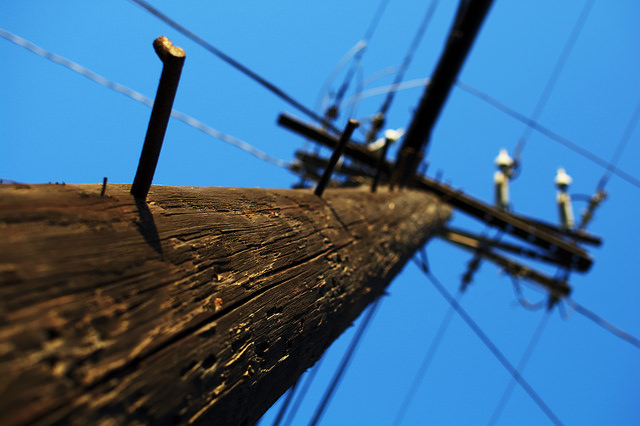
Feds nail webcam on utility pole for 10 weeks to spy on suspect
Court says warrants not needed. Footage revealed what passersby could see.
Ars Technica
63 points · by pavornyoh · 10y ago · 91 comments
The argument is always that they're only tracking the "same views enjoyed by passersby on public roads", attempting to create a false equivalence between a camera and a human.
This has always been a pet peeve of mine, because there are factors that nullify the projected equivalence: each of these 'passersby' on the public road can only be in one place at one time. They are not omniscient. Further, there is an assumed limit to the amount of data they can collect (what can one person see from that street corner) and an assumed cost to the collection of that data (and therefore: even a government is limited in the scope of collection; they can't place an agent infront of every house on every street). These were the assumptions present in the time of the writing of the amendment. These assumptions only apply to the economics of humans, not cameras, and materially changes the effect of the law in the present day.
Courts will need a mechanism to articulate that a camera is not equivalent to a passerby. It's not a question of function, it's a question of scope. Much like anti-trust laws or regulations against cornering economic markets don't differentiate based on function, but the scope of the function. When it comes to privacy - the kind that the Fourth Amendment was written to protect - yes, placing agents on corners is substantially different than placing cameras on corners.
They unanimously found that the government needs a warrant to put a GPS tracker on your car.
Similar to this case, the state argued that a cop didn't need a warrant to follow a car, so why was a GPS tracker any different? It just made the police work more efficient. The court disagreed.
I don't see how that would apply here.
That to me would be a pretty clear line between a passerby and law enforcement in this case.
"I'm curious: would they need a warrant to sit in a car outside someone's house to watch them? " -Zak
The Constitution however says nothing about "in their movements" or "in the light they reflect."
You're talking about placing a EULA on receiving visible light. That the photons have interacted with your person doesn't make them yours. Trying to tell people what they can and can't do with incoming visible light in a public place is an egregious breach of their freedom.
You simply do not have the authority (morally or practically) to control what happens to other people's observations about you in public spaces. It's not your data, it's theirs. Reaching into people's sensory systems and making rules about what can't get written down or shared is a disgustingly Orwellian violation of their autonomy of thought and freedom of speech.
You have a right to privacy in your enclosed property, over your secure communication channels, etc. When you can be seen from a public place, you simply don't.
On the belief that pervasive surveillance is a societal problem, it might be reasonable to restrict the state from using its property/infrastructure for surveillance camera positions, or to prevent the police from using such a system to go trawling for targets to investigate.
But you absolutely cannot bar a private individual from having cameras on his person/property/car or place restrictions on how he shares that data.
The increasing omniscience of your neighbors brings society back from a relatively short period of anonymity. In a small town, a single officer off the main road knew everyone's comings and goings. This did lead to a lot of abuse, and I'm glad that we're beyond the worst of sheriff as bully. But the answer to increasing observational powers isn't going to be in forcing law enforcement to be crippled, it's going to be in better open access and transparency on what and who they are targeting.
Of course not an easy thing, but it's a lot better than hand wringing about what the courts will gin up.
There are two big differences between passersby and unobtrusive fixed cameras.
• Passersby are generally easily noticeable.
• Passersby pass by.
A level of care that would make one safe with a high probability against being seen by passersby might fail completely against unobtrusive fixed cameras, so I'm not sure that the passersby-could-see standard should be the one used for cameras.
For example at a house my family had when I was a kid we were out in the country in a flat valley. From the end of our driveway I could see far enough up and down the road to see any potential passersby a minute away and postpone anything sensitive I wanted to do in the front yard until they had passed by.
On the other hand, I suppose that even if we decide not to allow law enforcement to use unobtrusive fixed cameras in situations like this it won't stop private parties from using them. Any private property that has a view into your private property could be a place where someone has decided to do some video voyeurism and is recoding.
Maybe the technological cat is out of the bag and we are just going to have to accept that if you don't want something seen you need to do it somewhere where there is no visibility from anywhere outside your property.
There's a gigantic difference between having a bunch of people see you in various places as you go about your day, and a searchable database of every place your face has been seen in public over the last two years.
"Who was seen where and when" isn't particularly privacy-violating. It's the search capability that is. This is especially true when it's targeted at a particular person - I'm not that worried about the police finding people who were in a particular area at a particular time. They've had that power for a long time, through canvassing and other traditional detective work. What I'm worried about is giving them the new ability to quickly and cheaply compile a list of everywhere someone has been and when.
>Maybe the technological cat is out of the bag and we are just going to have to accept that if you don't want something seen you need to do it somewhere where there is no visibility from anywhere outside your property.
Can we just skip the song and dance and say that privacy is only for those who can afford it?
If someone walks past my house, no problem. If someone sets up a telescope at the end of my driveway to look in my living room, I'm calling the cops.
Ignorance of the law is no defense, unless your job is to defend the law?
So the good-faith exemption exists to make sure technical violations that occurred during a good faith attempt at following* the constitution don't result in a criminal going free.
Think about it. If your mom gets murdered and the cops get a warrant that for some reason wasn't technically valid, would you want the murderer to get off scott free? How that that serve justice.
I think the court may be misapplying the good-faith exemption. In my jurisdiction it only applies only in situations where there was a defective search warrant. But each state may be different.
TL;DR; it doesn't make it legal, but it also doesn't give you a get out of jail free card.
I wouldn't be happy if the police screwed up for any reason. But violating rights in one case makes it more likely that rights will be violated in other cases. Better to let one guilty person go free than to injure and possibly lock up a hundred innocent people.
So find another way to punish it. Why should that get some off of a criminal charge. Most of world has no such rule.
And the point of a good-faith exemption is because allowing good-faith fucks up to be used as evidence doesn't increase (much) the likelihood of violations.
>Better to let one guilty person go free than to injure and possibly lock up a hundred innocent people.
But throwing out ill gotten evidence after it was obtained doesn't decrease the chances of locking up innocent people.
Even if we accept this, allowing the police to claim ignorance gives a loop hole to allow for illegally obtaining evidence. That is why the evidence must be obtained legally, not 'I thought it was legal but it wasn't'.
Of course sane people do not want guilty people to go free. What's wanted here, and what's important here, is not that the guilty go free, but that the innocent aren't subject to harassment, embarrassment, and all sorts of other -ments from the government. And before you ask, yes, it's okay with me if some murders go unsolved due to the absence of pervasive surveillance, or even the overly liberal application of the "good-faith" exception.
The cops can already lie to cover up a 4th amendment violation.
Oh, wait. There's a panopticon surrveilance blimp watching all of us, from hundreds of miles away anyway.
https://theintercept.com/2014/12/17/billion-dollar-surveilla...
What's a webcam on a telephone pole, then?
How does a judge parse the difference?
Seriously, the precedent that ostensibly allows this is very dangerous because it essentially allows police to feign ignorance in order to bypass 4A protections.
Except, nobody has argued it's off limits, instead, they argue that using that technology should require a warrant. The argument that criminals can use the technology freely is also pretty much a non-starter. The whole point of the 4th amendment is to say that law enforcement can't freely do searches even if others could.
By ignoring this point, the court makes the opinion a lot weaker than it could have been.
Is there a line where the surveillance would NOT be legal? Could they have had a drone circling his house? What about a satellite? Do you have an expectation of privacy from ABOVE your house even if you don't have it from public roads?
See Examples & Explanation: Criminal Procedure Constitution & Police, Seventh Edition (Examples & Explanations) by Robert Bloom for a detailed analysis.
Nor would they be allowed to create their own temporarily-installed pole with a camera on the top.
So to me, the public view argument only holds if the public was capable of it.
In short, you have no expectation of privacy when it's possible to be seen from a public right of way. I really see no problem with what LE did here.
Utility poles are generally owned by a private company though or the local government and are regulated.
Members of the public are not generally permitted to hang things or attach things to them, and since they are usually located on private property or property that the local government has rights to, the general public also isn't generally permitted to place things on them.
The idea that the position is privileged because it's a utility pole and it's illegal for civilians to modify them is a pretty weak argument. I'm no even sure that's true; people post bills and such on utility poles all the time. I'm tempted to nail a gopro up and see what happens.
If they had just taken a metal pole or a low-altitude drone perching on a tree as a camera base, you'd be fine with it?
I mean, a convicted felon was walking around with a firearm in broad daylight outside, within eyeshot of the road. The idea that this can't be observed from external perspectives by law enforcement but a civilian could legally do it is pretty weird. Weirder than the idea that law enforcement could use surveillance drones, to me.
I agree with the outcome of the case, just not necessarily how they arrived there.
As for attaching things to utility poles, etc. yes, most cities and local governments have rules/laws about that, they're just usually not strongly enforced. As an example:
"No one is allowed to attach to utility poles in the state of Pennsylvania without permission from the pole owner."
https://www.pplelectric.com/at-your-service/for-contractors-...
As long as the government had a warrant, or this was a private citizen exercising their legal rights, I have no problem with it.
What I would have a problem with is the government performing surveillance that only they could legally do without a warrant or evaluation by a judge of some kind.
Is there still the idea that you can face your accuser in court? Are we at the point where the camera+recorder is considered a legal proxy for a sworn public official?
(Asking as an honest curious question, not a sarcastic remark)
I know for a positive fact that at least some law agencies have the capability to put concealed cameras up that broadcast real-time video back to a data center. From there, the data is algorithmically processed by license plate readers and facial recognition tools that cross-reference their found data against databases containing persons of note (like persons of interest, but less specific to a given case) and, when results are found, notify agents or officers via messaging.
We're really just a hop, skip and a jump away from the "self-driving car of surveillance".
Yes, you have the right to cross examine the witnesses against you, including, e.g., those testifying as to the when and how the camera was set up and how it (and the video obtained from it) were protected against tampering and other facts relevant to establishing that it was recording where, when, and what the prosecution are claiming it was recording.
> Are we at the point where the camera+recorder is considered a legal proxy for a sworn public official?
No; physical evidence of various kinds has existed for a long time (what kinds are available change over time), but actual witness testimony as to its provenance, etc., remains important.
I expect this to get to the Supreme Court given the constitutional argument but I really have no idea how they might come down on the issue.
The problem is when they go nuts and try to capture "everything". The balance between the effort to keep an eye on a specific suspect in a specific case + budget/manpower/etc is reasonable vs our need for privacy.
That's the problem right there though. The FISC has already ruled that if there is no constitutional issue with a single targeted act, then adding more and more acts together can't create a constitutional issue out of whole cloth.
In other words, if it's OK to do it with one person as a target, then it's OK to do it to everyone as a target.
"Put another way, where one individual does not have a Fourth Amendment interest, grouping together a large number of similarly-situated individuals cannot result in a Fourth Amendment interest springing into existence ex nihilo. "[0]
[0] - http://www.fisc.uscourts.gov/sites/default/files/BR%2013-109... page 9, paragraph 1
Fine without a warrant, or fine with a warrant, and why?
The argument against "a mass grab to do this across entire geographical areas" tends to be that it is both unjustified (no specific suspect/specific case) and that no such warrant was (or can be) issued. Law enforcement tends to dodge the issue with a "no warrant required" claim. But if we want to make judgements about what is right or wrong, I think it's important to separate these different aspects.
I assume the federal government does not own the pole, so it would require the permission of the pole owner and/or the municipality, no?
"at the direction of the ATF and without a warrant, the utility company installed a surveillance camera on a public utility pole located roughly 200 yards from Leon’s trailer."
The utility company installed the camera voluntarily.
Nobody said you can't use webcams for surveillance, just that you need a warrant because that's how the law works.
At least, that's how the law is supposed to work.
There are a lot of stronger counter arguments against this approach that don't have to do with warrants. Cameras don't stop crime, they can only document it and possibly alert to something happening. It is better to just make arguments about the practice of mass surveillance and police priorities than to hope court rulings will knock out cameras placed on public land as unconstitutional.
I think the only difference here is the rural nature of the location.
--
Writing separately, Judge Thomas Rose said that the authorities had enough probable cause to get a warrant, and that their failure to do so was "harmless."Guy became a felon in 2004, but is involved in a shooting in 2006, and now the feds suspect he might have illegal access to firearms (because felons aren't allowed guns) - how did he not get popped for that after the shooting in 2006?