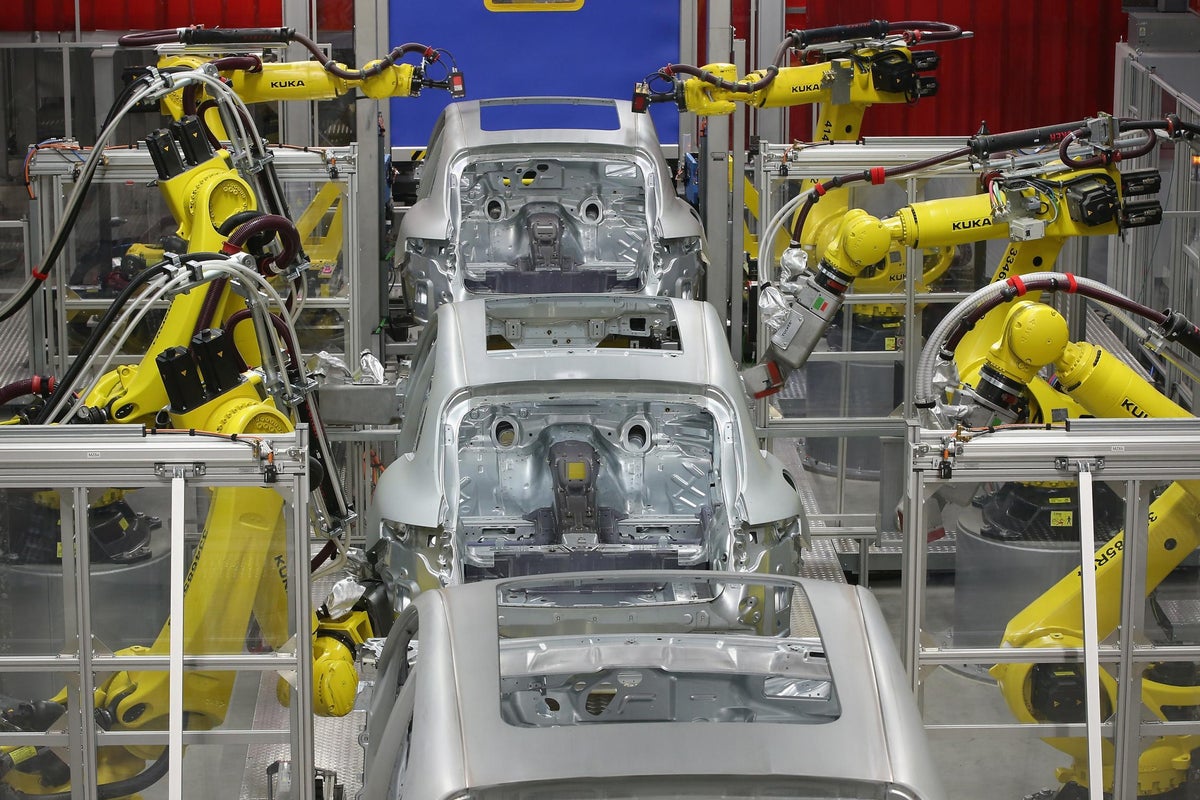
Basic income may be needed if robots take our jobs, AI expert says
The rise of artificial intelligence could put millions of human workers out of jobs - could a basic income be a solution?
The Independent
94 points · by jonbaer · 10y ago · 140 comments
Unemployment is _good_. Being poor is bad. They are only correlated because we decided that made sense in the past. It doesn't any more.
That said, it seems too much to say "Unemployment is good." It's hard to disentangle the effects of poverty versus unemployment, but there are pretty strong hints that having a (good) job is good for health--prolonged unemployment from solidly middle class jobs leads to depression, and people die at higher rates after retiring.
People need a purpose and outlet for their creativity, and a sense of order and direction for their lives: sitting at home all day playing video games would be disastrous, and encouraging automation (which a basic income will do) will make it even harder to get entry level positions. We've got to enable some kind of meaningful labor (market-compensated or not) that people still can engage in after the basic income is implemented.
Are there no charities, no community organizations, no sports teams? Why trade the forced labor of market compensation for forced labor of government compensation?
Meaningful labor already exists outside of market compensation. Anything the government would implement would just be beaurocracy soaking up funds that should be going towards the basic income.
I also think it's unlikely that people would spend all of their time playing video games. Sure, in today's overworked society all anyone wants to do when they get a free moment is zone out. But if people weren't so overworked, they'd likely seek out meaningful things of their own free will. No need for us to worry about them, humans have a natural inclination to seek interesting stimulation. Many people will get stuck on boring things, but many people will choose to get more out of life and as someone who would be in the latter category I want to live in a society where that is possible.
so, you get laid off and find yourself, first of all under stress because your financial situation is uncertain, but secondly wasting away as a person and frittering you newly abundant free time playing video games. i don't think that points to your deep need to toil, to be given work to do. it's evidence of a poorly developed ability to play, that is to find work to put yourself to.
as for me, i've had a few stints of unemployment and it's improved everything in my life, except my bank account. and when i got work again, everything became worse, again, except my bank account. now, like i said, this is just my own experience, but though i hear often enough that people have a real need to toil, i've never seen it in my actual experience. on the other hand i can see a real human need to play, which most people are deprived of. and, of course, a need for money, which is the only tangible thing people get from their toil.
You seem to be suggesting that people shouldn't have to be 'forced' to be employed (i.e. trade their personal skills for $$) but instead should receive an income from the government for simply existing. They could then do whatever they wanted in their free time.
This clearly doesn't work for everyone unless you are working under the assumption that the 'government' can just print money and everything will just work out.
So you seem to be suggesting that there should be two groups of people. Those who simply live on income given to them no strings attached by the government and another group of people who are doing something bad by being employed and are forced to give up some of their income/wealth to the government to be given to the group of people who opt out of that system.
This seems to be what you are advocating but I must be missing something.
BTW, I'm actually interested in a basic income mechanism as a more efficient way of delivering a social safety net to those who need some assistance but in my mind that presupposes that only a fraction of the people need assistance. I can't see how that works if the basic income is an attempt to provide a minimal viable income for everyone!
I think the difficulty in evaluating a basic income mechanism is in understanding how such a program would work with different amounts of basic income, $200/month, $500/month, $1000/month? Is it per person? per household? extra amounts per child? Is it adjusted geographically? Depending on how you answer those questions you get different incentives and different costs for the program.
While I don't have good answers to many of those questions I don't think a basic income program can work if it is construed as a way to enable anyone to simply quit their job, pursue their artistic or intellectual pursuits, and have 'the government' (i.e. other people) pay for that privilege. That type of an existence, while desirable, is not a 'right' to be supported by forcibly taking assets away from other people (taxing/redistribution of wealth).
I'm advocating for flipping that position and seeing where it leads us.
I don't think that people would suddenly stop working entirely. I think there would be a redistribution from rich to poor. I think that's reasonable.
If you feel that the world would fall apart and people would stop doing anything useful if they weren't coerced, then I would ask the question - why do the wealthy work? They already have a basic income. What proportion of people who could retire permanently at say, age 40, actually do? I think the picture being painted of a bunch of feckless, consuming meatballs, is wildly off base.
There is also a huge difference between providing assistance to ease the efforts required and simply removing the need for effort entirely by providing 100% assistance (i.e. dependency).
Taking a 'basic job' in order to live seems like a reasonable trade-off and a starting point for something better. To assume that people should be able 'to live' in the absence of a basic job (i.e. to live as a dependent) just because they don't want to work is problematic.
For the purposes of this discussion, I'm assuming that 'basic job' is not something inherently hazardous, although I also think that individuals should have the freedom to make an informed decision about taking on personal risks. So even hazardous jobs should be available as long as the hazards are disclosed.
well, what about "have access to food and basic resources". It's not like all value in the world only comes from labor.
If you don't want to exchange your skills (physical or mental) for money, then you probably need to find a benefactor of some kind to sustain you and I don't think that is necessarily a bad thing if it is a mutually consenting relationship.
Note, there is a difference between not wanting to sustain yourself through your own effort and being incapable of doing so. There is plenty of room to talk about government assistance in latter case, not so much in the former case.
Did you overlook the group of people that has huge capital resources from accruing it from generation to generation and can simply sit on this wealth as the robots it purchases bring in even more wealth? Or do you consider that "being employed"?
And do you think that if someone cannot find employment because there are not enough jobs in the world that they should therefore have a shitty life in their one and only finite existence?
I think it is pretty clear from what I wrote: "delivering a social safety net to those who need some assistance" that I don't think that.
The jobs which actually need to be done in order for us to feed and clothes ourselves are increasingly done by machines. In some cases overseas labour is cheaper than automation, but we're still progressing there.
As a result, because we're clinging to the idea that a person shouldn't eat unless they perform labour, we have to invent more and more categories of employment which become less and less essential - basically, people work in luxury sectors.
I don't think we've quite reached the point at which the world can spin without unskilled labour, but I do think we can now afford to compensate it appropriately, and I think that giving the lower classes negotiation power via the basic income is the best way to achieve that.
I don't understand this way of phrasing the argument. Do people really "cling" to this idea? It sounds equivalent to saying "we're still clinging to the idea that a person shouldn't be in good physical shape unless they exercise and eat well." I don't think many people cling to these ideas in an ethical sense, as if it would be immoral to be healthy without exercising or wealthy without working [0]. The ideas are just reflections of the actual state of the world, even though it might suck. I'd certainly rather be healthy without exercising and wealthy without working, but I don't expect or demand a forceful restructuring of society to satisfy my wishes.
[0] Actually, now that I think of it, many people even in this thread do condemn people who become wealthy without working. It's perhaps somewhat ironic.
Doing nothing in your life sucks hard. Everyone gets depressed and suicidal in the long term.
These can be seen as synonymous for certain definitions of "unemployed". You are not "employed", unused, not applying yourself to anything. In that definition, if you are able to provide for yourself and have found meaning in allocating yout time, that is a form of employment -- even if it's not a job.
That said, my preferred definition of unemployment is "without job, seeking job". Likely, basic income would reduce the statistic by that definition.
The way I see it, the idea behind basic income in a largely capitalist society would be to make being poor a lot less bad. It'd still be bad, probably, as a lot of us like having nice stuff; we like living in desirable areas, and those things won't be available to people on basic income, assuming we continue to use markets to distribute those scarce goods.
Those of us who come from middle class families who maintain good family relationships often have a similar option; crashing with mom and dad for a while. It's not really something you want to do for any length of time, but it's nice to know that if things really go south, you aren't homeless, and you don't have to do anything truly repugnant.
But just like crashing with mom and dad, it's not really a desirable long-term option for most of us. Sure, sure, it's going to be better than the jobs that are the worst on the unpleasantness/compensation scale, and I predict would dramatically drive up wages in the least pleasant fields, (and I predict would lower the rates of the less remunerative forms of crime for money) but if you are a software developer or something, especially if you come from a middle-class family that you maintain ties to, a realistically-sized basic income isn't really going to change your motivation.
Point being, unemployment (as usually defined in statistics, meaning people who want work but can't get it) will remain a bad thing, and assuming a realistically sized basic income, most people who currently work are going to want to continue working.
And... this is important. We need people to continue working. The basic income choice is really, "do we want people to do really unpleasant jobs for not very much money?" and then "are we all willing to pay rather a lot to make it so that people don't have to do really unpleasant jobs for not very much money?"
The argument in favor is the idea that if a job really is that unpleasant, it ought to be compensated for that unpleasantness, and effort ought to be put into automating that job away. Making workers less desperate would make those things happen. Making workers less desperate would also decrease the workforce participation rate. More people wouldn't work, and more people would work part time.
The argument against is that this is going to be pretty expensive, both in terms of what we have to pay to get the difficult-to-automate unpleasant jobs done, and in terms of just the taxes that would be required to fund the scheme.
Unemployment is bad overall. Too much free-time and not enough money (basic income won't cover "fun") will have consequences regarding crime.
Look at Sweden. Even with free healthcare, education and living costs covered the suburbs are filled with crime and radicalisation.
There are other affects of autonomous vehicles to consider. Labor is a major cost of shipping or taxiing. Accidents and the resulting repair, liability and insurance costs are expected to come down with autonomous vehicles. So the cost of just about everything we buy will come down, and we'll spend that difference elsewhere. Those 'elsewheres' will then see more employment.
What we can expect, at a macroeconomic level, is not massive national unemployment, but a transition period as the work opportunities change.
At a micro economic level, it will be very painful for millions as they go through the transition. I don't know if a basic income can make this transition smoother for the country, but it is worth studying.
Populations in most countries likely to own robotic technology are aging fast and there will be even more demand for such jobs. In fact, a lot of demand already exists, only that the costs are too high for middle-class elders or patients to afford the services regularly. (See: expansion of nursing care in lower-cost countries like Thailand, but most people would prefer to stay in their own country if they have the choice.)
Moreover, aptitudes the tasks required often match with those present in lower-wage workers in the service sectors. We need to retrain them for these higher-valued jobs. As a big plus, the jobs above often feel more meaningful than scanning items at cashier, delivering packages, or waiting table.
There is evidence that being unemployed is not good for people's psyche and well-being in the long run. Demand for meaningful, high-valued services still exists and we ought to retrain workers for these jobs instead. Pay for these jobs should be higher and hours reasonable--more redistribution could be utilized to accomplish these.
I believe earning one's living through work leads to a more meaningful existence. Demand for human work still exists for several decades to come. We need better social infrastructure to retrain workers at risk from technological unemployment and fully support them (including with good pay) during retraining.
Technology has the potential to let us be human, free us from menial jobs, and focus on what we do best--if we develop the socioeconomic system to complement it and help with the transition.
While this is true and one of the unintended consequences of guaranteed minimum income would be even harder to obtain elderly care, not everyone is suited for this kind of work - and if you think a large % of people who spent the last 20 years driving cabs and trucks can now go on to be a nurse or some such I don't think it's very realistic.
IMO there will soon be a new class of unemployable people - with low social skills and low enough IQ to not be trainable fast enough (one thing that is a requirement in modern economy is fast training and adaptation - no more learn one job and do that for the next 30 years - you stick around for one job for a couple of years and then your position gets automated, the company reduces capacity, relocates operation, shifts focus, etc. etc.)
So on one hand there will be vacancies for many jobs (like competent programmers right now) but on the other hand people available will not be able to enter those markets in any reasonable amount of time.
I can tell you myself - years of working on a computer over 8 hours a day have left my motor system very very underdeveloped and I have a hard time focusing on menial things, my first job was physical labor after highschool - I took months to get to the point where I could be useful and I was a work hazard during my training - the only reason I got a job there was because the manager knew me from school "internship" and he knew I could code/was a fast learner - he gave me a job before he could get an opening to move me to production planning/management. I needed the money because I was poor. But there was 0 point in hiring a person like me for that kind of work - if I was hired for that job I would be fired way before I got good enough at it to not be a hazard. On the other hand I've seen new people come on out of school that learned much faster and were just better at it. Just like there would be 0 point in hiring anyone that was good at that job to be a programmer.
If everything is perfect in a country, they can send aid to a foreign land for compassion, goodwill, and diplomatic relations. Always more work is available to do until..
When the whole world becomes like heaven and nowhere is left to improve, which is a long time to come, money would be far less important than it is now.
Except the (potentially) sweeping changes due to automation & other technologies aren't expected to happen in 300 years -- more like 5-20 years. Do you see a difference here?
This revolution is coming, it's part of evolution, stop fighting it, embrace it and learn how to live in new reality,
Do you really think your own livelihood -- and that of people close to you -- is that immune from the potential negative consequences of the "revolution"?
because you can't stop it.
Not entirely. But we can moderate and regulate it if we wish (and we pay close attention). That's the key issue, here -- not simply "either fight it or embrace it."
No, it wont be 5-20 years. What i am talking about can't be achieved in 20 years, what you will achieve is part of evolution, not revolution.
Do you really think your own livelihood -- and that of people close to you -- is that immune from the potential negative consequences of the "revolution"?
Don't worry about me, i will survive natural selection.
Not entirely. But we can moderate and regulate it if we wish (and we pay close attention). That's the key issue, here -- not simply "either fight it or embrace it."
Good luck with that, seriously, you will regulate it for sure as hundreds of other things that needed to be regulated in USA and didn't because of lobbying. How do you want to regulate it ? Did you regulate wall street? How about punishing anyone after 2008? How about HFT? Did you prevented deregulation that caused world crisis? No, you didn't and you know why. What about gun control? how about hundreds others, where big players are involved? So did you do all those things that felt even more right to do than what we are talking about ? No, so please wake up and stop pretending you have any choice.
USA know that technology is the core future of economy, no one will stop it, you know why? Because USA is not the only player in the world, and if USA still want to be in top, it just can't be stopped, because others won't. It's just couple examples from thousand why you can't do anything about what's coming. Big corporations will just benefit too much from it and you will see this argument "we need AI/robots, costs are too high, or we can't compete with the rest of the world". Sorry, but you already lost this war, you just don't know it yet...
If I'm a plumber working for myself and I fix pipes all day so that I can put food on the table and a roof over my head, am I not working for my own survival?
If I'm a plumber working for a plumbing company has something changed about the value proposition?
If I'm a plumber who quits the plumbing company to work for myself am I working for my own survival?
If I'm a plumber working for myself who decides I don't want to deal with marketing, accounting, risk management, and so on and so I start working for a plumbing company, am I working for my own survival?
Not necessarily. If a company can capitalise on those new opportunities without employing the levels of workers that are made redundant by the shift in the market, then this mechanism you're describing will not work.
A classic example is Walmart vs Amazon. Putting aside their side businesses, their core business is broadly the same. In the US, Walmart employs approximately 1.4 million people. Amazon.com employs approximately 230,800 people. Walmart is still larger than Amazon in terms of sales, but consider this...
http://time.com/4040160/amazon-walmart/
"Today, Walmart’s revenue is still much larger–although only 5 times larger now–and Amazon’s revenue per employee ($623,000) is nearly three times that of Walmart."
Why would Amazon seek to employ Walmart-levels of people when their business model allows each employee to earn 3x greater revenue (on average)?
That gap will get even bigger with automation.
You'd better be concerned about thousands of people they kill every year. It's far more important that an income of a bunch of lorry drivers. Even if some of them die as a result of losing their jobs (and it's quite an unlikely scenario), thousands of the lives spared would offset this by a huge margin.
As for airplanes - there's a lot more time to deal with issues than there is in a car.
If something goes wrong in a plane you need to land it, which is a pretty delicate operation. If something goes wrong in a car, all you have to do is get off the roadway and stop.
Another thing to ponder is, if certain technological innovations come to pass (ie, an affordable personal-AI system), should the government consider providing those technologies to all of its citizens? The disparity between someone with a personal-AI and someone without would increase exponentially, very quickly. This is simply considering the economic value an AI could provide, in terms of helping with business ideas, self-improvement, secreterial work, etc.
Anyways, massive unemployment is going to occur soon. If governments can't come to terms with providing a universal basic income, I would suggest they begin planning emergency food supply distribution systems immediately. The first thing that people will begin missing is food, and if a government can provide sustenance to needy populations, it would buy itself some time before civil unrest spread throughout the country. http://livescience.com/52724-can-strategic-games-prevent-foo...
(wish I had an emoji for only-kinda-tongue-in-cheek, i.e. saying something kinda unfair with self-awareness to be half-joking, but actually kinda asserting it anyway)
They were by far and large, absolutely terrible. Quality of life across Europe plummeted.
As T. S. Ashton pointed out (https://en.wikipedia.org/wiki/T._S._Ashton) in 1948, the industrial revolution meant the difference between the grinding poverty that had characterized most of human history and the affluence of the modern industrialized nations. No economist today seriously disputes the fact that the industrial revolution began the transformation that has led to extraordinarily high (compared with the rest of human history) living standards for ordinary people throughout the market industrial economies.
The parent comment was talking about artisans losing work, not farmers.
I think technological progress and innovation increased overall quality of life, while many specific things, such as jobs many workers felt they had no choice but to take in the shifting economic reality, were horrible for the people involved.
Saying that most of human history was grinding poverty is again, cherry picking. In terms of personal freedom and free time, as one of the most fundamental measures of value, humans had it way better at many points in history and much of prehistory.
The market found more things for knowledge workers to do. Visit the rust belt sometime - the factory laborers were left behind a generation ago, we just choose not to think about it because they're in a different caste.
First world economies been in (or close to) a post-scarcity economy for probably the last fifty years.
So you'd have 'human made' as a label on the side of slightly more expensive products tailored to slightly more well off people who see it as more ethical. Like a non food version of a farmer's market.
It won't save most of the jobs, but they'll definitely be enough people out there who don't want 'machine made' products by companies only using robots.
On another note, I suspect many of these articles also miss one other thing; there's no reason that every company would use robots or AI. Sure, large companies would. But in the same market would likely be hundreds or thousands of smaller ones with at least some humans in the workforce.
I mean, look at it this way. Go down the high street and look at the shops and restaurants. Sure, big chains exist, whether they be coffee ones like Starbucks and Costa or supermarkets like Walmart or Tesco or the likes, but so do tons of small companies run by people aiming at a local market, or a certain niche, or anything else. They're not all going to buy expensive machinery to run the shop, and they're not all going to go out of business. Heck, it could even be the opposite; quite a few businesses in the real world have actually gotten MORE popular once a Starbucks has moved in next door. People will still buy things from small businesses (especially if they're distrustful of large multinational companies), and those small (and even medium sized) businesses will still hire human staff.
That seems to be overlooked in these discussions. After all, if even something as big as Coca Cola or Disney or McDonalds or whatever has lots of competition, what makes you think your future companies won't?
Think about all the elderly retiring people that will need to be cared for. All the working moms who struggle to find people to care for their kids during the day. All the litter and graffiti all over our cities and roads.
Countries like Japan are freaking out about their aging demographics and how they will support them. The solution is definitely not to decrease the amount of people working.
Instead of basic income, why not use the money instead to give a generous wage subsidy to people at the bottom? So that even a street sweeper, caretaker, nanny, or preschool teacher is well financially rewarded?
FWIW, the Scandinavian model, which has some of the highest equality and well-being in the world, requires people to work and has some of the highest labor force participation rates in the world.
If automation continues to expand as expected, the majority of tasks humans do could be replaced by machines/AI. At this point, the total volume of work may be high, but the total volume of work only humans can best fulfil may be much lower than it is today. The question becomes, when we can apply automation to most jobs, what will human society look like?
Also, caring for children/elderly is not something that is necessarily desirable to automate...
The point of talking about an UBI now is to iron out any issues with it before it's needed. Furthermore, whilst the need for it isn't as strong as it might be later, there are certain benefits it could bring to simplifying and improving welfare even in today's society. If you're suggesting there's a risk people will not work, that all depends on the implementation (again, another reason why it's being discussed now). What I believe is likely to happen to the current job market if we had UBI is that people would be freer to switch careers, and as a consequence of this undesirable jobs are likely to have higher wages, and desirable jobs are likely to have lower wages. For example, cleaning jobs would pay more, and marketing jobs would pay less. In other words, the incentives for working would change based on the flexibility of the workforce.
> "Also, caring for children/elderly is not something that is necessarily desirable to automate..."
Most of that isn't paid work at it stands now, plus it's worth remembering that the automation of the future is likely to be more adaptive to individual needs (i.e. when it's driven by sufficiently sophisticated AI).
Lastly, the aim isn't to remove humans entirely from the world of work, the idea is to change the need for humans to work, the option to work will still be present.
It will come - simply b/c a majority will depend on it and politicians depend on majorities.
But it will also be so low that people will merely be able to afford a reasonable modern living standard.
At the same time there will be incentives to take new kind of jobs to pad the basic income.
Those jobs will be servant jobs - bringing people food, driving them around ... serving them ... b/c no robot can give you the feeling of being in a position of power.
So the fate for the uneducated or people educated but in economically irrelevant areas will be basic income plus being a servant.
Depends on what classification of free energy you want to use. Do you class energy from the sun as free energy? I know I've never paid for it.
How much do you pay to post here on hacker news, or read whatever online newspapers you like?
There are tons of things that are becoming freer and freer, as time goes on. Why wouldn't this eventually extend to food, or energy?
Posting on Hacker News requires me to keep paying my electric bill and my broadband bill or for someone, somewhere, at some point, to pay for the servers and power and everything involved in getting it to me.
No, you don't[0][1].
[0]https://physics.stackexchange.com/questions/59673/why-doesnt...
[1]https://www.reddit.com/r/askscience/comments/3xxpw9/why_does...
Fusion might be a vastly more efficient version of what we already have, but it's still neither perfect nor infinite. Sooner or later, you run out of fuel, or the reactor breaks down, or you have to build more reactors or something.
That said, if food production was so easy as to be almost free for the people with power, why not just make it free? If the cost is small enough, powerful people would be happy to absorb it to provide this service.
once we begin distributing gains to everyone there will be an exponential robotics boon in order to fill all of the positions people walk away from
If yes, what incremental steps could be taken in the US to start reducing healthcare costs down to a level where we can even think about providing a stipend on top of the free healthcare?
As a society, we simply cannot afford to give everyone whatever-it-takes care for end-of-life though. We need to prioritize the health care that has the most impact for the cost, the stuff that keeps a normal healthy person healthy and productive, not the stuff that extends a terminally ill person's life by an extra 6 months. To reduce our costs, we have to focus on managing end-of-life to be a positive experience rather than trying to extend it as far as possible at whatever cost.
Easiest way today of increasing "overall health" in the US: better diet and more exercise
I believe this will also be automated and there will be a 'Computer doctor' that can give you guidance and maybe a basic Rx for the majority of problems that take people off work (a lot of which are resolved by staying at home for a couple of days)
Then you would have more complex problems dealt by a doctor
Or is the lack of preventative care somehow showing up in the price of only some xrays?
Of course not, but prevention will lower your "consumption of services"
Providers gauging the price of x-rays are a separate problem
That's a good statement of the problem. It's useful to get that clear before talking about solutions. Solutions are hypothetical; problems are real.
How far along are we in that direction already? About 14% of the US workforce makes all the stuff - that's manufacturing, construction, mining, and agriculture. That figure was about 50% in 1950 and around 90% in the 19th century.
The conventional wisdom was that more education helps. That is no longer the case. About 37% of employed US college graduates are in jobs which require only a high school diploma.[1] Overproduction of college graduates has reduced the value of a college education substantially.
It's not often mentioned, but there's one class of jobs that's almost totally gone - large numbers of people doing the same thing under close supervision. In 1900, Carnegie Steel had 5000 men with shovels at one plant. Today, you might see one or two people with shovels working, but beyond that, power equipment is brought in. There's a fraction of the population which needs jobs that structured. Many homeless are in that category. (Jobs where drunkenness is tolerated have almost totally disappeared.) That's a problem at the low end. 13.5% of the population has an IQ between 70 and 85. What are they going to do?[2]
Nothing above is really in question. So that's a way to look at the problem as of right now.
Looking ahead, there's this well-known study on jobs likely to be automated soon.[3]
Understanding the changing nature of work is the first step to dealing with it.
[1] http://centerforcollegeaffordability.org/uploads/Underemploy... [2] http://www.dol.gov/oasam/programs/history/herman/reports/fut... (Note that this paper is from 1999.) [3] http://www.thisismoney.co.uk/money/news/article-2642880/Tabl...
We just need to find a new "car"/"phone". Something to get for everyone and their dog, that they'd want, ideally with recurring charges, that can't be delivered without employing God knows how many people (ideally something that would improve the more people you employ).
Because, whilst I don't subscribe to the positive side of Ayn Rand's philosophy, I do subscribe to the negative side. Having the government redivide wealth from the productive to everyone is something that may soften the short-term impact of unemployment, but in the medium/long term it's a disaster. I even agree that redividing wealth combined with human greed manifesting through corruption will make it impossible to turn back from redividing policies once they reach a certain percentage of the economy, by blocking any and all innovation (because it would require changing the redivision policies, which is too dangerous politically. Much easier to just block, say, autonomous cars. Meanwhile drivers die, or worse, kill others, are away from their families for weeks/months, and don't do anything useful. They're not improving anyone's life by having that job over not having that job. It would pretty much be better for everyone, including them, to just have them sitting at home watching TV. And why ? Because figuring out redividing policies would lead to political infighting, or even real fighting (just watch some European demonstrations by farmers, or students)).
I agree that the economy is there so people can live, and live well, not the other way around. But having the private sector do that is almost infinitely preferable over having government redivide wealth. We essentially need to find something new we can and want to do with the economy, that would improve our lives, and require large amounts of people helping to make that happen.