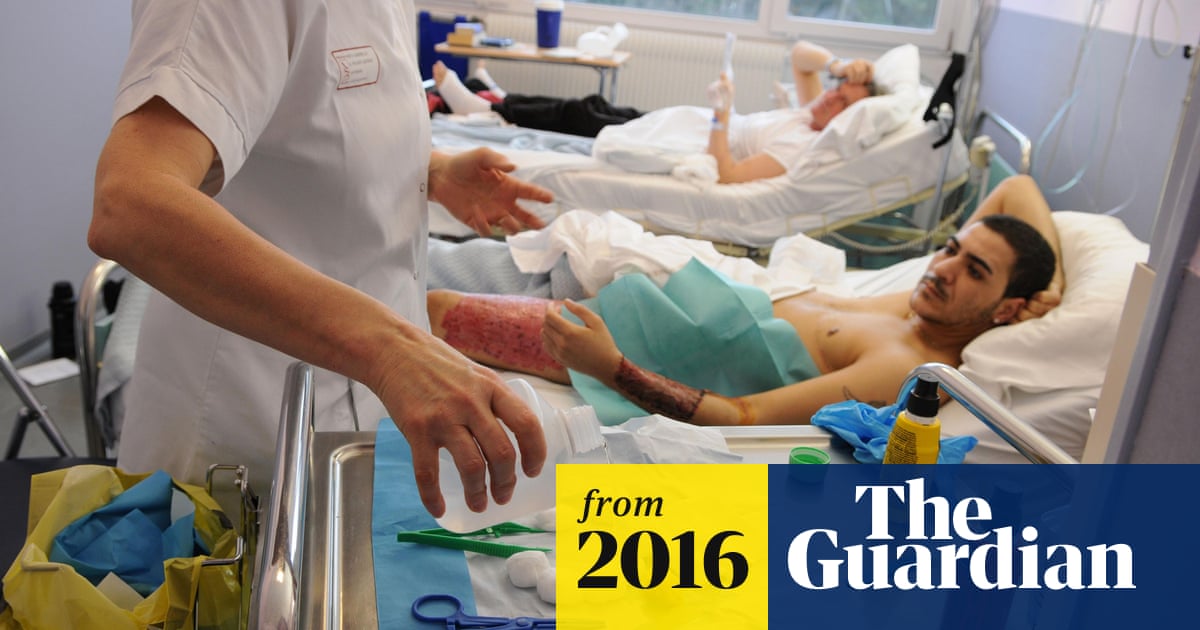
Medical error is third biggest cause of death in the US, experts say
Researchers found more than 9.5% of deaths in US are due to medical error
the Guardian
636 points · by lemming · 10y ago · 502 comments
She was given the wrong medicine in the epidural. She went into a coma, the hospital flew her to a specialty hospital in Denver to recover. Almost a year later she is still paralyzed from the waist down. Her life is ruined, her husband has two babies to take care of and an infirm wife.
The amazing thing is that the state of Louisiana has a $500k limit on malpractice! (Set in the 1970's) Plus he will not get the full $500k. In spite of their clear error the hospital will not just settle out of court. Instead if they pay out through the court system they only have to pay $100k, the rest comes from the state patient compensation fund which has $900 million dollars stored up. So my friend will get $350k and medical care for his wife.
This is called keeping costs down in the state of Louisiana. And this was affirmed in 2012 by their supreme court.
In my view there should be a nationwide malpractice insurance pool and the medical associations should push for better quality standards within their ranks.
I've had friends who have worked retained surgical instruments cases.
Meet one or two of those victims and you will never support tort reform again.
If this were a problem of gross negligence, then I would agree with you that we should focus there. But the problem isn't gross negligence, it's a problem of "business as usual." It's a thousand doctors following procedures with a 0.1% error rate and 999 thinking, "nothing bad's happened to me so I must be doing everything fine," even though they could each reduce that to a 0.001% error rate with a simple checklist or by actually washing their hands.
Put another way, if you put someone's life in your hands and you're not focusing a significant percentage of your efforts on procedures designed to radically reduce risk, then you're engaged in gross negligence.
There's another area where we all have that philosophy.
We send a million people hurtling through the air each day in incredibly complex machines. Airlines focus on safety because (a) they are actually responsible for their passengers and can't just call a mulligan because, hey, people make mistakes; and additionally, (b) they suffer massive reputational costs for safety errors.
So my medical malpractice reform would make medicine more like other industries with far better safety records. It would include a requirement that hospitals post their mistakes on their front door as people walk in.
Remarks like this are really counterproductive and frankly bizarre. Were character assessments ever relevant in lawsuits against tobacco companies? It's not hard to find unlikeable plaintiffs.
However it is increasingly hard to keep your rights to a _public trial_ in a courtroom when it's a tort case [0]. When doctors ask you to give up your right to a public trial, then the rest of society (in my view) demonstrably loses out.
And in fact, per-capita, Americans file fewer law cases now than in the 1840s. [1]
> If this were a problem of gross negligence, then I would agree with you that we should focus there. But the problem isn't gross negligence...
Gross negligence is literally the problem in the medical industry. The Johns Hopkins study found "medical errors account for more than 9.5% of all fatalities in the US." I'm uncertain that any "business as usual" by doctors is really a problem, but rather the checks and balances once offered to patients is being severely eroded.
[0] http://harpers.org/archive/2016/04/suing-for-justice/ [1] http://harpers.org/archive/2016/04/suing-for-justice/6/
Seems like that's an argument for a very discerning insurance company. Following the checklist should reduce their insurance premiums 10 times. And that's noticeable.
(Of course, the ideal insurance company in question needs to collect the information how doctors behave, and needs to be legally able to act on it.)
Liability is a very bad substitute for regulation when risks are comprised of high damage at low incidence. That's why you have speed limits instead of responsible self-determination and potentially rich surviving dependents.
It's impossible in medicine because we're not at that level yet.
Generally, I think there must be a way to hold most problematic doctors accountable while not causing excessive burdens for most good doctors. Also, any system will not be perfect, and the goal should be to maximize the health of most patients.
> it's a problem of "business as usual." It's a thousand doctors following procedures with a 0.1% error rate and 999 thinking, "nothing bad's happened to me so I must be doing everything fine,"
I see no evidence of this, and I doubt you have the audacity to say this in the presence of your own physicians.
> they could each reduce that to a 0.001% error rate with a simple checklist or by actually washing their hands
I'm not sure where you live where doctors do not wash their hands, or how you know that they do not, but wherever I have been, doctors wash their hands vigorously. Infection in hospitals is common. Everything needs to be super sterile. It's more than just washing hands. Everything needs to be packaged air tight and used once in one part of the body, and then thrown away. It's already much more involved than you're suggesting.
Doctors complete between 11 and 16 years of training [1]
Doctors spend an average of 60 hours working per week. They work on average 1.5 times more than the average American [2]
Doctors have too many patients and too little time.
They are already well educated and don't have time for checklists to remind them of every little detail they learned during their 10-year long training program. They don't sleep much and don't get paid very well for the debt that they incur.
Many doctors got into the field because they want to help people.
My father was a physician until 2004ish, and the stress induced by bureaucracy nearly killed him. He was a great doctor. You're suggesting making the system more complex. I'm saying, that's going to make patient care worse, not better.
If you choose to look only at court cases and do not read medical research, then trust is required in this system. Any procedural changes should be vetted by researchers using the scientific method, not bureaucrats who seek to make unscientific sweeping changes based on anecdotes to further their own political careers.
> Put another way, if you put someone's life in your hands and you're not focusing a significant percentage of your efforts on procedures designed to radically reduce risk, then you're engaged in gross negligence.
This is the job of a doctor. They focus on reducing risks to your health.
The solution isn't to add arbitrary checklists and make doctors more busy. The solution is to use the scientific method to add doctors, make our population healthier and capable of maintaining their own health, and reduce the load of patients per doctor.
> So my medical malpractice reform would make medicine more like other industries with far better safety records. It would include a requirement that hospitals post their mistakes on their front door as people walk in.
At first you argue against tort reform and then you argue for it.
I think things like Zocdoc will help good doctors be recognized and allow patients to self select their level of care. Reviews are just one thing. It's a complicated system that needs to balance many factors in order to maximize patient health.
[1] https://www.google.com/search?client=ubuntu&channel=fs&q=how...
[2] https://www.google.com/search?safe=off&client=ubuntu&hs=o9p&...
These abnormally low (and capped) penalties make it easier for those who should not be doing this work to keep showing up every day. I understand that we don't want to scare people in health care out of the field, but those who are clearly inept certainly should be afraid to keep working.
More than likely, the fear of recourse causes more error and malpractice than the errors themselves.
Think for a moment: why are commercial airplanes so safe? Why when an airplane crashes is it so rarely "pilot error?" And why, when it really is pilot error, does the pilot not get blamed? It is because of profound realizations in the design of the air travel system that veered toward systemic control of air traffic and its safety, rather than individual pilot accountability.
I will say unequivocally and factually: our health care would be orders of magnitude safer and higher quality if we treated it in exactly the same way.
Unfortunately the fact that the situation is life-and-death with huge liabilities that there really isn't significant effort to improve things. It's legally safer to continue practices that mostly work but are already standard than try something new.
Literally every doctor will make a mistake that kills someone. Every one. Every doctor will kill someone. And every mistake that causes someone to die will have been preventable.
An eye for an eye leaves the whole world blind. Harsh punishment for the inevitable doesn't result in positive outcomes. Quite the opposite. It leads to death and suffering.
I strongly, strongly recommend reading this: http://www.newstatesman.com/2014/05/how-mistakes-can-save-li...
Actually, it doesn't seem like you do understand. Mistakes happen. Do you make them? Are you "inept"? Should you be fired or should your company face massive financial consequences for them, regardless of negligence? It's absurd.
A better approach is to acknowledge that people will make mistakes, and work with doctors to identify why the mistakes are made and how procedures can be altered to prevent those mistakes in the future. This is how it is done in the aviation business. Punishment will not work.
Yeah but it's not just about punishment. A small portion of medical professionals account for a disproportionately large amount of all medical malpractice claims. The worst 1% accounted for a third of all malpractice claims according to a recent study. I agree that we shouldn't be cracking down on individual mistakes, but we certainly do need to crack down on doctors who are significantly more likely to harm patients in the future.
Malpractice, by definition, is action falling below the standard of care set by the profession. If malpractice occurs, "improving procedures" is not necessary, because the harm results from failing to meet the the procedural norms of the profession.
Improving procedures is called for when adverse outcomes result from problems that are not malpractice.
For smaller claims, the doctor may settle the case for less than the threshold for listing in the public provider record. The National Practitioner Data Bank [0] is more strict in what gets recorded and doctors can't cover it up as easily.
Doctors and hospitals might try and deny the issue but in some states, if the complaint is substantiated (but the doctor is not formally reprimanded) it still gets noted in the National Practitioner Data Bank. This will be checked by any prospective employers in the future.
In aviation, there is a philosophy that its better to admit a mistake, and learn from it. This is known as the "Asoh Defense" [1]. Doctors could learn a lot from Capt. Asoh. The NASA Aviation Safety Reporting System [2] is for aviators to self-report a safety issue without fear of being violated by the FAA for their admission. There is even an immunity policy for non-deliberate pilot errors.
[0] https://en.wikipedia.org/wiki/National_Practitioner_Data_Ban...
[1] https://en.wikipedia.org/wiki/Japan_Airlines_Flight_2#The_.2...
[2] https://en.wikipedia.org/wiki/Aviation_Safety_Reporting_Syst...
It's an interesting idea, but who pays for it? Taxpayers? Have fun with that politically. The doctors? You'll drive out those on the margins of "doctor or other career". We here in Canada already have a massive doctor shortage everywhere but major cities, so that's a problem.
Would that really happen? I know in Australia doctors pay for their own indemnification cover. (http://www.doctorconnect.gov.au/internet/otd/publishing.nsf/...)
No different then how the FAA and the NTSB operate.
EDIT: Medicine can be made safer through the same processes used to ensure air travel is the safest transport method in the world. It can't be as safe, but we can do better.
My point is that the current system encourages denial and cover up. It doesn't encourage improvement.
I think medical errors should be (financially and professionally) punished, but only up to some reasonable amount, aimed at the future and on damage to society, not on compensating the victim (which you can't really anyway).
If you want to be compensated in full for everything that might happen to you, then get personal insurance.
Getting insurance against i.e. disability is a better approach anyway, as this also covers cases where it is caused by no-one, by yourself or just by bad luck.
It seems strange that personal insurance is rarely mentioned as a (partial) solution for these situations in the US. Maybe because collective/social solutions have a bad reputation?
This way, you directly encourage good behaviour via decreased cost, and remove the element of (bad) luck for the doctor.
However, I think the tort caps exist because when big bad insurance companies are involved, courts decide to play Santa and inflate damages to huge amounts. Caps are a crude way of getting around the problem though.
The only thing stopping such a horrible error is this label. IV and Epidural connectors are fully compatible even though they should never be used interchangeably.
I can only imagine how many other simple medical failsafes are missing.
Your comment about the physically compatible, deadly-if-switched connectors was an eye opener: It's almost like if the USB standards group settled on a two-prong design that was physically compatible with a North American 110V AC outlet, and every USB cable shipped with a label saying "DO NOT PLUG INTO WALL OUTLETS".
I guess one problem is that the failures of the `can't improvise' case are really easy to see and imagine. Whereas the other failure of mixing up connectors could always be blamed on human error.
Someone should figure out which scenario causes more damage. With enough stocking, we should be able to avoid the need for improvisation?
As a technical solution, medical connectors could come with bits that prevent mistakes (and clearly different colours and perhaps even outside textures to use sense of touch, too); but with the safety bits simple to break off on both sides, so that you can still plug them together.
So you can still plug together arbitrary things, but you get a short moment where you have to consciously use some force.
[1] not diminishing what happened to people at all, but most of the time we're satisfied by medical approximations as much as we go on with our own mistakes.
[2] I'm all for self driving car studies increase, now that I've seen how people are taught and drive.
Far off-topic from medicine. This is something that has only possibly occurred to me over the past few weeks: this is a healthy perspective of software. We work in computer science and so far as science is defined today, it is about quantifying the incorrect. We spend far too much time talking about what a system does, instead of what it doesn't.
I've found that documenting constraints (before they occur) results in a clearer and more obvious path to valuable results.
Your tone indicates that you might see this as a personality flaw - I've recently discovered that it's most certainly the exact opposite.
To tie this back into medicine, it makes complete sense that epidural equipment should have the constraint of being incompatible with IV. This would drive up costs but life is priceless so far as I am concerned. To a far lesser degree, nobody should have to live with the guilt of making a mistake when the mistake could have been so easily avoided.
Poka-yoke, a technique from the Lean world, is useful here.
The greatest part? Their lawyer could not get any doctor to testify as an expert witness, which is required under Utah state law for malpractice (which makes sense, I suppose). Even if they could've, the lawsuit would've only covered $400k since it's capped. Which might've covered the doctor bills, but not the damages to his life... He was between jobs, then ended up in and out of the hospital for a couple years due to the infection getting out of control (lost his leg, had his shoulder replaced, physical therapy, ended up falling and having pretty sever damage and having to start over again). By the time he was on his feet again, he was worn out and past retirement age. Whose going to hire a "gimped old man"?
It was a mess. Still is... But things worked them selves out as best as possible. But it's incredible to me that that doctor is still practicing and possibly destroying other people's lives because no other doctor was willing to "out" a "colleague". Frustrating.
And it's exactly why many people think pregnancies and births are over medicalized, especially in the US.
Women have given birth for a long time without medical intervention, using competent mid-wives, and now were at a point where every pregnant woman wants an epidural, a scheduled C-section (!!), inducing labor via medicine, etc. It's pretty insane..
The movie "Business of being born" (http://www.imdb.com/title/tt0995061/) goes into detail of how the mindset of handling pregnancies shifted over the last decade, and how pregnancies are almost a "disease" to be treated.
Edit: Since I'm getting downvoted for this, I simply wanted to correlate that more interventions = more risk. No other intent, and definitely not trying to "victim blame" given I have no knowledge of the specific situation above.
And they were dying in droves: http://www.cdc.gov/mmwr/preview/mmwrhtml/mm4838a2.htm (Figure 2); http://www.cdc.gov/mmwr/preview/mmwrhtml/00054602.htm (Figure 1).
Maternal mortality decreased from 700-800 deaths per 100k live births at the turn of the century to less than 30 in 1967, and 5-10 by 1996. Hospitalized births is one of the, if not the most astonishing triumph of modern medicine. It's bigger than the advances in cancer treatment and HIV put together.
No medical care, and therefore zero medical errors: live until 62, die of something trivial.
I'm not saying that pregnancies shouldn't benefit from advancements in disease detection to prevent potentially fatal outcomes. It's not a black or white situation.
Inducing labor to prevent a fatal outcome during birth and inducing labor because you want to be at a party/whatever the next week aren't the same.
This is so blatantly factually incorrect that it actually makes me sick to read.
>I simply wanted to correlate that more interventions = more risk.
This is not always true and the maternal death rate shows that. I'll give you an example - I have a friend who had a scheduled C-section recently. She had a medical condition that made giving birth vaginally very risky from a health perspective. She could have been fine but there was a very large chance childbirth also could have triggered disability or death. She had a whole team of doctors coordinate with each other to choose the least risky option and they agreed that a scheduled C-section was best option for both maternal and fetal health. More intervention = much less risk in this case.
> This is so blatantly factually incorrect that it actually makes me sick to read.
Many of our friends are pregnant or have just had kids, and my wife is 9 months pregnant. We've had a lot of talk about this with them. I wouldn't by any means say that scheduling a C-section is something everyone does, but it's incredibly common. I know of two pregnant women in our peer group that already have a date on the calendar.
My wife and I could not have done more to avoid medical interventions during the birth of our child, but the baby was facing the wrong way and an epidural was necessary to allow the midwife an opportunity to turn it. Thankfully the epidural was done properly.
As an anecdote, my wife gave birth 3 times, never in a hospital or anesthesia. She doesn't remember the pain.
Given that criteria, the current medical system seems to be doing OK, as others have stated.
If (for example) midwifing was superior, then the data would show that, period.
[1]In 1978, the Canadian Supreme Court limited damages for pain and suffering. Adjusted for inflation, the cap now is just over $300,000. The United States has no federal cap on damages, though a few states, including Florida, have imposed them.
As well, in Ontario, the government pays most of the insurance premiums:
http://www.health.gov.on.ca/en/pro/programs/ohip/mlp/announc...
Do any HN users have thoughts on what sort of system could be put in place to minimize mistakes like this in the field?
It is in fact the role of a pharmacist to reduce medication errors - and this is achieved through a series of checks - largely focussed on asking 'is this the right medicine and dosage for this patient and the condition to be treated?' and 'has the correct medicine, dosage and dosage form been dispensed?'
Errors tended to occur outside of pharmacy's area of control; in theatres to where pharmacists often have little access, in ward settings where medicines are administered in sometimes noisy and chaotic environments, in clinical teams where pharmacists are not allowed to have a presence, and indeed in the modern NHS where pharmacy staffing levels are severely reduced.
A technological solution is possible - based on the concept of checklistbundles, patient medical and medication record systems and image scanning technology - but it is usually hard to sell clinicians on the idea of a check-list never mind anything else.
Until there is a true incentive to change practices around medication administration (i.e. unlimited fines) this will always be a hard thing to change.
Sure, caregivers can resent the patients asking too many questions, but this is more about setting up a collaboration and understanding the rationale behind decisions. This catches all sorts of errors that arise; it's not that the caregivers are incomptent, but they are human.
https://www.amsn.org/practice-resources/care-term-reference/...
Even today, with the push for electronic systems, many physicians push the entry duty off on someone else thus keeping this kind of error alive.
However, you won't believe the kind of things that go wrong with this approach either. It's basically operating a manufacturing plant inside a pharmacy / hospital, but without presence of anyone titled "engineer".
In an ideal world, the drug authority (FDA) would require all manufacturers to print proper barcodes in all unit doses at the time of manufacture.
It occurs to me that if all the medical malpractice deaths (250,000) were paid out at that cap ($500k), that would cost 125 billion dollars.
We don't have a lot of extra room in our budget right now, so that's going to be tough to pay out, even though it's not even enough. But clearly the even bigger problem is the 250,000 unnecessary dead people.
If we took a part of that money and used it to fund an agency that just works to fine-tune and eliminate medical malpractice deaths, that would save almost double the amount of people that die from guns and automobiles each year. But that wouldn't help your friend's wife, who didn't die.
What would have helped her would have been avoiding medicine that was not necessary, like the epidural. Of course it would have been an excruciating delivery that nobody should have to endure - but I think a risk assessment would conclude that the risk (death) is not worth the benefit (lack of pain). At the same time, having better drugs would also help, but we don't necessarily have that as an option today. So perhaps a campaign to avoid unnecessary medical procedures, and literature to help educate and give agency to those who would be going through those procedures, would be helpful.
Just like different shapes and colors of wine bottles are used for different wine categories.
I saw a show once which traced a medicine overdose to the bottles for the different strengths of the same drug being identical. The doctor just picked up the wrong one.
The idea that a "cap on damages" number could be found to cover lifetime expenses incurred for all malpractice cases would be difficult to swallow even if the number was backed up by a fairly large data-set. It's totally absurd when you consider that these numbers are usually arbitrarily set by uninformed politicians and highly biased lobbyists.
Can I have the link for SC affirmation ?
This is what politicians are referring to when they talk about "tort reform" (rather then the egregious legal nonsense they decry when trying to get it passed).
http://blogs.wsj.com/middleseat/2008/12/04/malcolm-gladwell-...
The hospital should be held responsible financially for the patient until she dies or their mistake gets fixed.
No lawsuit just a simple if you break it you own it philosophy so the hospital is responsible for the medical bill and any loss in financial earnings incurred because of their mistake payed monthly to the patient or its immediate family.
If they had life insurance it may be worth looking at that policy as well - depending on the policy it may also cover disability or loss of (use of) limbs. Sounds like every little bit may help.
Plus, that would set a terrible precedence if one hospital couldn't airlift someone out to another hospital that could provide adequate care, because they were afraid of a federal case.
Good doctors are few and far between.
Stories of mind-boggling ineptitude are so common that my only advice is: if you ever find yourself in need of medical care for anything major, your number one priority is to do your own research and micromanage your physician at every step to ensure he doesn't fuck up. Or he will. Big time. From the diagnosis stage to the treatment stage. Question his every decision because your life depends on it.
Trust me when I say this advice could save you from so much pain and sorrow many times over. I speak from experience. No not just one occurrence that left me bitter, but seeing it happen over and over. Being in a position where your life or the life of a loved one depends on people whose judgement you don't trust can be really emotionally taxing.
I would go into specifics, but this is not an anonymous account. I can only say in the medical profession, ineptitude and arrogance are the norm. The stories you read in these threads, they are common enough that I've seen these things happen again and again with my own eyes.
There's a lot of truth to what's been listed above, and the message that your #1 priority should be to micro-manage your care is actually good advice for above-average intelligent people. I can't stress this enough.
As with the parent comment, I shy away from sharing too much personal information about my own health battles. They are from birth, ongoing, and likely to stick around until I die. Want to hear something that would shock you?
My parents were advocates for my care and our insurance would pay for an innovative, proven type of new corrective surgery. The "Team" of a Head Doc and a couple others on his staff said over and over that my parents were being too pushy and that they would be the ones to decide when I would be a candidate for that surgery. My parents questioned their integrity, because it was obvious that I was a candidate.
The Head Doc got very arrogant. My parents got legal. What did they find? In the Head Doc's own notes, and agreed upon by his team in private, that I was an excellent candidate for the type of surgery being mentioned. They were lying to us, and for what?
We got a different Specialist after that. I'll never forget that lesson though, and later, having seen that Head Doc at an industry event later in life - he noticed I was doing well - to which I replied that indeed I was and no thanks to him either. Glad that asshole has retired.
You can micro-manage yourself to an early death thanks to the Dunning-Kruger effect. If you can afford it, a good course of action is to (a) get second opinions from trained professionals, and (b) research your doctors.
If your clinician feels very strongly one way, but it isn't supported by evidence, then something might be very wrong.
I haven't gone to the hospital or doctors too much in my life, but every time, I come away astonished at their attitude, and wondering how is it that people can call a doctor a hero. When I went to the hospital to get my gall bladder taken out, I was in the worst pain of my life. I needed pain killers, and could hardly talk, and they spent 10 minutes getting my billing information before a doctor would even see me. When the doctor finally game in, I wasn't screaming or anything, even though I wanted to, just curled up in a ball, and the doctor rolled his eyes at me like a teenage girl - I instantly became more scared of being cut opened by one of these assholes than of the pain I was in.
Before this, I had been misdiagnosed several times - I had to figure out it was my gall bladder from Google, and work hard to convince my doctor to even explore the possibility it was my gall bladder. I had to TELL HIM that not all gall stones are visible on an ultrasound. Before that, I had minor bladder issues, which the doctors turned in to a major issue by constantly putting catheters up me, and prescribing me several medicines to "see if they work" even though they all said to not take if I was experiencing the exact same symptoms that I had told them about.
I almost had a surgery for the problem - my doctor would always tell me that the surgeon would discuss possible side effects before the surgery - I was trying to get info at least days before the surgery, so I could sleep on it and make an informed decision, but I wasn't able to talk to him until right before they were going to put me under. When I continued to press him for questions, he was huffing and puffing, like a teenage girl, any other grown man would have been embarrassed to act like that. After pressing him, I finally found out that a very likely side effect of the surgery would have put me in a much worse situation that the problem they were going to fix - it would have turned minor but annoying irritation into me needing to wear adult diapers for the rest of my life! And he was visibly angry for having to tell me that! Of course, I canceled the surgery.
I could go on and on, like how I was lied to about my bill, telling me it would be around $250, but was really $2000, for tests that i didn't want, and knew would come up negative, or how my daughter was born early but healthy, and simply in the NICU for observation for 2 weeks, at $5000 a DAY, sitting in an OLD incubator, with one nurse watching a few kids. I, for one, can't WAIT until WATSON takes all their jobs.
  -Brain CT
  -Cervical spine CT
  -3 or 4 X-rays
I ended up leaving in more pain than I arrived in; after I suggested some possibilities based on Google they, seriously, looked it up on YouTube including how to test me for it (TOS / Thoracic Outlet Syndrome), then proceeded to give me an injection of muscle relaxer which didn't help at all, and then released me. I'd have been better off taking another 4-8 ibuprofens at home.
Thankfully I do actually have a fantastic, dedicated, caring, highly intelligent doctor who I saw right away on Monday -- severely herniated cervical disk (MRI imaging is amazing BTW).
Idk if I look like a drug junkie or what, but that was one of the worst days my life for both myself & my wife.
My condition is neither rare nor difficult to diagnose. My symptoms might as well have been lifted from a textbook.
My family member wasn't so lucky and died due to: a) Doctors again unwilling to diagnose in time until symptoms were impossible to ignore. b) They abandoned a treatment that was working for one that didn't. -- Not to mention that time he almost died during treatment because of a medication dosage mixup.
It's an industry run by imbeciles. Those within it who want reform are met with so much resistance it's maddening -- just having these stats out in the open is a triumph. I too can't wait to see the day a piece of software knocks them off their high horse.
Years later I read _The Checklist Manifesto_, only to be horrified that not only did medical personnel need to be told to use checklists, many resisted the idea. It's one thing to kill people because of a mistake, we all make them and thankfully the ones I make usually don't get anyone hurt. But it's quite another to kill someone because your industry is one step ahead of using leeches. I mean, suppose I make a commit that rolls into production and takes out production data. Someone asks, "did you follow the checklist?" If I say, "yes", it's unlikely that heads will roll and we'll update the list when we find out what went wrong. But if my answer is, "no. In fact, I don't even have a checklist/documented procedure, I just make sure my commit message is informative and hope I remembered everything", I'm likely to get fired. A doctor does it, shrugs it off with "we did everything we could", and a lot of time we all just go on about our day.
Do we have any doctors on the board who could explain a defensible resistance on the part of doctors to using checklists?
There are many business processes in the healthcare field, and the impact and ease of imposing checklists will be naturally very different for each:
* Diagnosis and treatment protocols / pathways - these span long periods of time (days to months), any checklist will probably be quite complex and redundant to the already existing longitudinal case notes.
* Procedures (like surgeries) - some parts like preparation can be subject to checklist. But the procedure itself may need >= 2 clean hands and good concentration, thus glancing over checklists multiple times during procedure, or worse attempting to tick off stuff might cause more harm than good. (don't tell me to add one more guy there - we need him to save another patient, and google glass is dead for now)
* Processes related to ordering, dispensing, and administering medicines: there are probably tens/hundreds of thousands of these processes happening in a hospital at any given day. If a checklist introduces speed penalty it will be rather burdensome for the facility (and patients too). Furthermore, an equivalent of a checklist (e.g. refusing to proceed unless certain required fields are filled) has usually been codified in the hospital systems being used. Also, I feel that adding a checklist for something that you do hundreds of times a day, will not achieve anything, because the muscle memory will take over - you will just do things as per usual and sign off "all done" on the checklist, because you always do them all the time whether you remember or not, right?
Analogous: in a multi-crew aircraft, one pilot is flying, the other is managing/monitoring (including the checklists).
Even with what you say, clinical decision support(which can be viewed as an automated system of double checking) have shown to lead to better care.
Dying is rather burdensome for the patient. I'll accept the speed penalty.
Visible use of checklists damages patient trust. You may (correctly) argue that patients who see their doctors following checklists should trust them MORE rather than less, but most data shows otherwise. Patient trust is very important not just for improving outcomes (they need to follow your instructions after discharge) but also in selecting a physician. That's why checklist use is higher in the OR, when the patient is unconscious.
Checklist use is slower. Virtually all physicians are already overscheduled. Lengthening every visit by 30-50% so that the doctor can go over a checklist that only ends up mattering a tiny percentage of the time means fewer patients get seen.
Or even, the nurse has a checklist, but I don't need checklists, I'm a professional.
John's Hopkins came up with a five-step checklist for central-lines that reduced overall hospital deaths by 10% http://www.hopkinsmedicine.org/news/media/releases/safety_ch...
I'm a pilot in my spare time; every single thing we do usually has a checklist associated with it. Preflight cockpit, external and cabin, pre-engine start, engine start, pre-taxi, engine runup, pre-takeoff, takeoff, after takeoff climb, cruise, descent, before landing, base and final, after landing, shutdown and park. Every phase of a flight has a checklist associated with it. Emergencies or unusual situations also have their own checklists. Hell, even walking into many FBOs, there are signs reminding you to turn off your master switches and close your flight plans.
In training, it is drilled into new pilots to always, always follow the checklist to the letter. Because when we don't, we stand a good chance of missing something. In extreme cases (just like in medicine), just one missed item on a checklist can get you killed [0].
I've found this obsession with checklists seeping into other areas of my life. I have a 15-item checklist for leaving the house when I go out of town, for instance. And in software development, I have a 10-15 item checklist I always go through before rolling code to master (this has saved me countless embarrassments on the low side and potentially bringing the site down on the high side).
TL;DR checklists are good, and more people should use them.
[0] http://www.rapp.org/archives/2015/12/normalization-of-devian...
Checklists are also good for helping you start things, if you have trouble getting started with stuff. It might be a little weird, but I keep a list of fun things I want to do. And I don't mean just big things ("visit London"), I mean smaller stuff. I find that after busy weeks my (old) brain is tired and doesn't want to start a new task, even if it's a fun task, so it tends to fall into patterns like "eat popcorn and watch Netflix." But if I have a list that reminds me that I could read up a bit about that microcontroller project I want to work on, or that topic I wanted to write something about, it helps me get started.
Generally yes. For most general aviation aircraft, the checklists are part of the POH (Pilot's Operating Handbook, required to be with the airplane at all times). These are developed by the manufacturer during testing and are considered the standard and the minimum requirement for doing a check. They may be occasionally updated either by the manufacturer themselves or by Airworthiness Directives issued by the FAA (in the US). AD updates often mandate putting a placard on the instrument panel to remind pilots of some issue.
In addition, in the pilot community many veterans make extended lists with other "gotchas" to look out for or "shortcuts" to help you remember parts of the checklist (like "GUMPS" for landing - gas [fuel tank selected, pumps, etc], undercarriage (gear down), mixture set, prop set, seat belts and switches) or "Lights Camera Action" for takeoff (lights on, transponder set, radio set, GO!).
And if you're renting a plane, the owner may have additional instructions as well. So it ends up being a combination of all three.
> It might be a little weird, but I keep a list of fun things I want to do.
I DO THIS TOO! :)
Things is great for organizing this kind of thing. This way, if I ever find myself with some spare time rather than just veg or mindlessly watch TV, I can find something productive to do. Like wiring a new switch, or playing with the Raspberry Pi on my desk or something.
Ironically, failing to release the gust lock was exactly what killed the pilot and passengers in the article I linked. Although like most crashes that was just the final result of a long string of failures.
(take w/ the usual Gladwell-grain-of-salt)
Yes, I wonder if anyone has studies the medical error rate as a function of how many hours the provider has worked previously that day, and the time of day. One thing I found crazy was that nurses were working three 12-hours shifts per week, but then there was overtime. This might be okay for a 7AM-7PM shift, but what about the 7PM-7AM shift? What if they changed to five 8 hour days instead? How would that effect the error rate?
1. http://www.nejm.org/doi/full/10.1056/NEJMoa1515724 2. http://www.nejm.org/doi/full/10.1056/NEJMe1516572
By contrast, pilots are typically allowed to work for 9-13 hours in a row, and a bit longer with extra support/breaks.
The 7pm - 7am shift is actually EASIER then the day shift because a lot less happens. The patient is sleeping, the doctors are away, family is gone, and the test labs are closed. At that point the nurse has one job and one job only, keep the patient alive until morning (a hospitals real job is not to fix you, but to keep you alive. It's your primary's job to fix you).
Of course the ED plays by none of those rules :)
She continued to chuckle a bit until she realized I was serious.
JH is actually on the traditional/conservative end of the healthcare spectrum when it comes to process/algo/checklist style care, for better or for worse.
Ironically, the recent debate has centered on "defensive medicine" which posits that doctors are too careful because of malpractice claims. But the estimated costs of premature death due to medical error dwarf the estimated costs of defensive medicine, about $50 billion per year: http://medicaleconomics.modernmedicine.com/medical-economics.... In fact, the data suggests that doctors and hospitals are not careful enough.
In the extreme, complications from tests ordered due to a defensive mindset could drive both costs.
I like this quote from Peter Pronovost, from the wikipedia article I linked in another comment:
The fundamental problem with the quality of American medicine is that we’ve failed to view delivery of health care as a science. The tasks of medical science fall into three buckets. One is understanding disease biology. One is finding effective therapies. And one is ensuring those therapies are delivered effectively. That third bucket has been almost totally ignored by research funders, government, and academia. It’s viewed as the art of medicine.
In my limited experience, the medical professionals I know in private practice feel that exorbitant malpractice coverage costs force them to manage a higher volume of patients than they would prefer. Insurance is a fixed cost so they can make it up on volume. But that gives them less time with each patient, and puts more patient care into the hands of nurses, PAs, and residents.
Edit--should have said the costs that lead to defensive medicine
You can prevent errors only with proper procedures.
NVM, it's here: http://www.bmj.com/content/353/bmj.i2139
I think not. You cannot legislate good care on the backs of physicians. Or physicians will go on strike just as they did in the UK last week. In 3 days, 40,000 surgeries were cancelled. 80,000 office visits cancelled. But the PR people were quick to get on the tube and with their constipated smiles reassure the public that there were no problems. How many of those people died? We'll never know.
In the US, as long as insurance executives cut physician payment in favor of hospital bureaucracies and executive compensation, HMOs pile on the regulations to reduce utilization, physicians are slammed left and right to guess what's right instead of doing the necessary tests- there will be progressively LESS quality care. Checklists do slow down care delivery AND they are insufficient. Errors snowball because a sick patient is like a set of dominoes ready to topple. Just because the surgical site was properly marked and the type of operation was verified, does not mean that the patient will not fall off the stretcher when 5 people have to struggle to move an inanimate pile of flesh from the operating table to the gurney. The more people involved in a given endeavor, then the likelihood of error increases. We need to strive to simplify care, not complexify it.
We have already shipped many of our manufacturing jobs overseas. At this rate, much of our medical care will go the same way. The upper echelons of the the insurance companies and the HMOs will enjoy their views of the New York skyline while they figure out how to outsource health care to Cuba.
We also need transparency on costs. Once we get the REAL data, improvements will inevitably follow.
We also need REAL data sharing. There are 453 electronic medical record systems now in the US and they don't talk to each other. 453 versions of 'microsoft-like behavior' obscuring the flow of information. It's too funny to think of HIPAA in an era when the NSA already knows everything. And people are always blabbing about their health problems anyway. Just stand in line at Panera, Starbuck's.
For this reason deaths caused isn't the best metric. It would be better to use QALY (quality of life adjusted years).
Medical error. Just because the patient was going to die sooner than later, does not erase the fact that a medical error was committed.
Quality of life is a completely different topic, in my opinion, and I am sure we would find more common ground in that discussion.
You don't understand why bradleyjg brought up QALYs.
But on the other hand, maybe the surgeon is performing a risky, error-prone procedure precisely because the patient is close to death. To the extent that's true, it might be misleading to compare this surgeon's record with someone else's.
I wonder if some of the resistance we hear from doctors about measuring/enforcing these things, is because of difficulties like this that are obvious to them and really screw them over?
The intern (and me) pointed out that it was pointless - his answer - "He is in our care, and if we do something, we do it right" - that is the attitude that saves lives.
A mistake is a mistake. It may even lose someone 15 minutes - doesn't matter - it was literally everything left that the patient had in the world. We are not talking about shit happens situations - there will always be risks when doing interventions.
One attacks medical errors. The grant application claims that it will prevent 10,000 deaths caused by medical error and the loss of 100,000 quality adjusted years of life.
The other attacks diabetes treatment non-compliance and the grant claims it will prevent 5,000 deaths caused by diabetes and the loss of 200,000 quality adjusted years of life.
All other things being equal, which one do you fund?
You made it easy by having the larger number of lives saved together with the one where people are dying due to no fault of their own.
(Also, I don't totally fault people for non-compliance - it's really hard to be perfectly compliant in any recommended thing. But I still prioritize it lower.)
It would be different if the procedure was executed properly but the patient died anyway, but if the death is a result of an actual mistake by the doctor that could have been prevented, then it seems pretty straight forward.
Edit: I should add that the tricky part is deciding if the mistake could have been prevented, and if so, the level of negligence in play. Doctor was drunk during surgery? Easy. Doctor had a spasm during surgery? Harder to decide.
People aren't perfect, so I could see this causing many doctors to just avoid risky situations all together in fear of making a tiny mistake.
The doctors most commonly sued for malpractice are those doctors with poor communication skills rather than the doctors who make the most mistakes.
There should not be any errors, period.
Yes, you can find mitigating factors, whatever. But that the end of the day we want to reduce all errors.
On the other hand punishing a doctor who dropped a salad fork in your stomach is easy. These laws are designed to remove bad actors.
My favorite story was his stopping a nurse from administering 700 units of a medicine that in that volume would have killed him. The doctor had written 200 but the bottom of the two landed on the line of the form near perfectly. Fortunately the nurse went to verify and he made it out that time
http://www.alexkrupp.com/Citevault.html#iatrogenic
(And yes, I know this could be made much more readable with some basic CSS, I'll get around to it eventually.)
In fact, since there 19,000,000 medical industry employees in the United States, and 300,000,000 guns (and probably somewhere around 100,000,000 gun owners), you have a 1.3% chance of a medical professional killing you and a 0.01% chance of a gun owner killing you.
"To determine the medical error death rate, the researchers analyzed data collected by the government and compared it with hospital admission rates from 2013. They extrapolated that information and found that 251,454 deaths in the US were caused by medical error that year."
I work on the team that maintains the CA Electronic Death Certificate System. Yesterday, our supervisor sent this out among the team.
The certificates have spots for immediate and contributing cause of death. We are working on a system for doctors to enter this information (tie in our system to the hospital's) while it is fresh in mind for the staff, and to gather the info in near real time for NIH after finalization.
However, even as a programmer, I think it is harsh to expect a doctor to self critique himself/herself in that position (assuming he/she were so inclined). As one of the commenters on one of the articles about this study pointed out, it used to be automatic that a death in the hospital went to the coroner. This would allow a somewhat neutral, educated, third party to asses for procedural errors and the like.
Are we, in the continuing age of Reaganism in the US, ready to budget for that sort of backstop to find, analyze and correct these kind of problems?
A quick look on the CDC site indicates about 70k a year deaths from infections acquired in the hospital (HAIs), but other very reputable sources point towards 100k deaths a year.
What medical error committed is not trivial, and should be listed. Not all procedures carry the same risk.
> They extrapolated that information and found that 251,454 deaths in the US were caused by medical error that year.
I would be interested to see their methodology, but it sounds tenuous.
The way this is framed in the media is especially absurd, calling it the #3 cause of death after heart disease and cancer. Many of the deaths in question certainly were from heart disease and cancer. They are not disjoint categorizations.
It was scary to see how quickly a new safety feature stopped a potentially catastrophic error.
http://www.patientsafesolutions.com/patienttouch-clinical-wo...
Because admitting to malpractice would be admitting guilt.
When it comes to errors resulting from misdiagonses: An experienced doc/med school professor once told me that they are unable to diagnose 10% of cases that come to his hospital (i.e., don’t know the cause of the ailment/symptoms).
http://www.gresham.ac.uk/lectures-and-events/designing-it-to...
I hope it isn't this bad when I read things about other fields.
They've been rewarded for how smart they are their entire lives, so they think they can understand things completely by reading a few paragraphs about it. Even worse if they have one life experience that somehow totally justifies their view of an entire field that varies _dramatically_ from provider to provider.
It is the same reason every software person living around SF thinks they are economic geniuses because they got rich by being lucky.
The anecdote about a motorcyclist bringing up a medical error causing a fellow motorcyclist to die -- as if this somehow makes riding a motorcycle safer? What the actual fuck.
Spend a few days observing a large trauma ICU and they will rethink their story about motorcycles. People have no fucking idea.
Yes doctors are more complex but the rating system can be improved over time by feedback and observation and this system can help filter out the doctors that became doctors mostly for financial reasons.
Shameless plug: I am committed to fixing this. IF you want to join me let me know. https://www.opendoctor.io
[...]
Overtreatment of illness or physical problems, he suggests, can lead to medical error, much the way that American support of dictatorial regimes “for the sake of stability” abroad can lead to “chaos after a revolution.”
[...]
[1] http://www.nytimes.com/2012/12/17/books/antifragile-by-nassi...
I learned about this concept in http://www.amazon.com/Antifragile-Things-That-Disorder-Incer...
I co-founded Care Thread [2] to help address the communication problems I saw working in hospitals. Electronic medical records systems weren't designed around real-time communication, and mobile secure messaging systems tend to replicate the original alpha pager workflow, without directing the improved technology at improving collaboration.
The project involves removing points of communication friction, keeping track of the patient's care team, injecting relevant EMR data into the communications stream and pushing it to the right care team members as soon as it's available, and keeping everything visible to the interested parties.
If you're interested in something like this, I'd love to talk. Please contact me through my profile or on our web site.
[1] http://www.jointcommission.org/assets/1/6/tst_hoc_persp_08_1... [2] http://www.carethread.com
That and letting machines begin replacing human doctors...
Local / regional Health Information Exchanges and efforts to combine them at the State level are now chipping way at this problem. An example is the Statewide Health Information Network for New York (SHIN-NY): http://www.nyehealth.org/shin-ny/what-is-the-shin-ny/
The main challenges are not technical (though data integration must be a nightmare and is almost certainly being done in a wrong and mostly useless way), but social.
This problem doesn't exist in 2nd and 3rd world countries and didn't exist in US two decades ago.
Search engines are filled with clickbait these days.
http://gawker.com/5954179/when-oopsies-leads-to-death-studen...
The article is better than most in pointing out that it's 9.5% of all deaths in the subheadline.
No one is scared of robotics but it costs the hospital a lot more money to run the DaVinci system and it requires significantly more OR downtime to prep between cases reducing OR utilization and the number of cases you can do.
Robotics may one day be the answer but not yet.
1. http://www.ncbi.nlm.nih.gov/pmc/articles/PMC3254844/ 2. http://link.springer.com/article/10.1007/s00384-016-2516-7
It is not only difficult to bring new products to market, but also difficult to improve existing products. The 510k application process is claimed to be getting less onerous, but yet it still takes over a year to get a decision after submission.
It's just hard to get anything out there in our highly regulated, litigious, and fearful society. The rapid iteration that we like to see in tech can't do its magic in this environment.
If it were true it would mean that for essentially every person you had ever heard of dying from any type of accident or pneumonia there would be one resulting from medical error.
Every fatal car wreck you ever read about. Every drowning. Every fatal accidental shooting or fall AND every person you had ever heard of dying from lower respiratory tract infection would have an approximately equal number of deaths CAUSED by medical errors.
In other words people who would have lived instead died because a medical professional made a mistake.
If you believe that's true I have a wonderful bridge here in Brooklyn I would be happy to sell you for a very reasonable price.
Medicaid pays less than Medicare.
:) Joking of course. But anything else would require us to address the problem.
The correct way to judge this number would be to see what % of people have access to medical care.
At the time anyone with a medical license is just a doctor as anyone else, because they all have the same license, disappears the need to show your potential patients that you are indeed a doctor that cares about quality.
/s
In a perfect society,what is the number one cause of death?
1) Like the hundreds of comments attached to this post (or at least the ones that I have read) today's mainstream media coverage of the Johns-Hopkins study (or at least the reports that I have seen) omits the study's admission that it understates the total "medical error homicide rate" (SEE NOTE 1 BELOW) (by not including similar fatalities at nursing homes, outpatient clinics and other non-hospital settings).
2) As a result, most people who viewed that coverage now incorrectly believe that annual medical error homicide rate is a paltry 250,000, when in fact it has previously been estimated to be nearly twice that number. See, e.g., the 2013 study reported by HuffPo, in which the total figure was estimated in 2013 to be over 440,000. (SEE NOTE 2 BELOW.)
That's like losing the 50,000 U.S. soldiers lost during the ten-year long Viet Nam War every six weeks, month after month, year after year, decade after decade.
3) A condition imposed by the hospitals submitting to studies of this sort is that findings of error cannot be disclosed to the victims' surviving families or legal representatives (who, of course, are legally authorized to access the victims' patient records, and to assert claims on behalf of their estates). Stated differently, the medical profession can be induced to examine its inadequacies only if it is first favored (bribed?) with perpetual immunity, anonymity and concealment.
4) It is unknown (or at least unreported) what percentage of medical error homicides: - Are ever disclosed to surviving families, - Lead to professional conduct investigations, and to sanctions, - Lead to claims or suits, - Go uncompensated, or unfairly under-compensated, or - Are fairly compensated, both before and after legal fees and expenses.
5) As a result we cannot know the size of the economic windfall enjoyed by the perpetrators of these homicides, their stockholders, and their liability insurers.
6) But we can make some rough hypothetical calculations. If, for the sake of argument, half of the families of the 250,000 (or more likely 440,000) annual victims of medical error homicide were reasonably entitled to a $2 million (gross) recovery, but received nothing, then the annual saved-liability windfall would be $250 billion (or, more likely, $440 billion). Year in, and year out...
7) If the true economic costs of medical error homicide, of fraudulently-evaded civil compensation for victims' families were ever known, perhaps a different light would be cast on the ceaseless whining by the medical profession, insurance industry and political conservatives about "too many" medical malpractice suits.
8) Medical and support staff who withhold or misstate the actual facts of a patient death or injury caused by medical error can (and should) be, but rarely are, prosecuted for violating state and federal wire, mail and other anti-fraud statutes.
9) All citizens can and should do what they can to reduce medical error homicide rate. For example, when victims' families can identify staff who commit, fail to report or attempt to conceal such errors, they should demand civil and criminal justice and professional conduct investigations and discipline.
10) And in cases of extreme recalcitrance by medical professionals and staff, a little public shaming should not be out of the question.
NOTE 1: As used in this comment:
"Medical error homicide" refers to an erroneous, and therefore negligent iatrogenic event that causes the patient to die. This term and its definition reflect the fact that intent to kill is not a required element of a homicide.
"Medical Error Homicide Rate" is the number of medical error homicides committed in a calendar year.
NOTE 2: Sources:
http://www.huffingtonpost.com/allen-frances/why-are-medical-....
http://www.hospitalsafetyscore.org/newsroom/display/hospital....
Complexity kills!
Glad to know the situation is better now.