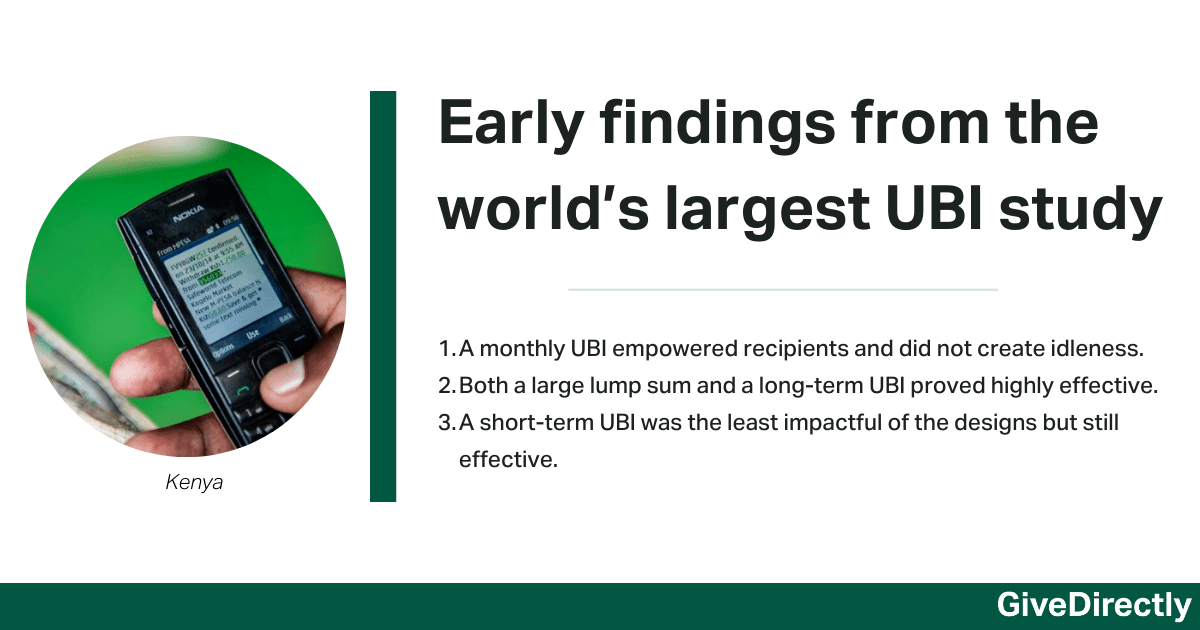
Early findings from the world’s largest UBI study
Money always helps, but for the poorest, one large lump sum can last a long time. A long-term universal basic income also looks promising.
GiveDirectly
274 points · by deegles · 10y ago · 213 comments
I pay 30% tax as a lower-middle income worker but I see very little of this used productively. The majority of voters don't pay taxes and rely on aid for everything from farm inputs to school fees. As a tax-payer who understands what taxes should do for me... I live with very poor infrastructure and amenities while the government squanders away money. If developed countries keep propping up our poor majority, they'll never learn to find innovative solutions to their problems and elect governments that will create sustainable wealth.
- Frustated Kenyan
Traditional NGO/charity consists of giving money/stuff/services to the poor. The problem with this is that if you are a poor person who depends on that money/stuff/services, and you manage to find a job to get yourself out of poverty, then the money/stuff/services you've been depending on will no longer be available to you.
This is a problem, because those NGOs are much more stable then your marginal getting-out-of-poverty job. So the person in poverty is faced with a choice: do you trade the certainty of the NGO hand-outs for the hard work and the increased uncertainty that comes with a paying job? The rational decision, in this case, is to stay poor and continue to rely on hand-outs. This is how people get into the "business of being poor". They're not being stupid. They're making a rational choice based on the fact that they've been given a reason not to work.
But Basic Income is different, as I say -- because it is unconditional. It should never be withdrawn. If you are poor, you get the basic income. If you get a job, you still get the basic income. So there is no downside whatsoever to getting a job. This is a profound difference from traditional NGO hand-outs.
In every place where an unconditional Basic Income has been experimented with, it has resulted in an (often quite significant) net increase in economic productivity. That is very different from traditional NGO hand-outs. So please don't think that they're the same thing. I'd urge you to research the subject more deeply.
Higher-level jobs require a more educated populace -- but it's been shown that when a Basic Income is given, people will naturally seek out greater education -- either travelling to find it remotely, or paying for education services locally. The jobs can't be "brought in" before the populace has the education to fulfil them.
One thing which Basic Income doesn't address, however, is infrastructure creation (or at least infrastructure which can't be sensibly paid for by end-user fees). So there's definitely still a need to address that, Basic Income or no. But for various reasons that should really be done by the government, rather than an NGO.
But naturally, The Pareto principle [1] made that 20% of clever households acquired business minded practices and they're economically independent now. But the rest is still begging and waiting the return of NGOs.
Giving aid is the worst thing possible if its given to the state. But giving it to the citizens is perhaps better, because they can directly improve their lives by investing in their children, in better tools, and in things like cattle that can directly generate sustainable income.
Free money won't destroy your society. It's how that free money comes into your society that is disruptive. If the money comes in top down it distorts the economy. But if its given from the bottom, then perhaps things can get better. Its not an experiment that has been tried before.
For example, if a poorer country raised minimum wage too much it could destroy the economy whereas the same raise in a more developed country will have better short term effects.
This could end up being unethical economic experimentation.
Giving people money allows them to buy livestock, supplies for their children or food and shelter. This will help to improve their quality of life and spur the local economy. I'm hard pressed to see how this could be considered unethical.
This is true, but given the evidence we do have (GiveDirectly's previous programs and previous basic income programs in developed countries) I see no reason to believe the effects will be anything but positive.
This is a sincere question, I'm fully aware that a lot of NGOs intend to do good but do more harm :(
I have a problem with neither paying taxes, nor helping raise up the underprivileged. However, I believe that the former should facilitate the latter, rather than feeding some official's offshore account.
I think that if external funding were withdrawn, then we'd see a lot more done to fairly distribute government revenue and our government would be motivated to increase that revenue by improving our balance of trade.
I'm a little biased towards capitalism... so I believe in equal and opposite reactions. The developed world deserves to eat what it's worked for too. Maybe we need a little negative pressure to see that.
These economies were 'allowed' to develop into rich industrial economies was because America provided privileged access to the US domestic markets in spite of their protectionist policies.
They allowed that because they saw the value of having these countries developed into 'westernized' bulwarks against the USSR's sphere of influence.
They could all easily have remained poor under different circumstances.
People's Republic of China has followed. India, not quite.
There are clearly ways to exploit globalization to become prosperous - e.g. the asian tigers. But it's not clear to me that historical examples are as useful. There's no way to know but I suspect the American colonies would not have prospered in the current economic regime.
—Adults more likely to work, even five years later.
—Children are healthier and get more education.
—Adults do not spend the extra money on things like alcohol or tobacco.
—Adults make significantly more when surveyed years after receiving the cash grant.
GiveWell, which has spent a lot of effort evaluating GiveDirectly, does have some lingering concerns [1] that programs like GiveDirectly's might worsen inflation or hurt people who don't receive a grant and live nearby. Research on these questions isn't conclusive, but suggests some minor, short-term effects. I suspect broadening programs to more recipients will mitigate the latter problem.
[0]: https://givedirectly.org/research-on-cash-transfers
[1]: http://www.givewell.org/international/technical/programs/cas...
Update: Fixed formatting and added to final paragraph.
I am a Kenyan too and this is not true. Everyone pays taxes. Though a poor jobless Kenyan should not be paying income taxes, the same group of people still pay VAT for everything else they purchase, bar a few exceptional goods and services.
These schemes create opportunities whilst reminding people that poor decision-making has consequences. The only reason that this works is because these schemes are run by banks rather than non-profits. Perhaps there's a little room for more regulation around the margins these institutions should make off of these loans... but at the same time they're opening up credit lines to people who would have never had them.
>elect governments that will create sustainable wealth.
Some people would say that individuals create wealth, and the governments are systems that exist because of the existing levels of wealth in a society. If you want a "generous" government, then you first need a "prosperous" society. Which governments are you thinking of that create sustainable wealth? I'm curious to get a Kenyan perspective on private property rights (i.e. do you think that is a crucial step for creating a "wealthy" society).
Africa doesn't need the American cult of the individual to develop. It needs (among other things) America to stop covertly supporting the illegal and corrupt transfers of wealth to tax havens.
Would that be enough to change your mind that they are "giving people livelihoods they can't sustain"?
Instead, give these people the cash to purchase locally sourced goods or open a business of their own. Economies don't spring up out of a pile of free rice.
Giving people free things usually helps them; what doesn't help them is the way that the 'gifts' are chosen, whom the 'aid' is given to, and how the poor are treated.[2] The gifts are usually chosen based on which companies and unions the 'giving' country wants to promote and help, instead of what the poor need. The 'aid' is often given to tyrants, and is a substitute for tax income, which disconnects the ruler from their populace and local accountability. The poor are then often treated like sheep who need to be told what to do, and can't figure out what to do with themselves, so they are the subject of government theft and general injust treatment.
[1] https://en.wikipedia.org/wiki/Mercantilism
[2] https://en.wikipedia.org/wiki/The_Elusive_Quest_for_Growth
Just one example. http://www.thenation.com/article/usaid-helping-haiti-recover...
Basically UCT (Unconditional Cash Transfers) work well when lack of capital is the primary problem.
But often times the cycle of poverty is self-reinforcing because of deeper issues and UCTs don't fix those (such as undervaluing education). Instead CCT (Conditional Cash Transfers) can often be more corrective to enact lasting change to poverty cycles.
Ultimately, I think some sort of UCT and CCT combination would be the best and least overhead form of welfare. But that is just IMO.
Of course, CCTs may eventually have the same problem as traditional welfare policies: self-perpetuating bureaucracies, contradictory incentives, resource misallocation, etc, etc.
CCTs could be issued in a universal sense as well, with an income threshold of some sort. But admittedly they are more complicated than UBI. But not necessarily as convoluted as current systems.
GD's one-time, large transfers help achieve concrete benefits. Super excited to see the basic income experiment in East Africa evolve.
1) Free Education 2) High Taxes 3) Strong Unions
Sounds leftist? It may astonish you which countries have the highest ratio of rich persons per capita live. This and a good explanation can be found in "Where in the world is it easiest to get rich? (TEDxOslo)"
https://www.youtube.com/watch?v=A9UmdY0E8hU
Just giving money may help in short term anyway, but I doubt it is one solution for everything.
> Just giving money will not work, see Saudi Arabia. They have all the money they can dream of and did not evolve.
There are so many reasons why that's not relevant to the conversation that it's hard to know where to start. 1) You are conflating value systems with poverty. 2) You are cherry picking one particularly bad example and using it as evidence that it could NEVER work. 3) "All the money they can dream of" does not apply to all Saudi Arabians, it applies to those that have a lot of money.
The Saudi's have a recently reformed education system, complete with a freshly built full-fledged research university: King Abdullah University of Science and Technology (KAUST.)
KAUST has a more Western model of education, instruction in English, American and European faculty, partnerships with multiple Ivy League institutions. The current President of KAUST is Jean-Lou Chameau, who was previously the president of Caltech.
Perhaps most significantly, the university is granted greater freedom of speech and thought than probably anywhere else in Saudi Arabia. Saudi royalists politically protect the University, while the campus's isolated location prevents random acts of "law enforcement" by the religious police.
KAUST has an endowment of $20 Billion USD, which puts it in the same league monetarily with H/Y/P and is about twice the endowment of Oxbridge.
So the Saudis are investing in the right things in advanced education at least: alternative energy, desalinization technology, chemical engineering...
They're also building a series of new model commercial cities along the coast where they will attempt the same thing on a city-state scale. The religious rules will be less strictly enforced in these model cities, but far more importantly (for commerce), they will have independent judiciaries (still based on sharia fiqh law), but with written standardized laws of contract (uncertain contracts have put a strain on the Saudi economy.) They're also considering relaxing the onerous permitting regulations required to start a business.
It seems like the Saudis' want to have their cake, and eat it too. On the one hand, they want the benefits of Western higher education and economic systems. But on the other, they want to maintain a fundamentalist religious monarchy.
I cannot really see that being successful. The academic freedom needed to conduct meaningful research is diametrically opposed to the restrictions on thought and expression in a repressive theocracy.
What do you mean didn't evolve?
My understanding is a lot of stuff is free in Saudi Arabia. Oil money is used to fund education and cash is given to citizens.
Not sure I understand your point.
Yes, education is important. But what also matters is a working government. Strong unions and high taxes are a consequence (you have them once you can afford them), not a tool to achieve wealth.
I hear Hugo Chavez' daughter has billions.
I'm not sure the OP program is meant to lead to any kind of 'evolution'. It's meant to lead to fewer poor people.
UCT fits free market theory, including market flexibility (if needs change or the first idea fails, consumers can change their spending much more quickly than donors can change their programs), and promotes democracy and empowering individuals. It also avoids common problems such as donors' bad decisions and their unanticipated consequences, corruption among those controlling distribution of the goods, and perversion of local markets.
As one example, according to a report in Foreign Affairs, the West's focus on AIDS, malaria, and TB, and their relatively enormous market power, took local medical resources away from more standard health care needs such as child birth, and might have resulted in more sickness and deaths than it prevented (IIRC the details of the article from several years go).
In brief, unless the nation is in crisis, send fishing poles, not fish.
If the U.S. pumps an endless supply of money into Haiti, how could Haitian banks hope to compete with their loan offers?
I would love to hear others' opinions on this.
I'm not an economist either, but I think the concepts you want to look up are 'money supply' and 'velocity of money'.
It has a lot more fungibility, which should also mean that the marginal utility of cash drops slower (as a function of total utility from that source) than for rice or shoes.
Only in that some of the people that remain home have a source of income. But that doesn't make it anything like a "basic income", anymore than the fact that some people are supported by family members working in the same country means that that country already has something like basic income.
This can be useful for answering questions such as:
* Will this discourage entrepreneurship?
* Will this create a culture of dependency?
* Will this boost the economy overall?
* If the economy is boosted, how sustainable is it?
These are the kinds of questions you're not going to be able to answer from a single data point, so it's worth finding similar situations to compare.
Rice is a viable basis for a currency, it worked for China for a thousand years. Maybe the free rice piles just aren't big enough.
There was a point, when taxes were still assessed in rice, that the relevant official announced a large tax increase because the government just wasn't able to operate on what it was getting from existing taxes. He also started the process of reforming tax delivery, largely by making sure tax barges could make their way down the river without excessive delays. They had been arriving nearly (or completely!) empty thanks to predation by vermin.
The delivery reform was so successful that the tax increase was canceled. There were no (significantly problematic) issues with taxes not getting paid; expenditures were well within tax revenues; but... using rice as a currency meant that just because somebody paid you money didn't mean you actually received any.
If we are going to try UBI, a fundamentally Western idea, it’s only right that it should be tried in the West. I’m not saying it won’t work - just that we don’t really know what will happen. East Africa has suffered enough from our neo-colonial experiments.
East Africa, and Kenya in particular, was carefully chosen for two reasons. First, Kenya has a mobile phone network that makes it easy to transfer funds electronically to individuals and then for those individuals to get cash from the funds at local stores. I wish we had this in the West, but we don't because of banking regulations. Second, poorer households in certain communities tend to use natural roofing materials rather than aluminum, which makes it easy to target funding by satellite.
The UBI is a political football in the West. The Mincome experiment was cancelled because of a change in government. The potential utility benefits from a UBI are so great that it would be a shame to think that we have to wait for it to be politically palatable in the West before we can get any data on its effectiveness. Also, as far as poverty relief is concerned, money really does help.
Possibly the most important detail here is one they call out explicitly in the article: this is the first time anybody's run a large scale experiment of this form which was not based on selecting candidates who were likely to benefit highly from receiving the extra money.
I am completely convinced that giving people extra money can cause a permanent, substantial increase in their income and living standards, if I get to pick the tiny fraction of the population who receive it. That's well-established and easy, and also not viable as a long term solution.
I really want to see if it works the same way when you aren't selecting the best candidates, but just distribute the money blindly. No matter what the answer is, this is really important research that will drive economic policy decisions. We're about to get the answer to one of the biggest economic policy questions of our time, and that's awesome.
Also, this post also has little fact when the emotive aspects of it contain phrases like "all star cast", "very successful", "political football", "benefits so great", "would be a shame."
Where's the facts?
GiveWell -- a separate organization that does in depth analysis of giving opportunities -- has a detailed write up on them: http://www.givewell.org/International/top-charities/give-dir... GiveWell recommends GiveDirectly as one of their top charities.
GiveDirectly's intervention has been tested by multiple randomized controlled trial, including a large-scale one. (See the GiveWell write up for details.) In general, the case of them seems much stronger than most charitable interventions.
(I have no affiliation with GiveDirectly, though I'm close friends with many GiveWell staff.)
http://www.poverty-action.org/study/impact-unconditional-cas...
http://www.theguardian.com/global-development-professionals-...
But then again, it was the country's own government, not some outside NGO.
-from your link
(and I say that even as someone who's largely unconvinced of a case for UBI in the West, wholly unconvinced this experiment will tell us anything at all about the likely effects of UBI in the West and - from the RCT papers I've read - think the benefits of cash transfers in developing countries are overstated by their most enthusiastic advocates.)
Care to make a guess?
For locally produced goods should be fine because producers are poor too.
For imported goods it might be harmful because UBI cash could get sucked back out of the poor region really quickly. What I'm hoping is that sucking cash out with imports will correlate with increased volume (that it won't be 1:1 exactly) of imports of useful equipment that is not manufactured locally.
> Creating a dominate telco market where having a phone is necessary (and therefore phone prices will be disproportionately higher?)?
Don't they already use phones for small banking like money transfers?
What the fuck? Are you not aware of the MASSIVE subsidies that are given all throughout agriculture to give away basically billions of tons of food to animals?
Why not do the same for ensuring that the food is consumed by people...
I worked with a company building AC mini grids in East Africa. They connected around 130 households in each village to a 220V grid.
The expectation was that people would use the electricity for basic needs (e.g. light, cell phone charging) but also for productive uses (e.g. grinding grain to flour, air compressors, saws, etc).
The expectation was that as people entered the second phase of energy use (after basic necessities) their consumption would increase as their income increased.
What this company found though, was that very few customers followed this pattern. If people bought anything that increased their consumption, it was almost always a TV. This obviously didn't improve their income, so often their use would actually decrease because they can't afford the increased consumption.
Last I heard, they were having serious problems getting people in these villages to use more power.
Through some pricing campaigns, they discovered that people's energy use was almost directly correlated to the price. If you made the price similar to other well developed countries ($0.10-$0.30 kWh) people would use lots of energy, but the amount they paid was still relatively small. If you raise the energy price, people use much less, but end up paying almost the same amount per month. So if it costs $0.25 per kWh people will use 4kWh, but if it costs $1 per kWh they'll only use 1 kWh.
Since their model included batteries to cover the night load, they couldn't afford to sell the energy this inexpensively. Hence their wish to increase day time energy use among the villagers through equipment use (e.g. welding, grinding).
My expectation from this program: some small percentage of people will use the money to invest in tools and means to improve their economic situation. The vast majority though will waste the money on things which benefit them in the short term, but provide no long term economic benefit to them (e.g. better cell phone, television, or maybe a solar home system)
Also from hearing the horror stories of doing business in East Africa (draconian regulations + corruption) I'm sceptical if anywhere close to 90% can make it into the hands of normal people. Hopefully this isn't the reality...
Not sure why I'm getting down votes. I've worked with a company actually working in East Africa and I don't see people using the opportunity of energy to improve their economic situation. After basic necessities they seem to use it for leisure.
>The vast majority though will waste the money on things which benefit them in the short term, but provide no long term economic benefit //
Things like having a TV? Do you have a TV, is it a _waste_ of money too? Would you say most of the people who own TVs would describe them as a waste of money? After you've got a bed, clean water and food, some sort of diversion from the humdrum is probably the next "need" that most people would address. TV can be a benefit, an inspiration, it's just not an obvious direct economic benefit (unless you're running the local TV shop, electrician or repairer).
Part of the problem with providing utilities with an expectation of them being used to create economic benefit is surely that people don't know how to use them for such purposes? Did you address that with your projects - like if you bought this apparatus for this amount you could process millet and run a company earning this amount.
Couple of questions about your electrical mini-grids - was there any cooperative buying, like setting up a TV in a communal building? How was the power being generated?
Yes I do, and yes, since it brings me no economic benefit and I could easily live without it, it is a waste of money.
By comparison, my smartphone allows me to send emails, make phone calls, and generally communicate with my colleagues. This creates value. Watching TV or Netflix creates no economic value.
It might create social value, but the OP is about creating economic value.
> Did you address that with your projects - like if you bought this apparatus for this amount you could process millet and run a company earning this amount.
Yes! Of course they realized that people might not have the ideal or the capital to go and buy one of these machines. They worked on a hire to own scheme with local partners, and offered a lower energy price to those who wanted to buy one.
Again, only a tiny percentage of people were interested in doing this.
> setting up a TV in a communal building
This is quite difficult to achieve. You cannot be seen as picking favourites, it's really not something that works from a business perspective in these communities. People get envious really quickly.
So, communal buildings. Well, there aren't any. The government has basically no presence in these places, and asking them to build a building would probably take 5 years, if it happened at all.
The only buildings that really exist are businesses, and if you set up a TV there, the guy running it will charge people to watch it. You're playing favourites!
You could give every business a TV, but then everyone will rush to set up a "business" so they can benefit from the scheme as well.
This company itself cannot set up a TV or build a community structure because quite frankly, it will be vandalized for parts. Also the legal situation in these countries w.r.t. copyright and statements against the governments is appalling. So there is a huge liability toward providing services to the community (e.g. internet, distributing content on SD cards)
> How was the power being generated?
Small scale PV array built in the village with supporting equipment housed in a structure. The scale of these projects was <20kWp.
Look. I'm not trying to sound negative. I want Africa to develop. They absolutely have the chance to be the next China and become an economic power house.
Unfortunately, I don't see that happening with the current political and regulatory environment there.
I've never been to Kenya, but I have spent a lot of time in countries with roughly similar levels of development. I'm skeptical too. But I would love to be wrong. And I think it is awesome to run this experiment.
The reason that I'm a little skeptical is that a lot of the big obstacles to entrepreneurship and investing in long-term social improvements come from big structural challenges that having more money in your pocket doesn't necessarily fix. For example, government corruption, lack of a good justice system to enforce contracts, lack of physical infrastructure to allow people and goods and people to move around the country, lack of access to banking resources. Those problems kind of need to be tackled at a higher level, and giving random individuals either money or goods doesn't really solve them. UBI seems like it could be much more effective in countries that don't face as many of those structural problems.
So is there a better way of finding that 10% and investing in them directly, without ridiculously wasteful organizations?? Do you force them to make ROI?
You are being downvoted because your real world experience violates the increasingly liberal tenets amongst HN readers lately. Free money for everyone means that I get to work on my killer app idea during the day, so free money for everyone is clearly a Good Thing(TM), right?
Probably not.
> Do you force them to make ROI?
No, because first you would have to teach them what an ROI is, and secondly because the local economy is so variable, any estimates would probably differ wildly from reality.
Unfortunately it means fat margins for the MPESA provider (typical transaction fees range from 3-10%, depending on the size of the transaction).
Also it's probably going to turn into a tax nightmare for the company handling the payments. I could go on for a while about how ridiculous VAT rules are in these countries. Processing a transaction worth ~$0.005 for VAT purposes...
HN username @ gmail.com
I'll put you in touch with these guys.
In addition to the GiveWell reports, GiveDirectly also document and publish their work and research. It's exciting to see the impact that they are having (and how minimal the systemic abuse of the money is):
We think the whole thing will cost roughly $30M, of which around 90% of the funds will go directly to very poor households."
... except for the part where taxes are collected from the population to pay for said universal basic income.
People born before UBI grew up with the scarcity on their minds, shaping the way they act with UBI.
People born right after UBI is implemented will be biased by parents who grew up wirh scarcity, like the children of American immigrants.
The study can only be valid when the parents of the person to be observed has UBI for their entire life.
http://www.npr.org/sections/money/2013/11/08/243967328/episo...
http://www.npr.org/sections/money/2013/08/16/212645252/episo...
Overall the basic income idea... I don't like it in a lot of ways, I just can't see it resulting in a productive society personally. But that's just my gut reaction and I could be wrong, so far the data I've seen is a pretty mixed bag.
I think things like this are a great way to experiment with it though (and without tax payer money). I might change my mind if there's more good data.
Or maybe everything I've said is bullshit. Who knows? Only one thing is for sure: without experimentation, we only hurt ourselves in the long run.
I worry that it would be a lot worse than that - that we could create a class of non-workers and workers. Some products would only be affordable to workers and if, like you're saying, those workers are only those working high paying jobs, this is probably how it'd work out. It could perpetually shrink the labor force while forcing those people who aren't working into a lower class in society and overall dropping our productivity at large - setting back the kinds of automation that such a society could require.
Personally I'd almost immediately attempt to drop out of the workforce. And well, software developers are often pretty heavily involved in this sort of automation. So maybe I'm just speaking to my own situation here more than anything.
Of course, this is only speculation, and probably one of the worst possible outcomes I can envision for such a program.
I definitely agree with you about experimentation though, and if the main funds for it are coming from donors voluntarily and not out of the tax payer's pockets then that's all the better. It would be great to have both private and public researchers in on this though, I'll take as many eyes as we can get on the data.
How do you figure? If that were true then that means companies are currently thinking "I could automate all these human jobs, but these guys need work so I won't"?
Not sure I've ever heard a business make that decision.
Wages have been lower relative to inflation, real estate etc because demand for human labor has been dropping. Consumer goods come down in price but real estate, gold and other limited resources are a reference for how low demand for human labor is falling.
Technology enabled outsoucing, and automation, to erode the demand for human labor. Luddites were 150 years too early. The capabilities of computers are only growing.
The next will be self driving cars, kiosks at mcdonalds and drone delivery. That will put a lot of people out of work.
Relying on wages to trickle money down only works when employers value their employees. These days we are in the intermediate period with a growing unemployed class, part time temp work, two year stints at companies, and stagnant wages for the average profession including developers.
There is no reason not to tax the productivity gains made by corporations by R&D and automation, and redistribute that to everyone. Alaska has been doing unconditional basic income from a tax on using its natural resources.
Most people will be 90% consumers and only 10% producers. Already, most full time jobs are just make-work. Conditional welfare and fulltime jobs make people afraid they'll lose their check if they work on what they are passionate about. That's an infantile mentality that holds many back from living productive lives. They instead pretend to work or pretend to be poor, to keep getting that conditional check. It's time to let the humanity at large grow up, stop wasting time and tap their potential.
There is always an issue of law and order though. If theft is a common problem then this may not work.
Should some of the concerns we've raise be addressed, this will definately sidestep the problems mentioned in haiti and other areas on this thread.
How long will the experiment last? I feel like the recipients knowing they are guaranteed a payout for at least a decade will result in very different behavior than only knowing you have it this year and maybe next year, even if you do for it a decade.
Great experiment. Very excited to see where this goes.
With this perspective, there's no distinction between micro and macro contexts for money. It's all a unit of account for how the economic output of a society gets distributed. Transferring money from one group to another is the exact same thing as transferring real goods and services, except that the recipient gets to choose what slice of the economic pie to receive (by paying for it).
Two things:
(1) opportunity for wealth building is only one, of many, reasons for BI, and (2) It is certain that for some portion of the population, additional income will not be sufficient for notably better wealth building. But its equally certain that some portion of the population that would net benefit from BI is held back solely by short-term resources.
People who win a fortune by the lottery often lose all their money shortly afterwards, even those people who intend to save and invest it. The reality is that some people are better than others at turning capital into gains through investment. There's definitely luck involved too, but Buffet knows how to buy a business, be its steward, and generate growth, not just for his business but for the economy in which it resides too. Simply investment in diversified mutual funds is not the same thing.
If you pick a typical poor person and give them $10m, they probably won't have the education or discipline even (to know how to) live off investment proceeds, much less grow the amount substantially. (See the outcome of most lottery winners)
That being said, basic income is talking about something different entirely, which is giving a lot of people a little bit of money. I think that could have a positive effect, although for all we know it may be transitive and only lasts as long as the money is being supplied. I think the question is whether the money helps people lift themselves out of poverty, and educate themselves or their children so as to enter the middle or upper class.
I think you could have expressed your first post more clearly -- I assume your point is that transferring wealth from one person to another in a particular society does not make that society as a whole better off. On a micro scale this is correct, but it may in fact make society more wealth if it leads to a more productive population in the long term. But it could just as equally lead to a less productive population. We'll have to see.
2000 calories to a starving person helps them alive, which translate to more wealth they can generate later on. 2000 calories to fat people is worth much less, if not harmful. Capital is just an abstraction of goods, and certainly their usage will have vastly different effectiveness depending on situation.
2 things I'm interested in seeing:
1 - Does it make a difference if it's USD sent over, versus local currency? (Is it a cash shortage, or a foreign cash shortage?)
2 - How much inflation will occur?
2. It doesn't increase the amount of currency in the country as a whole. Locally, if the economy is doing better, perhaps people will charge more for jobs, but they also trade with other parts of the country so that would tend to keep prices stable (if not too isolated).
From https://www.givedirectly.org/basic-income
"Location: To be finalized, but likely East Africa, where we have existing operations."
They've paid people before using mobile phone networks and it's worked well for them.
More generally, many countries need to make sure they have enough foreign currency to buy imports. Poor countries especially need to worry about this. Printing money to give away doesn't make sense when you can exchange it for something valuable.
Of course free money is better than no free money! That's all this will prove and few will debate that. The real questions are: 1) is it worth the cost, and 2) is it better than alternatives?
I would personally donate to a large-scale A/B experiment where you give one group cash and the other group food, housing and education worth an equal amount and see which works better.
I worry that the recipients are going to be better off (because you just gave them $30M) and then everyone is going to want to implement a huge, risky (and fundamentally different) program in the US.
Note to avoid excessive downvotes: I like the idea of UBI in theory and I will support it one day but I think we're not there yet. I think we need more automation and more overall wealth before it makes economic sense - before benefits > costs.
I think the majority of dissent in the United States would actually argue that free money is worse than no free money. (If this surprises you, you may also have been surprised that Trump is going to be the GOP nominee.)