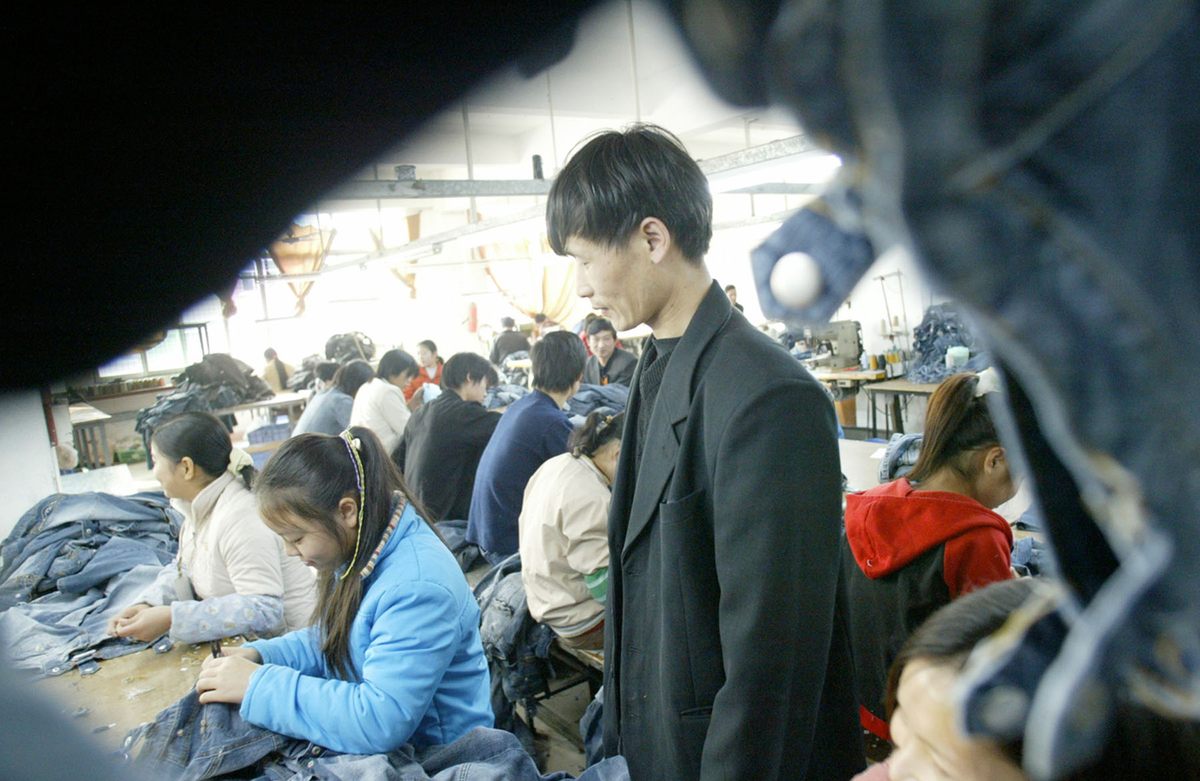
How the Jeans Capital of the World Moved from Texas to China
Blue jeans are up there with with Donald Trump and the right to bear arms as uniquely American creations. But each time you pull on a pair of blue jeans...
Atlas Obscura
55 points · by okfine · 10y ago · 74 comments
Lets take a look at one guy making jeans in the US: http://www.roydenim.com/video (video is a great place to start, you get a sense of what the work looks like). But for $225 a pair, its an indulgence.
The rest is pay for himself. It probably takes 6-10 hours to build a pair of jeans at the level he is doing it at, and that leaves him making a reasonable hourly rate
Also, there are development costs, etc.
Finally, the manufacturer isn't seeing $200. They only get the wholesale price (if they are lucky), or a percentage after the sale. With factories often needing payment upfront, and the brand not making money until after a sale occurs (if ever), there is a lot of risk that needs to be priced into the product.
How a about costs for the salesperson in the US? Rent for the store? Branding and marketing costs may be huge.
I recently looked into hand made automatic watches. The main difference between the major brands and smaller (EU based) unknown brands seems to be marketing. You can't pick up a life style magazine of visit an airport without advertisement for watches. This costs money.
Perhaps these guys in the video run too small of an operation to have the costs spread around and to invest in tech to speed up the process.
1500$ dress, has probably $150-200 in material (bought at/near wholesale prices), I'm sure that the jeans in the above video probably have about $20 in material.
Labor is the killer: Cutting, sewing and finishing one of those dresses is a 20 - 30 hour job. There are other costs too, some ongoing like customer service, shipping, marketing, some one time, like grading patterns so that you can make more than one size of an item, or getting photos taken of it for your store.
There isn't really a lot of "tech" in clothing manufacture. Sewing machines haven't changed much in 50 years, the fact that 50 year old equipment is STILL used for production should tell you something about the industry. It is HARD to automate something that is so nuanced.
The way it happens in an industrial setting is the same way its always been done. Lots of people doing the same job over and over on an assembly line. Yes some things have been automated to some degree but not to the extent they have in other industries.
Edit: Yes I have made jeans for myself before, but never at scale.
Same thing though, basically a luxury product.
operate the machine that makes 5,000 pairs a day
It turns out it's ridiculously difficult to make machines that will reliably deal with small, flexible, sometimes-overlapping, sometimes-folded, identically coloured bits of fabric.
You can automate parts of the garment-making process - embroidery, cutting things from rolls, stuff like that - but sewing the bits together automatically is really difficult for a machine, compared to a human.
If you've got clever solutions for this feel free to advance the technology - I'd really like a robot that can do my laundry :)
Maybe one would need to think about entirely different sewing patterns (that must look the part) and cloth stretching/folding mechanisms for this problem.
It's easy to see why you (with current technology) can't simply "make a robot that does what the human does" here.
Having recently gotten one of their hoodies, I can say that the quality is excellent vs what you might buy at target/gap/local retail.
But it isn't the stitching or the fabric that is the reason for me disposing of a hoodie (as an example) its going to be staining, or unavoidable damage (snagged my clothing on something).
We in the west, especially us smart folks, cherish our environment, and we think it is shameful to force people to work in inhumane conditions. How fair is it, then, to force our fellow westerners who didn't win the intelligence lottery to compete with labor in countries that don't care one whit about either?
It isn't right. The multinationals will shriek bloody murder about it, because they've made a killing engaging in moral arbitrage, but it's time to tariff the hell out of products produced in ecological and human conditions we would find deplorable in our own countries.
http://www.thepoliticalinsider.com/a-66-year-old-widows-farm...
Thirty years later, the daughter appeared at a Trump rally in South Carolins to thank him, probably one factor behind his decisive win in that state.
If you check the web you can find many other such accounts of his acts of generosity.
I suspect it's the same deal with globalization policy. This is a man who manufactures his clothing outside of the U.S. If he cared about American workers or inhumane conditions, he'd at least do it kicking and screaming instead of acting like he's inculpable.
Donald Trump's anti-NAFTA position in 1993: https://i.sli.mg/0HYlvv.png
His assertion of the need of Japan and Saudi Arabia to contribute for the U.S. defense of them, in 1987: https://i.sli.mg/joqU4W.png
[1] https://www.eca-international.com/news/november-2015/chinese...
I'm not trying to be argumentative, just genuinely curious about your statement. Is it a moral loss because the American poor are still relatively better off than their Chinese counterparts or something else?
You'd be hard pressed to find a Trump supporter admit that they are looking for government handouts, though.
Trump has absolutely no concern for America's labor force.
The economy follows the path of least resistance and offshoring jobs is that path in the short term. Many actors in our society get rewarded in a short-term basis, e.g: bonuses are given in a per-quarter or fiscal year basis. Short-term strategies are not necessarily good for the long-term.
I doubt there are many politician who's stances you agree with 100% of the time. There probably aren't too many you disagree with completely either.
Please don't take this as an endorsement of Trump though. Also, I am certainly not one of the "smart folk" so I could be wrong in my interpretation of your comment.
I'm comfortable with my intellectual abilities.
A slight imbalance can cause negative effects for either economy.
The fragility of the situation requires some deep analysis and, leaving this matter to a person like Donald Trump is something that concerns me.
Worse still, they are like a disease. I was in a bar/restaurant recently, and I couldn't help but notice how many people were wearing jeans. So I did a visual survey, and as far as I could tell, out of about 40 people, only myself and one other lady were not wearing them. Even my wife was in a pair.
I personally wear jeans pretty much exclusively and have no problem with it. I prefer and search for heavy jeans.
In my opinion people always look better in fitting clothes. If they are wearing unfitting jeans, they are going to look bad in it. If they are wearing unfitting suits, they gonna look bad in it. If they wear fitting clothes nearly everything works.
Many years back I've worked with an American company (I am from Europe) and they really didn't like us wearing jeans all the time (a totally normal thing to do in Europe where I am living). They said it didn't look professionel enough if you aren't wearing working casuals.
But of course its none of my business, everyone can do what they like.
It sort of feels like a feature of 'Brave New World', where everyone is apathetically conditioned to wear the same thing.
1 - http://www.newbalance.com/made-in-usa-1/
2 - http://store.americanapparel.net/en/
3 - Seattle
What does seem to be happening is more discussion about the impacts of many of the free trade agreements of the 70's/80's/90's - more specifically how goods made in the US were off-shored as a result.
[1]http://www.alternet.org/story/13095/levis%3A_made_in_china
[2]http://apparel.edgl.com/news/Reshoring-Success-Stories--What...
I was reading an article about the price competition in airlines. People would spend 30 minutes looking for a better deal, to get a flight that would be $5 cheaper.
If we do that for a product that basically flies you through space, imagine what you would do with a product that is disposable.
I guess the hypocrisy is that we don't want to talk about that issue. We would rather not have immigrants picking tomatoes, or sewing jeans. We can always just transfer that production to China, where the environmental and human effects are invisible to us.
The article itself says almost nothing. It quotes a Greenpeace report, from 2010, that says that there is blue dust in the streets (oh no!), that dye is released into rivers (oh no?), and that producing one pair of jeans uses 3625 liters of water.
(For comparison, producing a pound of beef takes 7000 liters of water, and a pound of almonds 4000 liters. [1])
[1] http://www.huffingtonpost.com/2014/10/13/food-water-footprin...
I've bought 5 pairs of Japanese denim from 5 different manufacturers over the past 7 years. If anyone has questions about raw denim, feel free to leave a comment or send me a message.
Is Miracle Air from Uniqlo part of it?