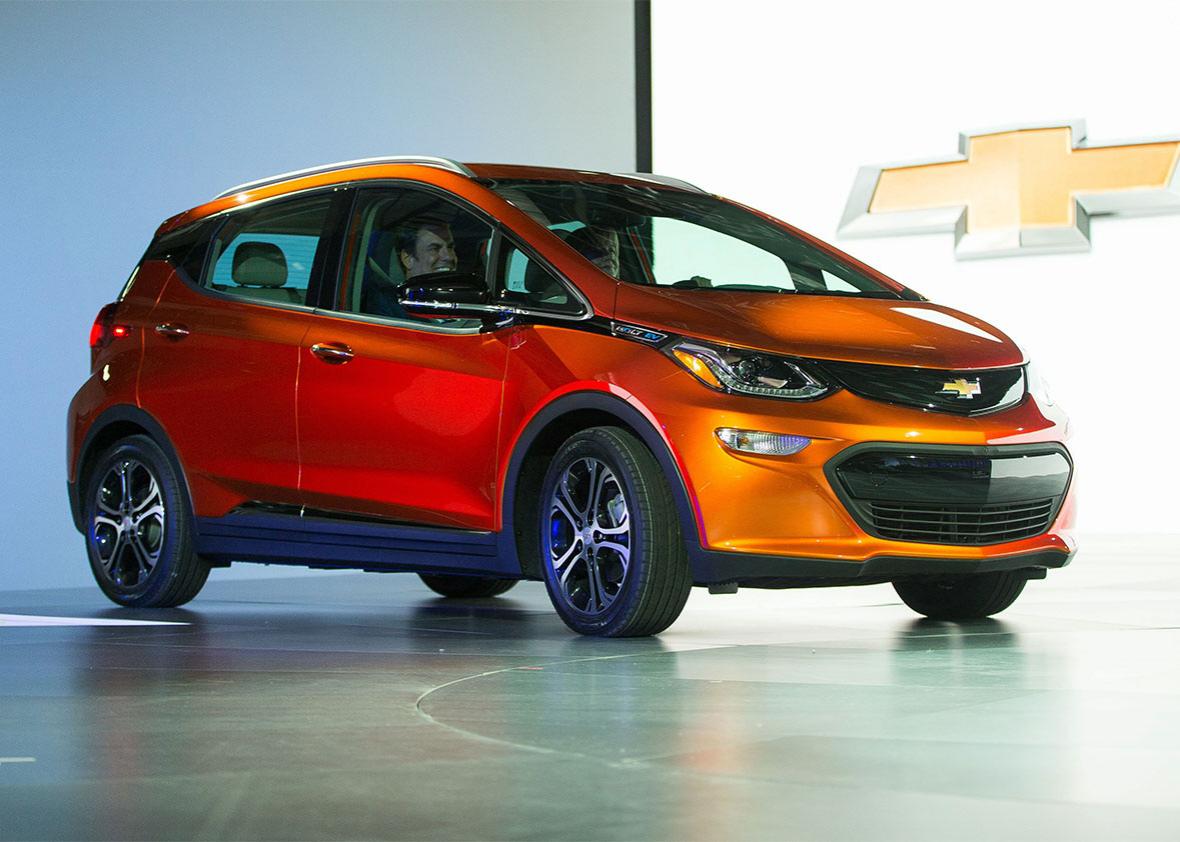
Electric Car Batteries Used to Be Ineffective and Pricy. That Era’s Over.
First generations of technology are always clunky, kludgy, and way too expensive. TVs were once the size of refrigerators. Personal computers had giant...
Slate Magazine
106 points · by jseliger · 10y ago · 169 comments
Right now, electrics comprise a tiny part of the automobile market share. Yet Tesla is already running into supply issues, particularly with lithium as there are only 3 companies in the world that do industrial-scale lithium mining, that too in a handful of mines around the world.
Secondly, I suppose we're currently in the honeymoon period for electrics. But what will happen 5-8 years down the line, when all the early mainstream adopters of electrics will have to replace their batteries? Is it feasible to recycle all those batteries?
An EV essentially is a car with a very expensive fuel tank (the battery), made out of specific materials and properties. While it is efficient in energy use and can make use of fungible electricity, lithium is rare, limited to specific areas of concentration, and can (as any material) only be partially recycled.
There's lithium elsewhere on Earth, or more precisely, in seawater, but processing seawater for minerals (uranium is another which might be extracted) is expensive in the sense of requiring a lot of energy (arguably the ultimate definition of cost is energy requirements).
At US rates of auto ownership scaled to the world and future populations, known lithium reserves would quickly be exhausted -- a few decades, if that. With recycling, yes, some of that would be re-used, but even at 90% material recoverability (and references I have suggest 30% is far more common), you'll lose ~50% of your original material in 7 generations. (The formula: remaining material = (portion recoverable)^generations. So: 0.47 ~= 0.9^7.)
Other options include other forms of energy storage (including possibly synfuels), other battery components, or we all just start walking a lot more.
It would be much more sensible to electrify the cars/busses/trucks/delivery vans that are driven a lot, that are driven in stop-start traffic, and that are driven in heavily populated areas first. That gives you much more bang-per-buck in terms of pollution and CO2 reductions.
Pointing out which specific subcases remain impossible doesn't disprove the larger case.
There's a good question as to how scalable EV's are generally. Present scale is minuscule. A small feaction of a percent in the US, and that actually fell in 2015. I'm not sure what 2016 and future trends (based on pre-orders) look like.
You've got the fundamental problem that battery energy storage densities by weight are ~1/100 - 1/50 that of liquid hydrocarbon fuels. Synthetic analogs of petrol, kerosene, and diesel would be quite useful (though expensive). All but irreplaceable for some uses (heavier-than-air flight, marine propulsion).
Among batteries, you have:
1. Liquid / molton salt batteries. Some of these have highly abundant substrates. The problem is the 300-600C+ temperatures they operate at. Especially in vehicle applications.
2. Metal-air batteries. Iron and aluminium particularly. Here the oxidation is supplied from air. You're consuming the (anode?) in use, and it's got to be replaced, but that can include recycling. Abundant but problematic.
3. Fuel cells. A reaction, typically of hydrogen and oxygen, producing electron flows. The problem is the reaction chamber, which usually requires scarce catalysts (e.g., platinum) which are a) expensive and b) rarer than lithium.
4. Advanced allotropes. Carbon or silicon or other materials which are abundant but offer unique properties in new molecular forms. While this is well outside my area of expertise, it's an un(der) explored area which might pack some suprises.
5. Biocells. Life does some amazing things with enzymes and other agents, including maintaining an exceptionally high voltage potential across cell membranes (see Nick Lane's book, recently mentioned here via Bill Gates). Humans utilising biological mechanisms to provide electricity might offer another out, though this again is highly speculative.
The advantage of my #s 4 & 5 is that they could rely on highly abundant elements arranged in complex molecules to perform desired functions. Experience suggests that such molecules are difficult to come up with, degrade quickly, and have narrow operating bands in which they're viable. But at least the abundance constraint is removed.
There's still interest in this for stationary energy storage on power-grid scale. But not for mobile. Sodium catches fire if exposed to air.
[1] https://en.wikipedia.org/wiki/Sodium%E2%80%93sulfur_battery
Wrt. possible short-term lithium supply issues, i can see how Musk would just build a new mine operation if necessary, like a Giga-ship to mine it from seawater :)
No, it's not. The ultimate causes for costs are human labor and taxes (including similar concepts like rent or license fees) – everything else derives from that.
You're not paying the Sun for its energy output, but the workers that mine the materials, process them, and build solar panels.
Solar flux is a given, and isn't modifiable by human activity. But the flux reaching Earth is limited, and in the sense of that which you give up -- opportunity costs -- there's only so much of it available. Stored solar flux -- as biofuels, wind, hydro, or fossil fuels -- represents an exergic potential (value) with an eMergic cost.
Economic prices fail to consider that emergic cost entirely, but in a very real sense it's an account balance being depleted. Environmental sinks also have costs associated with clearing and negative impacts.
Howard and Eugene Odum, ecologists, coined the term emergy and discuss it. There's a fair literature concerning it in ecology, though little or none in economics. I believe economics is in error here.
Again, very much not mainstrem econ. You'll find treatment in ecological, biophysical, and thermoeconomics however: Georgescu-Roegen, Daly, Hall, and Costanza, among others.
http://www.resilience.org/stories/2013-10-06/energy-ecology-...
(By Howard Odum's daughter.)
But it has to be done only once when the battery is produced, right?
How much is determined by the storage per vehicle, vehicles per capita, lifetime of the battery pack, and recovery rate of recycling.
If you go to an inventory of mineral or element prevalence in the Earth's crust, you'll come up with a list of elements and what percentage (usually by mass) they constitute of the Earth's crust.
Strategic minerals: iron, copper, zinc, silver, gold, tin, lead, mercury, gallium, etc., etc., all have specific rates of occurrence. We mine them from ores in which they're more concentrated, because that's easier (again: less energy requirement), but those ores are scarce. Ultimately the question becomes how much energy is required to access minerals vs. how much energy do they make available. If the first exceeds the second, they're a losing proposition no matter the technology applied to extraction.
Ore concentrations are formed by various mechanisms -- and I understand them only partially, this isn't my field, though I'm studying it now. Iron, for example was largely concentrated into ores billions of years ago, during the first big flourishing of life on Earth, in the Great Rusting. Biological activity, mostly algae, concentrated what had previously been unoxidised molecular iron (sourced from cosmic material that coalesced on Earth).
Other mineral ores seem to also have biological origins in concentration, some various chemical transformations, some geological activity (coal, oil, and natural gas most notably), some are pretty directly remnants of late meteor or asteroid impacts -- especially gold and heavy elements which would otherwise have sunk to the Earth's mantle and core.
I quoted this below, but yes: http://thinkprogress.org/climate/2016/05/09/3775606/used-sec....
Furthermore, lots of research is going into electric battery recycling. I've worked on EV-battery-related grant applications that also demonstrate promise. I can't say more about them, but I'm optimistic.
At the moment, lithium commodity prices remain oddly low if most people expect reserves to run out (if you (in the plural you sense) expect reserves to run out, there's a fortune to be made!). See also http://www.greentechmedia.com/articles/read/Is-There-Enough-....
Why would any consumer have to care at all about this? If it really becomes a problem the price of EVs will go up and then people won't buy them. You're letting details you needn't worry about influence your possible purchase now? That makes no sense. Do you worry about how Ford is going to source their parts when they run into supply chain issues (which they do)? Do you worry about any other company's supply chain issues? You are repeating anti-EV FUD.
> I suppose we're currently in the honeymoon period for electrics. But what will happen 5-8 years down the line, when all the early mainstream adopters of electrics will have to replace their batteries? Is it feasible to recycle all those batteries?
A) All manufacturers have buyback/replacement programs in place that they have to uphold with the customer. Again, you needn't worry about the details as a consumer beyond that.
B) If you really insist on worrying about the details, look at some actual historic data instead of FUD; the price of EV batteries has been dropping dramatically over the last 10 years. All real signs (the fact that manufacturers keep opening new plants and increasing capacity, and that there is no real shortage of Lithium in the world despite the "3 companies" baloney) point to them continuing to drop.
The only REAL reason to consider not buying an EV right now is the dramatic pace at which they are improving. But to me that just points to leasing instead of buying one.
One of the beauties of EVs is you don't need charging stations. I leased a Nissan LEAF 2 years ago, and it almost only gets charged at home.
You can't really know whether EVs are going to take over or not, it depends on too many factors. If our government gets bamboozled with Hydrogen the way they did with Ethanol, then yeah Hydrogen cars could become more popular than EVs.
But I would argue that even in that world, EVs are the better choice. They are lower maintenance and like I said, you don't need refueling stations. Your car refuels while it's parked in your garage.
And that's actually the point of switching cars to electricity: we have many sustainable ways of making electricity, and zero ways of sustainably making gasoline. Get cars running on electricity, then continue building out the infrastructure.
Taxpayers, for instance, have reason to worry about this, because things are driven ahead by subsidies. We don't necessarily have a market that would work the way you assume because of external pressures.
Re: wind power.
Websites go back and forth on this, but truly scientific analyses of "will we run out of X" are few and far between. But there's just no point in looking for a new quarry if the demand isn't there. You think it will be, but technology is capricious -- someone could invent a new gizmo that renders your investment worthless, so market forces generally don't support dragging a bunch of resources around until there's no other option.
There are ten pounds of lithium in a car battery. It's about as common as copper. That's hardly the end of the world.
http://gas2.org/2008/10/13/lithium-counterpoint-no-shortage-...
> particularly with lithium as there are only 3 companies in the world that do industrial-scale lithium mining, that too in a handful of mines around the world.
When the current lull in oil prices ends, electricity will take its place. And we will start the same cycle for batteries that we have lived through over the past 100 years with oil -- either technology will bring out more lithium, or research will move us to use a different fuel source.
Why recycle when you can give them a second life?
https://www.technologyreview.com/s/538541/nissan-gm-give-ev-...
No recycling involved. Just use the batteries as they are as cheap power storage.
http://cleantechnica.com/2015/03/26/ev-battery-costs-already...
GM says li-ion pack costs for its Bolt are ~$145/kWh, predicting $100/kWh by 2021: http://www.hybridcars.com/gm-ev-battery-cells-down-to-145kwh...
Tesla confirms its costs are below $190/kWh: https://forums.teslamotors.com/forum/forums/battery-cost-bel...
Batteries are following the same price curve of solar panels, and are about to get stupid cheap.
EDIT: If Tesla is able to drive down battery costs to below $100/kWh, I assure you, EVs won't be the biggest success story; you'll be able to turn every wind and solar generator into dispatchable generation cheaper than coal, nuclear, and natural gas. We'll be off fossil fuels in ~10-15 years.
They've either never had cars, have bought cars but have problems parking them or getting anywhere due to traffic (many cities were not designed for cars, and now have millions of them clogging every available space on and off the road network), or just jump on the back of black-market 'taxi' e-bikes to zip about. E-bikes already carry a large proportion of people in Chinese urban environments. There is no way that e-bikes, subways and buses combined are not the dominant people-movers in the country, today. While I did see some e-bikes in Japan, they were nowhere near as numerous. China is leading the way.
Typical Chinese e-bike cost new is USD$500 or less. Battery replacement (good for 1 year or so) is currently about USD$150 or less. They do get stolen a lot, unfortunately.
However, e-bikes are seeing a decline and/or full ban in top-tier Chinese cities due to new traffic regulations and new road design. It is still the predominant transportation tool in 2nd-tier and small cities where public transportation is scarce and downtown areas are smaller.
I'm not sure what you identify is a trend as you suggest, rather I think it's just some exceptions. IMHO such regulations are generally for a small area, the equivalent of a pedestrian only mall zone or a few central downtown blocks. Often the motivation is to show off how "modern" the city is (as upwardly mobile Chinese city mayor / party member assumes modern exists in foreign perception, after publicly funded junket to Europe/Singapore/etc.).
I wouldn't be surprised if, in the future, we see such exceptions reversed. After all, old people have to get around and there is tremendous acceptance here of e-vehicles to cater for that market. (Theirs are often covered with a passenger area at rear, and lockable.) This factor alone adds reasonable weight to allowing smaller e-vehicles in the heart of all cities. What has been banned in the heart of many cities is motorbikes, and for good reason.
It was quite an shock for me to go back to Paris and realize how much my neighborhood is polluted by toxic fumes and deafening engine back-fire.
For example if batteries continue to improve over the next four years as they have over the past four years, according to the article then in 2020 the batteries will weight 1500 lbs, travel 1142 miles on a charge and cost about $10k. (Or a 500 mile battery for $5k) And the cost of electricity will be, at today's rates, $1 per "e-gallon"
Who wouldn't want that? Project this to 2040 and the numbers become just ridiculous but the article suggests just 35% market share by then. I don't think so. By 2025 the market will almost certainly be strongly in the favor of electrics.
Cost can be brought down through manufacturing economies. We'll have to see if Tesla meets their price point with their Nevada factory.
[1] http://www.tedsanders.com/graphs/batteries-over-time [2] http://www.sionpower.com/ [3] https://yosemite.epa.gov/OSW/rcra.nsf/Documents/CC7D81DF3070...
There are two different studies, one which shows a 15% and one which shows a 21% learning rate (decreased price due to volume).
One thing that's worth noting is that lithium ion energy density (Wh/kg) has not increased appreciably in the past few years (~200 Wh/kg) - we're probably maxed out w/o switching chemistries. Oxis and Sony are targeting 500 Wh/kg Li-S batteries for 2019/2020, but I'll believe it when I see it - most of the Li-S research is super gee-whiz (lots of coated nanotubes, nanocomposites, etc) but that stuff never tends to make it outside of the labs, and if it does, will be quite expensive.
If CPUs had improved similarly, we would now have machines running at 100GHz. Just saying that extrapolating technology is a tricky business.
These battery pack charging stations could then also be used as power offloading for local power generation.
https://www.wired.com/2016/01/electric-scooter-maker-gogoro-...
It didn't work.
It reminds me my first digital camera, 2000$ and 3 years later you could get better for 500$.
edit: yes, it was a joke. However, not for nothing, this is still a bizarre comment indicating that only the highy technical nuances in the car are nuances and that it should be trivial to swap them out. The battery is tied to the drive train each having a highly specialized and proprietary function. The power train uses a "centuries old technology" a synchronous electric motor.
I am just jokingly pointing out that all cars use technology for motors grounded in history. Leaving aside considerable differences in size, weight, calibration, horespower or interconnection as well as subtle differences converting the imperial system into metric, sure, I guess you could argue motors are a commodity.
As for the battery, the leaf's is great. Slated to hold 70-80% of its charge for around a decade. However, again, this was a limited production run-rate and can't really be decoupled from the drive-train without a significant degree of knoweldge and tooling making it highly unlikely someone would do this for any other reason than to learn a massive amount and have a really cool project. The battery is a 24kWh supercell constructed out of 192 subsells with a cooling stack and whatever battery chemistry they are using[0]. So yeah, I was having a playful joke here.
I don't think anyone was arguing that EVs are overtly complicated due to the new radio & blue tooth technology they have to interface with the stereosystem...it's all about the powertrain/motor & energy source interface. jeez...
[0] Googled it, fairly standard: lithium ion manganese oxide batteries, like the kind grandma used to bake.
Electric cars are tough in that nobody knows how well they age. Based on my experience with lithium batteries, I'd be a bear in the value!
People always say "But what if some idiot has thrashed it?" Well, probably some idiot did, but at least they only did it for a couple of days... much better than buying a car which was solely driven by some idiot.
But the price is dropping, and eventually will be affordable.
I did the math and for comparison on a $3 million Enzo Ferrari a hood (couldn't find a quarter panel) unpainted and used is about $10,000. http://www.ferrparts.com/en/usd/diagrams/front-hood-and-open...
I like electric but I can't own a car that will cost so much to repair. A $15,000 bill not including labor on a $70,000 vehicle 20% of the total vehicle cost is not worth it.
Your comparison of the used Ferrari hood is hardly applicable at all. First it's a used part, second it's a carbon fiber part, not aluminum.
Additionally, why would you expect to pay the price for the part yourself? That's what insurance is for. In reality, Tesla is doing you a favor by making their body panels so expensive because that means it's easier for your car to get declared a total write off in an accident and you can get a new car instead of a busted up repaired car that will never be the same (as anyone who's had a car repaired from a major accident can tell you.)
Lastly, I'd imagine the cost of Tesla body parts has a lot to do with the fact that they are in extremely high demand right now because there's still a waiting list. Any body panel Tesla sells you can't be used to build a car.
I think the chance of getting new value for your totalled car is pretty slim, unless it was written off in the first year or you're paying extra for GAP insurance.
My car got written off by an insurance company last year after someone drove into me. I ended up taking a settlement and getting the car fixed myself, there was no way their write off settlement would by me anything like the car I was about to lose. I also hate "throwing away" something mechanically sound over a few body panels, some panel beating, and some paint. And it is certainly not the 'green' choice either!
As for being green; when you write off a car it's not like it just gets buried in the ground whole. It gets parted out and the parts all get sold. It's actually quite green. :P
Your insurance will give you replacement value for the car that was destroyed. No that's not original MSRP but it's what the destroyed car is worth. If you're really intent on repairing it, you usually use that money to buy the written off car from whoever the insurance company ends up selling it to (usually whatever mechanic or storage place the totaled vehicle is physically located) and then pay to have it repaired. If the total of that procedure is higher than what the insurance company gave you, then it's a bad idea to do that. :)
How is that a good thing? Does that mean that it would be even better if a paint scratch meant the car had to be replaced? This replacement is not free in the long run, insurance companies are not charities and someone is paying for the delight owner's receiving a new car instead of having it repaired.
Your Tesla number is definitely incorrect; I rear-ended someone in traffic and fixing the front-end was $10k of parts and $10k of labor. Not a surprising amount given what the car costs.
I suspect a Chevy Bolt will cost about the same to repair as other Chevy cars with a similar price.
Emergency braking safety system didn't kick in?
The Chevy Bolt uses Combo Cord, which supports J1772 and CCS.
Looking around Silicon Valley, almost all charging points have J1772. Some are free, some require payment, and some require membership in a charging plan. Higher power stations are mostly CHAdeMO.
There's a big retail markup on electricity. $0.59/KWh at some stations. And there are payment "plans", which look like cellular phone plans. Tesla's "Supercharger" is supposedly unlimited once you've paid your $2500, but apparently if you use ones near your residence, they send you nag messages saying it's really for travelers.
[1] https://www.evseadapters.com/ [2] http://shop.teslamotors.com/collections/model-s-charging-ada...
Because its meant only for travelers. Its for unlimited cross country travel, not as your local free filling station.
Grocery stores are starting to have deals with charging station companies, because it gives them a competetive advantage to have a charging station at their store.
Some government incentives can be great to give the infrastructure that initial boost (to help boost initial EV sales) but it seems the market can handle it after that.
Certainly there are "last mile questions" like number of charging devices and type of charging plug(s) and adding plugs to circuits/stringing new circuits near building exteriors and in parking lots and figuring out who to charge for that, but none of them have particularly "hard" problems left to solve at this point.
* Fisker Karma: The car looked super sleek, was super sexy and from an engineering standpoint it was a heap of shit.
* Chevy Volt: Was an ICE car that had the worst of both worlds. Not particularly attractive.
* Rimac Concept One: Ok this car was fucking brilliant but it was like $1M USD.
* Prius: Pretty decent as far as hybrids go. Aesthetics are lacking what many might consider: the ability to not look like a cross between a golf cart and a mobility scooter.
* Chevey Bolt: Seems to have pretty amazing specs. Aesthetics are sub-par for sure.
Yes, Tesla's thing was making a compelling electric car, however other manufacturers seem to be doing alright in actually making the car. They just need to bend the metal in a way that doesn't look fucking horrible and Tesla will have a bit harder of a time of it.
Edit:
Here is a quick album I made. Nearly every car looks the same:
edit 2:
Here[t] you can see Tesla's offerings. The roadster is omitted. However, of the 4 cars, they made: roadster and the models s,3,x,y* you would be hard pressed to confuse them for any of the cars in the above album. However, those in that album are very close to one another aesthetically.
[t]http://st.motortrend.com/uploads/sites/5/2016/05/2017-Tesla-...
* they haven't made y yet....
- Road trips. Range needs to accommodate the 95th percentile trip, not the mean.
- Apartment living
- Unknown depreciation curve
The other inconvenient fact is that you need to drive a lot for the TCO of an electric car to be lower than a similar gasoline car.
I don't really need my Prius to be better than an EV or a pure ICE, I just need something that works with existing infrastructure (not much EV infrastructure in Idaho where I live, and we make semi-regular trips to nothern Idaho to visit family) while getting decent fuel economy and reliability.
Actually, now that I think about it, from a reliability aspect my Prius trumps conventional ICE engines. The much simpler design of the Atkinson cycle engine, since it can sacrifice torque that the MG's can compensate for, leads to some pretty impressive durability and a relatively cheap replacement should it be necessary - it's much more likely (guaranteed, really) that I will need to replace the battery pack before I hit 300K miles but the engine and MG's will last until the car falls apart.
Nice! I wonder if it's available with a combustion engine.
> Put another away, the battery pack in the 2017 Volt will cost less than 10 percent more than the one in the 2012 Volt. But it will be more than four times more powerful.
Intel wishes its chips still quadrupled in performance every 5 years.
> We’re moving toward a world where more and more cars will either run primarily on gasoline but with an assist from powerful batteries or primarily on powerful batteries but with an assist from gasoline.
He's saying that in article talking about how cheap batteries have become and how in a few years they'll be $100/KWh? Within 10 years all EVs will have 100-150 KWh batteries. That's 400-600 mile ranges.
The only place where you'll see "hybrids" is some niches where batteries alone couldn't possibly make sense, but I have a hard time coming up with ideas for vehicles where batteries alone wouldn't be enough in 15 years and they're smaller than say a train or an airplane. Even buses should do just fine with a 200KWh battery for a 16-18h work-day.
> Earlier this week, Bloomberg New Energy Finance released a report arguing that by 2040, 35 percent of annual vehicles sales will be electric.
It will be at least twice as much by 2030. By 2025 few will want a car that isn't an EV, and the car makers will have no choice but to start competing in EVs as their primary cars.
It's also more than twice as heavy