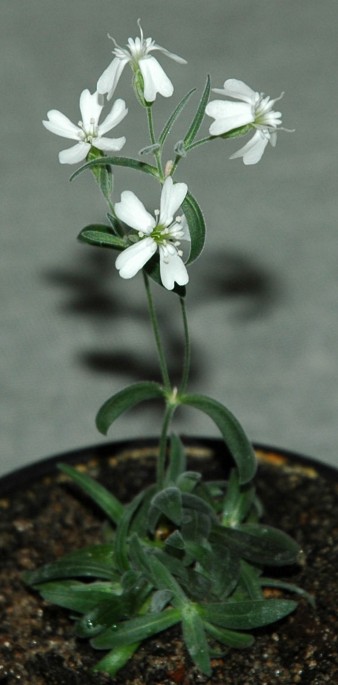
Wild flower blooms again after 30,000 years on ice - Nature
Fruits hoarded by ancient ground squirrels give new life to prehistoric plants.
Nature
187 points · by jackgavigan · 10y ago · 57 comments
When people talk about DNA degrading, they are usually referring to DNA that is no longer inside living cells, and that doesn't have these multiple levels of protection.
Until recently it was thought that DNA degraded more quickly, indeed making it un-viable after only a few thousand years, but a relatively recent study put the half life of DNA at 521 years, meaning that it would take several million years to degrade fully, under ideal conditions.[1]
Therefore, bringing back animals like the woolly mammoth should be quite feasible, but probably not dinosaurs.
[1] http://www.livescience.com/23861-fossil-dna-half-life.html
(Remember that if you have multiple cells, you have lots of strands of the same DNA, all broken in different places.)
But I'm not an expert.
[1] http://www.nbcnews.com/id/49366487/ns/technology_and_science...
DNA has some remarkable stability properties when it comes to preservation. This is one of the reasons people are so interested in DNA storage technologies.
DNA chemistry allows for information to be preserved for millenia at sub-zero centigrade temperatures.
Robert N. Grass, Reinhard Heckel, Michela Puddu, Daniela Paunescu, Wendelin J. Stark. Robust Chemical Preservation of Digital Information on DNA in Silica with Error-Correcting Codes. Angewandte Chemie International Edition, 2015; DOI: 10.1002/anie.201411378
Is the same problem as to restore a file that is partially distroyed in four or five points. You can still recover the original file if you have five copies, each one with the damage in a different area. Polyploid organisms have several identical security copies of each chromosome. If something in a chromosome is damaged, they can quickly fix the damaged areas using the safety copy saved in his 'twin' chromosome.
That's because they are expensive to maintain, professorships have been faded out and biology students and post-grads are usually not so much interested in real plants and systematics anymore, but more in genetics and laboratory work.
The small state of Saarland doesn't have a single publically accessible botanical garden anymore. Across Germany the outlook is dim.
Amy: "What's that splork on them? It's not germs, is it?"
* https://theinfosphere.org/Transcript:The_Futurama_Holiday_Sp...
I know it was quite hard to wrap one's head around this. Sorry that I didn't explain it more indepth to non initiated. That was so elitist of me.
(PS: I know what you want to say, but it's your own fault for arguing that way.)
If that's the game you're going to play, what was the point of your original comment? You're claiming to have known when you posted it that it was nonsense.
There's also a surprising number of Nazi secret bases.