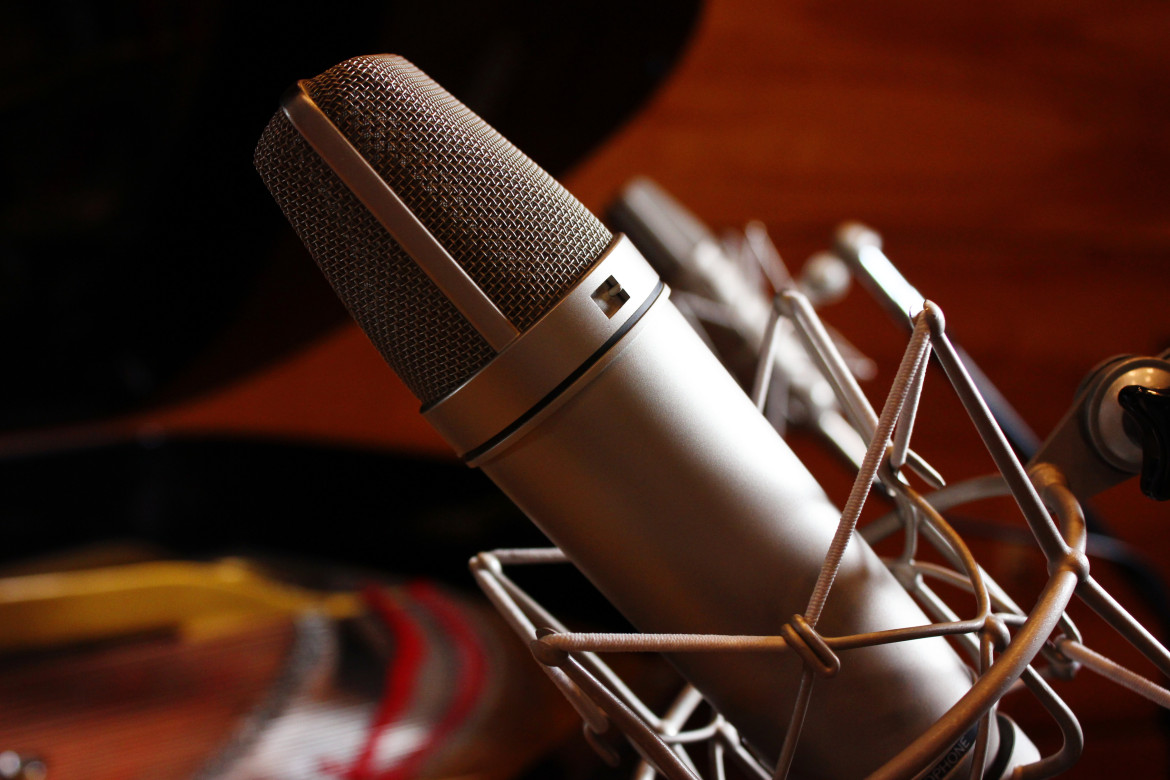
A top audio engineer explains NPR’s signature sound
The crisp, bright tone comes from a particular microphone — and a few other elements.
Current
392 points · by adamnemecek · 10y ago · 237 comments
Makes me wonder why they don't record the sound of the fans and then invert that audio track and mix it with the mic channel before broadcasting the master channel so that the relatively periodic noise of the fan cancels itself out.
edit: also, the weird phasing artefacts this would introduce would be much more prominent and noticeable, even if it succeeded in reducing the overall volume. So much so that doing basically this ('flanging') is a standard musical effect for making parts sound psychedelic.
I suspect the logical end to that sort of thing is to use multiple microphones to add "depth" to your sound recording, then filter out sounds coming from sufficiently far away.
The thing most people don't consider is that white noise (hiss, a fan) is readily tuned out by the brain - the brain is brilliant at reducing background noise - but artifacts introduced by artificial noise reduction are correlated to the signal and the brain interprets it as a distortion of the signal, not background noise.
That's why audiophile audio engineers fix the noise instead of using FFT noise reduction - at least whenever possible.
It worked for them and would work, so long as the person you are recording keeps their head very still. Any movement would change the parts of the sound emerging from their throat that gets cancelled by the cancelling mic.
Amplifiers use negative feedback to cancel distortion out ( because it's correlated ). Some folks, like at Pass Labs, tend to avoid neg. feedback for philosophical reasons, and people like their amps. They use part selection and careful design instead.
Adding two uncorrelated signals together, you end up with a louder, uncorrelated signal.
There is "single-ended noise reduction" ( the version I use is from CoolEdit 96 and CoolEdit 2000 ) but it leaves artifacts. It's still wonderful for things like single-coil hum, things with a limited spectrum.
However, you can take advantage of that because the sounds you want to keep generally are periodic at short timescales. You can use DSP filters to remove components of the sound that don't show significant autocorrelation. The same idea lets you remove white noise and random static from radio signals.
Getting two sounds to perfectly interfere is basically impossible. Real world sounds are way too complex for that.
Because the vocals are sometimes the only thing that's perfectly in the middle of the mix (balanced left/right), you can invert the left channel of a mix and then recombine it with the right to cancel out only the balanced tracks (so you're left with essentially an instrumental). Subtracting the instrumental track you've just created from the full song (again, by inverting and recombining), you should get the vocal track by itself. Fun stuff, right?
I'm not sure how well this works, as I've never done it myself, but it would seem like having the exact signal is important. As people have said, the fan noise isn't predictable enough to cancel using that technique. On the other hand...
I recently read about a machine learning application using K-means clustering in which you feed the algorithm sound from two microphones set up in the same room and it's able to separate the audio by who is speaking. I'm not sure how well such an algorithm would work when one sound is significantly louder than the other (such as quiet fans and people talking), but it certainly points to that being a possibility.
At the end of the day, the cleaner the source material, the easier it is to process in any fashion you want later on in the airchain. A lot of stations will have noise gates on their microphones, or even wideband gating before material hits the transmitter in some cases. With the right settings, it should be more than plenty.
The challenge is keeping those closets cool with ventilation that does not leak sound.
It's a point of pride in studio design today. The NPR article mentions similar isolation from the newsroom.
Fans have a tonal center around 110-220Hz, then a lot of harmonics that essentially generate pink noise... nothing that can be corrected in post production or flipping the phase.
They can switch to SM7s or RE20s and achieve much better S/N with respect to air handling systems, but they want the "U87 sound" (they can keep it, too, IMO - it's painfully neutral) and that just entails a much higher "room noise to signal" ratio.
On a different note, why is that (as far as non-expert me knows) that nice mics often have eq settings? Is this not a blatant layer violation?
The low-frequency/subsonic content that this switch will remove often consists of wind noise, pops from talking too close, vibrations from the floor/mic stand, etc. Even if these low frequency noises may be more or less inaudible, they'll contribute to a large signal swing that will decrease the headroom in the following amplifiers. In other words, you won't be able to turn up the gain in the microphone amplifier/mixer as much as you'd want, because the low-frequency but high-amplitude content will make the amplifier clip and distort the sound. Filtering the signal after the mic preamp won't solve the problem, because the preamp (which can provide in the order of 60 dB gain) will be the component that clips. By including a low-cut filter in the head amplifier circuit inside the microphone (the amplifier serves only as a buffer, and usually with unity gain), the disturbing low-frequency noises can be removed before entering the high-gain microphone preamp. You can find the low-cut switch next to the capsule in the U87 schematic [0]. It seems to me that they increase the capsule bias voltage, thus changing the low frequency response by electrostatically tensioning the membrane.
[0] http://recordinghacks.com/images/mic_extras/neumann/U87-sche...
edit: tweaked some things. meta: i'm not very good at commit messages.
Here's a Neumann mic from 1952 that could be set remotely. http://recordinghacks.com/microphones/Neumann/M-49
Today it is increasingly common to put the analog stuff as close to the source as possible and remote control it.
The things you mention (vibrations, LF rumble) are typically handled by the highpass on the mic preamp and are in the 75 or 80Hz range. In musical terms, that's 4+ octaves below the 1k proximity rolloff on the mic itself.
This is the one of the areas a recording engineer's problems are different than a software engineer's intuition.
In software, we have a lot of problems that can ultimately be traced back to not having good "visibility" into the software or its state. This has various far-reaching consequences, from specialized tools to examine software (such as debuggers) to cultural values ("one job per component") that help us reason about complex systems we cannot see.
But in the case of audio, we have a multiple sensory organs to directly perceive sound. A bad audio engineer would be able to push a few buttons to move his headphones around in the signal chain and know in seconds where the EQ is occurring. A good one would simply know the U87 rolloff "by sound" and would not have to conduct any investigation at all.
There are some cases where more detailed analysis is done with fancy tools–mastering song recordings, for example. But in live sound, an audio engineer's primary concern is UX, because good UX is the difference between solving a problem quickly and annoying pops or worse. One button that engages a good EQ is much, much better than something like this: http://adn.harmanpro.com/product_attachments/product_attachm.... And epoxying the single button to the correct position is even better still!
You raise a good point about (even in the bad case) moving headphones around the signal chain---and damn as an (especially functional) programmer I'd like that to be able to tap arbitrary locations in data flow like that. Enough all these control-flow-based debugging tools!
> One button that engages a good EQ is much, much better than something like this
Well there's always overkill, but would one of those be worse than one of those and then, next in the signal chain, a 1-button EQ whose functionality is completely subsumed?
You should look into dtrace and it's new Linux counterpart who's name currently alludes me. It's almost like being able to do just that.
No, you want to apply cuts as early as possible in the signal chain if you're trying to prevent overloads later in the chain. The "EQs" that you see on mics are almost always bass cuts designed to reduce proximity effects. This gives you much better dynamic range at the preamp because bass frequencies are energy-intensive, so cutting them early allows the amplifier to not have to do all the work amplifying (and distorting) them, just to cut them later.
Beyond that, with a few exceptions, most of the signal rolled off by the switch is stuff you don't want to hear anyways - "plosive" pops, rumble from low-frequency buildup in rooms, vibration, etc. Much of it can't even be reproduced by most speakers (speakers don't do low bass because, as said before, it's a hard problem and not actually audible in most cases).
As an aside, when mixing records, I'll often roll off guitars at 200 or 300hz, losing a couple of octaves of low-frequency information. In theory, this is awful. And if you listen to the solo guitar tracks, it's awful. But in an actual mix, it's great! It gets the low end of the guitars out of the way of real low-frequency instruments like bass and kick drums, making the bass sound tighter and cleaner. The guitars sound clearer too, because they aren't getting muddied by competing bass instruments.
The great challenge of recording is to capture the authority of a roaring guitar amp, the brashness of drums, the purity of a voice, and then squeeze it down into something that fits in an iPhone earbud and still has realistic proportions. That's why the idea of "accuracy" in recording is so ludicrous. A record is to a live performance as a HO train set is to a real train. It's a miniature, a model. To make it look "right", you have to exaggerate some details and lose others.
The goal is to get good sound out of your recording equipment, not to get ISO approval. :-)
Every recording studio or both for a live venue I've seen always seems to have 'round 1/4 equipment always in use, 1/4 rarely but sometimes used, 1/2 equipment never used :P. I really do respect the science and art that goes into audio engineering, but damn that's a lot of clutter.
Now the flip side is it's a lot easier to trim the fat administering a bunch of a computers (and the clutter isn't a huge sunk cost like some once highly valuable piece of equipment one might be loath to chuck), and yet this ideal is also far from realized most the time. Boxes in closet are just a lot more obvious than files in a directory.
Arguably compression wars and other such things are also a layer violation: sound engineers can guess at but not be sure of listeners' equipment. With computer and audio (or anywhere engineering, business, and less educated users meet), optimizing against presumptions is a common source of layer violations.
As has been noted, the particular quirks of the U87 ( or the like ) mean a filter to lessen proximity effect are Useful.
The "EQ settings" on the mic are actually to compensate for proximity effect. On the U87 it starts cutting at 1k -- way above what the interview states.
http://www.coutant.org/u87ai/u87.pdf
Another mic commonly seen in broadcast (and top podcasts) is the Shure SM7. Has similar switches, and even comes with a plate you can screw over the top of them so people don't futz with the settings.
Also, rooms, talent, and equipment are often much more influential than mic selection in making a 'signature' sound. But mics are to audio engineers as languages are to programmers... Everyone has a favorite, and opinions border on the religious.
Source: worked in radio engineering for 4 years before starting programming, live audio engineering 4 years after that, and have worked with dozens of mics and varying degrees of on air talent in many environments.
Likewise I'm sure you could swap a U87 on person X with a RE20 on person Y and it might even sound "more like NPR" depending on the natural sounds of their voices.
I agree. The number one rule of good journalism is not to put yourself in the story.
Step back, way, back, and let your subject tell their story.
> Current: Yes, but if you’re at a station and kind of frustrated with the bassy, boomy sound you get on your studio mic, and you can’t get the engineering staff to do anything about it for you, one thing that you could do yourself is to look on the mic and see if there is a bass roll-off switch, and turn it on.
Is the interviewer just tossing out "life pro tips" in the middle of an interview? Why does it start "Yes, but" when it's not a counterpoint to _anything_?
Yet they still occasionally have a story with a siren in the background, so I start checking my mirrors and pulling over.
Holy shit, NPR's fascination with sound effects. Yes, I want to listen to 15 fucking seconds of someone chewing loudly between paragraphs. Sirens, crowd noises, people talking about something undoubtedly unrelated in Urdu.
Dear god, NPR's signature sounds are why I don't listen to it.
And it's during this "conversation" that they play the sound clips:
HOST 1: "So there's this interesting thing they've just discovered, Host 2"
HOST 2: "What's that?"
HOST 1: "Scientists have discovered that when you eat..."
chomping and chewing noises
HOST 1: "... you're actually oppressing black people."
prison cell door slams
HOST 2: "What, seriously?"
HOST: "...and that's when we found Joseph SomethingOrOther" VOICE: "Hi, I'm Joseph SomethingOrOther" HOST: "Joseph SomethingOrOther is an expert on blahblah" VOICE: "Blahblah is foobar"
You just told me this person's name 3 times when 1 would've sufficed.
Oh, and the weird music. I'm not sure I need 15 seconds of annoying jazz improvisation at full volume between segments either. But that is indeed part of the "signature sound" :)
There's several scenes throughout the show that poke fun of various aspects of NPR that are usually quite funny.
[1] https://en.wikipedia.org/wiki/Emergency_Alert_System
[2] https://www.fcc.gov/document/enforcement-advisory-misuse-eas...
I guess that's not as bad as it sounds, given a twenty year life and daily use.
Going a little further, the mixing console you can see on the picture is a Lawo Sapphire[2], which NPR seems to have installed in 2012. According to this gearslutz post[3], a 12 faders + central section was starting at 20,000€ back in 2010. You can see on the picture that NPR has a 24 faders version.
The audio monitor on top on the console is an RTW[4]. It's kind of hard to tell which model it really is, but the TM9 for example starts at $4,200[5].
[1]https://www.gearslutz.com/board/low-end-theory/618100-mic-vo...
[2]https://www.lawo.com/products/radio-consoles/sapphire.html
[3]https://www.gearslutz.com/board/music-computers/864209-what-...
[4]https://www.rtw.com/en/products/audio-monitors.html
[5]http://www.rspeaudio.com/RTW-TouchMonitor-TM9-p/rtw-tm9.htm
And I haven't factored in cost/rent for the studio, music licensing, and a whole lot of other OPEX. Since there are quite a few local radio stations around, I'd say the CAPEX is not a big deal.
Radio pays notoriously bad. Local TV is just as bad, and they can't even afford photographers any more so reporters do their own shooting; I was laid off as a photographer when that change was made at a former haunt and newscast quality plummeted. (It's popular and spun positively now: Google "backpack journalism.")
Particularly local, you have to really love the craft to be in it. National/international is better, but to an extent. On-air talent soaks up the salary budget at pretty much every shop, universally, and to use a local example like KTVU or KRON I wouldn't be surprised if on-air talent was making $500k or less. You can do better at Google. The producer running the newscast is probably struggling to make rent. The camera operator certainly is, if they haven't yet been replaced with automatic, motorized cues driven by an overworked TD, who is just as worried about their own rent.
Ad-based business models suck, particularly when owners hate spending money. All media owners do. We got punished for the millions that had to be invested for the HDTV transition with 15% pay cuts at one station in the middle of nowhere.
They have a number of highly paid mid-level people, such a diversity officer (Keith Woods) who makes $220K.
More notable hosts make over the stated $300K, including Steve Inskeep ($400k) and Michele Norris ($350K –– wage gap!).
Highest honors, at least according to the 2013 990 linked here[1], go to Renée Montagne, who pulled in $412,581.)
These are not fully loaded costs. You probably want to add 10% for D.C.-based employees for employee overhead incl. labor lawyers, retirement contributions, payroll tax, &c.
Not bad to be a corporation that doesn't pay taxes, takes federal taxpayer money, takes state taxpayer money, takes corporate gifts, solicits foundation grants, and asks for individual donations.
[1] http://990s.foundationcenter.org/990_pdf_archive/520/5209076...
http://www.andymboyle.com/2013/07/21/an-updated-look-at-ira-...
Audio is a very expensive game to play well.
People who spend thousands on exotic speakers in the name of "transparency" in their home setup could do so much better in that respect with a pair of active studio monitors. But they might not like the results as much.
This equipment will have to run 24/7, be constantly worked on, be easy to service, will likely have redundant power-supplies, maybe redundant DSPs/Routing/I/O. And if anything breaks, you'd expect to get a 100% drop-in replacement (in terms of frequency response, gain, ...) delivered over-night, or by a courier/technician.
Regarding the mixing consoles: For live-sound (the only area I know a little about), only recently a wealth of very affordable mixing-consoles have flooded the market, but anything slightly larger still sets you back ~€10k for an entry system (Midas Pro, Yamaha CL, Soundcraft VI, Allen-Heath GLD). And there, I suspect the number of units shipped is one or two orders of magnitude larger than what Lawo sells for fixed installation in studios.
Generally, the equipment will work flawlessly, even when hauled around every weekend and not handled very gently.
I won't get into it all unless you want me to, but a system for live performance or broadcast has orders of magnitude more work to do, functionality which is demanded by a tiny market relative to consumer electronics, with far higher expectations on reliability, flexibility, etc.
There are certainly people (Pyle, Behringer, etc) who claim to sell cheap solutions, but they are substantially more likely to bite you in the ass in concrete, embarrassing ways if you try to use them in performance environments.
Edit: Fair enough, I'm entirely incorrect as far as the headphone price point.
On the production side of things where quality super matters, you'll see the more expensive headphones for sure. But every single person in the last newsroom I saw rocked the 7506, and though I've moved on to more expensive headphones for programming and my music collection, I still miss my 7506s on occasion.
This is radio, not some boutique studio with a ton of outboard gear.
Other mics - including cheaper Neumanns - don't have quite the same effect.
It's not about capturing the sound perfectly accurately, but about creating an impression with sound. That's why some pro audio gear is so insanely expensive.
It's very hard to create the same impression digitally because this kind of subtle analog distortion is complex, non-linear, and not very well understood.
Studio construction, baffling, and noise exclusion also matter.
What I didn't see addressed were some other factors I've noticed and/or been aware of over the years.
NPR's announcers, reporters, and hosts tend to speak conversationally. Rather than shooting for fill-the-room, highly-inflected (a/k/a Commercial Broadcast) voice, it's the tone you'd expect to hear from someone having a conversation with you in a room (though perhaps a larger room, and with less mumbling). That's a huge difference for me, and unfortunatly I'm hearing far more commercial broadcast inflection from the recent crop of announcers, to the point it's quite annoying. Steve Inskeep most particularly.
("Recent", for this old fart, means the past decade or so.)
The other element, and it's one I'm raging against, is that NPR has increasingly moved to live and unedited audio, to its tremendous loss.
When the network was small and it couldn't field reporters in many locations, sound often arrived after hours, or days, at headquarters where it was edited for broadcast. Even the flagship news programs were largely (and in cases entirely) pre-produced, with all news segments, interviews, etc., edited before they went on the air.
Yes, it meant that what you got from NPR was often slightly stale relative to other news outlets, for the latest breaking news (though hourly headlines broadcasts were generally current). But the result was polished and digested. In terms of a program which informed rather than merely screamed, it was, I'd argue, a better product.
NPR has been falling victim to currency bias since the late 1990s and I really don't care for it.
I listen to NPR to get the slightly stale event that someone has taken the time to gather more than one fact and is trying to make a 1 min segment out of it. I can't recall a time where an NPR story got walked back (looking at you FOX) for shoddy reporting.
Posts above have whined about how much NPR talent make. You should find out about your local morning zoo team and the Ken and Barbie team on your Action news. Those guys don't even get out of bed for 300K a year. Plus the people listed above also write and edit their material, vs Ken & Barbie.
At a variety of levels, NPR and their shows are worth every penny. In a few weeks listen to them talk about the RNC / DNC conventions vs the others.
I do have issues with how several NPR reporters and anchors have been terminated, most particularly Bob Edwards and (though she wasn't even a reporter or anchor at the time) Lisa Simeone (one of the most awesome voices on radio, BTW). Juan Williams, OTOH, should never have been hired in the first place.
And it's nice that they appreciate the different destinations for their signals, and take steps to prevent them from getting squashed into mush through multiple compression stages.
Thoughtful people.
Among the problems this presents is what I call "the chase", which are the final 30 seconds or so of an interview in which the host or interviewer is quite clearly trying to wrap up with a guest, who either isn't aware of, or doesn't want, to meet that time schedule. It is always awkward, and occurs at the end of EVERY live interview.
(The BBC also exhibits this, the worse when it's over some long-distance line.)
A pre-recorded, edited interview can go for full feel and length, and then be cut to fit the timeslot. One thing I recall (and miss) from those was a far more gracious interview wrap. I'm sure that far less of what had been said hit the air, but what there was was better for it.
I'd notice it on commercial broadcasts if I listened to those more. I am very well aware of it on NPR and BBC broadcasts. Somewhat less so on CBC.
> We are fans of being close-miked, and P-pops come into play there. But we make sure that we are within a foot of the microphone and usually a lot closer — close to six inches — in working with any of our on-air talent. That’s another element that goes into it.
BBC Radio 3 (a national classical music station in the UK) uses heavy dynamic range compression during the drivetime peak, but far less compression during the day. This compromise provides a better experience for both hi-fi and in-car listeners.
Very heavy dynamic range compression was historically useful for AM broadcasters, because it maximised signal strength.
(at least with modern performances -- perhaps Mozart intended differently, and is now spinning in his grave due to excessive dynamics)
A radio that's off has no listeners.
These days every note of music you listen to on every modern album has a compressor in it somewhere, even if you don't think you can hear it, it's there.
The problem with sending compressed signals is that they will probably be recompressed before making it to someone's ear and the chain of codecs may introduce strange artifacts.
A while ago NPR used to use 2B ISDN (112Kbps in the US) for remote locations. I believe they used G.722 codecs for low-latency applications (conversations) and MPEG layer II for higher quality stuff. That was data compression.
But the NPR distribution system isn't so bandwidth limited as to require crushing the data.
Also, Compression sounds good. Too much, or badly configured compression sounds bad, obviously. But don't throw it all away. (Not that producers are at any risk of doing so.)
https://en.wikipedia.org/wiki/Loudness_war
This is one reason why I've stopped buying "Remastered" CDs - they almost always sound worse. Shop at Discogs.com where you can specify the release date, or buy from a quality-oriented label like mofi.com
Dynamic mics like most stations use (SM7, RE20) hide a lot of sibilance by exaggerating the fundamentals.
That simple U87 costs about 5x what the other broadcasters use (typically an SM7 or RE20) and is much more fragile and difficult to maintain. As I recall NPR bought hundreds of U87s...
They didn't go into any of the other things.
This is not to say that its a bad thing, people are paying into a cooperative because they enjoy it, and they should continue to enjoy it. But public radio, though avoiding corporate advertising, still may have to pander, just on a lesser scale and to in a more democratic manner.
Though there are other audience segments.
If you listen to the NPR humour programmes and segments, they'll often allude to the whiteness of their audience, and it pretty much always draws a laugh.
(Edit: to clarify: CEB are the demographic, though it's not necessarily who NPR are pandering to. See followup.)
This[0] NPR page shows that only about 30% of NPR income is non-commercial. Also note the Nestle advertisement on the page (at least it was omnipresent when viewing on a mobile browser).
[0] http://www.npr.org/about-npr/178660742/public-radio-finances
Commercial radio is not like this.
I used to work at one of the largest NPR affiliate stations. Listener support is hugely important, most of the money we made came from listeners. IMHO, NPR is pretty successful in that they have built a model that supports quality journalism, at a decent scale, without a lot of annoyances for the user. Newspapers and other media orgs could stand to learn a lot.
In fact, I think there's a lot of the anti-HRT sentiment at work in vocal-fry. Girl's being told that high rising tonation is bad, so no wonder they ground out at the bottom of their range.
Women can't win. Not too high, don't push low, don't use like. And so on.
Men also fry, btw, you'd just be hard pressed to find a handwringing article decrying that.
But if you actually hear them speak and don't like their voice, that's not prejudice.