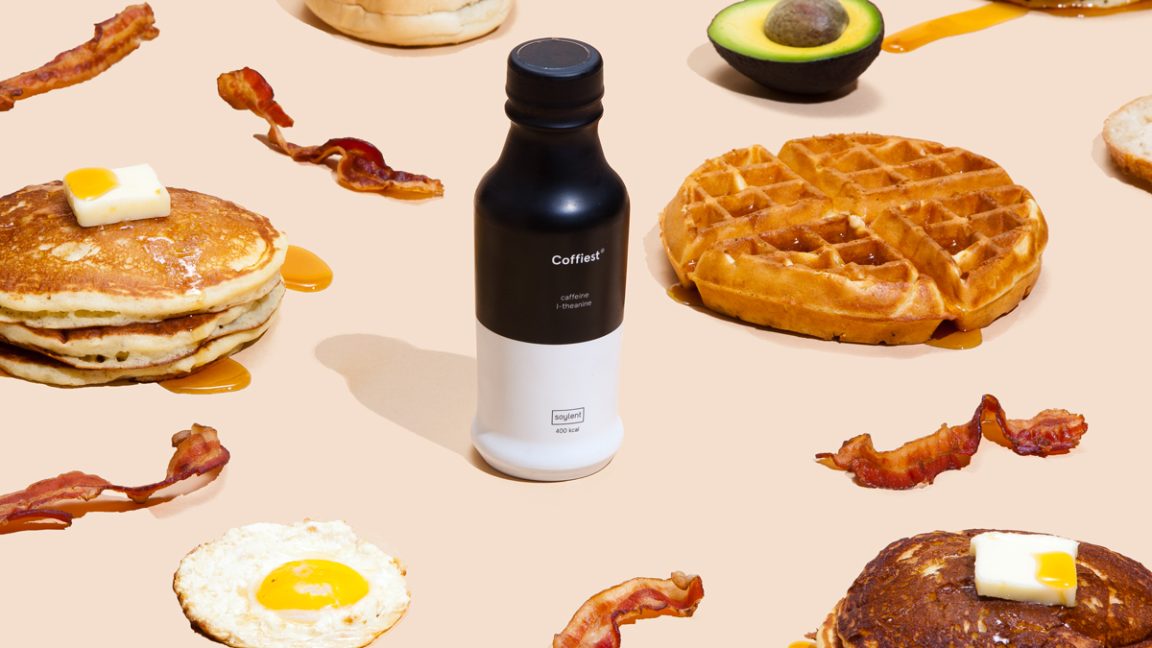
Soylent Coffee: Nootropics, fat, carbs, protein—but will it give you the toots?
Soylent makes a break for the breakfast table with "Coffiest" and "Soylent Bar."
Ars Technica
67 points · by johncoogan · 10y ago · 72 comments
- Fred Pohl and C.M.Kornbluth, "The Space Merchants", 1952.
I am glad to see that Soylent is continuing to name their products after Sci-Fi Future Foodstuffs Of Dubious Safety.
Nutrition facts labels and recommended daily intakes vary by country, and they're backed up by a lot of bad science and guessing games.
Consider that the USDA recently lifted their recommended maximum intake of cholesterol from 300mg/day (1.5 eggs/day) to no upper limit at all (after 50 years), or that study after study has failed to find any significant benefit from taking daily multivitamins (and to the contrary has found that taking too many, or the wrong kind, can cause liver damage), or that every sugary breakfast cereal and energy drink would seem quite healthy if all you looked at was the nutrition facts label.
I don't think nutrition facts labels are particularly meaningful, so a product sold almost entirely on the basis of how strictly it conforms to those government recommendations isn't of much interest to me.
If you're Soylent, you also have to lean heavily on government recommendations as a form of insurance against lawsuits. There's a lot of risk in encouraging people to eat only your food for every meal of the day, and being able to tell a judge that your product closely adhered to government recommendations is undoubtedly helpful in various litigation scenarios, but I don't think that necessarily forms a good foundation for what people should be eating.
That is factually false, since their labels do quite accurately reflect that they consist of nothing more than carbs (and a bit of protein, for some cereals). I'm not sure how one would come to a conclusion that energy drinks are good for you from their nutrition label, unless you're assuming sugars, artificial colorings, taurine and caffeine are all healthy compounds.
Most people think VitaminWater is healthy, and feel like they're doing something good for their body when they drink it. They'd probably be more discerning and come to a better conclusion about that product if you completely removed its nutrition facts label.
people think vitamin water is healthy because its called vitamin water. because the flavors are called things like "immune booster" "essential" "multi-v" and because they give descriptions on exactly what ailment this drink is designed to combat.
putting 1/2 cup as the serving size for ice cream is manipulating a nutrition label to sell more product, putting truthful information on the label and advertising your product as health food anyways is just dishonest marketing.
It had a full chapter on macro-nutrients.
Mainstream medical sources have never claimed to have strong evidence on the link between dietary cholesterol and heart disease, mortality etc. However since the link between serum cholesterol and these things is so string, it seemed prudent to advise limiting dietary cholesterol. However no, with more negative studies, this advice no longer makes sense. But at no point was limiting dietary cholesterol claimed to be as high of a priority as limiting saturated and trans fats.
That said, apart from saturated fats, total calories and protein (for people looking to build muscle) I don't think the rest of the label is useful for most people.
Ever since I've heard about Soylent I've wanted the company to do well -- I love cooking but oftentimes when I'm hungry I hate having to do prep work and cleanup because it feels like I'm procrastinating the work I actually have to do (and I can't skip eating because being hungry while working just gives sub par performance).
I can't afford Soylent consistently as a student and so have used soy milk and other [gross] concoctions in the past; but, I might have to use this news as inspiration (also taking note from u/sxates to stop by Trader Joes and give their concentrate a shot).
Or possibly they simply make personal choices about what they put in their own personal bodies differently than you.
I get that not everybody is me. I'm trying to provide the viewpoint that we don't need a new product to solve the issue of healthy, zero prep food. Plus, the existing options are way, way cheaper per calorie, which is a pretty important consideration, since most people seem to be resource constrained (including me).
I'd try the stuff, if they didn't put 1,6-Dichloro-1,6-dideoxy-β-D-fructofuranosyl-4-chloro-4-deoxy-α-D-galactopyranoside in it. (the brand name is 'sucralose'). That stuff gets everywhere, but I have a nasty reaction to it and really don't appreciate the company lobbying to have it treated like some kind of safe 'sucra' or 'ose'.
Some people prefer it over (2R,3R,4S,5S,6R)-2-[(2S,3S,4S,5R)-3,4-dihydroxy-2,5-bis(hydroxymethyl)oxolan-2-yl]oxy-6-(hydroxymethyl)oxane-3,4,5-triol (IUPAC name for sucrose aka table sugar).
There isn't really any purpose in using full chemical names in informal discussion. Most organic chemicals are pretty complicated, so using the full names just makes it seem like you are trying to scare people who don't know any better.
Personally (and I've tried it) I didn't like their initial strategy of being a 100% meal replacement and feel strongly like it makes a great supplement. I think their new products are more aligned with this and will likely renew my subscription today.
edit: i'm referring to the quote saying "So we have two mild nootropics" which i read as counting caffeine as one of them
The list of nootropics is somewhat fluid, as much of the science behind them is either recent or currently occurring.
> Nootropics (pronunciation: /noʊ.əˈtrɒpᵻks/ noh-ə-TROP-iks)—also called smart drugs or cognitive enhancers—are drugs, supplements, or other substances that improve cognitive function, particularly executive functions, memory, creativity, or motivation, in healthy individuals.
I think it would fall under that definition. Then again, so would adderall.
Is there an equivalent for a mix of vegetables, fruits, grains, meat, etc? It would make more sense as a complete cheap meal than a powder, except for being perishable.
It brings to mind the 'diet problem' http://www.neos-guide.org/content/diet-problem for which, if optimizing for price only, often suggests that you eat mainly potatoes.
Not exactly what you asked about, but, if I read you right, they accomplish what you're going for.
And there is the venerable Dillburito.
There are other competitor like Queal or Huel
I eat a lot of things many people would consider unsavory, including snails, oysters, cheese, etc., things way past their expiration date, and very bad (cheap) Chinese food. But this, no.
I had bought 40 bags of the stuff that sit unused in my cupboard.
Maybe Soylent is way different, I don't know, I didn't try it. But a small pill would be fantastic.
But one thing they sure get right is how to market to a niche: all you guys and readers of tech news sites.
It'll be successful, but let's not make it out to be something pioneering, because it's most definitely not.
Anyone who's doing full-Soylent really needs to read this massive meta-analysis:
So this has everything to do with it. There's more to diet than numbers, yet if you're on a pure Soylent diet, you're clearly not getting some relatively-unknown things that are almost conclusively beneficial to your body.
Absence of proof is not proof of absence. Eat your fruits and vegetables or, statistically speaking, your cardiovascular system will eventually suffer.
Soylent's marketing puts a lot of otherwise smart people at serious long-term health risk.
Even Rosa Labs doesn't recommend a pure Soylent diet. I liked Soylentconor's comment on reddit the other day, pointing out that the right way to look at Soylent is that it's "just food"[1]
I'm obviously not arguing Soylent is perfect, but it's almost certainly better than what most people eat most of the time, and humanity got here subsisting on, on average, much worse.
> Eat your fruits and vegetables or, statistically speaking, your cardiovascular system will eventually suffer.
You seem awfully certain given that you can't say what "relatively unknown [but] conclusively beneficial" things Soylent is missing.
[1] https://www.reddit.com/r/soylent/comments/4wowtp/why_is_that...
> Soylent scientists at work in the food labs refining Coffiest's flavor.
Well, not even close.