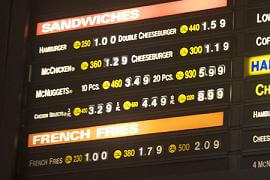
Healthcare Bill Requires Restaurants to Display Calories on Menus
The recent US healthcare reform bill has a lot on its plate. Then, again, so do Americans. One of the provisions of the bill will give the FDA one year...
SingularityHub
9 points · by kkleiner · 16y ago · 22 comments
Once again, that's just me, and it doesn't really speak to the accuracy of the figures.
I don't lead a particularly healthy lifestyle. I smoke & I drink, but the warning labels on those products never really altered my behavior, but for some reason the fast food calorie ones have.
Personally, I would take this as further condemnation of the calorie counting approach to health in the first place. Our ancestors did not need it, and there's nowhere in the human body to input raw calorie counts into our satiety mechanism. This is the classic hacks piled on hacks pattern, instead of fixing the root problem.
* Do you get enough of the necessary nutrients? * Do you eat so little that your body starts to reduce it's metabolism? * Do you have exercise program that continues after you stop a reduced calorie diet to rebuild the lost muscle tissue (your body burns both muscle and fat tissue when compensating for the missing calories)? * After the diet do you return to normal eating habits, or eat a diet that is balanced against your physical activity?
I'm not 100% confident about the "low carb" or "paleo" diets, but I am quite confident the standard line about fat and calorie counting being the key to losing weight is false. Science has abundantly demonstrated this. I recommend "Good Calories, Bad Calories" for a long discussion. In this case I particularly recommend the discussion about how equality symbols do not imply a causal direction.
I'm a little strident here because having dug into the issue I feel downright betrayed by people pushing "calories in/out" as if it's, well, truth. Because while the raw thermodynamics is true, everything else built on top of it is basically false.
Do you really need nutritional information hitting you in the face to realize that deep fried chicken that you're going to eat is bad for you?
It's not as if they use this information to decide between a hoagie and a salad. They use it to decide if they should get the huge hoagie or the one a couple of inches smaller.
On the other hand, having that information displayed prior to ordering not only makes it readily apparent, but it also removes the burden of forcing the consumer to be constantly carrying around past nutritional information in their head.
Unfortunately the government is in the business of creating illusions. As long as we slap a label on something we create the illusion that we are making progress.
This is along the same lines that the government thinks they are making school lunches healthier by adding a fruit cup with their food but pay no attention to that fruit cup being loaded with sugar because of the heavy syrup in the container.
It just creates the illusion that we are doing something healthy, but not actually fixing the problem.
I do not believe that there is much we can do about the majority of adult Americans, but we could start shaping the future for the children and foster proper eating habits from the beginning.
I don't disagree with most of your points, but at the same time I don't see why there's any reason this law should not exist; it's easy to implement and does help some people. This law is not the health care solution; it's one tiny part of it.
I think that the article is arguing that since this law will not have a major impact on Americans' health, it should not be implemented. I'm arguing that it's a good law because it makes sense to provide basic information on food, and it's not an unreasonable hassle to do so.