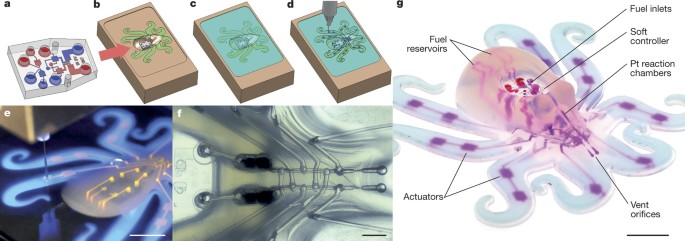
So the microfluidic logic isn't too amazing, it's just an oscillator.
And I agree with that this is a brief synopsis of some interesting work. What I don't understand is why this is in Nature. They did something cool, but they don't propose anything new.
Microfluidic logic and soft robotic actuators aren't new. Combining the two is really cool, but not something I would say is worthy of a Nature paper. Definitely a paper worthy of an engineering journal, but not Mature.
Honestly, the people who are likely to use this technology to the fullest are robotics enthusiasts and not the government or big companies. Soft robotics is really cool, but the thermodynamics aren't great. That is pneumatic actuators aren't that efficient, likewise chemical and pneumatic energy storage aren't very energy dense. This means that said pneumatic soft robot can't operate for very long, making it not practical for the sorts of things governments and big companies want to do.
However, it's really really cool and the pneumatic logic stuff might be cheaper to make than really tiny electric valves which is where hobbyist come in. One might be able to print such 'pneumatic automata' on stereolithography based 3d printers.