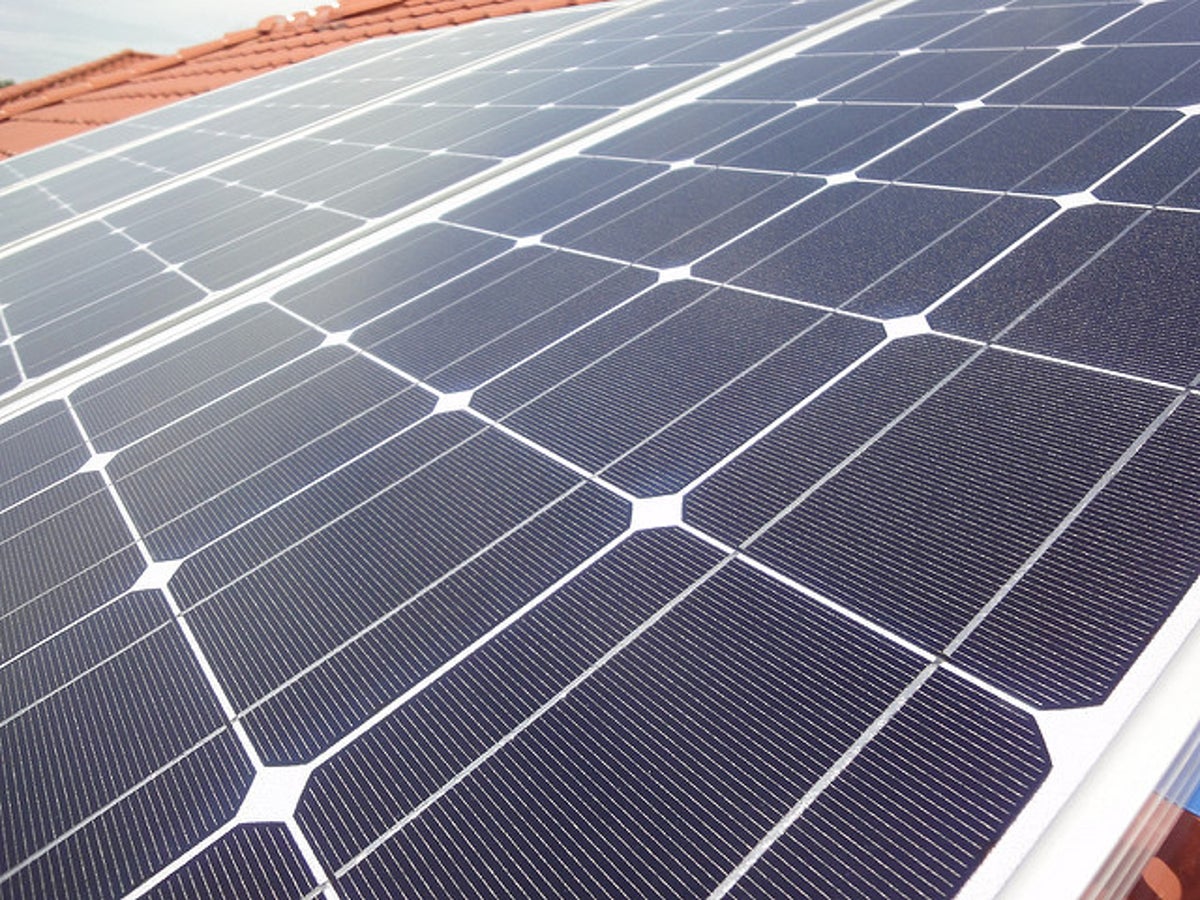
The Price of Solar Is Declining to Unprecedented Lows
Despite already low costs, the installed price of solar fell by 5 to 12 percent in 2015
Scientific American
276 points · by tedsanders · 10y ago · 164 comments
>"This means that the decline in installed cost observed since 2012 was largely caused by a decline in the cost of the inverters that convert the DC power produced by solar panels to AC power for the grid and other “soft” costs such as customer acquisition, system design, installation, and permitting."
On another note, calculating the payback of residential solar panels is tricky because many online calculators don't consider:
  - inverters failing and needing to be replaced (~10 years?)

  - bank of backup batteries need to be replaced (~10 years?)

  - significant increased labor costs of replacing the roof or repair roof leaks (roofers must spend extra time unmounting all panels before replacing shingles or tiles.)

  - paying a service to clean the panels if the house is in a dusty climate and the homeowner doesn't want to climb on the roof and do it himself
(That said, some people pay the premium for solar panels to gain power autonomy which overrides any over-optimistic estimates of installation payback.)
Backup batteries are still relatively rare, as they should be - they are fairly expensive as backup power. Most systems remain grid tied. Smaller systems don't require retail net metering for a solid payback, since almost all of the energy is used as it is produced.
Roof repair is again, real, but not as likely as you might think. Asphalt shingles under an array are protected from wind, and even more importantly, heat. They degrade at half the rate of the rest of the roof. Assuming 12-15 years for roof replacement, you will hit the module warrantied life of ~25 years before you need to replace the roof underneath the array.
Cleaning the panels really only comes into play when the pitch of the roof is relatively shallow (3 on 12 or shallower). Otherwise rain will clean them fairly well. A lot of people won't have any trouble walking such a shallow pitched roof, and will simply hose the panels off once in a while.
Also, in general, the price of modules per watt is about half of what it was 5 years ago. Peripherals are a major component of the improved economics, but module prices themselves have mattered just as much.
   > On another note, calculating the payback of
   > residential solar panels is tricky because many
   > online calculators don't consider (stuff...)
IMO that's the best comparison for domestic storage though.
Sure, you have to either trust that nat gas is available or deal with fuel, but a propane tank isn't obscenely expensive considering that it bumps your backup from hours to days/weeks.
Ehh? A Powerwall costs $3500 alone, WITHOUT the inverter or transfer switch. A Powerwall supplies 3.3 kW, which isn't enough to run a 3-ton air conditioning unit (30 amps x 240 Volts == 7.2 kW).
If you run 15kW (air conditioner plus a few other stuff), you'll need FIVE Power walls for a minimum price of $17500. (Plus the inverter, plus... etc. etc.)
----------
Or, you can get a 16kW generator AND switch for $3300.
http://www.electricgeneratorsdirect.com/Generac-Guardian-646...
-------
Powerwall is actually a lot more expensive than standard generators. Something like 5x more expensive.
Over the last few years racks, mounts, wiring, inverters and labor have made up ~60% of the cost.
Plus, Obama started slapping ~30% tariffs on the cheapest imported solar panels.
http://www.bloomberg.com/news/articles/2015-07-09/u-s-impose...
I read the state department report too. The 'disguised subsidies' they called China out on included 'advertising' the solar companies' existence on local government websites.
Clearly they didn't expect anybody to actually read that.
* solar panel prices have dropped a whole lot in 2016 already. Chinese PV panels now cost about 43 cents a watt. Production costs are around 37 cents a watt. (that's for Jinko Solar)
* utility solar is seeing improvements in construction (more robots), cable management, medium voltage something or other at the power plant, etc.
* China PV makers are moving to PERC and maybe more to Mono. This means a little more efficiency. First solar supposedly has their CdTe response.
* be careful before you go and invest in solar. (FSLR, SPWR, JKS, CSIQ, JASO) As I learned, there is a coming shakeout in 2017. The long term extension of the ITC in the US ironically caused a slowdown in deployment b/c utilities are no longer under the gun to receive the ITC. China also lowered their subsidies for the second half of 2016. Meanwhile PV makers increased production.
However, a 140-watt panel would cost me 362 dollars back home, which is 250 cents per watt: http://www.sunwind.no/product/show/?id=1297
Where exactly are these oh-so-cheap panels supposedly sold?
http://www.aliexpress.com/item/solar-panel-12v-50w-poly-2-pc...
Good place to start looking though.
There must be cheaper panels available in the US.
Why don't you visit Germany with a van?
http://www.nrel.gov/docs/fy04osti/35489.pdf
http://www.clca.columbia.edu/236_PE_Magazine_Fthenakis_2_10_...
It doesn't make any sense that China would be subsidizing their panel manufacturers to the extent you are implying.
http://spectrum.ieee.org/green-tech/solar/solar-energy-isnt-...
Related quote: "If the photovoltaic panels made in China were installed in China, the high carbon intensity of the energy used and that of the energy saved would cancel each other out, and the time needed to counterbalance greenhouse-gas emissions during manufacture would be the same as the energy-payback time. But that’s not what’s been happening lately. The manufacturing is mostly located in China, and the panels are often installed in Europe or the United States. At double the carbon intensity, it takes twice as long to compensate for the greenhouse-gas emissions as it does to pay back the energy investments."
China already has the biggest hydro electric project and I to see massive installations in China for Solar, Wind and Nuclear to combat their air pollution and health problems
This makes me think of some interesting structural economic issues I hadn't considered before.
Compared to the global distribution networks of hydrocarbons, distributing PV panels is uncomplicated and a lot less bulky. On the other hand consolidation in the industry and eventual economies in scale of production could point to less diversification at the lowest levels of supply compared to a system where individual wildcatters, new tech like fracking, and even cartel members (and outlaws/terrorists) undermining their quotas have a not insignificant effect on the cycles of energy pricing and supply.
Even technology with a well-defined trend toward decreasing prices like RAM or hard drives have this complication if you need to make your purchases right after floods in Thailand, or at the wrong time when a standards for RAM are coming into effect or stopping production.
With a small number of huge suppliers, and decades long replacement cycles leading to boom and bust cycles for the industry, it could be as difficult for users to plan energy supply needs as it has been when it comes from mismanaged areas of the world.
> The continued decline in total installed cost is noteworthy considering the fact that the price of the solar panels (or modules) themselves has remained relatively flat since 2012. This means that the decline in installed cost observed since 2012 was largely caused by a decline in the cost of the inverters that convert the DC power produced by solar panels to AC power for the grid and other “soft” costs such as customer acquisition, system design, installation, and permitting.
Another seldom mentioned fact is, that solar plants don't have a minimum size. So for large regions in Africa, where there is no grid yet, it is much easier to set up isolated small solar plants in villages than to construct a whole grid.
But the real elephant in the corner of the room is that there is no really good method yet for buffering power generated by solar by day, for consumption overnight, when it is needed for lighting, heating, cooking, etc. A conventional station doesn't care what time of day it is. THAT is the barrier to widespread adoption, and it's one that solar proponents always seem to overlook...
One is that they deal badly with usage intermittency - one must be always charging or discharging them, you can't just store them.
The second is just, where do I buy one? Nobody seems to make them, no idea why. Maybe this one solves itself when solar gets widespread, or maybe there's some government hand in that and it won't be available when we need it.
The head of Applied Materials solar operations had a useful way of looking at costs. He'd draw a latitude line on a map, saying that below this line (Northern hemisphere) solar could beat out other sources of power without subsidies. About ten years ago, that line ran through Spain and Southern California. As the costs decline, it moves north. This is more useful than looking at costs over all locations. Solar is a location-specific thing. SF's BART system once looked into solar panels at stations, and decided that only one station in the whole system (Contra Costa) got enough sun to justify it.
Tesla is making noises about "solar shingles" for residential installations. The idea is to replace the roof, rather than sit on top of it. Others make those now; CertainTeed Products, for one. Dow Chemical just exited that business. Solar shingles work, but high installation cost and lower efficiency make it unproductive.
The article mentions "residential systems" twice as points of comparison. It also references the 5% reduced costs in home installs in the subtitle of the article.
According to the table on page 6 of this EIA report for weighted average LCOEs in America before tax credits for 2022 [2], photovoltaics are projected to be around $74 per MWh. That compares favourably with $100 for nuclear, but unfavourably with $56 for natural gas, $59 for wind or $64 for hydroelectric. (Solar gets a weighted average federal subsidy of $16/MWh subsidy; wind $8.)
[1] https://en.m.wikipedia.org/wiki/Cost_of_electricity_by_sourc...
[2] https://www.eia.gov/forecasts/aeo/pdf/electricity_generation...
A lot of times you see solar prices compared with base load power prices, but solar competes actually with natural gas[1] fired peaking plants which sell power at higher prices than a coal fired plant.
Similarly residential users are charged a substantially higher price for electricity than the base load price. Partly because a substantial amount of power comes from peaking plants and because the utilities have a grid to maintain[2].
[1] If you wonder why the Koch brothers hate solar remember they are in both the oil industry and the gas industry. Little of the former is used for power generation where peaking plants use lots of natural gas.
[2] Utilities hate roof top solar because it messes with their economics because their bond payments and maintenance costs are fixed.
Which is exactly where solar is available – it can’t deal with 100% of the peak load, but it can take about three quarters of the market for peak load techniques.
It seems like there could be a really big difference between the cost of conventional power between Australia and the US if what you're saying is true.
https://www.eia.gov/electricity/monthly/epm_table_grapher.cf...
Looks like they are ~$0.23 (that's US dollars) in Australia.
I guess the sun is better in Australia too.
Even if you just have regular power outages, or are a data center, hospital, etc that is required to gave full power off grid for days solar becomes far more attractive. Solar is also rather atractive to the military as logistics get complex and expencive.
What surprises me is that roofing on these new homes isn't required to have a south-facing exposure. Seems like that would make it a lot easier for homes to add solar.
They will when the cost of traditional electricity is priced to better reflect it's environmental impact.
In fact, I personally think nobody should be permitted to not have solar in a new building in 2016. You can't remove the seatbelts from your car in 2016. You can't build a new building with asbestos in 2016 and you can't turn your semi-auto rifle into a fully-auto (in most states). Just because you own it, doesn't mean you can do anything you want, that argument makes no sense.
Here in Germany, rooftop solar electricity costs about half of what the utility companies charge off the grid.
http://www.imf.org/external/pubs/cat/longres.aspx?sk=42940.0
And honestly I can't even say why. Water, biogas, wind. We already have quite a range of responsible energy sources. But none of them are as exciting as solar power to me. Nearly like a Mars colony. Not much logical reasoning behind it, but still quite exciting.
a reduction of 5-15% in a year is huge. are you familiar with how compounding works? that means the price will fall by almost half in about 5 years, and will be a tiny fraction of what it costs today, in a decade. what's expensive today will be economically viable or even cheap in just 2 or 3 years.
look at the graph! it's right there with easy to read colors and shapes.
Look into the new science on that one. It can make carbon sense when you flood a desert to feed a hydro dam, but if you flood a forest then the carbon math isn't so great. Microhydro seems an answer, but there too you have to calculate how much forest is being deprived of water, and what that means for carbon uptake. It's probably still better than coal, but it isn't perfect.
Many small dams produce a lot of forest-water edge cumulatively, unlike a few huge dams.
Plenty of people don't want that kind of risk.
Worse this usually happens during the times when they make the most profit (daytime/summertime).
They have every incentive to try and kill solar - which is, in fact, what they've been trying to do (google for 'ALEC solar' to see how).
Maybe where you live. But most places in the world, power generating utilities are publicly owned and price regulated and the incentive is to reduce costs. No corporate conspiracy here, and still no solar panels.
Couldnt remember the good information I had on the subject at this but a quick google search gave me an article thay covers some of the basics.
http://www.vox.com/2014/9/29/6849723/solar-power-net-meterin...
I've visited a number of countries twice in the space a few years (e.g. Myanmar) that have very obviously have had a huge number of solar panels put up in that period. First none at all - then everywhere.
It's most noticeable in sunny areas that have no grid at all or one that is very poorly functioning.
(Is there a US equivalent of http://www.gridwatch.templar.co.uk/ ?)
https://www.agora-energiewende.de/en/topics/-agothem-/Produk...
Solar will only be able to increase (without storage) until there is no black coal used.