172 points · by walterbell · 10y ago · 78 comments
Everytime I see this indoctrination, i can't help but to set the record straight.
People who commit "Piracy", or te be more precise: Copyright infringement, because "Piracy" actually means large scale infringement with a commercial motive; are NOT more or less "moral" or "ethical" than people who do not commit copyright infringement. ( And strictly speaking, they almost don't exist. )
This is also why mindsets that can be portrait as "Why don't we just give the consumer what it wants? " actually works in practice, not just in theory. Look at the succes of Spotify & Netflix for example.
"Piracy" is about convenience and market failure. It's not about money and certainly not about immoral people or ethical superiority.( But it sometimes IS about rentseeking. )
Even if you disagree with this statement and think that "Because Money" , you should not only look up what a freeloader problem is; but also what deadweight loss in economics means as this effectively means that copyrightholders are stealing welfare and money from everyone, if you'd interpret the concept with the hardline type of thinking often associated with "Anti Piracy" type of people.
If you do this in Kindle World - copy words from a book, and sell them as your own in a different book with your name on it - you get taken down and thrown out, and the author may sue for lost income.
Online course content is no different.
It's theft. There is no other word for it.
The content in question is available world-wide via pluralsight. The author has set a price for his content and it's up to consumers to choose whether they wish to pay for this content or not.
Someone who bypasses this and chooses to pirate the content has made a moral choice not to pay the author for their time as requested.
There is no large corporate here restricting access to content, this is a person who has put in work to create something and released it at a specific price.
If no-one is willing to pay for content then how will content producers be able to afford to make more?
Personally I try to pay content creators wherever I can for the content they produce. I subscribe to patreon for several webcomics and youtube series I enjoy and buy technical books where available for topics I'm interested in.
I'm absolutely capable of going and getting all my content for free to but choose not to do so, because it seems obvious to me that if everyone does that, the content I like will no longer be available, or will have to have other monetization means (e.g. advertising) that I'm not a fan of.
For me the rampant piracy problem is a classic tragedy of the commons. People like the content but would rather others paid for its production.
Hope I've understood this sentence of yours correctly. Actually in this case, Pluralsight, which the author of the blog post has published courses on, is a large corporate in the software/technical training domain and has acquired many other training companies in the last few years. Pluralsight is highly restrictive in that it does not allow downloads of course videos (just a limited offline cache using its proprietary DRM restricted player) or moving them to a device or system of the paying user's choice. Compare this to DRM free publishers like O'Reilly, Packt and many others (see my other comment elsewhere on this topic), Pluralsight is terribly restrictive for users (IMO).
Troy isn't an employee of Pluralsight and it's his content that he publishes via their platform.
It's his choice as content creator where to publish the content he creates.
Obviously if users don't like the platform he's chosen, they can choose not to consume his content, this isn't some situation like a Marvel movie say, where only one company can produce that type of content.
There are many other options for security courses.
Fyi, Spotify is not a success (yet). Spotify would actually be an example of it working in theory but not in practice because the music streaming service has been losing money since its inception.
Regarding your comment about deadweight loss: Yes, in a perfect marketplace, any product with a marginal cost of 0 should be priced at $0. But this ignores the fact that numerous products, including books and software, have very significant upfront costs that vastly exceed their marginal costs. If everyone pirated them on the basis of your economic theory, those industries would completely collapse.
Very briefly UK copyright entered the 20th Century (sic); the balance away from the public interest now is so wrong it's ridiculous.
Netflix and Spotify are just convenient channels for the content monopolists to charge for the access to "their" content.
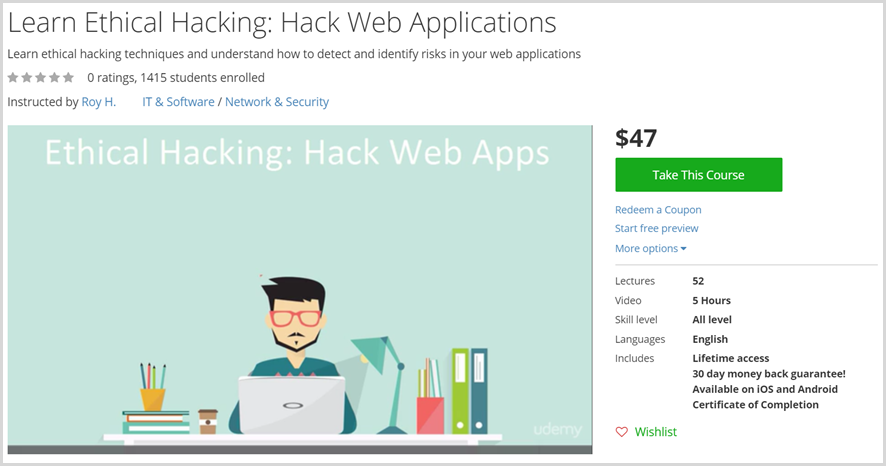
'The course: Learn Ethical Hacking: Hack Web Applications has been removed from the Udemy platform. We apologize for any inconvenience. If you have already purchased this course, please log in to your Udemy account and contact Support.'
"Many of you have asked about what happened to the money received from Troy’s course. There was none. As the fraudulent instructor had created coupon codes to allow students free access to the course, no money was exchanged in this process."
[0] https://blog.udemy.com/maintaining-the-integrity-of-our-udem...
Sometimes I wonder if there are people who're frustrated with the restrictions and/or DRM and upload the content believing it to be some kind of karmic retribution. I'd be interested in knowing any comparisons of piracy in relation to revenues across these two kinds of platforms - the restrictive/DRM filled ones and the unrestricted DRM free ones.
At least this is what they told us [0] the last time we spoke with them ~2 months ago.
[0] https://pexe.so
The CEO posted a blog on this event: https://blog.udemy.com/maintaining-the-integrity-of-our-udem...
Basically Troy's course got posted on Nov 18th,it was reported on Thanksgiving Day, and it was taken down the next day.
https://medium.com/@robconery/how-udemy-is-profiting-from-pi...
which accuse Rob Conery of ranting.
How can they not see that this is wrong?
Ranting in a more public space might be frown-upon-able (I apologize for that word) but if it's your own space, spew vitriolic screeds until eternity, yo.
(In my defense, it's right at lunch and I'm a bit lightheaded)
But I guess babbling into a camera for a few hours if far more protection-worthy than months of programming. ¯\_(ツ)_/¯
I'm pretty sure it's that one.
What makes you think that he does find programming content unworthy of payment?
They follow the DMCA process, and it's pretty easy to get your content taken down. Sure, if you report something on Thanksgiving day, you might have to wait until Monday as the legal department isn't standing by 24/7. But I've reported piracy to Youtube and it's taken them 3 or 4 days to reply as well.
In short, it's the Internet. Yes, people steal your digital stuff. Yes, it's up to content creators to police that. Yes, it's tiring as a content creator to chase your stuff all over the Internet. But it's the Internet.
Do you still keep the original? Do you also see art forgery as theft?
And when I mention it on Twitter I get automatically followed by companies who produce videos for Udemy.
No, I'm not a Udemy user. Never was. I haven't subscribed to anything.