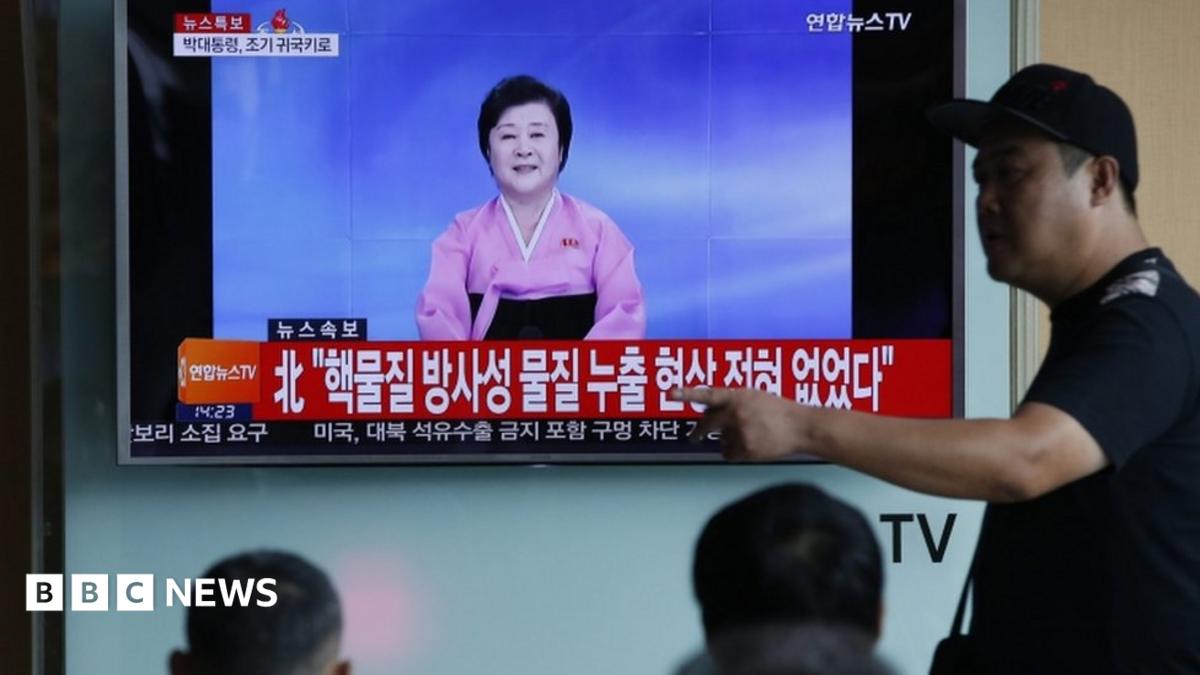
North Korea claims success in fifth nuclear test
North Korea says it has carried out its fifth successful nuclear test - reportedly its biggest yet - with the US warning of "serious consequences".
BBC News
77 points · by niccolop · 10y ago · 158 comments
I try to put detailed descriptions on each photo.
Presumably China does not want to see this happen because re-unification with South Korea would be a possible outcome (although I suspect the South Korean economy would have trouble absorbing the North Korean population without significant aid from the US and "international community"), and that would put a strong US ally right on China's border.
In my mind the only peaceful resolution to this situation is a diplomatic agreement with China, which would seem to be exceedingly difficult to achieve without a massive effort on the part of the US. Unfortunately, given the level of rancor and demagoguery against China that is showing itself in US politics at the moment, not to mention provocative actions such as the TPP and Abe's desire to change Japan's constitution to arm itself, the aforementioned peaceful outcome seems unlikely to me.
Maybe the PRC counterintelligence guys screwed up, but....
[1] https://en.wikipedia.org/wiki/Arms_industry#World.27s_larges...
[2] http://www.un.org/en/sc/members/
tl;dr those who protect peace also nurture war.
See also
>The Decline of War - We are experiencing one of the least discussed, yet most remarkable cultural shifts of all time: war, one of our species’ most abiding and defining social practices, is at its lowest ebb ever
https://medium.com/@angushervey/the-decline-of-war-8760f9a5b...
Yuro Orlov: "I do rub shoulders with some of the most vile, sadistic men calling themselves leaders today. But some of those men are the enemies of your enemies. And while the biggest arms dealer in the world is your boss, the President of the United States, who ships more merchandise in a day than I do in a year, sometimes it's embarrassing to have his fingerprints on the guns. Sometimes he needs a freelancer like me to supply forces he can't be seen supplying. So, you call me evil, but unfortunately for you, I'm a necessary evil."
Lord of War. http://www.imdb.com/title/tt0399295
The world is becoming more peaceful.
And in theory, nuclear weapons make the world more so, which is why these countries pursue them. Despite what the mainstream news likes to report, there's a microscopic probability that the DPRK would attempt to use a nuke offensively.
Probability of nuclear war after nuclear weapons were invented: > 0
No matter what you say, fact remains that by simply developing nuclear weapons, we've dramatically increased the chances of a nuclear war in the future.
I would like to believe that, but I'm not so sure I do. There have been plenty of people in history who have advocated a nuclear first strike: MacArthur and 'Che' Guevara being two examples. I don't feel that Kim Jong Un or the North Korean government are particularly rational.
As sadly as it sound, the H-bomb seems to promote peace through the status-quo : developped country (eg. USA, UK, France, ..) send troops but wheres there is no nuclear threats. Damocles Swords like that (nuclear / bio weapons) prevents us to go to traditional war against each others. Without them, we will end fighting each others, with fists and stones if needed.
It might be due to the lack of this equlibrium weapons that terrorism arise : they can't fight traditionally on their land, neither can't they protect their ideology, so they aims at our weakest part.
* Oh and, as a side note, it only seems to prevents physical war. Nowadays we fight and kill rather through our economy than our bullets.
I don't think it's quite a MAD situation. Hopefully very few are so disillusioned as to think that packing heat is the only thing stopping this whole place from erupting into gun-fire.
[0]: https://www.law.cornell.edu/constitution/second_amendment [1]: http://www2.law.ucla.edu/volokh/freestate.pdf [2]: https://www.law.cornell.edu/supct/html/07-290.ZS.html
As an aside, on the topic of American violence itself, I recall reading a study a while back that America has always had much higher levels of violence than European nations, but I cannot seem to find it now. Anyone have any idea what I'm talking about?
Skip to 14:00 for the relevant part.
The number of casualties in conflicts has going down FAST in the second part of the 20th century. We are in a historical worldwide period of unprecedented peace.
The most recent aberrant point in that downward path has been the Iraq war. But even this one pales in comparisons of the horrors of the past.
https://ourworldindata.org/war-and-peace-after-1945/
Don't pin me down on this one. Statistics differ because they count differently. However, overall they will agree that the number of conflicts is declining.
On a side note, the number homicides is also constantly declining in most developed countries.
https://en.wikipedia.org/wiki/The_Better_Angels_of_Our_Natur...
Now where's your citation to the historical increase in violence?
The continuous gun pointing has been some of the safest times in all of human history. Sure it's probably bad for your nerves if you think about the reasoning behind how it all works, but I'd much rather have this than go back to actually using conventional weapons on a regular basis.
When was the last time that happened before nuclear weapons? I can't think of a time without going back at least a millenium.
And the cold war peace have not been that much different from the colonial times.
IOW mankind reached such astounding levels of destruction potential that it just obliterated the possibility of war between potent parties.
Case in point, I'm confident we could build even more powerful weapons, but we don't, because it's useless.
http://www.independent.co.uk/news/world/asia/north-korea-ban...
>I call it the Madman Theory, Bob. I want the North Vietnamese to believe I've reached the point where I might do anything to stop the war. We'll just slip the word to them that, "for God's sake, you know Nixon is obsessed about communism. We can't restrain him when he's angry—and he has his hand on the nuclear button" and Ho Chi Minh himself will be in Paris in two days begging for peace.
Sure they will say some aggressive things from time to time, but it's entirely rational for them to remind everyone that they have these nukes and are willing to use them.
If they do try to launch a nuclear attack (or even a conventional one), they will forfeit the cushy setup they've created for themselves.
Nothing in Western democracies, Middle Eastern theocracies, or even African dictatorships comes close to the horror that is North Korea. They torture people for entertainment, without even a pretext. They kidnap children to serve as sex slaves for their leadership. They starve families to the point that parents beat their own children over single grains of rice.
North Korea is such an extreme outlier that no other extant nation compares.
(1) NK eventually attacks a sovereign nation. Most likely, their nukes will be used as a threat to back up their aggressive actions rather than being actually used.
(2) China, at first perhaps tentative and apologetic, eventually joins in with strong anti-NK policies and pressure.
(3) NK doubles down, building up its offensive capabilities and maybe launching more attacks.
(4) Very sad day for the innocent North Koreans living under the regime. The US, or China, or the UN, or all of the above smash NK into the dirt.
(5) Profit.
(1) Continued rattling and blackmail for international aid
(2) Eventually becoming a nuclear state that nobody wants to touch cementing itself in perpetuity
And to confirm its absolute disregard for human life since then has proceeded to stir up trouble in dozens of other countries and destroyed millions of lives in pursuit of its own financial interests, the latest victims being Iraq, Libya, Syria and with Iran in crosshairs.
Entire regions some just coming out of hundreds of years of destructive colonialism found themselves head first in old world politics of violence and self interest couched in the modern language of human rights, democracy and peace.
That's a tally easily of hundreds of millions of lives in disarray or extinguished just from the latest meddling in the middle east purely because of financial interests. But yet all these blatant crimes against humanity for some reason are all ok. Because?
Nobody's human rights have been protected, democracy has not been advanced, but 'interests have been secured' on the back of entirely fictional narratives and fabrciated intentions. This is mind boggling.
This is perhaps the same kind of self serving rationalization and reckless disregard for human life that advocates first strike against North Korea. If these are the good guys who are the bad guys?
Right now, North Korea cannot deliver a nuclear payload anywhere. It's one thing to create a nuclear test device, but it's another matter entirely to miniaturize it for delivery.
However, if allowed to progress unimpeded, North Korea will soon have missile technology that can reach Japan consistently. Around the same time, their miniaturization project will likely be complete. At that point, other nations will lose the option of intervention.
North Korea's government is simply... unstable, in both senses of the word. There is simply no other way to put it. The more closely one examines the country, the more disturbing the picture becomes.
They cannot be allowed to have a permanent nuclear deterrent.
At the very least South Korea needs to be involved. A strike against North Korea will put South Korea immediately into an expensive all out war even if they didn't start it. Second, even if the US military was "still" mighty[1] we would need the blessing of Russia and China or at least their promise not to retaliate and start World War III.
To the person who said...
> There are also credible reports of genocide. That'd be reason enough don't you think?
NO! Many times no! This is one of the reasons the world hates us. We think it is our position to unilaterally police everyone in the world. Everyone should universally decry genocide, absolutely and aggressively. But we are citizens of the world not dictators. We should not be pre-emptively striking. We should not be sending money and weapons to other countries (or at least only send them to one side of the fight for god sake so we don't have two sides fighting each-other with our own weapons!). Every time we have been interventionists either overtly or covertly it has caused unintended consequences and often disastrous ones. When will we learn that it hurts more than helps?
* I say this as a born American.
[1] We spent more on our military than any other country by a huge margin. I really don't understand
Every nation has an inviolable right to defence under international law, and North Korea has explicitly threatened the US, and its allies, continually and belligerently, for years. A country does not have to sit around and wait for its enemies to strike before it acts.
Even Russia, one of North Korea's allies, has warned it that its continued threats of nuclear strikes put it at risk of creating a legal basis for an attack by the US and South Korea: https://www.theguardian.com/world/2016/mar/08/russia-warns-n...
From your own quote:
> put it at risk of creating a legal basis for an attack by the US and South Korea
Exactly AT RISK. Let's wait until there actually is legal basis first rather than talk about attacking with no legal basis what-so-ever.
That is patently false. The United States alone has a long history of successful humanitarian intervention, beginning with Tripoli and running through World Wars I and II. Even within our lifetimes, there was the NATO intervention in Bosnia and Herzegovina.
I believe you may be looking at this through a post 9-11 lens, which is causing you to place too much emphasis on blowback. Obviously Operation AJAX, the alliance with Baathists, and funding of the mujahideen in Afghanistan had significant negative unintended consequences.
However, that is by no means an ironclad rule. For further information I'd suggest A Problem from Hell by Samantha Power and Freedom's Battle by Gary Bass.
I'm not familiar enough with Tripoli to comment on it.
So scratch the word "every" from that statement and replace it with "most"
I'm also don't consider it an intervention when our allies are being attacked and our allies ask explicitly for our help.
Edit: let me make this very crystal clear. I am not a pacifist. I'm a non-interventionists. There is a difference. If we are attacked or there is an imminent threat (I'm talking a battle ships with guns pointed at us right at our or our allies border kind of threat not "credible intelligence" from a "confidential source") we can and should respond with overwhelming force. This is not one of those situations.
Heck, some of the ones on the list are on US soil and many others are rescue missions not aggressions. I think it was implied when I said intervention I was talking about offensive posturing.
Also, that poem is nice and all but I didn't say I don't know what Tripoli is. I said I don't know enough about it to comment on it. I make sure I know what I'm talking about before I write on it.
Edit: From YOUR OWN ARTICLE:
> U.S. demonization of an enemy leader, or military action against him, tends to strengthen rather than weaken his hold on power.
Literally the whole "Common Themes" section of the article you yourself cited speaks about how intervention doesn't work.
You posted a source that defends my point. Thank you.
You are being incredibly naive. The US is the de facto hegemon on Earth. We have been living in Pax Americana for close to 100 years and knew about it for around 70. All pretenses fell around 30 years ago.
When it comes to military power, the US is in a league of its own with one empty league between it and everybody else. The US is an empire (and the mightiest one yet) and will act like that until it isn't capable to do so any more. Historically, that's around 100 more years but I'm not sure history is predictive here.
"Incredibly", eh? Sounds like hyperbole. Also, let's not result to personal attacks shall we?
Right now we are seeing a para-military terrorist group that is a global threat. We have that because the US created a power vacuum that started by intervening in the middle east. Which both Bush AND Obama contributed to. And for that matter the first Bush and Clinton as well. And there is a strong argument to be had that the 9-11 attack was because of prior middle east interventions especially with Israel and Saudi Arabia.
But by all means let's create another vacuum in Asia too that will destroy our ally South Korea and create a vacuum that will probably be filled by China not South Korea as much as we'd like that to be the case.
> We have been living in Pax Americana for close to 100 years and knew about it for around 70. All pretenses fell around 30 years ago.
I'm not sure this is not the point you are actually making so I might actually be agreeing with you. But before we were in this place we didn't assert our power like we do now, yet -- just an observation -- all the sudden we have all these problems. Not to be treasonous but when the "de facto hegemon[sic]" comes into power and the world falls to shit maybe the world and Americans are better off with a more even power balance.
> When it comes to military power, the US is in a league of its own with one empty league between it and everybody else.
Yet somehow we are weak according to many Americans.
Agreed, but one thing that has been a constant throughout history is that empires eventually become complacent and buckle under their own weight, and have to face smaller contenders that don't have the inertia to maintain the status-quo.
It's telling that there really isn't any empire that has endured "forever", probably because this is simply not possible.
Portugal was the first global empire and ostensibly lasted for 600 years, but its decline started much sooner than it's total lifespan (around the 200 year mark). The country is now a shadow of what it once was, and the US will also be one day.
Against NK, which would probably the last "conventional" war in history (unless we started a war with Russia)... we'd be a force to reckon with. After that, though, the state of war today are unconventional forces with unconventional tactics. The US then has a disadvantage. We're too big, too traditional, all we have is a hammer to solve problems, when what we need is a tiny screw driver.
NK has its estimated 10000 conventional artillery pieces in range of Seoul - they will pound it to rubble the old-fashioned way. You can (theoretically) intercept a single ballistic missile, but there is no defence against a mass artillery bombardment.
Edit: Hmm. You lot make some good points about just how many 'small' hits they could pull off, assuming that each gun emplacement has ammo etc. so I did a bit more research. Seoul Capital Area has an area of ~11,000 kilometers square[0]. Assume a generous affected blast area of roughly a hectare per shell (we're talking about shelling a population center here so you don't have to level every building to have a serious impact) and that's 1.1 million shells (if they're firing with uniform distribution, which they won't be) to seriously damage the city. Assuming a normal distribution where they all aim haphazardly for the CBD and let fly, it's even worse, call it 500k shells at a guess.
10k emplacements, if they have 50 shells each, will deliver this in (as per post below) 8.3 minutes. So yeah, even if it can't "pound Seoul into rubble" it would be a highly undesirable outcome for the South Korean people.
I take it back. Conventional artillery isn't slow if you have enough of it.
Let's do the maths - I don't know about NK weapons but a NATO 155mm shell contains about 11kg of TNT. 10000 guns can deliver 110 tons of explosive in a single salvo. A British AS90 gun can deliver 6 rounds a minute, so assuming a similar rate, that's a kiloton in 90 seconds or 20 kilotons in the 30 minutes you suggest, or a Hiroshima in just over 20 minutes.
And don't forget artillery will be well dispersed and dug in, and the leadership will be in deep bunkers anywhere in the country. Who and where will you "glass"?
Imagine if Saddam, Assad, and Gaddafi (he stupidly gave whatever he had away to the country that later killed him) all had nukes and the capability to deliver them.
"The first objection is that South Korea is right there, and thus is conceivably within range of a nuclear strike. In particular Seoul is directly next to the border with the North. However, there are already more than two thousand North Korean heavy artillery pieces ready to shell the metropolis at any time.
The damage to Seoul is going to be significant under any military intervention scenario. But if action is not taken, the threat from North Korea will become permanent."
Not so sure.
Never had a problem with North Korea here in Europe. Of course we're far away, but other governments also far away have indeed dropped nuclear bombs (and at Japan which you're concerned about), and have started wars all over the planet, including meddling in Korean affairs, and sponsoring some dictatorships around the world.
Heck, a far away government once ruled both Koreas as a colony they called Indochina, and another one gathered European citizens to go fight against Koreans in the fifties...
So not so sure why countries that actually did that shit should have the moral high ground or be considered less dangerous UN-wise than countries that merely want to protect their actual borders and haven't harmed anybody yet.
First, North Korea is not a nation defending borders. It is a personal fiefdom that deserves neither the name "nation" nor the respect it entails.
Second, past colonialism does not establish a moral equivalency with the mass-scale starvation, systemic imprisonment, and wholesale torture occurring right now in North Korea. This is an unfortunately common trope trotted out by countless dictatorships over the years. See And you are lynching negroes!"[0]
Third, even assuming for the sake of argument that those events were every bit as terrible as the current nightmare in North Korea, the events which you reference occurred in the past. The North Korean government is committing atrocities now.
We can't do anything about the past. But we can damn sure do something about the future.
[0] https://en.wikipedia.org/wiki/And_you_are_lynching_Negroes
Plus, your mention of the lynching has little to do with the reply and the subject. And there are other countries that practice unjust imprisonment and torture, I might mention a few in the West.
We can't do anything about the past except remembering it and practicing its teaching. If by "doing something about the future" means bombing NK, then the future will have millions of refugees pouring into China, Russia, and South Korea. At least we should ask an opinion to the "reasonable" countries that border NK.
That's like, your opinion man. Other fiefdoms, especially rich in oil and fundamentalism, seem to be respected just fine, with their monarchs et al.
>Second, past colonialism does not establish a moral equivalency with the mass-scale starvation, systemic imprisonment, and wholesale torture occurring right now in North Korea.
Isn't some other country the number one in the world in terms of imprisonment? That has like 5% of the world's population, but 25% of it's prison population? And where blacks are disproportionately imprisoned?
Another sadly all too common trope is for people in glasshouses to throw stones, or even worse to look at "the speck of sawdust in their brother's eye and pay no attention to the plank in their own eye".
And of course it's "all in the past" (as if colonialism is ancient history),and hundreds of thousands have not died and whole countries been destabilized in the past 15 years, with BS offensives and pretexts like WMDs and such.
>Third, even assuming for the sake of argument that those events were every bit as terrible as the current nightmare in North Korea
What "nightmare" that's any different than any run of the mill dictatorship supported and sponsored by "holier than thou" countries (not to mention beasts like Pinochet)?
There's imprisonment, hunting of dissidents and other stuff, but nothing beyond the ordinary. And if it wasn't for embargoes there wouldn't be much starving either.
Suharto's Indonesia was sponsored to hunt down and kill 1 million or so dissidents -- but those were lefties, so it doesn't count. Plus it was 40 to 20 years ago, ancient history.
Most of the "nightmare" seems to be the same kind manufactured truth used time and again to install dirty lackeys in yet another place (like the dictator's uncle being thrown to the dogs and other inanities). Libya and Iraq today are worse than with their dictators, and as for Syria, their legitimate guy looks like a bargain compared to the fundamentalist madmen that control those parts now.
I've never seen those mocking the "and you're lynching negroes" argument doing it for anything else than to defend their double standards.
It's always: "Sure, we do X bad thing, but it doesn't matter, because it was in the past, or because what's important now is to fight the Y bad thing, or because that doesn't absolve Y".
And, yes, it doesn't absolve Y, but it bloody puts it in perspective. And it also doesn't absolve X, so why those mocking the "and you're lynching negroes" line never seem to have a problem with the X, e.g. the negro lynching but always with what the other side does? Maybe they should begin by fixing their own glass house instead of telling others how to fix their?
I've never heard of Indochina referring to anything but SE Asia which is far away from Korea. What am I missing?
The Korean war was another Cold War play-field in Asia the coincided and happened to draw, among other US and "UN" forces, the French, who couldn't be bothered to fight Hitler in their own turf, but wanted suddenly to help fight communists 10.000 miles from their borders.
My first thought when I read the news was that the current way of dealing with NK -- condemnation, shunning, embargoes -- seems to be a dead end. What is it even accomplishing anymore? Escalating seems to be a path to hell, for everyone involved. What else is there besides appeasement? I hasten to add that I don't know enough about the various international relationships involved to really have a solid opinion.
I don't think the sanctions, embargoes, and shunning are working either. But those first two hurt the people who are already too weak to revolt not the dictator. And the third one is just posturing.
I don't know the answer. I just know that attacking preemptively has proven to create power vacuums, solidify international public opinion against the US, and cost thousands of lives. Not just American soldiers but civilians too.
But some off the top of my head suggestions...
- Propaganda war
- Let another country like South Korea take the lead (and support them of course)
- Do nothing. If (granted a big if) North Korea is not suicidal. They are just saber rattling and don't pose a real threat.
But I hope that all the smart people in our state department are collectively smarter than me.
I'd say South Korea and China. Tell them to figure out, between them, what they think the world's strategy on North Korea should be. (China has a lot of potential harm from North Korea falling apart or going to war.) Tell them if they agree on how to approach NK, the US will back them (presuming we think their approach to at least be sane), including with force if needed.
That would make it South Korea and China's problem (which it really is, much more than the US's problem, despite NK continuing to utter threats at the US). And it removes "US vs. China" as one of the problems that makes the NK situation so intractable.
Compared to whom?[0][1][2] We are first or second in most measures of military strength globally. We currently likely have the most powerful military ever to exist in human history.[3]
[0]http://www.globalfirepower.com/aircraft-total.asp
[1]http://www.globalfirepower.com/navy-aircraft-carriers.asp
[2]http://www.globalfirepower.com/active-military-manpower.asp
The only place we are weak is that we are stretched thin. But we did that to ourselves through interventionist policies.
On top of that, where does a conventional strike leave China? Any intervention that isn't Chinese led will necessarily renew PRC support for Kim.
Why not?
Your reasoning and posture is precisely why the North Koreans are justified in seeking nuclear weapons. They have a right to it.
Are you sure? It is only 35 miles or so from the North/South Korea border to Seoul. That border is well-defended, but I'm not sure South Korea would gamble on being able to stop a single nuclear missile (or even a device fired from a gun) in a barrage of smaller ones.
Tie one to a horse and send it over the border. Put it in a Volkswagen and put it in gear, send it over the border. Mail a package. Put it in a speedboat, duct-tape the throttle and jump out.
> North Korea's government is simply... unstable, in both senses of the word. > They cannot be allowed to have a permanent nuclear deterrent.
Yeah yeah, that has been said about quite a few countries in the past. Based on what - flawed mathematical models? The sole purpose of those was to create new war grounds. If the country has such great prediction powers, let's first use it in economics.
I don't mean to support North Korea here. It might be an irresponsible, undemocratic state. But non-proliferation cannot be done by saying "I'll keep my gun but you are not allowed to keep yours because I think you are an irresponsible unstable person". Whereas history since WWII clearly shows who has been the trigger-happy entity.
It's amazing how much sacrifice people are prepared to make for the good of mankind, when it's someone else's lives...
Not to mention there's no guarantee that the "liberation" of North Korea will improve the lives of North Koreans. One word: Iraq.
Transforming North Korea into a true vassal state of China may be the solution, but there will need to be a serious governmental transition in North Korea first.
Japan invaded through Manchuria in WW2 so it makes sense for China to have as big a buffer zone as possible in that area.
The border between china and afghanistan is very mountainous and very far away from Beijing.
NK is such a failed state that we keep on propping up its failed regime because no one knows what to do with its 25M citizens