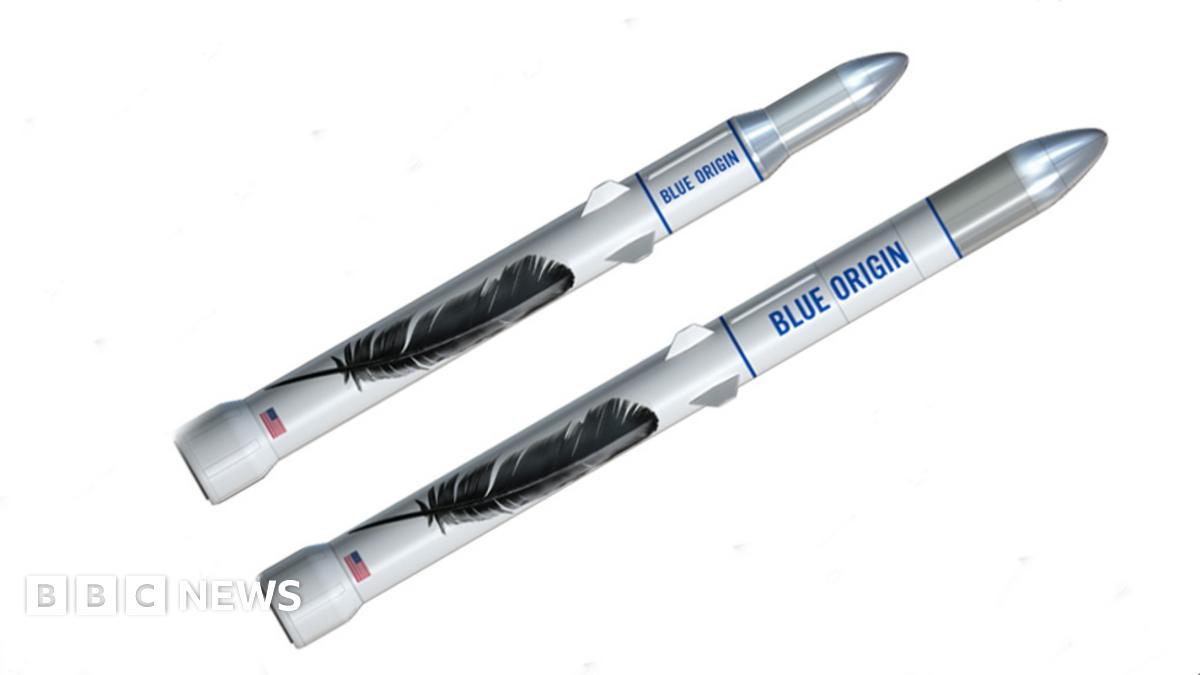
Jeff Bezos names big next rocket New Glenn
Amazon boss Jeff Bezos says the big, re-usable rocket he has been developing inside his Blue Origin space company will be called New Glenn, after John Glenn.
BBC News
130 points · by smb06 · 10y ago · 119 comments
I'm intrigued that they plan to go from New Shepard straight to a rocket that's bigger than Falcon 9 (3.85m pounds thrust for New Shepard vs. latest Full Thrust version of Falcon 9 at 1.71m pounds). I was under the impression that New Shepard wasn't as serious as Falcon 1 (.e.g not capable of reaching orbit) and that SpaceX spent quite a number of years moving from pre-Falcon 1 to the regular launch successes of Falcon 9.
Maybe someone who knows more about this can explain - are the technical challenges involved less associated with pure size and more to do with design/fabrication processes etc.?
I read that Blue Origin (specifically Bezos) has a lot more funding to throw at this problem than SpaceX did/does (IIRC Bezos has something like 6x the net worth of Musk. That alone might not say much, but it's obvious that if push comes to shove, Bezos can throw more money at the problem). And if you look at some of the numbers (not sure if they are completely "confirmed" yet), New Glenn still won't quite have the lifting power of Falcon Heavy (despite it's larger size).
Also, if you look at the timeline of Falcon 9 (Funded in 2006, first launched in 2010), Blue Origin's looks very similar, so it's not exactly impossible.
To me it just looks like they are going in a different direction. SpaceX wanted to get to reusability with an orbital rocket first, then scale up. Blue Origin is nailing down the extreme reusability in sub-orbital land for now, and will apply that to an orbital rocket. And the simpler design (one massive booster VS 3 separate stage-1 boosters) seems like a simpler plan (i'm not trying to imply in any way that any of this is easy, it's still rocket science!)
It's looking like we are going to have another space race in the next decade. And I can't wait!
They also make money via manufacturing for other companies. IIRC the engine for New Glenn is going to be used in an upcoming ULA rocket.
It's very early for them, and it's clear that SpaceX has a good decade or so on them, but it's exciting to have the possibility of real competition in this area again.
If that's true then perhaps they are going the route outlined in The Rocket Company -- Fuel is cheap, so make a really freakin huge rocket that holds a freakin huge amount of fuel and go ahead and send up a relatively small payload, so long as they have true re-usability.
That's what i'd bet they are going for. Every launch (even GTO launches) will be RTLS. Plenty of fuel on board to avoid the suicide-burns that SpaceX is doing, lots left over to give some wiggle room in case corrections are needed.
If they can maintain the same level of reusability that New Shepard is expected/hoped to have (basically rivaling that of airplanes), then the additional cost of the rocket itself can be amortized over many many launches.
No, you pay with weight. Just using more fuel means your efficiency may(!) go down, with an ultimately worse outcome. But I'm lacking info on the design vs. other designs, so that general rule might be couterbalanced by other gains.
[1] https://en.wikipedia.org/wiki/Tsiolkovsky_rocket_equation
So from that perspective, very reusable.
But that's also a sub-orbital rocket. It's only a little bigger than SpaceX's landing legs without a payload[0]. So it might not be the most accurate comparison. Also, they have yet to launch anything else. So it's clearly still early for them as a company.
New Shepard is shown in this image in between Delta IV Heavy and New Glenn near the middle.
Also Bezos has more cash and less dependent on external funding or public opinion - if several of his rockets blow up in a row it won't stop him, and he can proceed quicker.
Also, New Shepard uses hydrolox. That is harder than Falcon's kerolox. Not to say New Shepard is more comples than Falcon 1 - they are very different vehicles hard to directly compare - but it's definitely not a toy.
I suspect however its also worked like a testbed for engine, plumbing and electronics trials for the bigger plans brewing behind closed doors.
I think there's a reasonable chance of all of those happening, and it feels incredible to see companies like SpaceX and Blue Origin building the foundation of commercial spaceflight. Good luck to both as they continue to grow and iterate on their journeys to other worlds.
We would never have been able to mess up the atmosphere so much without industrial technology and now it is likely in my opinion that we will never be able to fix it without that same level of technology. At least if we want to avoid megadeaths-scale disaster (and even then, it's a very long shot and I doubt we will manage it).
Rather than asteroid mining, what I want in my lifetime is an end to mining, period, an end to exploitative adventurism, an end to expanding our rapaciousness across the cosmos. I want the development of organic, sustainable technologies that don't depend on endless inputs. I want people to love the beauty on this planet before lusting to see another.
https://en.wikipedia.org/wiki/SPACE_Act_of_2015
>The update to US law explicitly allows "US citizens to engage in the commercial exploration and exploitation of 'space resources' [including ... water and minerals]."
Also, the only thing that will end mining on this planet is if all humans are dead. Until the Zharnog Mining Fleet from Seeplebop 14 strip mines the entire planet, that is.
80.1 Ah, for a small country with a small population! Though there are highly efficient mechanical contrivances, the people have no use for them. Let them mind death and refrain from migrating to distant places.
80.2 Boats and carriages, weapons and armour there may still be, but there are no occasions for using or displaying them.
80.3 Let the people revert to communication by knotting cords. See to it that they are contented with their food, pleased with their clothing, satisfied with their houses, and inured to their simple way of living.
80.4 Though there may be another country in the neighbourhood so close that they are within sight of each other and the crowing of cocks and barking of dogs in one place can be heard in the other, yet there is no traffic between them, and throughout their lives the two peoples have nothing to do with each other.
No, we just need to stop depending on metals and fossil fuels, both of which are possible and desirable. We've already come close to achieving the latter; the work of this century will be doing the former. Unless we waste all of our time trying to get into space, that useless, airless desert.
The reason we have good things is because we have relatively unlimited energy and raw material goods. It's not like we have some "magic" cave men didn't.
Closed loops are possible. Your carbon inputs and outputs are relatively meager; you are a machine with a small cost in energy and entropy, easily paid. Etc. for our dependencies (buildings, cars, etc.). The big advantage humans have over nature is we don't have to rely on ecosystems to supply our energy budgets; we can generate power directly from the sun, or from atoms, or a dozen other ways.
Probably typed on an aluminum Macbook, containing boron-doped silicon chips, in a house heated by natural gas and powered by the same or by coal
We are in the middle of a project, right now, to make natural gas and coal obsolete. This shouldn't even require any imagination to conceive. Yet, still, you chastise me for doing so?
Recall, we're imagining the future, not regurgitating the present.
http://www.dailymail.co.uk/news/article-3082348/Astronaut-Jo...
Alan Shepard (first American into suborbital) -> New Shepard (Blue Origin rocket to do reusable suborbital)
John Glenn (first American into orbit) -> New Glenn (Blue Origin rocket to do reusable orbits)
Neil Armstrong (first American to land on the moon) -> New Armstrong (Blue Origin rocket to do reusable lunar launches)
And the last interesting question will be how dynamic is the throttle capability. I am amazed at the 'net 0' games that SpaceX has to play to bring the booster to a net zero vertical velocity with an engine that can't reduce its throttle low enough to operate in a mode that produces less thrust than the mass of the booster and remaining fuel. 10% of a BE-4 is like 100% of a Merlin 1D.
All that sums up to a new entry in the field that has chosen many different options, hence it will provide a lot of new information about choices that work or don't work well. Can't wait to see it flying!
[1] https://www.blueorigin.com/be4
[2] https://en.wikipedia.org/wiki/BE-4
[3] https://en.wikipedia.org/wiki/Merlin_(rocket_engine_family)
SpaceX is years ahead of Blue Origin at this point, and rather than aiming for a rocket larger than a Falcon Heavy / Delta IV heavy as a 'starter' (which of course is excellent PR and makes Blue Origin right away a manufacturer of larger rockets than SpaceX in the eyes of some) maybe they should go for something a bit less ambitious to lob into orbit, failure is a lot cheaper on a smaller scale, and in the beginning there most likely will be failures.
Also Bezos doesn't give a fig about Mars, so his design doesn't have any compromises BFR might have in terms of size, propellant choice, etc to be a custom launcher for MCT. Musk had no real existing benchmarks to compete against when setting SpaceX's strategy because he was leaving everyone else face down in the dust. Bezos has SpaceX as a benchmark so he's building a strategy asymmetric to theirs to carve out his own niche and beat SpaceX in that sector of the market. Also if SpaceX cost efficiencies create an expanded market for access to space, a larger vehicle will become more viable in that environment than it might be now. Bezos is aiming for where the puck is headed, not where it is now.
Second, there's (so far) only a modest market for heavier launches, and it's unlikely that a low-volume big launcher is significantly cheaper than FH, which has more parts but they're higher volume. So it's not necessarily any easier to enter the market there than it is to enter the market with F9-sized payloads.
Third, nobody knows what the BFR will be, and yet it may fly before New Glenn.
Truely, when billionaires compete, we all win! :-)
It's not that simple.
Of course the true veterans would probably tell you that the economics of the launch business is actually the hardest part, but since we're talking about Jeff Bezos here, the normal economic rules probably don't apply.
I think BO are going to nail down re-usability first and then work on increasing their payload capacity.
Serious question because I don't know - seems like it would introduce a lot of overhead into daily life having to support that much life "out there". What's the value prop? Why would I want to live in space (aside from it being cool)?
Managed well, a huge pool of resources that would obviate some of the need for us to destroy our own planet to get at resources.
Innovation is not just about making completely new things possible, it's also about improving the things you can do, making them cheaper: Making it so that you can do them in a way that does make economic sense.
This is just the first step of several. The first step is worth doing, even if you won't cross the finish line while doing it.
Until we are a space faring civilization, we are one asteroid/comet strike away from extinction.
While I agree that a major strike would be horrifically catastrophic, I think it's easy to underestimate the platform for life that exists on the Earth. Unless the biosphere is entirely wiped clean, it's always going to be easier for us to persist on Earth than in space, because this is where we evolved.
We don't understand our global ecosystem well at all. Think about one tiny aspect of human life--the gut bacteria. We are starting to learn that it is important, but we don't really know for sure where it comes from, what it does for us, and how changes in its makeup affect us. The Earth is TEEMING with bacteria, most of it unknown and unstudied. We have no idea what the long-term effects would be of removing ourselves from that permanently.
And if you can think of any risk to the Earth, it's greatly magnified for a spaceship. A comet might hit the Earth? Well even a small meteor will wreck a spacecraft. And there are a lot more of the small ones, and they are harder to see and track.
In the very long run, I hope we do figure all this stuff out and become a space-faring civilization. But in the short run there probably needs to be other reasons to try living out in space.
The two that I can think of are tourism and energy research. Tourism is a huge business and if you can imagine a luxury hotel in low earth orbit, well, it will need a staff and logistical support. As launch costs go down, this might start to make business sense.
For energy research, a multi-terawatt solar array in zero gravity might let you do all sorts of interesting things with exotic materials and high energies, like work on manufacturing antimatter.
SPOILERS HEREWITH
Also, big brain dump.
The fundamental premise makes no sense --- the amount of energy needed to blow up the moon in the way described is about 10^29 joules, if you do the maths, and even the sun takes six minutes to release that amount of energy. It's not survivable to be in the same solar system as that, and I'd be unhappy about being in the next solar system; I'd expect some high-fraction-of-the-speed-of-light fragments coming along fairly soon. The first question any sensible physicist is going to ask after seeing the moon explode into fragments like that is 'why hasn't half the Earth been vaporised?'
(Not to mention that there's no mention as to what the fragments of the moon are orbiting around.)
The research is poor. When the Hard Rain comes, anything in low orbit is going to be toast, because all the bolides are going to have to pass through there to reach the Earth. They literally build the Cloud Ark in the worst possible place. (Why not boost each piece out to geostationary orbit, or better, the same orbit as the Moon but on the opposite side of the Earth? Any fragments you meet there will have very low relative velocity, so you can assemble the habitat there in safety.) Likewise, the entire concept of the Cloud Ark can't work --- it relies on burning thruster fuel all the time, and there is no way to replace this. It's fundamentally unsustainable.
(Also, it suffers badly from Darlings: this is when an author discovers a Cool Thing, and is determined to use it whereever possible. In Seveneyes' case, it's whips. When an editor tells you, kill your darlings, this is what they mean. Unless it's important to the plot, this sort of thing is simply an indulgence and should be removed.)
The plot is... very telegraphed. Very, very telegraphed. He made such a big thing of the mines and the submarines that it was painfully obvious they were going to important later. Indeed, in the last section I found myself saying, "yes, all right, the people from the mines are coming up, JUST GET ON WITH IT AND MEET THEM". And then when the ex-President shows up at the very last moment before the Earth gets destroyed, the entire remainder of the first-section plot flashed before my eyes, and it wasn't a good sight. (Particularly after the promising beginning when he opted out of political soap-operaing entirely.)
Then there's the weird tonal shift half-way through the book, when the cannibals appear. At that point, there is no possible way any of them can survive; they simply don't have the population any more to maintain the skills to run the equipment. As Stephenson says, they live in a high-tech incubator; they need people, lots of people, because they need knowledge to make everything run. With only a double-digit population they might as just give up and die. Instead we take a hard left into some weird metaphysical area, and then whats-her-name gets her magic gene machine out and... I don't know; I had no idea what he was trying to do here.
Then there's the last section, set in the far future. We get a bit of closure from finally seeing the other end of the submarine and mine plots (yeah, and what happened to all the other submarines? And all the other mines? Oh, and his explanation of why the mines couldn't expand doesn't make sense either), but it opens up lots of other plot threads, and seems strangely disconnected from the rest of the book.
As you can tell, I feel quite strongly about Seveneyes; parts of it are really excellent, especially the first third; so much so that discovering that the whole thing was just sort of... incoherent and rambling... came as a horrible disappointment. I don't know what the book is trying to say, or even if it's trying to say anything at all.
Oh, well. I'll just have to go reread Anathem now.
[1]: https://www.amazon.com/High-Frontier-Human-Colonies-Apogee/d...
[1]http://www.recode.net/2016/6/1/11826514/jeff-bezos-space-sav...
Who'd go?
People compare it to the colonization of America, but there are a few fundamental differences:
1. Who are the pioneers. The early settlers in America were the low class or religious fanatics (think ISIS style). Many couldn't afford their own ticket, made it to America to get a piece of land (translate: basic economic opportunity), which was unavailable in England.
Who'd go to Mars? You'd have to send the best and brightest. There'll be plenty of robotic help, but with Mission Control half an hour away (with periodic week long breaks with no mission control), they're on their own. An Oxygen leak? Fix it yourself or everyone dies.
Oh. and no StackOverflow for help.
How much will you have to offer these people. The first batch will go for the principle or fame (the first colonists on Mars FTW!!). What about the thousandth?
2. For that matter, how will you ship infrastructure there? In the 1600s, all you needed were some "surgeons", blacksmiths and you're done and ready.
Nowadays, you'd need hospitals, operating rooms, ER, experts, dentists, metallurgists, teachers, professors, colleges...
Oh, and if you're a top notch scientist, won't you want to keep up with what's going on? No scientific conferences/conventions on Mars.
3. Who keeps the loot. Seeing how Tesla's slowly moving everything to a "rental" model, how will "property" exist on Mars? If someone disobeys "God Elon", will he be thrown out into the wild? Or will he threaten to not send basic raw materials until the colony behaves?
It'll be a viable threat for quite some time
brb, writing my SF novel.
A man can dream.
Musk's rockets while landing, haven't been mass re-used yet. So SpaceX hasn't adjusted it's pricing.
Bezos's rockets while landing/re-launching aren't putting cargo in orbit. So they have no KG/$$ to obit prices.
Everyone else is just doing single use disposable still. Likely we could see prices start to fall within maybe 3-5 years once re-usability is proved out and pricing adjusted.
<quote>
Our mascot is the tortoise. We paint one on our vehicles after each successful flight. Our motto is "Gradatim Ferociter" - step by step, ferociously. We believe "slow is smooth and smooth is fast." In the long run, deliberate and methodical wins the day, and you do things quickest by never skipping steps. This step-by-step approach is a powerful enabler of boldness and a critical ingredient in achieving the audacious. We're excited to give you a preview of our next step. One we've been working on for four years. Meet New Glenn:
</quote>
Yes.
> Am I missing something to explain why it's "big next rocket" instead of "next big rocket"?
Well, if you are looking at the meme, which is incomplete, yes. And even most of the more complete descriptions of English adjective order I can find are missing this. But there is a category (I'd call it sequence) that comes before any of the listed categories, that includes things like "first", "next", "last", etc.