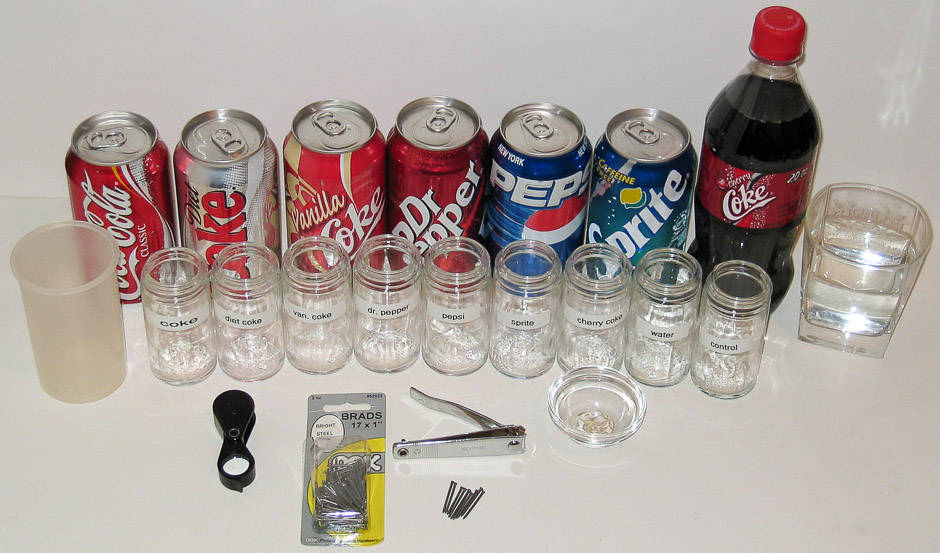
"Will Coke Dissolve A Nail?" Experiment – joshmadison.com
An experiment to see if Coke really dissolves a nail after four days like the email says
joshmadison.com
118 points · by selmat · 10y ago · 99 comments
Yeah well why would anybody believe that if a soda can be used in such ways that it is also bad for you? I mean I flush the toilet with water! With WATER! And it removes most traces of excrement... Arg, it must be bad for you!
But then again, vinegar is a fairly common cleaning agent: Baking soda and salt are fairly effective as well. I've used salt and lemon juice to clean tarnish off of copper: Toothpaste to clean the tarnish off of silver jewelry or shine up gold. None of these are viewed as bad or unhealthy in the doses we tend to consume them in. Vegetable oils and waxes are used in industrial applications: Soy can be used as a base for ink and lipstick.
Stomach acid itself is about as strong as battery acid, actually. And this is something your body produces and is necessary.
Basically: There are a great many chemicals that have multiple uses, and are only dangerous when used in sufficient amounts or on specific surfaces.
Absolutely, but I'd be worried about someone who chugged any of those things in the same quantity peopole tend to drink coke.
or to reverse it - do you know anybody drinking coke in same amounts as usage of vinegar when pouring over salad?
Generally, yes.
>and its ability to dissolve the material on which it is applied
(Bio)chemistry is a bit more complicated than that. But anyway, if you have calcium or similar waterproof stalagmites in your intestines, you'd better get rid of those asap.
What effectiveness? Who even does that? And from those who do it, who measured the effectiveness compared to plain water?
Gee, a simple metric might've been just to measure the mass of the nail before and after.
Phosphoric acid is used in some commercial rust removers and soldering fluxes for metals like steel, nickel or chromium.
That + a wire brush. It did much better than just water + wire brush.
I'd also be interested to see if it's at all possible to dissolve a nail in coke - perhaps by heating the coke, agitating it, and using vast quantities over a long time?
I imagine it is possible so long as the nail is made of something prone to corrosion, but I'm not so sure it would be from the ingredients in the Coke as much as the exposure to water.
Prone to acidic corrosion. Freshly machined stainless steel will rust unless its passivated in an acidic dip, you couldda chrome plated it but dissolving off everything not chrome ends up in about the same place.
Another good one is aluminum as in aluminum nails, pre 1980s house siding was aluminum for decades before it switched to short life vinyl siding, and aluminum is mostly impervious to acids and reacts very strongly to alkali. Technically pure aluminum will melt away in either, but the oxide coating is stable in acids and dissolves in bases, so in practice aluminum is acid proof and alkali melts right thru it.
Just turn the bike upside down, pour some coke down the seat tube, leave to stand overnight, and hit the seat with a mallet the next day.
But coke does help avoid the angle grinder approach.
Citric Acid will eat metal, which is why liquids like orange and lime juice are not stored in metal containers.
Still unclear what is meant by "iron". I mean, low carbon steel is iron with some trace impurities. Cast iron? Nails aren't cast, besides it's brittle and less prone to rust than low carbon steel.
The active ingredient in Coke is phosphoric acid. Its pH is 2.8. It will dissolve a nail in about 4 days.
Phospohric acid, which has a PH of 2.8 can dissolve a nail in about 4 days.
-- edited for readability
Can Fanta dissolve a piece of liver?
Yet another gem is
Can Pepsi be used to de-calcify and clean toilets?
Also there was the slight possibility that the keratin nail provided buffering that prevents the steel nail from dissolving. It would have been prudent to test them separately.
"Predicting if a Metal Will Dissolve in Acid" [0]
as well as
"Is Soda Acidic? – How Cola Impacts Digestion" [1] and "Why is phosphoric acid used in some Coca‑Cola drinks?" [2]
    > Short of drinking undiluted vinegar, cola is about the most acidic thing you can buy to
    > drink. The pH level of soda is approximately 2.5 (testing seems to come up with results
    > ranging from 2.3 to 3.5 but a pH of 2.5 is commonly cited...
[0] https://www.boundless.com/chemistry/textbooks/boundless-chem...
[1] http://flatulencecures.com/is-soda-acidic
[2] http://www.coca-cola.co.uk/faq/why-is-phosphoric-acid-used-i...
TL;DR: No.