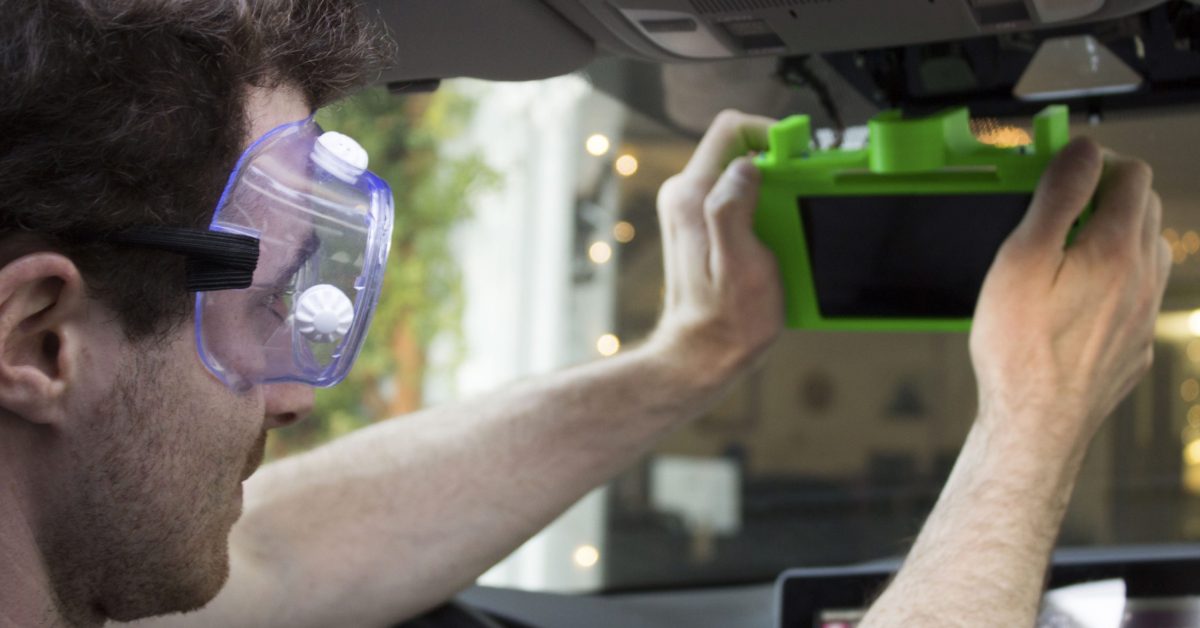
George Hotz cancels his Tesla Autopilot-like 'comma one' after request from NHTSA
George Hotz, infamous iPhone and PlayStation hacker turned CEO of ‘comma.ai’, promised to deliver an aftermarket product capable of advanced...
Electrek
330 points · by gatsby · 10y ago · 473 comments
> The singular includes the plural; the plural includes the singular. The masculine gender includes the feminine and neuter genders; and the neuter gender includes the masculine and feminine genders. "And" as well as "or" shall be construed either disjunctively or conjunctively, to bring within scope of this Special Order all responses that might otherwise be construed to be outside the scope. "Each" shall be construed to include "every", and "every" shall be construed to include "each". "Any" shall be construed to include "all", and "all" shall be construed to include "any". The use of a verb in any tense shall be construed as the use of the verb in a past or present tense, whenever necessary to bring within the scope of the document requests all responses which might otherwise be construed to be outside its scope.
I've seen similar paragraphs on other legal documents, but this is the most thorough I've seen. It's basically just a huge middle finger to all (any?) armchair lawyers who want to weasel out of the order.
I've been trying to convince people lately that Silicon Valley isn't all delusional technolibertarian assholes, but guys like this sure aren't making my case easy.
The government appears well aware of this hand waving garbage that companies are trying with "it isn't really autopilot, keep your hands on the wheel wink." This is exactly government's job and is a fabulous example of a government reacting to ongoing events that have proven that so-called autopilot systems are inherently a danger to the public at this stage.
Edit: grammar
And it is likely necessary. Meeting regulations is far harder and more expensive than just the feel good that you met the reqs. If there wasn't a stick held up as a credible threat, plants would just trash everything. Not because they're evil, but because plants simply can't care - they aren't people. Thusly these agencies are impersonal and brutal in kind.
Which article of the Constitution is that? I don't seem to recall it.
"We the People of the United States, in Order to form a more perfect Union, establish Justice, insure domestic Tranquility, provide for the common defence, promote the general Welfare, and secure the Blessings of Liberty to ourselves and our Posterity, do ordain and establish this Constitution for the United States of America."
Keeping its citizens safe would likely fall under general welfare.
It also raises the question of what you think the Bill of Right's purpose is.
Granted, it's a huge stretch for him based on the language of the letter, but that's how I read the situation.
The more software becomes mission critical the more we will need level headedness and quality rather than tantrums.
As I've followed these developments and those of Google and Tesla I've been wondering at times if I live in some alternate universe. The level of diligence and care that must go into systems which have the potential to maim an kill are nothing to laugh at. They require serious engineering which takes time. You can find the best and smartest humans on the planet and they'll still fail at building reasonable controls for life critical systems in controlled environments. When you are building these controls for life critical systems which will operate in the diversity of our roadways, honestly the task gets very hard.
I'm not against progress and I do think that self-driving cars are the future. However, it may be wise for those trying to march towards that future at breakneck speeds to take a step back and consider that these systems should first be implemented as backups to humans. Develop the solutions through preemptive braking and accident avoidance where humans are still very much engaged in the driving activities or focus on building expertise in controlled environments. On that note, kudos to Google for doing just that. Their first phase has focused on low speed situations and have been restricted very much to lab work whereby they have paid employee's serving as observers and backup.
The degree of care that went into the e-stop design of the lathe and mill controller and the number of checks and tests of the fuel estimation software are stuff that I'm (hopefully justified) proud of, that's not stuff to cut any corners with. In both cases that took me longer than Hotz claims to have spent on creating the whole self driving car code, there is no way you can do this safely with that mentality. It is absolutely irresponsible to take that attitude towards systems like this, life is not a video game with 3 more lives if you lose this one (or cause others to lose theirs).
For a machine with the potential to easily maim and kill, to be completely autonomously operated in a chaotic environment where it interacts not just with other computer controlled machines but also with humans, even children, I honestly hope that the amount of safety precautions required will grow very quickly.
I like Tesla's and what Elon's accomplished has been impressive but he seems hellbent on "winning the race" to release a self driving car and that worries me.
Is this a bad thing? Is it not justified by utilitarianism?
Makes sense, since they regulate the activity that is the 4th largest cause of death in the US.
In other words, is it acceptable to move fast, knowing it will cause deaths, if we could be certain the net lives saved would be greater?
Cruise Automation was very lucky to be acquired by GM before they got a similar letter. Similarly, Otto being acquired by Uber. They were both proposing to sell similar add-on systems. Their valuations would have been much lower after receiving such letters.
NHTSA has it right. "It is insufficient to assert, as you do, that 'your product does not remove any of the driver responsibilities from the task of driving'. As you are undoubtedly aware, there is a high likelihood that some drivers will use your product in a manner that exceeds its intended purpose."
Did Tesla got a similar letter? They have exactly that problem and exactly the same excuse. Tesla claims “Autopilot is an assist feature. You need to maintain control and responsibility of your vehicle.”
Here are three dashcam videos of Teslas crashing on autopilot. These are the three where there was a stopped vehicle partially blocking the left edge of the lane, and the Tesla plowed right into it. Tesla blames the driver. Looks like the NHTSA isn't buying that.
[1] https://twitter.com/comma_ai [2] https://www.youtube.com/watch?v=rJ7vqAUJdbE [3] https://www.youtube.com/watch?v=xoSNw_n1Xgk [4] https://www.youtube.com/watch?v=qQkx-4pFjus
Is it the same problem? One is an aftermarket kit vs being built-in to the car.
The level of rigor Tesla has applied to this problem, as cavalier as it may seem at times in the news, is many, many times that which was applied to what Comma.ai is building.
Tesla's mode == aggressive, but diligent.
Comma's mode == aggressive, and flippant.
Did Mercedes? Did Volvo? They have the same systems in place in production vehicles.
Mercedes even advertised their vehicles as autonomous.
http://blog.caranddriver.com/mercedes-benz-pulls-e-class-ad-...
> Here are three dashcam videos of Teslas crashing on autopilot.
Glad you had the opportunity to bash Tesla.
>One of the biggest flaws of the tech industry is the belief that being a tech expert is enough to disrupt other industries in which they don't have any expertise. Sometimes they get lucky and it works despite something like Uber's or Airbnb's total ignorance of the law. Sometimes it fails like with numerous cryptocurrency companies relearning why the finance industry has so many dang regulations. Seems like comma.ai is falling in the latter camp.
Take a look at the front page of Hacker News right now: in addition to this story, there's "Soylent halts sales of its powder as customers keep getting sick" and "Uber drivers win employee rights case" (presumably over Uber's fierce opposition). With 30 items on the front page, that means we've got 10% of the news in our field which could plausibly be parsed by outsiders as "technolibertarian assholes". I've been watching public opinion of the Bay Area startup scene gradually eroding in the last half-decade or so, and this is a big part of the reason; it's a real problem that we need to start thinking about.
[1] http://articles.chicagotribune.com/2014-03-26/news/chi-suit-...
Since he hasn't done the due diligence he's throwing a fit. Sigh... Looks like self-driving isn't something that can be accomplished Today without a good amount of resources.
With regard to the more general point of your post, even if it's nominally possible to eke out a profit under overburdening regulation, you're still allowed to take a principled stand against it.
They were planning to ship by the end of the year -- obviously the regulator should get involved before it's in the hands of users.
I've seen requests from regulators before. If you don't have or can't produce exactly what they asked, you call them up and tell them some parts will take longer. The point is to have a dialogue; the threat of sanctions is just to make sure you work with them.
He gets two weeks to provide an enormous amount of detailed information about the product, I assume under threat of legal consequences if any of it contains an error, interspersed with lots of reminders that they can and will close down his business if they feel like it.
He has announced the release of the product, was taking orders for it and said it was going to be shipping by the end of the year [1]
The timeframe here is driven by Hotz who apparently has not had any communication with the relevant regulatory agencies. Any attorney he hires would tell him "Okay lets push back the release to mid next year while we work with the NHTSA on resolving their concerns" and the NHTSA would probably be perfectly fine with working with him.
"Move fast and break shit" doesn't count when you're putting lives at risk.
lots of reminders that they can and will close down his business if they feel like it - yes and they should.
[1] https://electrek.co/2016/09/14/comma-ai-claims-to-have-packa...
You can't just wire up an Arduino to the CAN bus of a 4,000-pound missile and sell it on the open market willy-nilly.
best self-driving comment ever.
Which either he should have readily available, since he's the creator, or he should have known, since he should be able to demonstrate the safety of the device.
> I assume under threat of legal consequences if any of it contains an error
Usually you hand over what you have, then you negotiate with the regulator for a time frame to answer the more difficult questions. If you're unsure about something, tell the regulator up front.
The correct response is not to throw a tantrum and shut everything down.
> interspersed with lots of reminders that they can and will close down his business if they feel like it
That's the textbook definition of 'regulation'.
I think the correct response is to work with them 110%. Having that government body happy with you isn't a bad thing - you could become the reference spec for self-driving if you please them to an appropriate degree.
> That's the textbook definition of 'regulation'.
Right, and it's one of the big problems I have with this form of regulation.
I think it violates the idea of "Rule of Law", as opposed to "Rule of Man", which was one of the major factors behind the rise of modern free society.
Hmm. Regulatory capture? Yeah. That.
Here's a nicely readable transcript of what they wanted:
https://news.ycombinator.com/item?id=12817061
None of them sound particularly difficult to answer. Maybe they are difficult to answer in sufficient detail to satisfy the NHTSA, but you can always start out by answering them as best you can, and then seeing if they want more. There are people on the other end of this letter, not some unthinking machine. Toss off a quick response and say, "If you have any other questions or need further detail on the answers given here, please feel free to contact me at any time."
I think you have pretty much already assigned a negative agenda to NHTSA, when they've just requested some info.
While they may have followups if they don't like the answers they get, of all the agencies you find, NHTSA is not one that tends to have a serious pre-bias towards anyone.
There's only one question which could be considered too broad, which is compliance with safety standards, but it's generously worded as a yes or no question. He could simply answer "no, I haven't analyzed my product against against the safety standards".
[1] http://www.nhtsa.gov/Research/Vehicle-Research-&-Testing-(VR...
He said the NHTSA made "no attempt at a dialog". What does he call that letter? Ridiculous.
The truth is that rapid advancements in software development happen because most software has a failure rate which would be considered appalling in any real engineering discipline.
this all a pr move by andreeseen/horowitz to pump all their holdings in companies doing selfdriving tech. they prolly knew he'd never succeed.
jus odd to throw in the towel after the gov comes knockin esp after a $3 mil investment like these investors are smart are we honestly supposed to believe they didn't know this was going to happen
eh or maybe $3mil ain't nothing and they's jus threw it at him because jus maybe he could do it if not it's a win win
probably both.
His follow up tweets imply he's moving on to China, since they're less likely to be a major hamper of innovation.
And we wonder why the United States' influence is in decline...
Really, this sort of thing should be done in a much more controlled environment before pulling the trigger on releasing it on the unsuspecting public.
Read the bloomberg article and be amazed.
Another way to look at it: western foreigner looks to beta test a product with the lives of Chinese citizens. I'm not sure how well that's going to go over.
Yes, the penalty is scary looking, but it is par for the course. You don't get exposed to it if you are doing amateur/freelance/e-commerce.
As soon as you touch critical national infrastructure (Telcom, NTSB, Healthcare, finance) then you have to deal with the government, which never forgets to remind you of the threat of authorized violence and financial penalties.
If you want to play at the high stakes tables, you have to pay the blinds. If that's too scary, then stay at the smaller tables.
The unfairness commentary here is pretty naive.
So why "quit" when the feds ask you to deal with regulations that involve passenger safety. Its not like he had to spend $20M on clinical trials.
Comma's approach was complete end-to-end learning with just a single camera (to give you some context, research problems involving two cameras are already considered distinct (but related) research problems from those involving one camera), which is an extremely different approach (the Google/Uber approach can be thought of as more "handcrafted"). From the deep learning researchers I know of there was heavy skepticism of Comma's approach. End to end learning makes for nice demos but is still an active research topic.
From what I can tell, Mobileeye is somewhere in between an end-to-end approach and a handcrafted approach, so I would guess Tesla is similar to Mobileeye on that spectrum.
One of the things that seemed missing from the lecture when I watched it is how data was going to be collected for handling exceptional situations/collision avoidance. Hotz also glossed over the question in this interview from July: https://www.youtube.com/watch?v=2zy_07g2IrM#t=35m
I suspect they ran into trouble with edge cases. Also suspicious is this job posting on their website right now:
"Localization Lead Engineer DESCRIPTION
We have over 50,000 miles of video data from cars, and will have millions by the end of the year. Looking for someone to build a SLAM algorithm capable of scaling to the world.
Imagine an API that, given a picture, returns the exact location of the camera with cm accuracy.
Build this
REQUIREMENTS
    Strong math background.
    Ability to write concise, reliable, and readable code quickly.
    Github with stars is nice.
    Computer vision experience a plus.
http://www.comma.ai/positions.html
Hotz has been claiming that they would not need mapping and SLAM like Google's self-driving car. The whole "Looking for someone to build a SLAM algorithm capable of scaling to the world" sure sounds like "I guess this time he couldn't find anyone on IRC to finish the hard parts for him and let him take the credit" that lawnchair_larry posted elsewhere in this discussion (https://news.ycombinator.com/item?id=12818219).
This has got to be a joke. Text like this proves he was out of his depth
Money isn't everything to some people. He has the true hacker ethos.
Maybe they're all losers and you're a winner, but perhaps being an elite hax0r isn't all that's needed to go to market...
If you can't reply to a regulator letter, how are you going to deal with supply chain or cash flow issues? Bad reviews in the press or on Amazon? People who want refunds? Not to mention the literal horror of a car crash. To borrow a term injected into this election season, you gotta have Stamina.
On the other hand, I am really concerned that he and his team didn't appear to think about working with the government agencies beforehand to sort out any regulatory requirements in order to prevent this kind of situation. Shocked!
Well consider the attitude of SV hackers toward the established auto industry. They think we're a bunch of... I dunno... rust-belt, old-school, last century, bumblefucks who don't understand technology. Given that attitude it probably never occurred to him that there might be people or even regulators taking this stuff way more seriously than him.
(Oh, and in case anyone responds with "well let's see your code!", please note that I'm not the one making asking people to trust their lives to my code, making wild claims about what I've built, nor issuing challenges to the likes of Tesla.[5])
[1] https://github.com/geohot/kvm-kext/blob/master/main.cpp#L642
[2] https://github.com/geohot/kvm-kext/commit/082b7ca99cba4c3b9c...
[3] https://github.com/geohot/kvm-kext/commit/96441be079562b0dd0...
[4] http://www.bloomberg.com/features/2015-george-hotz-self-driv...
[5] https://electrek.co/2016/04/06/tesla-autopilot-comma-ai-geoh...
He spoke so derisively about other companies that failed to deliver, and now because of the inevitable paperwork that comes with a product that takes over your car for you at times (level-3 autonomy iirc), he too fails to deliver.
If he leaves to join Tesla, it seems pretty irresponsible, given that he's raised $3.1M and has a team of employees relying on him.
But that's all speculation until we see what comes next.
Perhaps I'm unimaginative at ~1:30am, but I can't imagine what he wants comma.ai to do, unless he sells or licenses the product to automakers who can do the paperwork for him.
It's a self driving car (or rather a prototype of an "autopilot" feature like Tesla's), AFAICT.
From [1]:
> After a couple miles, Hotz lets go of the wheel and pulls the trigger... Hotz shouts, “You got this, car! You got this!”
> The car does, more or less, have it. ... Amazed, I ask Hotz what it felt like the first time he got the car to work.
> “Dude,” he says, “the first time it worked was this morning.”
[1] http://www.bloomberg.com/features/2015-george-hotz-self-driv...
And just to confirm, your summary is correct. It's not self-driving, but it is lane keeping and intelligent cruise control adequate for fully automatic highway driving in normal circumstances, like Tesla's current Autopilot is. It was to be an aftermarket accessory that could be installed by the buyer, presumably hooking into the OBD2 port and controlling existing servos. The initial release was to focus on a small number of Honda and Acura models which already have lane assist and cruise control features, but not as sophisticated, so it was able to take advantage of that existing hardware and extend its functionality.
I don't understand how a startup like Cruise can get past this regulatory hurlde in the US but Hotz can't.
On the other hand, Shenzhen is the world capital of electronic / hardware components sourcing, manufacturing & production. Geohot's trip to Shenzhen may or maynot be an indication of his intention of releasing comma one in China but rather an expected visit to check up his product manufacturing.
Also, perhaps Cruise have already been dealing with government agencies and perhaps in compliance of regulatory requirements so that we don't hear about same trouble for Cruise.
Disclaimer: Worked for a company exporting an "organic" product from China - which meant paying the harbor master a rather large fee per ship to have them labeled as such. When the product arrives in the US and other countries, it's treated as being whatever it is labeled as.
What's interesting in China is they have in the past executed people for white collar crime in addition to regulatory officials as well. This though can happen for a variety of reasons unrelated to regulation, rather corruption, being in a rival faction of the wrong people, etc. Anyway, I am not saying it happens a lot or every day, but rather it seems tolerance with regard to regulators and corporations is not necessarily unlimited, especially depending on who's pockets you are lining and where you are from.
Google, Uber, and so many others have struggled and are struggling still.
Here in North Texas I just took a weird exchange between two major highways (I-30E to Loop 12N) and at night, poorly marked lanes, very aggressive exit/entry points, and the first thought that popped into my head was "There's no way a Tesla autopilot - or anything - on the market today could navigate this at posted speed even in ideal conditions."
I'm sure it's a bit over-the-top of me to come up with such useless tests, but I love driving and wish there was as much emphasis on actual driver education as there is on innovating driver-less vehicles.
I don't think it is a matter of passing the regulatory hurdle; it's a matter of not wanting to deal with it.
The media on the other hand... I am sure filling the 24x7 news cycle up every time one of these cars gets in an accident and never covering the advancements has a chilling effect.
It's hard to over-state the role of federal R&D funding in the development of self-driving tech.
Every accident that happens and person who dies is a death that could have been easily prevented if companies had been allowed to go to market last year.
I feel like there is some backstory here I've never heard.
It seems that Hotz said, “dealing with regulators and lawyers… isn’t worth it.”
Which seems very unfortunate/shortsighted due to how useful this tech could be. Why not hire someone to deal with them for you?
And that second part is part-and-parcel of wanting to operate in this space.
We can refuse to be real engineers (it is a great responsibility), but then we should drop the title.
In any case, a software engineer still has legal liability. Maybe someone who works on mission-critical systems can comment more specifically here. Maybe it's contract based vs standardized.
It's either taking a long time in order to be in compliance / certified or very costly or both.
Hotz mentioned a 2016 end of year shipping date, it's impossible to do that if they have to "dealing with regulators and lawyers".
He is truly an example of an irresponsible engineer and a great lesson to learn from.
He published a paper with their summer intern here: https://arxiv.org/pdf/1608.01230.pdf
On the other hand, the arxiv is also the default method of communication in quite a few fields (physics and maths, mostly), to the point that while grant committees etc. look at your peer-reviewed papers, I essentially only check the arxiv for new developments, not the plethora of properly peer-reviewed journals.
Whether it's something that falls under government regulations like Hotz's project, or transitioning from a couple of 3D-printed models in your basement to an injection molded factory, making things (at scale and in the real world) is hard.
It's so obvious it seems almost Freudian ...
Less charitably, it's step one toward Tres Commas.
Also, one comma would be $1000, which is what the thing was supposed to cost.
Besides, isn't one comma 99k worth of room? It's marketing lingo aimed at the hubris of venture capitalists.
Do I think there's significant political pressure to have his product, ahem, driven into the ground as to not be a viable competitor to larger firms? Yes.
Do I think it's a sign of immaturity to pack up your stuff and leave when confronted by a small challenge? Yes.
Do I think dealing with the NHTSA (and potential NTSB) is a small challenge? No.
Am I still a fan of George Hotz as both an inventor, innovator, and persona? Yeah, I can see where he's coming from.
Do I think it's hilarious that a vocal contingent here criticizes him for taking a "path of least resistance" (regulation) in his development and iteration process? Absolutely.
I think it's likely that he's getting exactly the same treatment one of those "larger firms" would get if they did the same.
The difference between him and those "larger firms" is that the "larger firms" would've been planning for the regulatory checks from the start. They would never have been blindsided by a request for information because they'd have known this stuff is a legal requirement and would've been proactively having discussions with regulators, figuring out what they'd need to provide, etc.
And speaking from what I've seen working at a startup in a heavily-regulated industry: federal regulators aren't black-suited startup-killing robots. They don't seem to care much how new or "agile" or "lean" or "disruptive" a company is. They care that the things or people protected by the relevant regulations... are actually protected. Crazy idea, I know, but it certainly does appear to be the case most of the time (cue people lining up with anecdotes to angrily tell me I'm some kind of statist apologist whatever and shouldn't be listened to...).
Journalists being shown demos in controlled circumstances are a notoriously unreliable source of information about the viability of a product.
However, I think that in this case, the author of the tweet has a lot of credibility (https://twitter.com/AlexRoy144/status/791996855114694657) as the holder of multiple performance driving records. You're right that it is only one anecdotal perspective, but it's kind of like a prominent Apple blogger tweeting that a new Microsoft product has phenomenal UI. It's just one perspective, but (to me) it's interesting enough to merit further consideration.
To stretch your analogy: when the FCC sends Microsoft questions about the product's RF emissions, does the prominent blogger's endorsement really matter? Firstly, RF is out of the blogger's wheelhouse and secondly, hypothetical Microsoft ought to have planned for regulatory compliance from the beginning, or at least have the technical specs recorded somewhere.
Domains like medicine, roads,... life critical engineering makes me feel the hacker way, reckless plan (path of least resistance) is wrong.
I think it's awesome that a government agency said that this practice is not acceptable when someone's life is at stake.
1. Describe in detail how the comma one is installed in a vehicle and provide a copy of installation instructions for the comma one.
2. Describe in detail the advanced driver assistance features of the comma one, including how those features differ from the existing features of the vehicles in which the comma one is intended to be installed.
3. Describe in detail how a vehicle driver uses the comma one and provide a copy of user instructions for the comma one.
4. Provide a detailed description of the conditions under which you believe a vehicle equipped with comma one may operate safely. This description must include
a. The types of roadways on which a vehicle equipped with comma one may operate safely;
b. The geographic area in which a vehicle equipped with comma one may operate safely;
c. The speed range in which a vehicle equipped with comma one may operate safely;
d. The traffic conditions in which a vehicle equipped with comma one may operate safely;
e. The environmental conditions in which a vehicle equipped with comma one may operate safely;
f. The amount and type of driver inputs necessary for a vehicle equipped with comma one to operate safely.
5. Provide a detailed description of the basis for your response to Request No. 4, including a description of any testing or analysis to determine safe operating conditions for a vehicle equipped with comma one.
6. Describe the steps you have taken or plan to take to ensure the safe operation of a vehicle equipped with comma one, including but not limited to automated shutoff of comma one features and owner education.
7. Provide a list by make, model, model year or year of production of each vehicle for which you support or anticipate supporting use of the comma one.
8. Describe in detail any steps you have taken to ensure that installation of the comma one in any supported vehicle does not have unintended consequences on the vehicle’s operation.
9. Describe the functionality of comma one, if any, if installed in an unsupported vehicle.
10. Have you done any analysis or testing of the impact or potential impact of comma one on the vehicle’s compliance with the FMVSS? If yes, please describe the analysis or testing in detail and provide supporting documentation. If no, describe why not.
11. Describe in detail how the comma one impacts a vehicle’s rearview mirror, including whether it requires removal of the rearview mirror or the extent to which it blocks or obstructs the rearview mirror.
12. State your position on how the comma one does or does not affect a vehicle’s compliance with FMVSS No 111, Review Mirrors (49 CFR 571.111), and provide any supporting information or documentation to support your position.
13. State the date on which you currently plan to begin selling the comma one, and provide a list of all retailers and/or websites through which you anticipate selling the comma one.
14. State the date on which you currently plan to begin shipping the comma one.
15. Provide any other information which you believe supports the safety of the comma one.
Even the simplest (non-safety-critical) systems in automotive requires typically a lot more documentation. E.g. if you have to prove that your development process is automotive spice compliant then you need documentation for everything - from detailled requirements to test conformance. For safety critical stuff it's even more.
This letter is designed to kill the company. That is a result I support, but, the people saying "This letter is designed to kill the company" are entirely correct.
I think that he could have gotten away with showing a substantial effort towards answering the questions and getting some kind of experimental license to verify the technology is viable, I emphatically do not believe that the goal was to 'kill the company' given that all these questions have - for the automotive industry - reasonable answers and that if Hotz was serious about this that he should not have been totally blindsided by this request.
If he was then he should probably have researched the space a bit better before embarking on the project, it's one thing to be a 'hot hacker' but it's quite another to go into this business without the required knowledge about what being in that business will entail.
Trying to imagine SpaceX/Elon Musk backing out of the rocket business because 'the paperwork is just too damn complicated and lawyers are no fun', ditto for Tesla, Google or any other party that is trying to re-vamp some branch of industry.
If the tech is for real the reporting requirements are a reasonable extra cost to be born by the company, the amount of money available for this tech would dwarf the cost of the reporting.
You can respond pretty much with anything that accurately answers the questions. If they want more detail, they can then ask for it.
I don't get where this strange idea that if he doesn't provide 100k pages, he's going to be subject to a fine immediately comes from. It's 100% completely and totally wrong.
If he literally answers the questions, he's fine. If they want more detail, they can ask for it.
The letter is not designed to kill the company, and the people who think so have probably never dealt with any regulatory agency.
My source on this, btw, is that i've dealt with many regulatory agencies many times.
They aren't psychos, even when they are adversarial.
To give you an example, when involved in a pretty adversarial issue with the DOJ, i cannot say they were anything but professional.
When the DOJ wanted more info on something we said "hey, can we just sit down for an hour and chat", and they'll usually say "great, let's do it", and then maybe they'll say a few weeks later "hey, thanks for doing that, we have some more questions about x, can we set up another hour" and so on. Are they always like this? No. (am i the most experienced person in the world? also no, it's also not what i do anymore at all, but this was my experience with pretty much every agency, every time)
But the vast majority of the time, they literally are just trying to gather info to decide what to do.
It's only when they are trying to actually get a particular result that things change. But you'll pretty much know when that happens, and this ain't it.
The only agency i've ever seen just be outright hostile is the CPSC.
The NHSTA, in my experience, is pretty much one of the most level headed and professional agencies you will find.
If you have actual evidence to the contrary, where they have "shut a company down", i'd love to see it.
https://www.nhtsa.gov/staticfiles/communications/pdf/Honda-r...
This letter is designed to give pause to (e: previously I wrote "kill") a company operating with complete disregard for proper operations in a regulated industry.
I have no idea what FMVSS is but that there are regulations here should be obvious, no doubt this would be something you'd become aware of after a little bit of research. As a consequence you should have an answer to that. This covers 10-12.
13 and 14 he should have known at the top of his head. 15 it seems you could just say you've nothing to add or drop whatever else you have on hand.
Nothing about this strikes me as unusual, unexpected or hard to answer. There is no way this is the reason Holtz gave up unless the product is a complete failure, he hasn't run any safety tests whatsoever or he's using this as an excuse to cover up something else.
Modifying a car is one thing but directly interfering with parts critical to safety?
I think that's the reason he's bailing - he doesn't have the lawyer crew, he doesn't want to play the law game - he just wants to create things.
Turning a risk analysis into a deliverable suitable for interfacing with federal regulatory bodies is actually fairly easy. You're just generating a report on engineering work you already did. It's only hard if you want to get away with not mitigating risks (or high levels of residual risk). Because if you document the risk, it serves as proof the engineering team knew about the risk when the product was brought to market.
There is some gap between just wanting to create things and to create things that impact personal body integrity. It is of some concern that in today's software engineering environment that this is even a question.
It would be so much easier to respond if you could just do exactly the same thing that the larger players did.
Unless, of course, those other companies didn't have to produce any such documentation. In that case, clearly, every last company working on autonomous vehicle functions would have to receive a substantially similar order, post haste. We wouldn't want anyone crying about selective enforcement, after all.
There is quite a lot of "voluntary" in there, along with "future regulation". I would guess that a lot of the voluntary safety assessment letters they get essentially say, "this is not entirely safe in absolute terms, but is definitely safer than an inattentive human driver."
Also: secret commercial information is exempt from FOIA.
The commercial info is not necessary. They need to learn and follow the forms and protocols, and at least pretend to to be respectful when kissing the ring. If GeoHotz ran a restaurant, I wouldn't want him to be the one talking to the health inspector, either. He has the wrong personality for it. You really want the schmooziest suck-up in the company to do that stuff.
I fully expect that all the companies with compliance departments have reams and bales of responsive documentation. As comma.ai appears to be clueless with respect to regulators, the more sample material that they can look at to crib the correct answers, the less likely it is that regulators would summarily drop the axe rather than try to work with them in a reasonable manner.
The FOIA route is appealing because it feeds into a sense of perceived indignation.
But the most important thing to copy from the large players is never going to be spelled out in their submissions.
I'll let everyone in this thread in on the secret: hire someone that specializes in quality management systems.
George, "that wouldn't work" :)
(Edited to reflect the point more politely)
Are you suggesting people should be rude to you when your product is shit?
https://github.com/commaai/research
The last blog post talks about them having a system for the 2016 civic. I guess maybe they will sell it on aliexpress?
Besides, if Hotz can get his car to navigate China before Musk can get his product to not drive in the wrong lane in a fucking parking lot, then we've got game on.
I wonder if his choice to cancel Comma is related to Tesla's recent announcement that all new Tesla vehicles would ship with a full video camera outfit.
This is factually incorrect.
Tesla vehicles rely on Mobileye [1] cameras to do its environmental analysis. These cameras come with the processing hardware to analyze the sensor data they're getting, and spits out environmental information that the driver assistance [2] can use to navigate the car.
Whether Tesla had access to the sensor data directly rather than just the analyzed stream is not public information. Now that Mobileye broke up with Tesla [3], it's unlikely they'll ever have it.
Mobileye has years of experience in dealing with the kind of visual data you need to have on the road, such as crazy HDR (you want to be able to extract useful information when the sun is glaring at you as well as in the dark woods in the night, and be able to switch immediately as when you're going through a tunnel). They've developed dedicated hardware to reliably and quickly do object distance and velocity detection: this is exactly the scenario that a "Real-Time OS" is made for. You cannot afford to be pre-empted and lose 5ms on your analysis and miss an action frame.
Thinking you can pull this off reliably with a non-RTOS and consumer cameras is... naive.
[1] https://en.wikipedia.org/wiki/Mobileye
[2] Mobileye's equipment was never rated for full-on "Autopilot", which is why they were very unhappy with Tesla marketing their systems as such
[3] http://www.wsj.com/articles/mobileye-ends-partnership-with-t...
This was admitted by Musk on Twitter following the fatal crash in Florida: https://twitter.com/elonmusk/status/748625979271045121
I'd like to see GH's Failure Modes and Effects Analysis, Fault Tree Analysis, Failures in Time Analysis, etc., etc., etc.
This stuff is really safe and not there yet for a REASON.
[0] https://www.scribd.com/document/329218929/2016-10-27-Special...
Actually, now that I think about this more... does Tesla's autopilot have ISO 26262 certification? I hope that the recent advancements in self-driving cars isn't a result of tech companies bending or breaking the rules, but I don't know enough about when ISO 26262 is required (if at all).
Still personally rooting for him because I personally think his product is amazing, and is poised to be a huge success if he does ship.
As an outsider, his audacity, backed by proven technical smarts, seems to be the quality that should define the Silicon Valley startup scene, but over time, sentiments here at HN and other forums seem to suggest otherwise.
"we didn't do anything wrong, but somehow, we lost -- nokia, or car companies in 5 years"
What is the role of the national highway transportation safety administration wrt driver less card and trucks?
Can they issue rules? Can they prevent deployment? Is it for cars and trucks? Once driverless exists will there have to be a differentiator for auto/truck?
Yes. They are a federal regulatory agency.
I hope George learns all the lessons he needs from this to make whatever happens next a success.
It looks more intimidating and scary than a friendly "hey, we want info about your product".
I thought this was an interesting perspective - Alex Roy is famous in car enthusiast circles for his driving records over the past 30 years. He's set speed records with drives across the US and around Manhattan, and has set electric/semi-autonomous records in a Tesla Model S in August 2016.
The point being that Alex Roy has probably spent more time thinking about driving, planning trips, and understanding traffic rules than most other people alive today. His perspective is just a single perspective, but given his massive experience with car-driver systems I think it's an interesting perspective.
I don't think we should presume that the guy who defied Sony, AT&T, Apple, and the DCMA is doing any such thing.
Maybe he discovered a flaw in the design of comma AI or something.
https://news.ycombinator.com/item?id=12492856
I'm really not overly negative about new things but this was predictable.
nuclear energy, supersonic planes, etc. - applying the "disruption" and "agile" method does not work everywhere, to put it mildly.
https://electrek.co/2016/10/28/george-hotz-cancels-his-tesla...
It looks to me to be fairly mild and entirely reasonable. To immediately respond to this letter with "fuck it, we're not going to make this product anymore" is bizarre, and not the government's fault.
I also think it's likely that he never actually intended it to become a real product and it's all about the journey and experience.
---
[0] Of course, there is much valid debate as to whether we really -know- how to do this either. But legacy and history carry weight, unfortunately, either way
1) Figure out how to explain a nuanced argument to their constituents.
2) Block progress until their explanation problem goes away (in this case, by raising the benchmark).