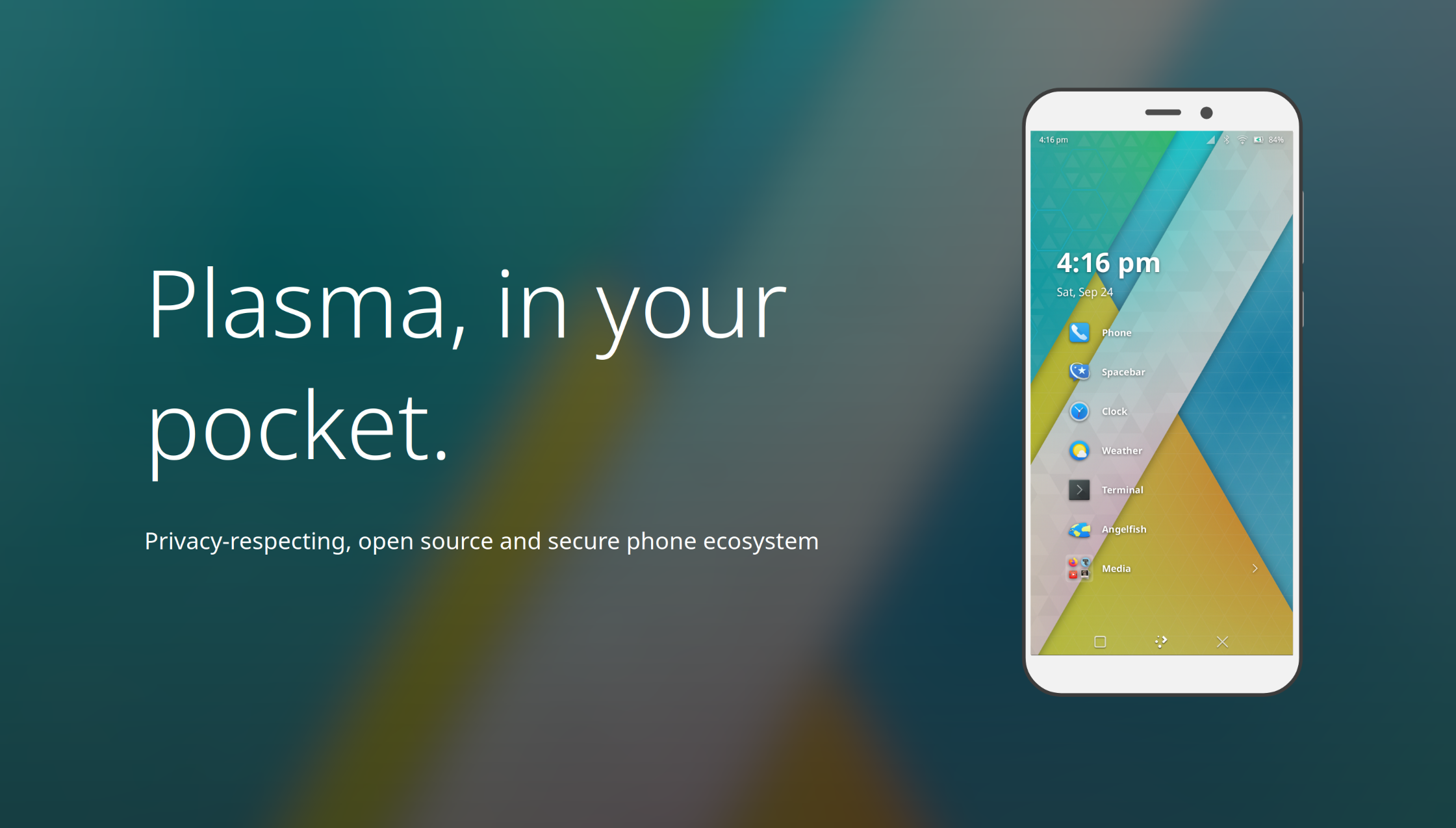
Plasma Mobile
An open-source project to create a mobile shell and application ecosystem for Linux, based on KDE Plasma.
Plasma Mobile
615 points · by mintplant · 10y ago · 268 comments
As this catches on, it only helps improve linux hardware (ARM) support, telephony applications for linux, and the like. As well as being able to have (or make for others) a truly remarkable user interface and apps. This is a mobile computer, running linux, running a desktop environment (not webkit, or Java VM, or closed source code) that only limits what you can make by your skill and imagination.
Yes it looks pretty mediocre now, but that's because its waiting on you to get involved.
I loved always having access to a physical keyboard and an actual root linux shell out of the box without any hacking. I loved that my n900 behaved more like a computer and less like "mobile" device.
Too bad Nokia decided to end support for the n900. Most of its developers and lots of its users abandoned ship, and now I only use it as a camera because the n900 is stuck in 2009, and the web in 2016 is so bloated and heavy that nothing- not even the web browser or the unupdated apps- are usable now.
Also, look into the neo900 project and Pyra. Neo900 is trying to upgrade the n900, and Pyra is the successor to Pandora, which is a pocket computer in a semi-similar vein to the old nokias. Neither is finished, but they're worth a look.
Reading this made me so sad. This is exactly how I feel. Nothing will ever be good enough again. :(
As mentioned, it'd be a usable device on its own to this day. If newspaper sites hadn't become unusable without an adblocker, if I didn't need browser updates every nanosecond and if the latest memory-hogging web trend language wasn't, well, what it was. I'd still use it.
Now I own two mobile devices. A BlackBerry Passport. Great UI, physical keyboard, indestructible. Dead software ecosystem, horribly closed source, last of its kind and while there's a lot to love It's not hard to see why. Then there's a rooted HTC phone. Great choice of software (termux alone makes up for so much). Hate hate hate ssh'ing with a touchscreen. Typing generally. Terrible battery life. Seems like it'll die from one harsh drop.
If my social life would not force mobile messengers on me, I'd have gone back to 20€ dumbphones and text/voice only. Though I bet even those come with a horrible browser and the accompanying remotely exploitable holes now.
All in all? Wonderful project. I'm very much hoping for a third player in the mobile game.
I used it as my main phone when travelling for years and it worked everywhere I needed it to when other phones wouldn't. I'd use it for getting unwacoughted access to WiFi when I was in a tough spot. I'd manage my servers with it. I'd use it to emit music through the radio on car trips and such (why is this no longer a thing?). I could even push my own programs on it without having to make a sacrifice to the phone gods. I'd also kill for a keyboard like that again.
But no, instead you have to get a hobbyist device or get one of the many shiny slabs running (poorly) one of three (and I mean, really, two) ecosystems.
So many of us miss that phone.
Android is 100% native code since that version.
Even the changes in Android 7, although they use an intepreter written in Assembly, the code is JITed with profile information, both are cached and it gets ultimately fully compiled to native code when the device is charging.
Also in case you didn't notice, Apple is pushing for LLVM bitcode for their newer OS versions.
There is even a BOF on this weeek's LLVM meeting about how to make LLVM IR fully hardware neutral.
Your points are still relevant, don't get me wrong, but the system isn't running Java bytecode specifically.
Google just used the Java language and APIs. But never it's byte code or VM.
Nowadays, the next best thing is the Pyra, but that still has't been released.
By the way, have you seen the neo900 project? It sounds like you would be interested, although it is also incomplete.
The n900 is everything that I thought the g1 was going to be, but wasn't. In a way, it was my fault for blindly creating my own hype over a first generation product I knew nothing about. The g1 turned out to be my bad and disappointing foray into smart phones.
Also, yes I have heard of the neo900 project, but am sad that the project is so far from its goals. There will never be enough n900 users to meet a crowdfund. :(
I'll give you the keyboard though. Nothing beats a full keyboard.
How much extra power do we have to cram into the device just to achieve the same performance?
Back in the late 90s/early 2000s, you could just run Linux on your x86. Sometimes half your hardware didn't work, but as long as you could get Ethernet and display you were in pretty good shape usually. The thing is, you could install it. You could try it.
With ARM, everything is so specialized. Looking at the forum posts for this thing, half of the threads are about porting to devices.
The manufactures have no incentive to standardize the platform. They customize to a device and it's better for them if you just throw it out in two years when they drop support.
A limited number of hobby devices now use the device tree configuration, but the ARM platform is far from being as standard as Intel or Power.
If the Ubuntu Edge had been funded, I think we'd be in a difference space with at least a handful of devices that had some standardization (if only to accommodate Canonical). As it stands, ARM fragmentation is a huge problem for hackers/devs.
Also SOC manufacturer usually has the drivers reference code but he might not publish it.
Generally not. Linux kernel modules generally can't be loaded by kernels with different versions, as the ABI constantly changes. It can be hard to use them even with the same version, if it was compiled differently. This is why they're always pushing for the drivers to be open-sourced and submitted to the kernel project for inclusion, because maintaining them separately is a giant PITA.
Phone makers don't bother because they don't care: they're not going to maintain the drivers very long anyway.
ps: I was actually looking into FDroid to free myself a little from Android locks, wishing for a simple linux + ssh + any signed code I wish.
The polish it has is unbelievable.
The question is: how? The website doesn't make it very clear to developers (after a fairly quick skim on my part, at least) as to how they can help with the initiative. I have a Nexus 6p, and it seems like my device isn't supported, but how can I maybe help with porting to a new device?
It had most of the downsides of android (closed drivers, no updates after 6 months, buy a new device or get exploited, beholden to vendors, OEMs and telcos which invariably suck, central control over software distribution), and zero of the upsides (abysmal performance [even the dialer was a laggy mess], lack of software)
Except for the fact you might trust Mozilla more than google, it wasn't anymore meaningfully open than android, and suffered crippling drawbacks in comparison. Nobody except a few developers cared that you can write apps in html/js.
Plasma sits on top of the Android HAL like Firefox OS did. Nothing different there. Go buy you QC license and see for how long you'll get blob updates.
You're totally wrong about the performance penalty of FxOS compared to Android on the same hardware, but I'm done arguing that with trollaways.
I don't see that detail mentioned on the site. Perhaps people familiar with KDE and Plasma know, but I don't. Or perhaps I'm overlooking something obvious ...
EDIT: Wikipedia says that Plasma is a desktop environment, not an OS, and that "Plasma Mobile is a Plasma variant for smartphones".
For mobile developers, the biggest difference is that they'd be using the Qt framework instead of the Android framework.
So the pitch at least for mobile developers, should be why it's a more pleasant and better (and more productive) experience to develop mobile apps with Qt vs the Android frameworks.
I'm not how much better Qt is going to be since I haven't used it. But I've been a long-time desktop Linux KDE user, and one of the biggest gripes I have with KDE is that its quite unstable and buggy compared to Mac and Windows.
KDE 4 became almost very-stable with 4.13+, but the early version of KDE 4 were horribly unstable. With Plasma 5, from what I hear, things got worse again.
This is the biggest problem, I think. To the people who have actually used KDE on deskotp Linux for a long time, how many of you have enough confidence in the stability and reliability of a mobile Qt/KDE environment to use it everyday?
I switched to Plasma 5 about a year ago, when the first stable version landed on Arch linux. It's been a daily driver since. Initial versions had lots of bugs in them - persistently high CPU usage. Sometimes the desktop hung for no fault of the user. Proper resumption after standby/resume was a lottery. On the plus side, the Breeze theme was a breath of fresh air compared to the older Oxygen theme.
Since version 5.6 was released things have improved and keep getting better with every new version. There are still occasional cockups with Intel graphics drivers leading to high CPU usage. The problem though seems to stem from the Qt libraries. Some GTK 3.x apps don't show proper widgets (blame Gnome devs for not having consistent themes for 3.x versions). I did give other DE's a go - Gnome 3.xx, Cinnamon, XFCE etc., but always ended up switching back. Plasma offered the best mix of customizability, performance and aesthetic appeal for me.
But for some reason they use marketing language to make it look like they have invented some new mobile OS.
By the way, it doesn't look very secure:
- first, you have to unlock the bootloader. It means you can install custom firmware but anyone having physical access to your phone can do it too.
- Google did a lot to make Android more secure. For example, every application is run under a separate user account to protect it from other (potentially malicious) applications. Applications' privileges are restricted. KDE doesn't have such features.
So if you like KDE or want to run or maybe write KDE applications this project will help you. But you'll have to forget about security and I guess the project is in early development stage now so there can be bugs and something might not work.
https://news.ycombinator.com/item?id=12861481
It turns out it runs Neon, in a container, on top of Cyanogenmod. They formerly used Ubuntu Touch, but no longer.
My favorite mobile OS so far has been Meego that ran on N9. That device was mind blowing and that OS. Amazing. It had such a simple, yet useful UI. Multi-tasking was better than what even Android has now. I hope Jolla doesn't die like that and we see a lot more devices come out running Sailfish.
http://i.imgur.com/J82pZMh.png
You'd say that is flashy? Just curious :)
I mean checkout this: https://www.kde.org/announcements/4.3/images/kde430-desktop_...
Too much going on. Too much transparency, too much eye candy as if everything is made of glass. Plus the unnecessary widgets to hold desktop icons. I'm no expert in UI/UX design but as a user I find it unpleasant.
Just other day I was trying latest Ubuntu on a pen drive and I couldn't believe that renaming a directory now open a modal dialog that asks you for the new name of the directory. WTH? What was wrong with the inline directory naming? It was perfect and everyone else does it. It's such a basic thing to understand. You rename an item and edit it's name inline. You see all the time what you are remaning. As soon as you rename it, you see the change take effect immediately and see the new item take new place if sorting changes. Instead we now have a modal dialog that that asks for the new name. I also couldn't find any "create new file" in right click. What was wrong with that? IRRC, the search button also does open a dialog elsewhere.
Then come GnomeShell. That thing has 4 different types of controls on 4 edges of the screen. Every edge has a different control. Left has dock, top has a panel, right has workspace switcher and bottom has yet another panel which hosts different indicators than the top panel. I think bottom one handles 3rd party app indicators. Why do I as a user have to remember which different positions for different indicators? If I open something from top left corner (launcher) and want to switch workspace, I'll to drag my mouse all the way from top left corner to the right edge. I just don't get it.
I do actually really like Unity7. It's simple, clean and yet powerful. All indicators are in 1 place, switcher is simply inside dock and has amazing keyboard accessibility. I hope Unity8 doesn't ruin it with it's focus on mobile.
/rant
I don't hate Gnome. I love Gnome and has great respect and gratitude for it's developers. They are some of the best developers I know. It's just that the recent UX decisions have made it unusable for me and it kills me to think about how amazing and simple Gnome could have been.
It may be underpowered now, but that physical keyboard still makes my envious: I could almost maybe write code on something like that.
  > It may be underpowered now, but that physical
  > keyboard still makes my envious: I could almost
  > maybe write code on something like that.
It was slower than swype & variants for normal (mail, sms, etc) writing.
The physical keyboard had the benefit of providing relatively easy access to 'dev' keys - esc, ctrl, special characters. But it was so teeny that even as a proficient user (it was my primary phone for 3-4 years) the experience was arduous.
Years later I bought a tablet + BT keyboard (a Logitech one with the hard clam shell that became the stand) and that experience is much preferred. Would work well with a phone too, if you're happy with a small screen. Not pocket sized, certainly, but the keyboard is actually usable.
But I could and did use it to write and edit long-form prose.
It's way better than a touch-screen for shelling in and fixing server issues when you're stuck at a party away from keyboard.
Actual code writing tends to mean using lots of symbols though, and while the N900 keyboard was better than a touch screen, both make you want to rip open your skull and put the wires in directly in frustration.
I miss that keyboard.
When I had that keyboard, the best email-interface was still Mutt over a terminal. You could use Vim! Type without looking! It was ace.
That phone had the best microphone out of any I've ever owned by a clear mile too. Certainly the only one that could stand up to being used in the band practice-room without just distorting to hell coz of the volume.
I still use it for that, for video-recording band-practise, cos nothing else ever came close. The USB port broke and now can only transfer files with WI-FI and have to use an external battery charger, and all my batteries are swelling slightly and really ought to be retired.
But I don't have anything else that will actually work for it.
I've definitely coded bash on it, many times.
Earlier versions of Maemo had been using GTK.
The intro of the Qt based Maemo 5 on the N900 effectively drove a wedge into the community, in particular as Nokia gave away N900s at the unveiling.
At the same time Nokia and Intel could not agree on the structure of Meego, with Intel first going deb (same as Maemo) but then switching to rpm with Moblin2.
In the end the whole mess was handed over to the Linux Foundation as both parties lost interest (Intel started Moblin in large part to light a fire under Microsoft to support mobile Atom).
Sailfish is based of Mer, A community reimplementation of Maemo without the proprietary Nokia bits (power management being a key part), that was started before the merger. But adopted various Meego elements afterwards.
BTW, it was the Sailfish IRC channel that spawn the supposed Poettering death threat. It was actually a bad joke about using kickstarter to fund an assassin after the Sailfish teams latest late night session of fixing breakages that a updated systemd caused. yes, Sailfish use systemd. And they were also a early adopter, if not instigator, of Wayland.
Judging from the video, the state of Plasma Mobile is very impressive.
Main plasma mobile developer here, I wanted to reply some questions that surfaced in comments and give a bit of overview on current state and where we need help. We initially based it on Ubuntu Touch, and later on started using our own stack based on Cyanogenmod, more information on it at : http://blog.bshah.in/2016/05/02/plasma-mobile-new-base-syste...
So basically currently Plasma Mobile is made of,
  - KDE Frameworks
  - kwin_wayland
  - Plasma workspace
  - Plasma phone shell
  - Various Applications
  - Minimal Cyanongenmod base
  - LXC userspace tools for android
  - Neon rootfs with Plasma Mobile
Q: Why we are using libhybris and not freedreno?
A: Short answer: In theory, we can use freedreno.
Long answer: kwin_wayland supports DRM backend, and freedreno provides the DRM on android devices, however we don't have access to device which supports freedreno easily. For instance I attempted to get mainline kernel working on Nexus 5 device and also submitted some device tree source files to Linux kernel tree, and will be available in kernel 4.9 release.. But sadly I was not able to finish this project
Q: Why not other devices?
A: Currently we don't have access to multiple devices, however we will be happy to help the community members to "port" or in other words, make Plasma mobile run on their devices.
Q: Where we need help?
A: You can help on pretty much everything.. Some things that come to mind, are
  - Porting to other devices
  - Various Plasma on Wayland todo items
  - More applications for Plasma mobile
  - Work on base system
Edit: edited for line breaks
Thanks! So were you able to get a usable result on Nexus 5? Sounds like it's the best candidate for this task. Do you plan to continue that effort, or there are some blockers that you couldn't resolve? I'm running Sailfish on Nexus 5 now, which uses libhybris and CM kernel with Qualcomm blobs, but I'm interested in more open alternative, and without driver blobs as well.
Not really there are not much important blocker to get DRM working, however main thing is I don't really have free time to continue that effort.
Also, when you say DRM, do you mean digital rights management? Why do we want that?
I have a Huawei Honor, but can't find any Android alternatives for it.
However, it seems they're trying to appeal to the more Libre folks - anti-all-current-smartphone-OS-vendors and their watchful eyes - who are generally developer types -- at least as far as I know. And those types of people are usually willing to give in the UX department.
I'd love to see this (and any alternative smartphone OS) project succeed, but it's got a fair amount of growing to do before that happens in my opinion.
I would love to someday have Linux running on my phone and just be able to do whatever the heck I want with it with simple APIs for interacting with sensors and cellular voice/sms/data just working. Like Arch Linux for your smartphone. That would be so fun to hack on I think.
I'd love to be able to have a working, stable and open mobile system. I don't want to be locked in into Google because i don't trust them (or anybody else) enough.
Android is great but i miss linux-like feeling of possibilities. But it can be due to my lack of technical skills. Maybe if i rooted the phone it'd be good enough now?
Anyway, i hope they succeed.
One way to take a step in this direction without root is with Termux and its addons (android 5+ only). It's made me much more content on android, although it'll only be truly comfortable if you plug in a keyboard or your phone has a physical keyboard.
Oh, but you should be impressed. For how long could OpenMoko not make phone calls?
Open-source phone OSs have a habit of neglecting actual phone functionality. So I think it's great that they highlight it.
Of course, Neo1973 was a different story, as it pretty much wasn't supposed to be fully working on day zero ;)
I believe Openmoko used GTK+. Maybe Qt was what the project needed all along.
And since 2008, when I got my Neo Freerunner, I didn't have many issues with phone functionality unless I broke it myself (which I kept doing, as I loved to tinker with that phone) - and I've been using Freerunner for years until I replaced it with N900. The worst issue I experienced that wasn't my fault was that in GTK-based Om2007.2 messaging app slowed down awfully once it got thousands of SMS in its history, with evolution-server hogging the CPU for many seconds on most actions. Didn't happen on next OS iterations.
There was also buzz issue on early devices, but that was easily fixable.
Running linux on my phone is cool, but getting away from binary blobs would be priceless.
More here: http://www.osnews.com/story/27416/The_second_operating_syste...
If the anchor text ("VIDEO INTRO") isn't hovered while its parent `div` is, the result is black text on black bg.
Freedreno[1] kind of was progressing to enable that, but I'm not sure if there is any handset around which would be usable in native form given there some other drivers involved besides the GPU. Did anyone try that with Google Pixels?
Plasma Mobile supports the Nexus 5 and (maybe) the OnePlus One right now. CopperheadOS doesn't support either of those. I was unable to get a reliable source for supported devices for Ubuntu Phone (best I found was [1], not even sure if that's related) and so far I don't believe that the supported devices for THAT platform intersect with the other two.
Searching for sailfishOS device support only comes up with Jolla phones. It seems as if not only is the market lacking alternative systems, it's also near impossible to try out the ones that do exist. Buying a device for some experimental OS is something I have done (Flame for FxOs - still sad that it died, owned a Palm Pre), but cumbersome and expensive.
Copperhead is just a liberated Android for the most part, it just replaces Replicant.
Since Jolla develops sailfishOS, and the OS itself is mostly proprietary, it should be no surprise there isn't a hobbyist community supporting it on Android phones.
Plasma Mobile and Firefox OS were both in a class that could feasibly eventually sell phones with it stock. Its the same problem as the desktop Linux ecosystem - as long as you have to actually install the OS yourself, the market is nonexistent compared to the preinstalled market. You need units in stores in peoples faces before you can start making meaningful inroads into market adoption.
"Liberated" to the extent that it removes Google stuff such as Play Services, yes. However CopperheadOS is not completely libre. They do include non-free 3D drivers, for instance.
I agree that Copperhead largely appeals to the same group of people, and it's much more actively developed.
What I'm hoping for is some sort of 'reference device' (i.e. the Flame for FxOs) that is supported across platforms. It doesn't matter if it's ~older~ (Nexus 4?), just a way to compare platforms against each other: Run Ubuntu Phone, Plasma Mobile and CM on the same device (not at the same time ofc), check out if your use cases are supported/the platform can do what you need. Keep whatever is best, retry in 6 month. That'd be awesome.
http://www.techradar.com/news/phone-and-communications/mobil...
hardware specs: http://www.gsmarena.com/lg_nexus_5-5705.php
I'm sure they will have at least a couple dozen of installs.
However Plasma 5 still has its fair share of UX issues here and there so I'm crossing fingers the KDE design community gets its hands on this.
But you don't want to clearly tell us who it is?
Their main-project is the KDE Plasma desktop environment, which is a GUI with accompanying applications for desktop Linux.
Probably the most famous thing outside of the Linux-world that they are responsible for is KHTML, which is what WebKit (and therefore also Blink) is based on.
I am totally against Google and its restrictions and tracking proprietary code in Android but this project looks more like an attempt to get user base to sell them some paid services later.
Do you really need KDE to make your phone "hackable"?
Google did a lot to polish Android code and released it under an open license. I doubt that project is able to invest a comparable amount of work.
Having the same interface on desktop and mobile devices is not going to work well.
UPD: their installer installs a firmware (like twrp) that makes your phone unprotected from reflashing and stealing your data or installing a backdoor if someone gets physical access to the phone. They do not warn about it.
KDE e.V. is a non-profit, so I don't think they could legally even do that...
I'm now very expecting the KDE tablet.
Ubuntu Touch is the big one though, I'd love to see more devices compatible with it. Some industrious fellow out there is probably willing to port most of the python crap in Kali to something more useful, agile, portable, and compatible with Ubuntu Touch, if something like that isn't already going on.
E.g. if you make a video, don't make it 6 minutes long, don't use such kind of annoying background music, don't advertise that you can call someone. It's like advertising a computer by showing that it can connect with a USB mouse. Show us the dev environment for apps, and how far your API can look into the system. Show us the operating system and its features, e.g. by showing that someone manipulates the list of processes in screenlock widgets or something. Show us the people who do cool stuff with it that they couldn't do in a walled garden environment.
The old free software dilemma: Do you wait until your product is polished, thus cutting yourself off all possible publicity? Or will you be vocal about your development efforts, and stand the complaints about rough edges, in order to attract helping hands?
E.g. both your messages target different people. Why inform users about your work in progress product instead of developers who may help you? And is this page really the best way to generate helping hands or is this more a user ad?
Verizon is also required to allow using any compatible LTE handset, and they aren't allowed to care what OS you use on it. The problem is that nobody is developing them.
It works way better than a few years ago, and for the reference, almost all mobile providers, including Verizon[1] and AT&T[2] (not sure about Sprint) are violating Net Neutrality by giving preferential treatment to their own services.
[1]. https://www.dslreports.com/shownews/Verizon-Begins-Zero-Rati...
[2]. https://www.dslreports.com/shownews/ATT-Not-Worried-About-Re...
Sprint and T-Mobile are _terrible_, and no amount of savings is worth suffering through their networks. Oh, and there's the little matter of T-Mobile leading the charge against net neutrality.
Hopefully I don't send up swallowing these words, but I've gotta say that they appear to have made it extremely easy to install this. Running two fastboot commands, cloning a repo, and running a shell script is pretty easy, and making it easy goes a long way towards making it approachable.
EDIT: Install script is broken on macOS. I fixed it and got it flashed. It's dreadfully slow. :( I'd consider stability and performance my top two priorities. I already largely hate mobile devices, so the poor performance is really frustrating. I still need to play around with it to see what the other capabilities are like.
Or $425: http://store.shopblackberry.com/store/bbrryus/en_US/pd/produ...
Any particular reason those don't work for you?
I'd just gotten my first smartphone and I went and searched for a "hacking app". An app for hacker news came up instead.
Several usr names and smartphones (and two dumb phones) later, I check check this site daily.
It didn't help them that much.
Plus as far as I am aware, none of them contributed anything from their forks back to the Qt community.
Language abusers.
i have the nexus 7 original. i've tried running custom roms of the latest android os and it's just too laggy. would love something that is custom.
any luck with android sandboxing, maybe dalvik ?