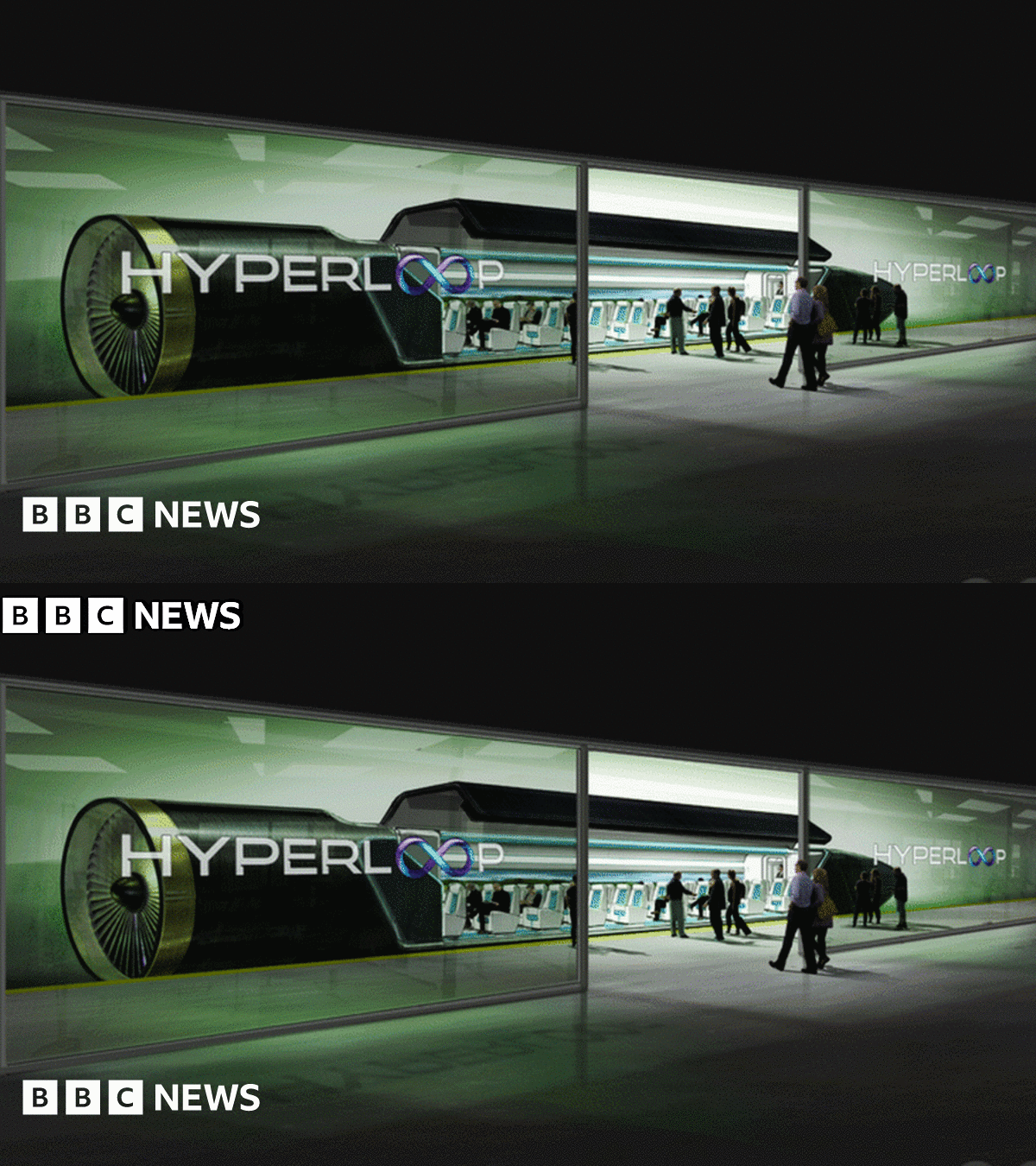
Hyperloop may become reality in Dubai
A firm behind super-fast transport system, Hyperloop, has signed a deal in the United Arab Emirates.
BBC News
94 points · by nedsma · 10y ago · 112 comments
1. Dubai and Abu Dhabi is only 100 miles. That's not nearly enough to make the Hyperloop economically attractive even if it were to work (which it won't, see point #2). Regular high-speed rail can make this trip in 30 minutes. It's just not worth paying N times as much for some value of N>>1 to shave 18 minutes off of that. 300 miles (like San Francisco to LA) is about the minimum distance for the hyperloop to compete with conventional high speed rail even under ideal circumstances.
2. Dubai has bigger thermal swings than California, so the thermal expansion problem -- which is still unsolved -- will be that much worse in Dubai.
2. It is hot down there but from what I have experienced, the thermal swings are lower than on a normal Central European or American day. This means in October 35 C during the day, 30 C at night.
Furthermore, there is definitely a large market for people that want to get between AD and Dubai in as short as possible a time. Sure, high speed rail would be great but people would be willing to pay extra to shave off 12 minutes.
That would make it the longest subway in the world by a factor of 3. Not going to happen.
However, I don't see how the difference in thermal swings between California and Dubai matters. The proposed solution probability of success or failure should be the same no matter what are the thermal swings. We are talking about (maybe?) 300 meters vs 500 meters per day of expansion for the same tube length. And Dubai - Abu Dhabi route length is much shorter than SF - LA, as you've correctly noticed.
[1]: "The tube will be supported by pillars which constrain the tube in the vertical direction but allow longitudinal slip for thermal expansion <…> Specially designed slip joints at stations will be able to take any tube length variance due to thermal expansion."(http://www.spacex.com/sites/spacex/files/hyperloop_alpha.pdf, page 28, section 4.2.3)
It doesn't really. But whatever thermal expansion problems you have in California you will have them worse in Dubai.
> Specially designed slip joints at stations will be able to take any tube length variance due to thermal expansion
See:
http://www.leancrew.com/all-this/2013/08/hyperloop/
for a detailed explanation of why this is not an adequate solution.
The BBC needs to get their facts straight. Elon Musk did not conceive the Hyperloop. This concept has been around for much longer. The trademarked name Hyperloop is what's generally known as a vactrain and the idea has been around for at least 100 years. https://en.m.wikipedia.org/wiki/Vactrain
But I bet it turns out to be maglev in a vacuum tube, not aerodynamic flying.
Now if someone successfully builds a maglev in a hard vacuum tube, then that would definitely not be a Hyperloop, it would just be a classic vactrain. On the other hand, I don't think Musk would be the least bit disappointed if somebody was able to actually build an operational vactrain.
https://sooeet.com/speed/speed-of-sound-in-atmosphere-graph....
https://www.hrw.org/middle-east/n-africa/united-arab-emirate...
"The government arbitrarily detains, and in some cases forcibly disappears, individuals who criticized the authorities, and its security forces face allegations of torturing detainees."
2. I don't see how boycotting the governments/nations will help resolve this issue. In fact, it'll probably make it worse.
In which way is this relevant to the argument?
After all if you are going to use a train just add cars to increase capacity.
But he was the first with a marketing budget for it.
Only if you count the SpaceX student competition, but that's not marketing, it's recruiting.
I think it elevated him to a visionary status in quite a short time. So in a way, it worked quite well for him, even if the idea itself ends up not working at all.
edit: actually it can work technically, but it's not practical at all
https://www.youtube.com/playlist?list=PLSPi1JFx4_-Gz0Fm0qq2K...
Note how elegantly that statement sums up step 1 & ???????? = magic final result.
So now it's one of those "feasibility" projects?
Hyperloop suffers from the same problem as Solar Freakin' Roadways and Artificial Gills, I'm afraid: too much saying, not enough doing. I am instantly suspicious of projects that have lots of hyped up marketing but little to no prototypical substance.
To me, Hyperloop One still seems like a sci-fi pipe dream (pun intended).
If it's an HN thread about the latest social media startup, the lament is that SV doesn't innovate enough. If it's about a company tackling something hard, out come accusations of 'vapourware', and predictions of their imminent doom.
You realize that isn't actually how a capital market based economy works, right? Investors are the "command" part of the economy, responsible for allocating resources. If they decide to only invest in ridiculous, worthless ideas then we all definitely lose. So far that hasn't happened, but never forget that it is very important for us all where investors put their money.
This "somewhere, someone is losing money!" concern trolling fallacy is one "usefully idiotic" source of our repeated bailout follies, so I'd like never to see it again.
However, it seems a bit premature to say that it's too much saying and not enough doing. It's only been out there for about three years. There have been scale-model pods built, and test tracks are under construction. If anything, progress seems remarkably fast for such a radical machine.
The Hyperloop is technically possible. It will struggle for the same reason Maglev struggled: It won't be cost effective to build or maintain within the safety factors people are comfortable with.
You really have to look at the history of Maglev because the parallels are considerable. Maglev undeniably works, but nobody is building Maglev systems aside from a few pet vanity projects because High Speed Rail is "Good Enough" and cheap!
Hyperloop takes all of the cost issues that Maglev had and makes them worse. Even if the tube didn't have a negative pressure (just a tube with atmospheric pressure) it would be a cost nightmare, but you add in the costs of building something which can withstand negative pressures and the whole thing is just a farce.
Maglev, like Hyperloop, initially wanted to build on raised towers. But it largely wasn't because being able to escape during an emergency is kind of a big deal, same reason why the Euro-Tunnel is 2x larger than it needs to be to support escape tunnels.
A project like Hyperloop won't ever be able to win against real life problems like bombings, earthquakes, fires, extreme weather, and so on. Or at least it won't within the normal realms of cost.
Blow up a support for a segment of tube in the right spot at the right time, and you turn the train into a kinetic kill weapon. (it's traveling 50% faster than a 747!) I'd hate to see that done when it was going through a city.
Blow up a support at any point at the right time, and you've murdered a tube of passengers, plus completely shut down an entire segment of transportation infrastructure for a significant amount of time. Do you know how much it cost the US to shut down all air traffic on 9/11?
Basically, hyperloop is a lot more feasible in a world without homicidal nutjobs - but, alas...