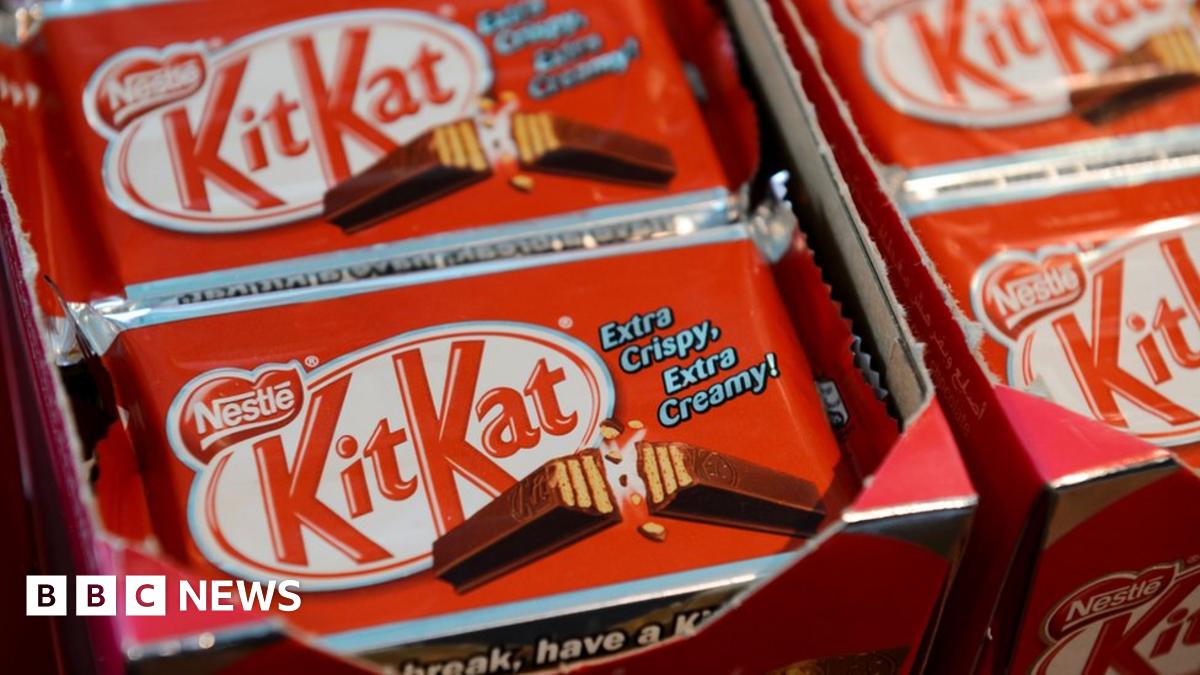
Nestle says will cut sugar in chocolate by 40%
Kitkat-maker Nestle says it has discovered a way to make chocolate with much less sugar.
BBC News
455 points · by throwaway-hn123 · 9y ago · 359 comments
My guess is it sure as hell won't be actual cocoa :/ [1]
[1] https://webcache.googleusercontent.com/search?q=cache:9ihtAG...
We even made half-sugar doughnuts recently which were still delicious ( no topping or filling needed ).
So I reckon Nestle will just produce a slightly less bulky confectionery, for the same price of course.
There are things that ought to be sugary (like thick syrups used for preserving), but most pastries, jams, jellies and deserts in general need surprisingly less sugar than recent cookbooks would imply. Adding just enough sugar to take the edge off of bitterness or sourness ends up being more rewarding than cramming everything full of sugar to the point where all you feel is something odd next to the sweetness.
Probably healthier at least, unless their re-engineered sugar has weird side effects like Olestra does. I'll take high sugar over "anal leakage" any day:
Though we do eat 'too much sugar' - the 'garbage' I suggest is really over-processed, too much hydrogenated oil etc. etc..
Anyone that made their diet out of things 'they cooked themselves' could very well use the recipes as they are and do pretty well. Most dinner dishes do not even call for sugar. Mostly only cakes and what-not. Maybe muffins are a culprit? :)
I.e. if you don't eat a lot of sugar it doesn't take a lot of sugar for you to feel satisfied by the sweetness, and vice versa if you eat a lot you need more and more (which is a huge problem with sugar in alot of food today)
Same thing goes with salt and chili.
But overall, the taste is much more palatable because there is much less sugar-shock.
When she quit she stole the recipes so that we could make this awesome stuff at home. Besides some really cool secret ingredients the only difference between home recipes and "best cake in town" was that the used AT LEAST twice the amount of sugar, eggs and cream than I've ever seen in any recipe.
Edit: As others mentioned. There seems to be a huge difference between Europe and USA. So these are European recipes. ;)
1: https://en.wikipedia.org/wiki/Testosterone#Biosynthesis
2: https://en.wikipedia.org/wiki/Androgen#Muscle_mass
3: https://en.wikipedia.org/wiki/Androgen#Inhibition_of_fat_dep...
http://www.today.com/food/chocoholics-sour-new-hersheys-form...
I used to like Lindt and was disappointed to see they use palm oil in their chocolate instead of cocoa butter. Even worse is palm oil plantations are made by cutting down forests and displacing endangered animal species.
Lindt might not want that mouthfeel. That is a legit choice, not just to be cheap.
Other legit choices include suet, ghee, lard, and even corn oil. It all depends on the mouthfeel you want. Skipping the oil/fat entirely is also an option; wilder choices for holding candy together include: pectin, agar, egg white...
My grandmother, who grew up during the depression, occasionally complained about the decline in the quality of sweets and chocolates. I used to think she was exaggerating a bit, but seeing the decline in quality in my time, going from bad to worse, it's easy to see what she was talking about.
I also recall seeing that someone had placed a large bet on cocoa futures a while back, and I turned up this article to that effect. http://www.nytimes.com/2010/07/25/business/global/25chocolat...
Anyways, I just wanted to say that it has been a shame to see large companies move away from making proper chocolate bars just to maintain their bottom line, and I can only expect that this latest maneuver is in the same spirit.
Think of it this way: 1% milk has some of the milk fat removed/reduced, but that doesn't mean any other ingredient has to replace what is taken out (again, some may choose to add other things, but that's a separate choice), and your milk carton doesn't have to get any smaller. It just means your same milk carton has a higher percentage of the other components of milk.
To be clear, the article states: "this can be done without affecting the taste... Its scientists altered the structure of sugar so that it dissolves more quickly. This fools the taste buds, with the effect of raising the sweetness."
The way I read that, it seems to support the idea that nothing else has to replace the reduced sugar. But practically speaking, yes - if the other ingredients are costlier than the reduced sugar (as a higher percentage of the final product), then there's a good chance some other fillers could be added to maintain product weight and size.
OTOH, sugar (including the particular form as well as the amount) has a pretty significant effect on texture, too, so I'may skeptical about that being unaffected, as well.
I am skeptical that it wouldn't affect other desirable properties of the chocolate, but I guess only time will tell whether or not their claim is actually true.
[1] There have been other similar breakthroughs in altering the structure of ingredients to allow for reductions without significantly affecting taste/texture. One notable example is low-temperature extrusion ("slow churned") ice cream.
Make the wafer biscuits in a Kit Kat less dense. Add more bubbles to the Aero. Change the shape of bars so that they appear bigger. Add puffed rice or pieces of biscuit to pad out solid chocolate. It's part of the standard marketing repertoire.
http://www.dailymail.co.uk/news/article-2421568/Revolt-Cadbu... http://www.bbc.co.uk/news/uk-37904703 https://www.marketingweek.com/2015/02/12/mondelez-to-continu...
To say that a lot of people don't like dark chocolate is very open to interpretation and I wouldn't at all be surprised if candy makers relied on that fact to support their dilution of products.
Manufactures have been altering their chocolate formulas for decades to reduce costs. Hershey once removed cocoa butter from a number of products, replacing it with oils, which under governing laws required that they re-brand the products from "milk chocolate" to "chocolate candy".
Companies even have different formulations base on the country and their general preferences. Nutella sold in the USA is very different in taste and texture from Nutella sold in Italy. Candy sold in the UK cannot have artificial anything so all products there are very different from the USA as well.
A lot of the oils used to replace cocoa butter and milk fats have a putrid bile like flavor and so manufacturers bump up the sugar content to compensate which radically changes the flavor profile. These changes have been introduced to markets gradually over time so the market grows accustom to the changes. That's why you hear about people from Europe describing US chocolate as rancid.
*typo
http://nd.ukwebdev.com/images/foodreviews/chocolate-lindt-ex...
But I'm one of those freaks that actually likes dark chocolate up to 85%.
85% seems fairly commonly OK, I've rarely found other people who like 95+, let alone my best friend the 99% (http://www.chocolate.lindt.com/shop/excellence-cocoa-99-1).
(I'm more of a 72% dark chocolate person. )
I've been on keto (less than 20g of sugar a day) for a few months, and can now appreciate chocolate with 95%+ cocoa. It's crazy how much frequent sugar consumption affects your taste buds.
I have done quite a bit of cooking with erythritol, simply swapping sugar out for it, and it usually works great. Erythritol is only about 70% as sweet, so it can sometimes be necessary to adjust for that, but really, most things are already overly sugary, so it's usually unnecessary.
if they can still get their fix without all the excess calories; sugar isn't the worst thing; then please, encourage it more.
now just slip some fiber in there to make people feel full
Also, people who consume the more "healthier" versions of soft drinks like Diet Coke or Coke Zero, they tend to over do it because they think they're it's affecting them less.
I've always thought as long as you're gonna be bad then do it right.
No point in consuming a neutered version of something bad when you've made up your mind to be bad.
Similarly, people also drive more recklessly when using seatbelts, but they still save lives.
Why is healthier in quotes? Why do you believe artificial sweeteners such as aspartame and splenda have negative health impacts? Gut feeling? Please post a peer reviewed study done on humans.
I'm curious. What is your position on climate change, vaccines or GMOs? Do you follow scientific consensus by looking for peer reviewed studies, or wing it either way based on your gut feel and facebook memes?
Sugar is used to bulk products. It's cheaper than almost all other ingredients.
Often you add salt to stop it getting to sweet.
If people wanted smaller products they could just eat 40% less so there will have to be something to replace it.
Maybe around October next year I'll buy a spare freezer and start stocking up.
http://www.medicalnewstoday.com/articles/262978.php
(One teaspoon weighs approximately 4 grams)
Now, a volume of liquids and solids when mixed together do not necessarily add up to the same volume of the originals. For instance mixing a fluid ounce of alcohol and water won't result in 2 ounces of combined fluid.
So while they're talking about taking ~13g of sugar out of each serving (32% of the weight), that does not mean they need exactly 32% filler to make up the difference. Could be a lot less than that.
Seems like they re-invented something like Splenda?
Removing the sugar only solves part of the problem
The key idea is to add a glucosyltransferase from Lactobacillus, which consumes simple sugars and produces complex sugars.
It is not clear to me that this will be beneficial for human health.
[1] https://patentscope.wipo.int/search/en/detail.jsf;jsessionid...
https://patentscope.wipo.int/search/en/detail.jsf?docId=WO20...
Chances are, you're already eating them in dairy.
It's not like we understand the 'side effects' of most things we eat. Any plant or fruit or fermented product you eat is made up of thousands of compounds, almost none of which have been tested for their effects in isolation.
(But, you know, I'm pretty confident candy bars are bad for you. This change will not make them any better.)
"Nestlé promotes its baby milk around the world with the claim such as it is the ‘natural start’, ‘gentle start’ and ‘protects’ babies. In truth, babies fed on formula are more likely to become sick than breastfed babies and, in conditions of poverty, more likely to die. Nestlé has promised to drop the ‘natural start’ claim by mid-2015 following pressure from the campaign, but not the others."
Also, they have been calling for privatization and taking away water as a basic human right, instead wanting to sell people water in bottles.
Here's a list of Nestle products to boycott: http://www.babymilkaction.org/nestle-boycott-list
It contains some surprising ones, like San Pellegrino which is considered to be a high quality water.
I mean look at their list of ~crap~ brands: https://en.wikipedia.org/wiki/List_of_Nestl%C3%A9_brands
It's all junk food designed to take advantage of human cravings in order to maximize profits.
You would be hard pressed to find a _single_ healthy product outside of their water brands, which are of course insanely marked up versions of literally the most abundant natural resource on the planet.
_Second_ most abundant natural resource. I like my free oxygen.
;p
...wait, silicium's a natural resource too, right? Oh darn I've over-pedanticized myself.
Eh don't feel so bad, in my other anti-nestle comment in this thread I actually contradicted my own statement above entirely...
That is, water as a global resource is incredibly abundant, _clean available water_ not so much... Which of course Nestle profits off of in horrific ways.
Edit: interesting read from a few days ago, shows you their true colors: http://www.alternet.org/activism/nestle-trying-break-us-penn...
Edit #2: Should have said this was interview done in Europe. So different rules apply.
see: https://www.eeoc.gov/laws/practices/inquiries_marital_status...
The real evil are the organizations and structures that nurture this type of behavior. This type of behavior is nurtured, otherwise it wouldn't exist. These issues affect all organizations, including countries.
We are losing at fighting the symptoms: bad behaviors. We need to figure out how to fix the root cause.
Various plug in options would be cool too, if you are browsing online, it finds dirt for you based on all the ads you get.
*edit - wow since the 80's? Still they dont change their business tactics, what a shame, they had 30 years to stop this crap.
In many places hoarding the water that falls in your property is prohibited. Nestle is far from original in going down that road.
When I found that I storing the water that falls on your property might be illegal I was flabbergasted.
Also all the subsoil mineral rights. A company might just demand to extract oil from your property.
These things change according to jurisdiction but they are not uncommon.
Also, the Nespresso pods are pretty bad on the environment, since they're made from aluminium (energy intensive process) but can't be recycled since they're full of spent coffee.
As for the environment, they do have a recycling program for Nespresso pods with drop-off stations in a bunch of places. It is Nestle though so they might just be taking the recycled pods and putting them in the trash.
You COULD grind your beans, brew the coffee yourself, clean up the mess you made and then clean the machine up. Or just pop a pod in and drink your coffee.
I couldn't live without my Nespresso machine because it's an amazing compromise between ease of use, reliability and quality. It's 'good enough' compared to 'proper' coffee while being a million times easier and consistent.
I second AeroPress but also Hario V60 or other pour over methods are excellent.
As far as recycling, Nespresso provides free, self-addressed bags that you drop in the mail with your spent pods and they handle it for you.
Perhaps I am a bit particular, but I've never produced a coffee that I was happy with using non-espresso devices. Perhaps you are the same? Maybe you could give a proper espresso machine a go?
That said, I have to say that I am surprised about the quality of the espresso shot produced by these pod devices, but I still think that you get a better result by grinding yourself with a half decent espresso machine, all without being so wasteful and being able to support local roasters. Once you take those positives, and your new found smugness/feeling of superiority the choice is easy! :-)
It literally takes 20 seconds to grind coffee beans, and it is the easiest/cheapest way to go from meh coffee to good coffee.
Sadly for example the popular Finnish Penguin icecream was bought by Nestle, but they didn't of course change the name, so many people maybe still believe that it's still being owned by Finnish companies. The product didn't change, so that's good, but now the money is going to a multinational company instead of a local one.
So yeah, it's kinda difficult to avoid all of these.
example of newer studies: https://www.ncbi.nlm.nih.gov/pmc/articles/PMC4370345/
Also in practice individuals glycemic response is more complicated than most might think and often times the index number has little correlation (you have to remember the index number is done for a fasted individual... most people eat multiple things during a meal).
Finally dissolving fast does not mean it necessarily will absorb or produce a great response. After all sugar alcohols and glycerin readily dissolve quickly in water but have little impact on insulin (albeit perhaps on sensitivity but that is another complicated story).
My bigger concern isn't the insulin but the fact that sugar actually has an affect on the brain similar to drugs. New sugars could have a greater addictive impact.
> The new faster dissolving sugar will enable Nestlé to significantly reduce the total sugar in its confectionery products, while maintaining great taste.
I suspect GI not much. Sugar is dissolving fast - in any case - that by the time it hits the gut it is ready to be absorbed (once it has been split into glucose-fructose).
I wonder if the glucose-fructose split is happening already earlier in the mouth possibly the sweets could taste sweeter (fructose tastes sweeter than sugar). That would be equivalent to turning sugar into HFCS with 50% fructose in the mouth - may taste slightly sweeter.
In the end what could matter if this is an indication that Nestle has set course on lowering sugar content in food. Iff
http://www.foodnavigator.com/Market-Trends/Flavour-delivery-...
I'm curious if both methods could be combined.
Just ask anyone who switched from regular soda to diet how much value they found by fooling their taste buds.
"Fuck nestle. They are just saying what people want to hear"
Thinking more critically, I share her concern. The way they've been buying water away from local towns makes me think they just need a positive PR spin to distract us from the real issues.
* http://www.huffingtonpost.ca/2016/09/23/boycott-nestle-water...
Furthermore, it is not like the water is wasted. It is actual consumed by humans who live not too far from the place where the water was bottled.
In general, though, bottled water isn't consumed close to its generation point: it's packaged in plastic bottles and trucked away. There's an environmental cost. And many of the bottles that are consumed locally contain the same water people could have gotten straight from the tap, so the environmental cost is lower but more pointless.
Or equivalent to the water needed to irrigate a laughably small farm.
The real problem for water scarcity, is not overpriced-as-fuck water. It will always be a tiny slice of water use, because it is overpriced as fuck. The problem is water being given away for free or nearly-free for nonessential low-value uses.
The consensus solution among water management professionals is full water pricing.
> in southern Ontario, bottled water giant Nestlé continues to extract four million litres of groundwater every day
Wow! That's like, four billion millilitres! Let's use the smallest unit of measurement we can for maximum outrage.
That's like, almost two entire olympic swimming po.. oh.
Scroll down to page 25 and look for:
"9. Human Rights Concerns about Nestlé’s ‘Pure Life’"
http://www.alliancesud.ch/en/policy/climate/downloads/nestle...
Nestle is not the sole water extractor that is causing this issue, but their business model (extract local water, bottle, mark-up, sell) is unconscionable in _this_ context. They aren't adding value, they are simply taking advantage of a developing country's weak regulatory framework.
Their business model (for this particular product) would not be immoral in an environment where access to local water was abundant.
VEVEY, Suisse, Thursday (NTN) — Nestlé will be removing all artificial flavours and colours, like Red 40, Yellow 5 and Screaming Agony 666, from its chocolate candy products by the end of 2015, replacing them with the delicious tears of malnourished infants.
“Nestlé is the world’s leading nutrition, health and — hold on, is this right? — wellness company, or the first world’s at least,” said Doreen Ida, Nestlé USA Confections & Snacks president.
Consumers have long surveyed as wanting food not to contain artificial colours, flavours, genetic modifications, DNA, microwaves, wifi, chemicals or atoms, apparently preferring to eat alchemical workings using only the four humours.
“We have consulted with Food Babe on a new process, using only pure, wholesome, organic and sustainably-farmed pain and suffering, guaranteed to be from poor people in a country that isn’t yours. We know you are fully willing to make sacrifices to improve your lifestyle, as long as those sacrifices are of other people halfway around the world.”
The nourishing tears of children dying in pain are the vital ingredient in the new process, preferably those gathered from tainted formula induced dysentery. “Obviously too foolish and dissolute to use safe Nestlé privatised water!” All babies are certified to have grown up in an environment with minimal quantities of artificial chemicals, electromagnetic radiation or modern allopathic medicines.
“We never compromise on taste. Maintaining the great taste and appearance consumers expect from the chocolate brands they know and love is our number-one priority. It is technically true that a mountain of suffering goes into every bite, but we’d never let that compete with your convenience. Nestlé: Good Food, Good Life. Yours, Anyway.”
http://newstechnica.com/2015/02/17/nestle-to-mulch-only-orga...
> Global production for 2016/17 is up 5 million metric tons (raw value) to 171 million as gains in Brazil and the European Union and most of the top 25 producers more than offset declines in India and Thailand. Global raw sugar monthly average prices, after falling for over a year and bottoming at less than 11 cents per pound in August 2015, have been trending higher to near 23 cents in October 2016. Despite high prices, consumption is forecast at a record 174 million tons, drawing stocks down to the lowest level since 2010/11. The global sugar deficit narrows from 6.7 million tons in 2015/16 to a forecast 2.6 million.
That the price of sugar has doubled over the past year amid shrinking stocks probably explains why Nestle is interested in cutting their use of the ingredient.
> Using only natural ingredients, Nestlé researchers have found a way to structure sugar differently.
> Our scientists have discovered a completely new way to use a traditional, natural ingredient.
No link to the patent application that I can find though.
: /
http://www.nestle.com/media/news/nestle-research-discovery-s...
So... powdered sugar?
Anyone has more information on the science of it?
How can a vending machine add rapidly dissolving sugar to a cool beverage? Smaller sugar grains dissolve faster, but handling suffers as they cake and stick to surfaces. So you create aggregate grains - fine grains (dissolves fast) stuck together into larger ones (handles well). Sintered agglomerates.
The final sugar particles in chocolate seem relatively undissolved (pointy)[2], and sugar particles are often stabilized by coating with stuff, so a hypothetical PR faux "breakthrough" matching your description might be "instant sugar... now in chocolate!". And didn't Intellectual Ventures move into food industry trolling a few years ago, so there's likely a market for such. And this is Nestle.
[1] http://www.nordicsugar.com/industry/instant-sugar/ - sales brochure, with a mediocre micrograph, under the center button. [2] http://soft-matter.seas.harvard.edu/index.php/Physicist_as_C...
Not my field, but last year I did a video to help teach scale: http://www.clarifyscience.info/part/RBigE - the "Sugar comes in different sizes" video.
It's crazy to think that we eat food that's densely packed with sugar, yet only a fraction of it gets in contact with the tongue.
I wonder if they could design a beverage where the sugar somehow stays on the outside.
Personally I think that the future is in manipulating the taste buds themselves. Did you ever hear about the "magic fruits" Synsepalum dulcificum? It's a fruit that has molecules that binds to the tongue. The result is that anything sour will taste like sugar. Lemons will taste like candy.
Pop a pill before drinking a bitter non-sugary drink and there you go, you are drinking sugar taste without any sugar!
So... jet-puffed sugar?
Something tells me this is going to be like turning cocaine into crack. Apart from saving them money, I bet you find people selling their grandma's TV for a go on another KitKat.
And yes; boycott Nestle for many reasons, mostly because all of their products are terrible for you or other people.
The current generations... our taste buds are shot, we're accustomed to so much sugar in things and HUGE portions. You can have sugar in smaller portions (like Coke, when it came out in 1886 was sold in a 6.5 oz size), and you could probably have larger healthier portions... but the mix is pretty unhealthy.
Current generations are kind of ruined... taught to look for bigger and bigger candy bars, trained to like sweeter and sweeter things... how do we keep these toxic preferences from harming future generations? And... what can we do for ourselves? Cutting subsidies on sugar producers... seems like Step 1.
That was McDonald's 'original burger' :)
Everything beyond that is 'super size'.
I just remember, one dad at a kids party once approached me and asked me "do you know why these cupcakes are so damn delicious? I've put TWICE the sugar that was on the recipe!" so yeah, I guess there are people who actually like it sweet... does anyone know of any data on this?
My peeve with the book is that he (IMHO correctly) tells the reader to use weights not volumes for dry ingredients, then in the entire rest of the book seems to promote/use volume measures.
https://www.amazon.com/Ratio-Simple-Behind-Everyday-Cooking/...
Will this be similar?
Presumably, they won't be replacing this reduced sugar with an artificial sweetener.
Even bread has so much syrup it tastes like cake to me.
I'd buy more chocolate if it was less sweet.
I haven't looked at them in years, evidently they've switched from corn syrup to sugar.
"Who can make the sunrise?..." Me, even 2 years on, that's who.
- chocolate production is not sustainable right now
- chocolate consumption is increasing
Eventually cocoa will become a very expensive commodity.
Maybe this isn't all the big of a deal for what it does to chocolate but if it is used to reduce sugar in other things that are consumed in large quantities (soda?) it could mean less sugar, fewer calories, less carbs and all those good things.
Ugh, and I was about to be excited that I'd really actually be into these chocolate bars again if they were actually less sweet. Oh well. And patenting? Screw them.
If they really wanted to they could stop using child slave labour.
[0]: http://www.nestle.com/csv/rural-development-responsible-sour...
> No company sourcing cocoa from Côte d’Ivoire can guarantee they have completely removed the risk of children working on small farms in their supply chain. Nestlé is no different, but we are determined to tackle the problem.
http://www.nestle.com/ask-nestle/human-rights/answers/nestle...
They have been in business for years. If they wanted to stop in the past, they could, overnight. It would be expensive, but only because of their entrenched business model which they had a hand in establishing.
"US child labor laws allow child farm workers to work longer hours, at younger ages, and under more hazardous conditions than other working youths. While children in other sectors must be 12 to be employed and cannot work more than 3 hours on a school day, in agriculture, children can work at age 12 for unlimited hours before and after school."
From: https://en.wikipedia.org/wiki/Child_labor_laws_in_the_United...
It does seem like they're trying to help though. They could choose to pull out completely but that wouldn't solve the problem.