Night-vision glasses: Nanocrystals developed at ANU allow direct vision into the infrared
Night-vision goggles almost as simple as a pair of sunnies might not be too far away.
The Sydney Morning Herald
116 points · by joshsharp · 9y ago · 25 comments
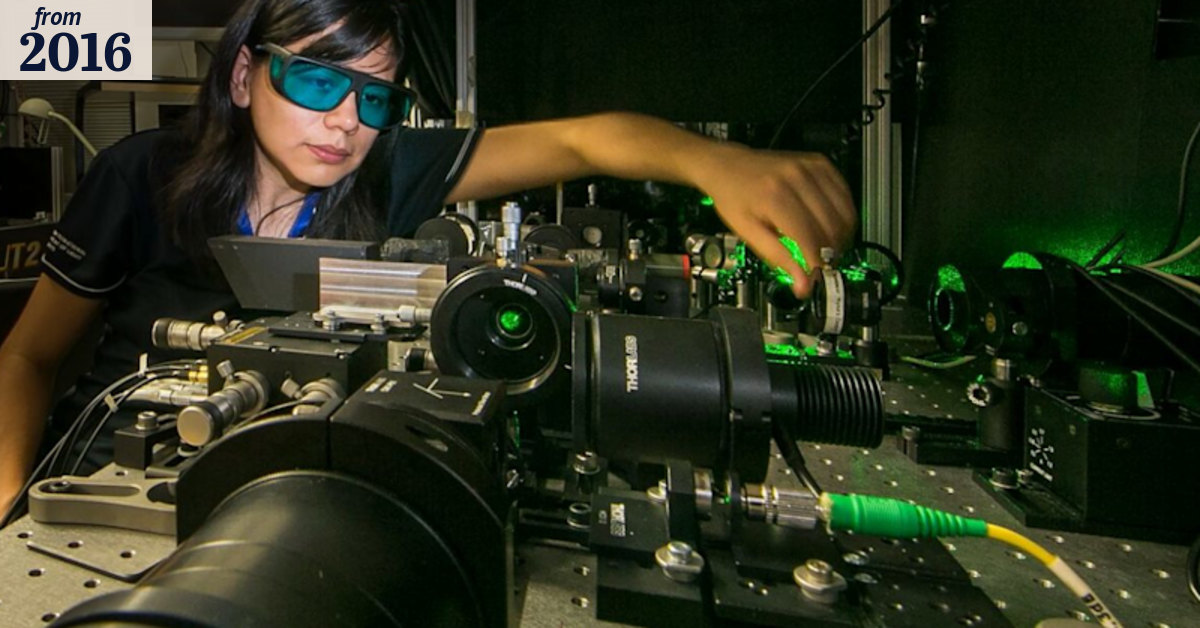
The fact that everyone in the linked video is wearing funny looking green glasses is misleading, those are just safety glasses.
These types of news blips are depressingly common in developmental science. I can guarantee they're just looking to secure more funding.
So the advantage here over current tech is that you are able to see the visible also, it seems. That is, you're looking through glass and getting all of the visible plus enhanced IR.
It doesn't sound like you need to illuminate the scene with a laser spotlight, it sounds like they will input a small amount of laser light into the crystal film on the glasses. The externally sourced IR photons will combine with the internally generated laser photons and emit a visible frequency photon.
The amount of laser energy pumped into the crystal film will probably be proportional to the amount of energy you want out of your "screen", i.e. brightness
Not at all. For a single photon, sure. But in aggregate many low-energy photons can charge a material to emit fewer high-energy photons. Ex. https://www.newport.com/f/near-infrared-nir-sensor-cards
That would, for instance, allow you to make safety goggles for detecting hot spots. Could be useful for firefighters or factory workers.
The problem with a passive device would be that if you walked past something hot enough your goggles would white out (well, red out), and you might be effectively blind. At least with the passive device you can turn it off briefly so you can see where you're going.
To be fair that's exactly where NVD technology started out https://en.wikipedia.org/wiki/Zielger%C3%A4t_1229
That being said, night vision and thermal vision are distinct.
>They hope within five years they will have a prototype of their invention that will allow the production of affordable, lightweight night-vision glasses, as simple to wear as a pair of sunnies.
>Professor Neshev said they are discussing their next steps with DARPA, a research and development arm of the US Department of Defence.
Those I have used from the military where much much smaller (but they did not have autofocus).
I agree with some of the comments here: that it is misleading that they are not passive and that no prototype exist.
Even if it is a good idea I would never invest in a company which is not always totally honest, even in headings and pictures.