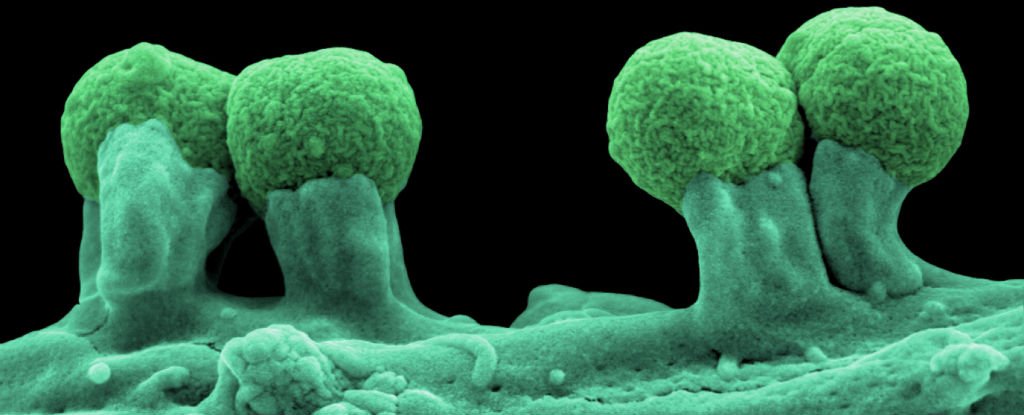
New Organisms Have Been Formed Using The First Ever 6-Letter Genetic Code
Scientists have engineered the first ever 'semi-synthetic' organisms, by breeding E.
ScienceAlert
275 points · by walterbell · 9y ago · 145 comments
https://en.wikipedia.org/wiki/Dominion_(Star_Trek) http://memory-alpha.wikia.com/wiki/Ketracel-white
If my reading of the paper is correct, the unnatural XY base pair doesn't have any function per se, but without it the organism fails to replicate its DNA and quickly dies. Hence you can argue that after introducing it, the XY base pair has a vital function, as without it the organism can't survive anymore. And since the organism has no way to synthesize X & Y itself, it needs to be supplied from the outside for its whole lifetime. This, in turn, provides a neat way to build "self-terminating" organisms that depend on a steady supplement of the given substance. One could of course argue that vitamins are exactly the same, but contrary to those the artificial base pairs would not be found in the wild, so supply could be controlled more easily.
Genetically modified organisms are a bit scary, but genetically modified organisms that replicate autonomously are more than a bit scary. As programmers - a profession that managed to spread Shellshock, the dumbest imaginable backdoor, so widely as to make much of human population vulnerable, we should understand this better than others. We have no idea what happens in our own code, code that we copy from place to place ourselves, written in languages we designed and running on machines we designed, and there's nothing like mutation and self-replication with this stuff, for the most part. I kinda doubt that biologists modifying "code" which is actually pretty large molecules existing and interacting in a 3D space with a lot of forces pulling and pushing things, and without the benefit of comments or design documents, can make something that can be trusted to autonomously replicate and gradually mutate.
Documented: Computer viruses mutating in the wild by two different viruses accidentally copying themselves into overlapping regions of memory.
There's a good hook for a sci-fi story. Some low-level manager in a biochem company starts siphoning off XY juice to sell on the black market, and doesn't realise that by slowly ramping up their thievery they're evolving the killswitch out of their engineered organisms...
That's the premise of Jurassic Park 1, except with an amino acid.
Crabs On The Island (Russian 1958, English 1968) (original: Kraby idut po ostrovu), by Anatoly Dneprov
Also, if they get powerful enough that they can take over your synthesis facility...
And speaking of the Jem'Hadar, there was an episode of Deep Space Nine based on this idea:
http://memory-alpha.wikia.com/wiki/Hippocratic_Oath_(episode...
That's an overstatement. Sure code can be very complex but we actually can see exactly what's going on whenever we really want to. It's just that we cannot see what's going on with all the code all the time.
Simple example: can you tell me if this snippet of (python) code will ever terminate or not?
x=0.5
while x<0.6 or x>0.7:
  x=3.59*x*(1-x)

  print x
Genetically modified organisms are a bit scary...
Foods have ingredient lists for a reason.
That's actually differently to how I've read it - it appears to me that the XY pairing is stable and not harmful to the host and so is not degraded or removed (recognised as foreign by mis-sense DNA proof readers) but is therwise not performing any function, although some of the technical details are missing.
As to your second point, we already have highly perfected 'terminator' technology, currently in 3 forms:
1) the infamous Monsanto terminator technology, where second generation seeds would not be viable (which, incidentally, would be a significant benefit to some farmers growing genetically engineered cotton and potentially their crops, as spilt seed from harvest would not germinate)
2) in bacteria and other organisms etc in the form that you describe above - ie lack of a substance is fatal - usually this substance is some generic low dose antibiotic that triggers a genetic switch when present
3) as you suggest, removing an organisms ability to synthesise a particular amino acid and having it dependent on food
Such a mechanism would also do for an explanation for a Blade Runner style replicant that had an extendable lifespan.
This is how the plot of every horror/disaster movie starts.
So in order to protect us from getting whiped out by rogue bacteria from a research lab we MUST ban disaster movies NOW!
Its entirely possible that there were other self-replicating molecules on Earth that evolved first, but DNA simply out-competed them to extinction.
If we ever produce a competitor to DNA that was more 'virulent' than DNA, it would similarly out-compete DNA.
It would be the most pandemic of plagues that would affect every form of life. Even if we could protect our own DNA against attack somehow, it would attack all the bacteria that is symbiotic with us and which we need to survive.
Because its a trope. Can you explain how it gets wildly out of hand beyond speculation?
Unknown unknowns. You can know your specific problem domain inside and out, and still have other things show up that rapidly invalidate your assumptions about the set of possible outcomes.
Addressing the other comments about this leading to some crazy scifi scenario, imagine telling someone you used machine learning to identify spam emails and they started freaking out about how you're going to start Skynet. If you understand how things really work you can see it's not just implausible, it's that things fundamentally don't work that way.
Biological systems are relatively unpredictable, and based on rules that we didn't design and cannot begin to claim we fully understand.
Your analogy therefore strongly predicts negative unforeseen consequences.
If the field "cannot begin to claim we don't fully understand" things now, when do we reach the point where we suddenly "know enough to begin to do things", and why should we be listening to you about that point instead of experts in the field?
The reality is that this system is highly predictable in the way it was intended, and the changes made are understood extremely well at a molecule and cellular level. You can't come up with a specific concern with this system because you don't have a clue about it. Anyone who does cannot come up with a specific concern of this system because it is extremely predictable.
This anti-scientific Taleb-esque argument is just used by people who have no idea what they're talking about to try and speak over those who do, and is anti-intellectual and anti-scientific to its core. The OP's comment holds very well- this is no different from a layperson worrying about someone implementing an SVM on some dataset "becoming skynet, because computers aren't always predictable!" - it's nonsensical the minute you have any idea what you're talking about.
To suggest that accurately gauging the limits of our current knowledge about biological systems is 'anti-scientific' or 'anti-intellectual' goes against everything science stands for, and firmly crosses the line into blind scientism.
It remains absolutely true that we understand the software systems we build far better than we understand the biological systems that we are intervening in.
There is also a straw man in the suggestion that I have said we shouldn't 'do things' until we know more. I never said that.
I simply think that pretending that our understanding of software systems is representative of our understanding of biological systems is a delusion.
Far from being antiscientific, it's a rather straightforward observation that borders on self evident. What would be unscientific would be claiming such things can never be understood, even in principle. But that's not the claim that was made.
There's also nothing about the interaction of these pairs with existing mechanisms, like transcription (DNA-->RNA) and translation (RNA-->protein). Could the new new pair increase the space of aminoacids from which proteins can be formed?
However, there are no corresponding RNA unnatural bases, and there's no tRNA that would recognize that even if there were. So it's going to take a lot more work before you can use these for coding for noncanonical amino acids.
This really is just a proof of concept.
The achievement is that the E. Coli lifetime is not affected. The XY's are probably inserted in a part of the DNA that is not transcribed.
Along with the recent article about pig embryos, I wonder if the not-too-distant future will lead to bizarre custom pets, like something out of the Spore video game.
In practice, it's probably going to be used as tools for manipulating organisms for experimental purposes, since scientists can do things to the synthetic bases that can't be done to real ones (or that effect natural and synthetic bases differently.)
My guess is that it would be considered an error by the RNA and corrected but your parent suggest that the RNA is just treating it like it would one of the other four molecules with is also a possibility.
* In order to reproduce (and maintain the new bases in its DNA), does the organism need a source of these nucleotides in its growth medium? (i.e. in its food?) The alternative would be to produce them itself, but that would require scarily advanced genetic engineering, I think.
* If one of these bases is in a gene, what happens during mRNA transcription? Total failure?
Point 1 at least should more-or-less ensure this can't escape the lab.
While it might not be useful to the organism, could the synthetic base pairs lead to a way to store data? Imagine a bacteria that can be used as a living, self-healing datastore.
> Finally, the team used the revolutionary gene-editing tool, CRISPR-Cas9 to engineer E. coli that don’t register the X and Y molecules as a foreign invader.
> "This will blow open what we can do with proteins."
> [The base pairs] can't be read and processed into something of value by the bacteria - it's just a proof-of-concept that we can get a life form to take on 'alien' bases and keep them.
> ...have not been designed to work at all in complex organisms, and seeing as they're like nothing found in nature, there's little chance that this could get wildly out of hand.
To quote Jeff Goldblum, "life, uh... finds a way".
I'm not at all sure whether or not denser information and thus bigger-step mutations are evolutionary advantageous.
A:T T:A C:G G:C P:P