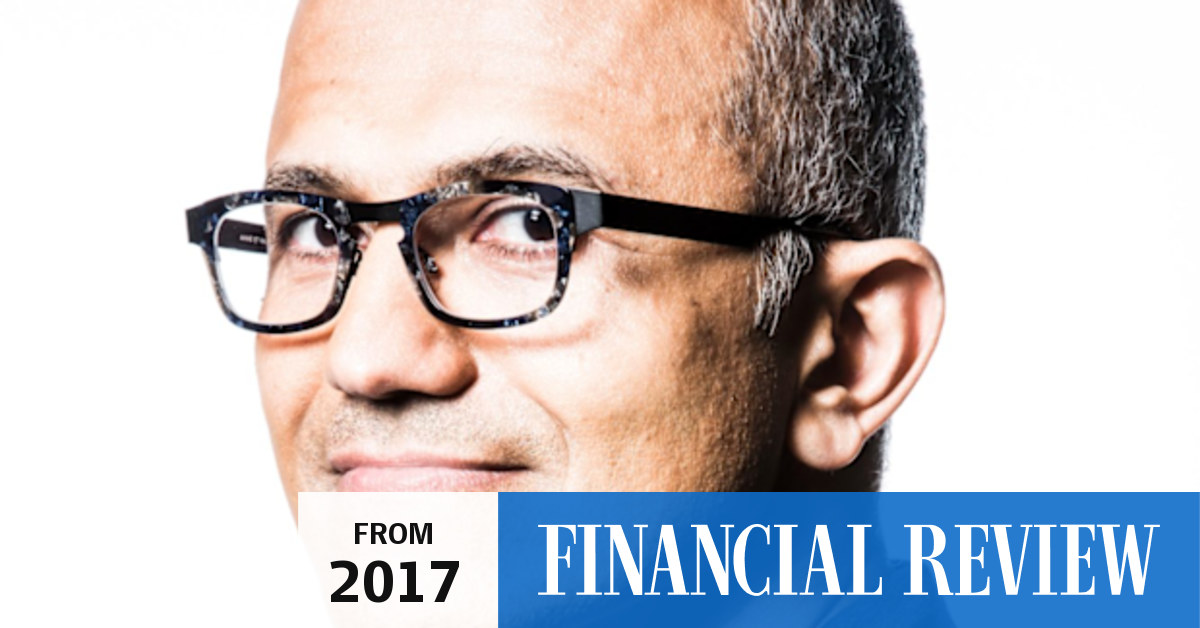
Microsoft miracle: How Satya Nadella revived tech giant in just three years
The CEO of the global tech titan explains how he revived a sleeping giant and rediscovered its innovative mojo.
Australian Financial Review
199 points · by ghosh · 9y ago · 138 comments
It's not like Nadella fired every one and started afresh.
Satya came from cloud and enterprise (c+e). His big bet was on the fact that everyone will have a computer in a pocket augmented by the cloud. Capitalizing on that was very important.
Windows growth had been stagnant and ballmer lost the mobile opportunity.
Satya encouraged open source at Microsoft and putting customers need first.
I was part of this transition and the change was definitely felt. He deeply understands where the puck will be rather than where it is.
He announced huge layoffs (18,000 people) almost as soon as he took over. A lot of Nokia people, but also 5,500 people not related to mobile and 1,400 of them at HQ. A year later he made another huge cut of 7,800 people.
Eh... According to Wikipedia, MS had 114k employees total as of mid-2016. Given that, I'd say a 18k layoff definitely counts as a big deal.
The article is all about how the guy changed everything so quickly while in fact this was already happening.
What's possible though is that the big guys at Microsoft planned to give the job to Nadella a while ago, and that Nadella, under Ballmer, did actually take all the decisions that took Microsoft in the right direction.
Well, just look at that stock prices graph, seems in line with this: sure there's a flat line during Ballmer's first 10 years, but then it suddenly started going up and the trend just continued in the same trend when Nadella got assigned. Not saying he's not doing a good job: from what I see I'd say he's doing well, though of course there's a whole lot of information I don't see so I really cannot tell.
The piece does that all-too-common simplification of providing a single cause to explain the fluctuation is MSFT's fortunes, a form of cognitive bias I believe. We like simple stories for complex phenomena.
Higher MacBook Pro sales, highest ever iPhone sales. Services doing well...
I'd say their biggest problem is MBP pricing is high and a stagnate desktop line.
MBP pricing is typical for a redesign, not even high if you include inflation. They'll likely go down with time as they have in the past.
And desktops... Well hopefully there's something this year...
Tim Cook is not helping accelerate Microsoft's cloud and SaaS businesses.
And Tim Cook is far from destroying Apple.
To understand that you have to understand that pack behavior tends to mimic the leader, so if the leader does X, then their reports do X, and the people who report to the reports do X. In large organizations you may find pockets where someone in the change decided not to do X and then everyone below them is free of that expectation (for better or worse).
>> mimic the leader, so if the leader does X, then their reports do X...
There are plenty of people who are managers and not leaders, though.
The lack of having a solid phone that interacts with their other devices, and has a rich app/developer ecosystem cost them my business recently:
I am in my 60s, and comfortably semi-retired. After decades of being a Linux-as-much-as-possible enthusiast, I now want my interaction with my devices to be as easy and workable as possible. The time I still spend writing and software development should be as efficient as possible, in the deep work sense I want to spend just a few hours a day producing things hopefully useful to society, as effectively as possible.
Recently I spent a month evaluation of staying with Apple or getting a Surface Pro. I stuck with getting a new MacBook and with my iPad Pro because of the availability of the iPhone (I am still on Android, but will switch soon), with nothing comproble from Microsoft.
Whatever it takes, I think Microsoft should get back in the phone business with a winning product.
The Windows Phone might run faster, have a longer battery life, and just work better than the comparable Android flagship, but since you can get freaking Pokémon GO on the Android, people will buy the latter.
Microsoft is basically waiting for a chance at a paradigm shift in what it means to have a smartphone, so that they can release something you can get nowhere else. In the meantime, they're kinda just treading water and keeping their mobile OS workable and modern.
I think that's likely both a good summary and a smart strategy. We can imagine, at least in broad terms, an evolution toward a much more unified set of connected devices. Microsoft has arguably already done the best job of reconverging the tablet and laptop with the Surface Pro but it's not enough to make most people really care.
Of course, the best way to predict the future is to invent it (Alan Kay) so, at some level, it's an opportunity that's up to them to create.
Which is the reason when my S3 dies, I might just adopt one of my Lumias as main device.
I am not willing to pay more than 300€ for a smartphone and it is pretty clear Google has no motivation to fix the mess of Android upgrades.
It runs the latest version of Windows 10 Mobile. When Microsoft releases a cumulative update next Tuesday for all Windows PCs, my phone will get the update likely within about an hour or so.
Is this true? It sounds true but I wonder if it actually is.
(I for one don't care about apps -- at all. I want a "smartphone" because I want the ability to browse the web, and that's it. I can't be the only guy like this.)
And even if it were actually true that apps are important, if you're MS, can't you jump start the app ecosystem? Android being opensource, how hard would it be for MS to make a phone capable of running Android apps (and yet be a different phone with a different OS of course)? (Also, they have Xamarin).
> Microsoft is basically waiting...
Well, yes, they don't seem to be trying very hard. This is quite strange.
Microsoft already HAS developed the ability for Windows Phones to run Android apps. (They actually sent me a free phone just to test the feature!) Sadly, they decided not to release it, and we don't really know why. It could have been that they were worried about developers settling for Android apps instead of making UWP apps. Or Google could've threatened them, which seems plausible too. (Android is kinda "open" source, where yes, it's open source, but Google will do underhanded things if you dare to use it in any way they consider a risk to their dominance.) I can tell you the Android Bridge for Windows Phone worked amazingly, and my demo unit phone still has that version of Windows on it.
I had a lumia 950 and with the crashes, lack of apps and UX horror I bought a OnePlus after 2 months amd never regreted it.
I heard that Windows Phone 7 was nice and everything went downhill with WP8 but I wouldnt know personally
Fewer apps, turns out to be a pro, I've found. I'm realizing how much less distracted I am without every app and its dog installed. Also I'm realizing how well most things work via the web anyway (such as youtube), without requiring me to be logged in and sending rich tracking data to Google all the time.
Mind you I am a huge fan of Steve Jobs, despite the fact that I think he also was kind of an asshole. People are complicated I don't think Steve succeeded because he was an asshole but due to the other qualities he had not related to being an asshole.
And people of course change. Bill Gates seems like a much nicer man today than he was when he ran Microsoft. I guess much the same happened with Steve Jobs. He was a better person in his older years than in his younger.
Arseholery seems to fall into exactly that category. It's not helpful per se, but associated with many traits that obviously contribute to success, including clarity of vision and confidence in one's opinion against others' advice, and the ability to persist against all odds.
Nadella seems to be of another fabric entirely; he's not afraid of having a plurality of voices sing at the same time, he's more a conductor than a general.
What he's pulled off so far is amazing; lets hope it lasts.
Jobs didn't succeed because he was an asshole, he succeeded despite being an asshole.
You sometimes see people trying to emulate Jobs and thinking they need to be an asshole. His take was that they completely missed the reasons for Jobs' success.
He was definitely an asshole though, especially early on.
>"Bill doesn’t really want to review your spec, he just wants to make sure you’ve got it under control. His standard M.O. is to ask harder and harder questions until you admit that you don’t know, and then he can yell at you for being unprepared."
https://www.joelonsoftware.com/2006/06/16/my-first-billg-rev...
> He had my spec in his hand!
> I noticed that there were comments in the margins of my spec. He had read the first page!
> He had read the first page of my spec and written little notes in the margin!
> Considering that we only got him the spec about 24 hours earlier, he must have read it the night before.
> He was asking questions. I couldn’t stop noticing that he was flipping through the spec and THERE WERE NOTES IN ALL THE MARGINS. ON EVERY PAGE OF THE SPEC. HE HAD READ THE WHOLE GODDAMNED THING AND WRITTEN NOTES IN THE MARGINS.
> He Read The Whole Thing! [OMG SQUEEE!]
I've talked to people who met Bill in person and by all accounts be was smart, driven, pretty nerdy, and reasonable.
Seriously though, it's harder to find bigger philanthropists then the Gates.
May be he had something to do with these initiatives and lead to him being promoted eventually.
When I was approached to come work for MSFT I said "no" right away. The person recruiting me said "just listen to our pitch and then you can say 'no' if you want". After hearing Satya talk about where he wants the company to go and what it'll take to get there I had a 180 degree switch on how I felt about MSFT. I talked with some other old-timers who were there to see if things really had changed and they all told me that it was a slow progression but things were certainly changing for the better.
Now it's totally possible that they all are just good at selling to people but it was enough to get me to join and 95% of the time I'm glad I did.
I joined a short while ago and deeply regret it, since all we do is sales. Even OSS is treated as a pure sales play.
I have seen the same thing you are talking about and it is certainly one of the shitty parts of the job. Luckily I've done enough with the sales group around me that they are starting to understand that you don't sell Azure like you would O365 or whatever. There are still days where I walk away thinking that I must be on a different planet but the time I get to spend working with customers and building cool shit makes up for all of the bs.
Key point. I'm very happy with Microsoft, and have been since they first announced the surface line and the various other moves they've made to make a single OS.
But They've crossed the threshold of the "holy crap? MSFT did that?" And they are in the "well, this needs to work a whole lot better for me to stick around."
The fact that the CEO is aware of this already is a good sign. Looking forward to the surface event this year.
Windows 7 was great.
Windows 10 is not. Having a good cross platform code editor surely isn't going to make me use Windows 10.
It was really cheap [1], and it ran on top of DOS, so you didn't lose anything you already had. The big advantage was access to a GUI and new graphical applications. If you didn't like it, you didn't have to run it, but it was always more useful than the old-style character-based DOS front-ends.
The alternatives to Windows 3.x involved paying up to 20x more for a different operating system, installing it, and possibly losing what you already had, OR dumping your whole expensive system and buying another expensive system, buying expensive new apps, and relearning everything.
Worse, you'd be buying another expensive system while losing access to Lotus 1-2-3 (on which your commercial life probably depended).
The real alternatives weren't the 68000-based Amiga/Atari/Mac etc, they were DesQview and DR GEM.
Not sure why DesQview failed. However, Apple did Microsoft a huge favor by suing Digital Research and effectively killing GEM (except on the Atari ST).
[1] From my faulty memory, it was something like $40 when business applications cost $200 to $600. OS/2 cost around $500 and Sun was charging $950 for Unix.
http://stockcharts.com/freecharts/perf.php?$COMPQ,MSFT,$SPX&...
See: http://stockcharts.com/freecharts/perf.php?$COMPQ,MSFT,$SPX&...
.
So I read articles like this and look at the rebranding and really have a hard time deciding whether I want to point to these things as at least having a good direction, and showing that they understand that they need to care about these things. But then I'm dismayed at the execution. Does anyone else have the same thing going on?
1. They've completely dropped the Phone market under him. As in gave up.
2. They are not in the personal assistant game at all. Alexa & Google have that market all to themselves.
3. The educational market is steadily switching to Chromebooks. The new generation of kids will likely not even know how to use MS Office.
4. On the back end, they've made .NET work on Mac and Linux. This is great for me, since I don't have to worry about Windows Server licenses, but doesn't this eat into their large cash cow?
5. SQL Server - the other cash cow, is great, but free alternatives will start affecting the bottom line.
6. Windows 10 rollout stalled very much short of their stated goal of being on 1 billion devices.
2. This is being worked on, there is cortana for cars, pc's and phones, so it would make sense for it to expand to even more devices in the future.
3. This is the point of windows 10 cloud, which recently leaked.
4. Windows is really not the cash cow of Microsoft, getting more people into the ecosystem is better for buisiness.
5. Free alternatives have existed forever, alternatives that you could argue are the same or better, recently SQL Server was ported to linux which actually should shore up its market share, and even possibly increase it.
6. True but does this actually matter that much?
2. Maybe it is being worked on and maybe it'll even be great. The problem is that people don't replace personal assistants every 2 years. They lost the first mover advantage.
4. Windows for enterprises, specifically server versions are cash cows. I fail to see the value (to Microsoft) of a developer getting into the .NET ecosystem if they intend to run your code on Linux.
5. It's true that free alternatives have always been around. But now, they are reasonably good. And more importantly, good enough.
6. Yes, it does. It's actually one of the few places where they could monetize people getting into their ecosystem.
2. Yet. Microsoft has a tremendous research department. They could still come out with something game-changing.
3. This is also good. We don't need a bunch of kids who are brought up on software designed in the 1980s and hasn't advanced since.
4. I think MS has decided that they need to open up to certain degree despite the loss of revenue that it can cost because of the other less tangible benefits.
5. It's a good thing that MariaDB has been forked from MySQL because Oracle has had a tendency to kill every open source project they've acquired, or let them die.
6. The problem with Windows 8 was that aside from the improvements under the hood, every single thing that changed was for Microsoft's benefit, and not for the benefit of the users. Windows 10 backed off on this arrogance, but only a little. Microsoft has clearly made the commitment that when it comes to PC operating systems, that the user, and not the software is now the product, and that from now on, in order to get the marginal improvements in their products, you will have to sacrifice a lot in terms of privacy, usability and convenience. And that's assuming that their QA is up to snuff, which it clearly isn't.
I had major hope for Microsoft in the last few years, and I'm starting to see Nadella's MS slowly unravelling all of the good progress. I just can not believe that Windows Phone adoption got as high as 15% in Europe and then under Nadella they immediately dropped it like it was dirt. The hardware and software was superior in every way to every alternative, and this deprecation has made many of their other successful manoeuvres pointless.
It's mindboggling to me that they're crediting Nadella with Surface and Hololens, in particular.
As for the phone though? Microsoft lost that one a long time ago. They can/should continue to milk other client cash cows and continue with other businesses like Xbox that are peripheral but they're well-established in. But phone would require an all-in push and it's hard to see how that would make sense for Microsoft as a distant #3.
Focusing on Azure doesn't preclude them doing something like that of course; Microsoft's a big company. But I can't fault them from deciding that they largely missed mobile and moving on. (I'm unconvinced Surface and Hololens will amount to anything significant either but I don't really see those as a focus.)
But in the meantime they'd been pushing Continuum, W10/Phone integration, UWP, Xbox/Phone integration and so on. So removing phones tarnished a large chunk of their product line imo. Same for the Band. There's no competitor to it, still, and it's also gone. Same for Kinect. Same for Onedrive subscriptions, etc etc.
This is what worries me about Nadella's MS and it's the same thing that worries me about Cook's Apple...treating the product line like commodities without acknowledging the importance of the ecosystem.
Having said that, as you say, they're a big company. My perspective is solely from that of a devices user.
I doubt he had much choice. WP can't exist just for the sake of it. Yes they were increasing market share, but at what cost? If you're losing money on each phone sold and if the amount you're losing is linear with each sale because you're effectively buying the sales, selling more is a road to catastrophe. Gaining WP market share would only be worthwhile if there is a path to profitability. I don't know this was the situation for a fact, but it seems likely.
>...treating the product line like commodities without acknowledging the importance of the ecosystem.
Right, so the argument is WP was worth subsidizing because it supports the rest of the ecosystem. But suppose supporting the rest of the ecosystem was better served by integrating it with competitor's products? Hence Office for iOS, etc. At which point WP just becomes a boat anchor round their necks. I don't think there was any possible future in which it was worth the costs.
In your analysis dropping the product was irrational. I don't think it was, but must admit I'm only speculating as to the reasons. I'd love to know the reality.
They are doing ok with hybrid tablets though. Here in Germany it started to be more common to see hybrid tablets with W10 than Android on the retail stores.
So I still have some (tiny) hope of them succeeding with phablets with SIM card on them.
In any case, I am more willing to just adopt one of my Lumias when my S3 dies, than sponsoring OEMs that never update their devices.
No, the hardware was Qualcomm reference platform, which you could find in some Androids too. On Android it just wasn't subsidized the same way as it was on WP side.
Windows Phone 8/8.1 was amazing. W10M has lost the lustre that 8 had.
https://data.afr.com/2017/01jan/microsoft-ceo-hype/index.htm...
https://www.google.com/finance?chdnp=1&chdd=1&chds=1&chdv=1&...
or how about Google?
https://www.google.com/finance?chdnp=1&chdd=1&chds=1&chdv=1&...
Success and failure can and should be measured relative to other related companies in the same industry.
Last 3 years
https://www.google.com/finance?chdnp=1&chdd=1&chds=1&chdv=1&...
M$ clearly have made their point with continuous eternal Beta program and sheeple insider ring, UWP and WDDM2.0, Gimmicky stuff cough DX12 gamemode cough.
Destroyed the PC, Mr Nadella should be praised for all this...
I haven't touched a ms product in over a decade. And by god I won't until the end of my miserable days in this world.