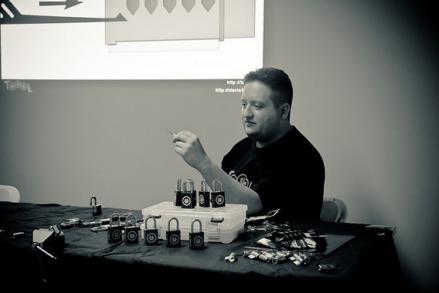
The Strange Things That Happen at a Lock-picking Convention
A note to Dutch innkeepers: If you are going to host a convention of lock pickers, and you promise them free Wi-Fi, it is probably a futile gesture to...
Slate Magazine
173 points · by pmoriarty · 9y ago · 123 comments
Demo animation: https://m.youtube.com/watch?v=jgekjfwphGc
Here's great analysis of the lock with an attempt to pick it and an breakdown of the design after taking it apart: https://m.youtube.com/watch?v=b96pmWSArr4
----
EDIT: In case you want buy a Bowley Lock, they're now available for sale to the public here:
http://www.bowleylockcompany.com/store/c1/Featured_Products....
IIRC, also wondered how this particular design prevents against bumping; none of its protections really seem aimed at that usecase. Not to mention the relative frailty of the key, and the general problem of an easily visible (and thus reproducible) secret.
As for bumping and the key strength, given those topics are covered in the second video, you're comment to me at best feels naive.
Lastly, no system is prefect. Even if the metal the lock is made of was unbreakable and as a result you could 't destroy the lock to bypass it, you could still build a robot that inserts a metal key to turn the lock and dynamically assembles and inserts every possible bidding for each pin.
Feel free to post a lock you like, locks to me are more about simplicity vs security - not some overly complex system will never be used in mass production.
The main issue with this system is the stainless steel keys I think (required to have enough strength so they don't bend up). High security keys always cost more, but cutting SS keys has to be murder on the key duplicator (and $20 per key is quite a price and reflects the challenge of working with SS). And it's more expensive for Bowley, so lower profit margin compared to their competitors even at scale.
However I'm sure the quality is good for that price. I am curious though, are their any anti-drill pins in the cylinder? Or, if the entire cylinder is Stainless then that is practically the same thing.
What if he thinks that someone will be able to pick it? Someone who picks locks for a living, perhaps?
http://www.evva.co.uk/products/mechanical-locking-systems/mc...
Here's a video showing how to pick it: https://m.youtube.com/watch?v=0aNvEL5p1fw
Yep, I remember in high school, in fact it was in Pasadena not far from Cal Tech, I don't remember who, but somehow I learned from somebody how to open the high-school lockers by 'feel', in a fairly short-time I could open any locker quicker than my own knowing the combo.
Locks are fairly amazing when you think about it the locksmiths and the criminals all know how to crack any lock, yet the people in the middle think they're secure.
Years later as a landlord I got to know my locksmith fairly well, one day by offhand he told me that the master-key ( So I could have one key to rule them all ) I was using could open 1/2 the units in the city.
I think it's a testament to human progress. We've never been as safe as we are today.
Maybe time to just leave the lock away then. It's pretty common in Scandinavia, and, at least for me as a tourist, had quite an impact on the societies' mood.
(I know lots of people in Germany who don't bother to lock their doors.)
This was handy for getting around the Institute after hours (steam tunnels).
Instead, I would read the material that Deviant Ollam has published (http://deviating.net/lockpicking/resources.html) or look for an upcoming TOOOL meetup (http://toool.us/).
(2) I don't intend to be pedantic – and perhaps I'm mistaking hyperbole for fact – but how could you are opening a combination lock with an secret unbeknownst to you more quickly than your a combination lock with a secret known to you? Unless, you're shimming the new lock and avoiding dialing the correct combination altogether, in which case you would solve them all locks in the same span of time, this is unlikely. However, you said you're opening the lock by 'feel,' so I assume that's not the case.
Given that, I could easily see how "feeling" that you'd hit the right digit (give or take) might be faster than focussing on visually actually hitting the right digits.
and yes, it actually was quicker to open them by feel than by looking at the numbers on the dial.
It is highly amusing how many keycard readers amount to "close this circuit between two wires hidden behind drywall". Or when they expose USB ports, or screw heads, or are protecting a glass door.
One of my favorites in a NY office design was the keycard passes through a door in a wall that was only a foot higher than the door, with plenty of open space above that (about 5-6'). Security theater isn't just the provenance of the TSA.
Nevermind the nanny state about porn, both viewing and creation, or drugs. Makes Washington State or Colorado look like lawless states in comparison, and yet they still have a ton of nanny state rules that help no one.
Any knife? You can't carry a pocket knife in the UK? That's ridiculous. Knives were nearly the first tool proto-man ever made, and they're still the most useful general purpose tool you can have.
https://www.withoutakey.co.uk/blog/is-it-legal-to-use-lock-p...
However, no police officer would ever identify a few bump keys on your keychain....
From what I've read, possession of lockpicking tools are legal virtually everywhere in the USA, as long as one is not intending to commit a crime with them.
If I am mistaken on this point, I would love to be corrected. IANAL.
Similar to the white/grey/blackhat hackers I suppose. You can use the skill to educate, reduce harm, and do good. Or you can use it solely for profit or ruining lives.
[0] https://www.youtube.com/watch?v=oFdzijpUdNM
Also, it's very possible that he didn't if he was training. I had two colleagues who once decided not to use keys for a month to enhance their picking skills.
I once misplaced my key, and managed to pick the lock with a small strip of plastic used to bind boxes of printer paper. The longest part of the endeavor was finding a pair of scissors to cut the plastic to the right size.
The lock/cable in question retails for about $40. Assuming we paid half that, we still dumped thousands of dollars on presenting only an image of security.
That was the state for 2015, things might have changed.
However, a good lock that's difficult to pick for anyone, with or without bump keys or comprehensive experience, is pretty easy to come by. That said, the hard thing is often knowing the difference: expensive and heavy are not necessarily good hints.
From around the 35 minute mark in the "What The Bump" talk, security researcher, TOOOL founder and President Barry Wels said:
"It [bumping] also works on these high security locks: multiple rows with dimples, keys that look really dangerous thinking if I have these on my door I'm really safe. The thing is, they open just as easy as the other locks, as far as we've seen. The only problem is getting bump keys. We really had some help from some of the state of the art Dutch locksmiths, with very advanced tools to make these keys. But once you have these keys, they're just as easy to open as the other locks. One of the statements which is my favorite is: I think you can teach this to a monkey to open locks like this. I'm still looking for somebody with a monkey to actually shoot some video. If you know somebody with a monkey that we could train to do this, that would be fun.
"It also works with locks with moving parts in it. The ball offers no protection because you take the original key, it has all the information already in it. The ball is always in the same position or there are two different spacings of the ball. It all works the same, because there are a lot of locks with protective measurements that are standard for all the locks. So once you have a key that is cut to the deepest, these mechanisms are still in place. The ball is still there, for instance, and it will still open.
"We opened some some pin-in-pin locks. The brand name is Mul-T-Lock. They were not happy that we opened them, and they were not happy that they were being mentioned in a white paper, and they more or less demanded a public test to show that it wouldn't work. So when the guy was at our place I explained to him how the technique actually worked, because he had no clue. So then he demanded a closed test where the results were kept secret. I said I'm willing to do that. He also put a time limit of four days or something ridiculous like that. So I said I'm willing to do that but it will be on a commercial basis because I can not use the information for my website, you want to keep it private. When I told him my price just to keep it friendly -- I wasn't asking a lot of money -- he ran away and never seen again. I do hear he's still very angry. But if Mul-T-Lock wants a serious test, they can always contact me directly, but not through this Dutch sub-dealer of them.
"We opened some impossible locks. By impossible, I mean I opened some locks, and you can see it on the other video, it's available online if you go to the toool.nl website. I opened some locks that I would never open without damaging it ever, because the mechanism is so well designed. There's only one flaw, which is that the part that makes it secure stays the same in all the keys, and only the variation pins change. I'm talking now about the Assa Twin lock. It's a lock with two rows of pins, and the secure row of pins is always the same in a certain region, which makes it very vulnerable for this attack. Talking about the Assa Twin, another reason that I thought I would never be able to open a lock like that is that it was so well engineered, the tolerances are so small, if the pin is half of a millimeter or a tenth of a millimeter too high or two low, the whole lock does not work any more.
"This is also something that we found, that the tighter the lock is made, the more engineering is put in to the lock, the better this technique works. If the key that slides in to the lock wiggles too much because the key has got a lot of space in between, the energy transferred is a little bit lost. If the pins in the chamber have a lot of tolerance and are not straight in the house, but a little angled or a little bit left-right, the energy is not transferred ideally. So the more expensive and the more engineering is put in to a lock, we found most of our favorite locks opened within a few blows because they are so well designed that they are perfect impact energy transmitters that allow smooth transmission of this energy."[1]
That said, since the technique of bumping made a big splash in the mainstream media, lock manufacturers have experimented with and released locks with "anti-bump" features. Those locks might not be as susceptible as the locks that were the subject of Wels' talk. On the other hand, there are and will continue to be plenty of locks in use that don't have any anti-bump features at all.
He does then go on to describe bumping more challenging locks, but I'm not convinced these would be as easy. Especially for a monkey...
I think if it's the amount of metal that is inaccessible to the outside. Something like the Haven lock that is bolted to the floor, makes a lot of sense.
That of course requires a way of opening that is digital.
I'll think of the pros of digital locks:
+ The proliferation of protocols makes master keys almost impossible.
+ Faster update cycles when encryption gets cracked.
+ Keys that are handed out to household members or visitors with potential losses can be easily retracted.
+ The above separation of concerns. The way to keep someone out should be separate from the way to ask for permission to enter.
+ The easier integration with other security layers such as face recognition, voice recognition, etc.
Sorry, if the above was off-topic. Downvotes humbly accepted.
Against forced entry, standard cylinder locks are inherently weak, because they're just not big enough. It's often possible to force the cylinder to turn, shearing off the pins. Especially if the pins are brass. Locks need to be much larger than usual to resist forced entry. Here's a classic mechanical prison door lock.[1] It's a straightforward lever lock, but it's far larger.
There used to be a thing for "detector" lever locks; if you push a lever too far, it trips the detector, and you have to put in a key and turn it the wrong way to reset before you can try again. Those were once claimed to be unpickable. They're not, but it slows things down a lot.
Then again, windows are also ridiculously weak when you think of it like this.
Not claiming any responsibility for it, naturally, simply observing that it had happened.
Maybe randomizing the contents of a selection of not so random lockers... (purely for educational purposes, of course)
Looked like a perfectly normal lock-picking convention to me.
He picks a ton of locks and has a few recommendation videos if you're looking to buy.
If you're that concerned though, likely best not even to attend conferences that would be selling picks, since it's easy to track where people go and use network analysis to ID the likely intent of that cluster of people, use public info, info leaked by someone else there, etc.
Bump keys are a simple "automated" way to pick a lock: https://en.m.wikipedia.org/wiki/Lock_bumping
If you feel like tapping a bump key with a hammer is to much effort, you could attach the bump key to a vibrating toothbrush; aka a "SonicBump": https://m.youtube.com/watch?v=rDlZbQ20aLI
;)