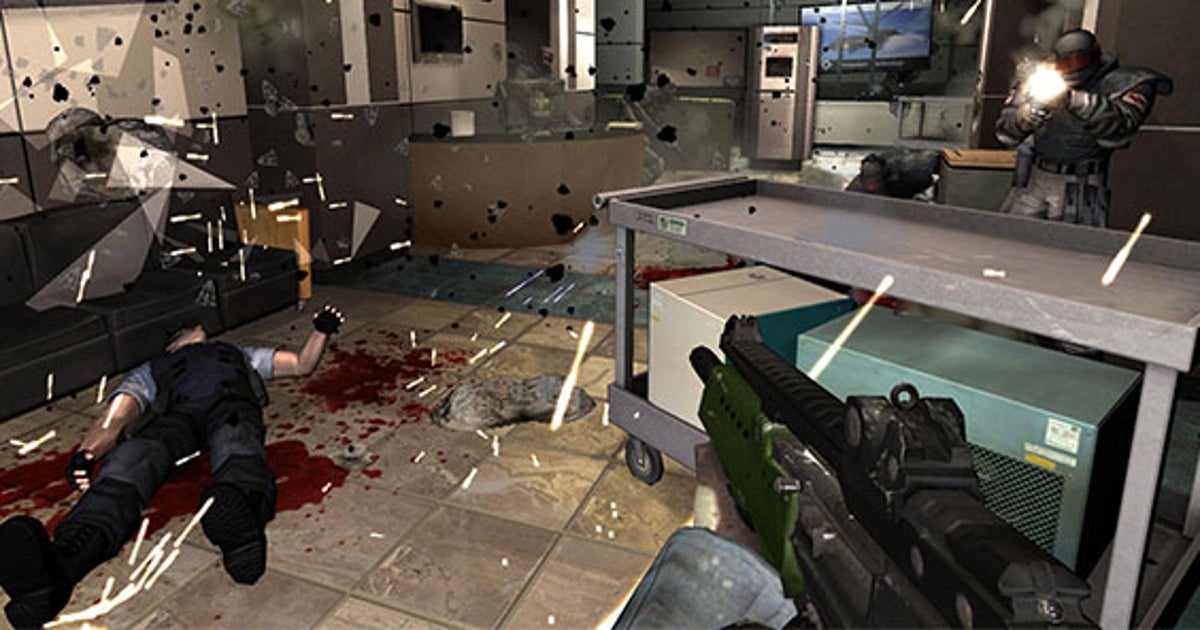
Why F.E.A.R.'s AI is still the best in first-person shooters
The shadows on the wall tell me they’re coming. Two of them, both with assault rifles swinging idly at their hips. If I…
Rock Paper Shotgun
597 points · by danso · 9y ago · 273 comments
So I had set up a test scenario, with an agent that could travel, buy stuff at shops, use axes, cut trees, and so forth. When I ran this test, I had set a goal of procuring timber.
What I expected the agent to do:
1. Go to shop
2. Buy axe
3. Go to forest
4. Cut tree
5. Drop axe
6. Pickup timber.
So I ran my GOAP test, and saw what the agent came up with:
1. Go to forest.
..
When I saw that step 1, I was disappointed, because the agent clearly should not be going to the forest when he has no axe yet.
But then, as a proud parent of my AI, I saw what the agent had actually planned:
1. Go to forest
2. Pick up firewood
3. Go to store
4. Sell firewood
5. Buy axe
6. Go to forest
7. Cut tree
8. Drop axe
9. Pickup timber
Hooray! I simply forget to give my agent money. But GOAP made him smart enough on how to get some money on his own.
I had of course equipped the agent with 'sell' action, and I had placed firewood in the forest, which I promptly had forgotten about when writing a test scenario.
I was so proud of that smart little agent!
Cool stuff, that GOAP!
And this reminds me, I wrote that code 12 years ago, and I still want to incorporate it (with a switch) into the xscreensaver code, but never came to it...
Plus, the ghosts are faster than you when you are eating dots.
I tried writing a text adventure game generator once that would combine puzzle templates you gave it like "object X you need is in a tree and you need a climbable thing Y to get it" and "object X is in a vending machine and you need a coin to get it" to create basic chains of puzzles. Without more constraints it would do silly things like create a vending machine containing ladders, vending machines in trees, vending machines containing other vending machines and trees, and vending machines that gave you a coin for a coin.
All sorts of amazing, um, features, have been found in that game.
  1. Obtain a vessel capable of holding liquids.
  2. Drink from the vessel until it has one unit left.
  3. Empty the vessel onto the ground.
  4. Refill the vessel to its maximum capacity from the puddle you just made.
  5. Drink from the puddle.
So you can also quench your thirst by swimming in a river, then drinking the coating of water stuck to your own ear.
So the cat thing was exactly the same problem. An infinite number of cats could walk through one puddle of spilled alcohol, and then ingest enough alcohol to get poisoned by licking each body part. Lick first toe of right foot? That's a shot. Lick second toe of right foot? Another shot. Lick third toe of right foot? We're having a party now!
On the one hand, it seems like there should have been some additional effort there. But on the other, the game actually simulates that when you dunk something in water, it gets wet, and then stays wet until the water evaporates. I don't know of any other game that not only does that, but also handles dusts and powders, and things falling from the sky due to weather, and even getting diseases by inhaling vaporized droplets of a contaminated liquid.
You would think that with all that incredible detail, the pathfinding AI would not kill the framerate just from two dozen pastured sheep all trying to find their next clump of grass to eat.
Make it procedurally generated and allow people to share the best ones they find.
Haha, exactly, it was a really funny prototype. It took you by surprise by how much common sense knowledge you kept having to feed into it to stop it doing bizarre things e.g. knowledge like vending machines only contain small things, vending machines don't dispense the thing you put into them, large things aren't found in trees, ladders + trees + vending machines are large, vending machines are found on the ground... Even with all that it would put vending machines in the middle of a forrest, trees in an office and stack vending machines on top of each other so you would have to keep going if you wanted it to have some grounding in reality.
Also, if you're not careful you'd need constraint solving to make sure adding a new object into the world didn't short circuit a previous puzzle e.g. if you had an elaborate puzzle to obtain a coin but then added a second coin for another puzzle you could use the latter to skip the former puzzle.
> The kind of game like Bureaucracy that puts the player into some borderline absurdist rage that soon changes into laughter.
Yeah, I was wondering if you could treat the absurdity as a feature somehow instead of the hard work in trying to fight it. The major roadblock I was finding is it's hard to make the player care about what's going on if it's just a bunch of generic objects and puzzles. I've barely seen any advancement in AI in terms of interesting computer generated plots and characters which is what you could combine the above with.
Instead of better gun fighting AI and path finding, I'm really looking forward to games with complex AI characters where the gameplay involves you persuading them, befriending them, manipulating them, interrogating them etc. where the game has a plot that adapts to what's going on.
Games are all about shooting stuff and physical object puzzles right now. I'd like to see game equivalences of movies in genres like drama and thriller that revolve around complex character AI interactions.
For those unfamiliar: You're trying to impersonate someone, so you use a convoluted trap to get some cat fur, which you use as a mustache. But the person you're impersonating doesn't have a mustache, so you draw one onto his ID with a marker.
I'm pretty sure you can find all of these in Japan.
I'm curious about "8. Drop axe". Did your system have the constraint that the agent could only hold one thing at a time?
Or was the goal to carry the maximum amount of timber, in which case it's completely sensible to leave the axe in the woods and pick it up again when you return (assuming no other constraints, like competing agents or weather).
pickup-item was defined as:
PRECONDITIONS: HANDS_EMPTY==1, NEAR_ITEM==1, HAVE_ITEM==0
POSTCONDITIONS: HAVE_ITEM:=1 HANDS_EMPTY:=0
Which makes it so that agents carry one thing at a time, indeed.
You can use it in different ways: like you describe: have some agents prefer certain actions, different from the preferences of other agents.
The way I use it is to adapt to the environment. For instance, I make walking over to let's say an apple, less costly if the closest apple is near.
Look up `Children of Orc.'
The player can give assignments to the other Orcs, and the action plans for those assignments are displayed in-game. The Orcs are smart enough to find cheap plans. When tasked with procuring stone, e.g. they will see what the quickest way is. Sometimes scavenging for discarded stone may be cheaper, other times, with pickaxe in hand near a quarry, quarrying is the way to go of course. They adapt. But whatever plan they come up with, it is communicated to the player in an info-window.
Much of the automated planning literature is about finding ways to find the balance between computational tractability and expressivity of the domain & goals. Many attempts to fuse logic and imperative programming with an aspect of history: hierarchical task networks for example, which are like a high level procedural language with non-deterministic method dispatch. Games like Killzone 2 for the PS3 also had an interesting followup use of automated planning via hierarchical task networks, to do squad tactics; http://aigamedev.com/open/coverage/htn-planning-discussion/
Another thread is Golog as a variant of Prolog that uses Reiter's Situation Calculus to formulate complex goals and domain constraints in a relatively consistent syntax and applied towards "Cognitive Robotics": http://www.cs.toronto.edu/cogrobo/main/systems/ .. it's unfortunate a lot of that work seems stalled since Reiter passed away.
With all the recent hype around connectionist, deep learning AI, etc., there still is a lot of important work going on in the symbolic logic side of AI, particularly in this space of working in dynamical domains. Fusing the two will be really interesting.
If you read this article and want to learn more, click that link.
https://github.com/stolk/GPGOAP has an implementation of goap in C, the code is really clear and easy to understand.
First, remember the first principle of game AI, the goal is not to defeat the player but to entertain him. A simple way to say it is that too good AI is not what you want.
Secondly, for most games, the fun is simply not on the AI component of the game.
If you take those two points together, 1) good game AI is tricky concept, 2) that's not where the fun is anyway, then you got that not a lot of people cares about game AI.
Does the fact that people tend to spend more time on the multiplayer component of a game rather than the single player play any role in this 'not caring about AI'.
I mean, I really did not enjoy playing against AI because they are quite stupid in most cases, and the only way to make a singleplayer become harder does not seem to be to make the AI smarter, but rather have some 'modifiers' against the player.
For example in L4D, the damage you take from a hit by a common zombie on normal difficulty is 10HP (out of 100HP), but on expert the same hit is worth 20HP.
Other things to make it harder would be to spawn in more NPCs and just get the player more busy, or speed up the events in the game (like tetris).
But in all games with a decent multiplayer, it is just _way_ more fun to play against other human beings rather than shooting a bot. Because it actually poses a challenge.
EDIT: typo fix
2001 had this figured out. HAL purposely makes dud moves in chess so that the humans have a chance of winning.
Therefore, I've always enjoyed single-player games more. I fully agree that I do not want the AI to beat me every time; that's just frustrating. I want to be entertained with a good challenge that I can ultimately defeat. Surely there is an interesting game design challenge in this field?
Between those three and their proceedings or conference videos, it's really easy to stay on top of developments in the industry. For an example, check out the AI Summit videos on the GDC Vault - many of them are free.
Planning approaches were a pretty new thing in games 10-15 years ago, but since then there's been a lot of work on exploring them, and people understand their benefits and limitations much better these days. For an example, there's a great study of the use of planning across many games by Eric Jacopin at GDC 2015 AI summit.
1. http://www.gameai.com/ 2. http://events.nucl.ai/ 3. https://sites.google.com/view/aiide2017/
But AI in games does have a bit of an identity issue at times in that the obvious application of game AI(an AI opponent) doesn't represent the broader picture(FSMs appearing in every character controller and interactive element, planners employed in some forms of procedural content generation). With machine learning being the hot thing now, some AI devs are looking for angles to use it, which tends to push them towards backend data work that isn't too far removed from what other web and mobile companies are doing.
Also, nobody wants to run a google-sized deep learning network or what have you in order to train a mere game AI.
Things have gotten better over the last decade or so, with game studios letting developers publish research papers or slide decks or even entire software stacks as open source. Sometimes studios pay to send developers out to give talks and do recruiting. A decade ago, it would have been a hard sell to even get permission to buy your own ticket to a developer conference at most studios. The last AAA studio I worked for had similar policies - only a few people at the studio ever went to conferences, and we all had to pay out-of-pocket. That studio's policies have changed and they now let employees give talks. In comparison, the silicon valley firms I worked for had better wages and encouraged us to both attend and give talks. I think some of the improvements in games industry culture here have probably been triggered as a result of competition from SV startups and open source.
When it comes to AI there are specific challenges: It's very hard to repurpose one game's AI for solving another game's challenges. It's very difficult to build truly general AI frameworks. Good game AI depends on knowledge of game systems, content, and mechanics - how each ability works, how the environments are laid out, the structure of level objectives, etc. All of these things can end up changing during development, and in a multiplayer game they may vary from match to match. As a result, even if you have a bunch of knowledge from other titles and you can reuse source code from the best titles in the market, you may still fail to build good AI for your game on your first few tries. It's that difficult.
General purpose machine learning frameworks have helped here though, and people using off-the-shelf engines like Unreal can take advantage of all the existing tools there to start building AI quicker. So that's nice.
For example, I remember when you turned the difficulty up to 11 on the AI from the first Black Ops game, the enemies just turned into aimbots with a half second or so delay before firing (made watching the kill cam pretty funny). On the other hand, it's not feasible to hand your AI a depth field (which is already not super cheap to produce) and have them use real computer vision methods on it. Also it would probably be too strong a nerf, and now you'd have a very expensive and laughably inept AI.
Scary.
The original Halo:CE had great enemy A.I. too. Though I think was more 'scenarios' being programmed in. What made the campaign fun asides from the big levels was that the enemy encounters were different every time.
Especially on the Legendary difficulty. To this day, the Halo series has the best set pieces and is overall the best single player experience of any FPS save for Half-Life
Unlike a lot of newer games where it seems higher difficulty is just more enemy health and damage.
I do agree with the author about the lack of progress in FPS enemy AI. The recent releases from the Call of Duty franchise are nice games, but the AI enemy combatants look dumb next to their FEAR counterparts. Why has not FEAR's AI strategy been adopted by other games/studios? The article does not mention anything about this.
I believe online-play preempted advancements in game AI.
People will play competitively online if they want a challenge. Single player mode in FPS games these days seem less geared towards being a challenge and more geared towards being cinematic.
I would argue STALKER has the best AI in any FPS.
I really got the impression that a million little actions were happening around me even if I was not there to observe them.
It really keeps the game fresh and exciting.
https://aigamedev.com/open/interviews/stalker-alife/
Enjoy.
-- JustForFun.
The STALKER series was my all time favourite shooter series, and I'm sad that STALKER 2 never saw the light of day :(
PS, a friendly note in case you didn't know: people typically don't sign comments on HN (as the guidelines say, your comment is already "signed" with your username)
I follow AI much more than I following gaming. I definitely find it curious that enemy AI has hasn't made a lot of progress when game-playing in a different form is such a focus of deep learning.
2. Quality control: DL is a blackbox. Bad for the playing experience for obvious reasons. And even if just using pre-trained models, the lack of control goes directly against what both the designers and players typically want (predictable fun).
3. Finally, DL hasn't made THAT much progress here, actually. There have been serious efforts to apply DL to modern games (e.g. DeepMind with Starcraft), but what you've probably seen is "just" DL applied to some finite-state, 100% deterministic, complete-information, zero-sum games. A far cry from complex dynamic environments.
Which is not to say it cannot be done. Just that the incentives (both business and technological) are aligned differently -- too little bang for a lot of buck.
Come on, you could have decent AI back in the day that pinned me down and made me run for cover, then had me at that cling gling oh shit moment when a perfectly timed grenade lands at your feet just as you were starting to take a breath†. Today we're stuck with scripted sequences and playing whack-a-mole with sniper rifles.
† only HL1, Halo and FEAR seemed to manage that.
I remember a discussion on gamedev.net once where exactly this was brought up. Its very hard or even impossible to tune an ANN to behave how the designers want it to. Simpler systems may not be as technically intelligent, but their behaviour can be tuned, encouraged, scripted etc to provide the experience that the designers wish.
Beyond that, I remember they also talked about how it simply wasn't worth it because game AI isn't about being smart, its about being fun, interesting and "looking smart" (ie looking humanlike, human flaws and all). Machine learning is simply solving a different set of problems than what games have.
We did some of this for racing games which really have pretty easy AI when compared with character games or strategy. An example is take ghost runs from real players, essentially splines from real players good and bad, but adjust the runtime play to the current vehicles but try to run that line. That way runs appear more human and probably can't be replicated by AI as well.
For racing there is also the typical rubber banding AI which tunes to the runtime play[1].
Most AI in games really come down to just scripts and action recipes. Zone based events/actions, path passed actions/events, follow/ranged/staged reactions, global actions/events, AI directors that can tune the game to the player or difficulty dynamically etc.
Left for Dead probably has the best AI director out there for tuning some great co-op games[2]. It does med drops, weapons, enemies appearing all based on the current state of the players and skill. Music also changed per player based on their situation and intensity of that situation.
The Director, sometimes referred to as the AI Director, or simply as AID is the artificial intelligence of Left 4 Dead that features a dynamic system for game dramatics, pacing, and difficulty. Instead of set spawn points for enemies, the Director places enemies in varying positions and numbers based upon each player's current situation, status, skill, and location, creating a new experience for each play-through. The Director also creates mood and tension with emotional cues such as visual effects, dynamic music and character communication. Moreover, the Director is responsible for spawning additional health, ammo, weapons, and Special Infected, like the Witch or the Tank.
It should be noted that there is another Director in the game, which controls the music on a per-player scale, called the Music Director.
Most FPS games with the exception of titles like Alien: Isolation simply haven't needed anything complex. Essentially more complex AI with the same freedom wouldn't be noticed by the player in most FPS games. Given more freedom a more complex AI suffers from being less comprehensible as the player is less aware or unaware of the actions it took to do something clever. For example a clever enemy that flanks the player is experientially identical to a scripted event that spawns dumb enemies on the players flank. Further the advantage to the second technique is not only that the AI requires less work but the entire scenario can be carefully designed.
Which is not to say a more intelligent AI wouldn't make for a fun FPS game it's just people haven't been making those games.
I suppose for some players and some games, it makes sense to train for "good" - but even with chess - is it really fun to play an ai you cannot realistically beat - ever?
The same stuff that made critics laugh at enemies not seeing you when standing on a 0.5 square meter shadow in the middle of a well-lit room because you're technically "hidden in darkness" is what is now "solved" by removing the mechanics altogether in favor of safe and cool looking scripted sequences.
Basically, this: https://twitter.com/robotduck/status/759529875992698880
For skilled gamers (which I am most definitely not) I can see how this 'cheat' is annoying, but for me, who isn't the best at precision movement in 3D games, I found it helped me immensely during these types of sections to simply turn off the sound.
We might wish that the folks at EA or Activision make shiny cool AI (and I'm sure many of them there want to!) but in reality that doesn't really do a whole lot to benefit their paying customers.
Besides - "AI" in games is really about how to create stage pieces that simulate more complex behavior. Like all software development, it's mostly smoke and mirrors, and it's all about how smart you can set that up to give the user the impression of something magical.
E.g. an enemy coming out of cover at a different position than when they last popped out is cool, but working out that coming out of cover is just a bad idea and waiting in ambush would be more realistic and smarter, but lead to stalemates.
Heck, you hardly ever see even vaguely decent morale implementations ("hey you just effortlessly killed 80% of my unit, so I'll, um, charge you!!!").
Again, in EverQuest some enemies would run away and get help. In World of Warcraft they just mindlessly attack until dead. EverQuest's AIs (lame as they were) were simply too deadly for a truly mainstream MMO.
That's not to say I don't enjoy playing them, but I do sort of miss the days when games actually had deep single player gameplay.
The AI was a joke, though, but that now seems to add to the charm. It goes really well with the campy voice acting and over-the-top characters.
It's a game I'll keep recommending over and over again. The sheer amount of player choice, customization, and environmental openness and interactivity is tough to beat, even today.
Once CoD:UO (and 2, and so on) came out, they began killing off the great historical single player experience they had.
Look at the old Rainbow Six games against the new ones, same for Ghost Recon. Hidden and Dangerous was a great game too.
Those games are actually hard, and have gameplay that isn't just "watch explosions, shoot some enemies, get shot, sit behind wall to recover HP".
Just look at Rainbow Six 3 against Rainbow Six: Vegas 2, the second one was about as linear as you could make a game, the first one gave you a lot of options in how you would achieve a mission.
If you're saying that these games are shallow, I will fight you irl.
The whole genre of linear single player FPSes is sort of dead. Lots of mixed genre games that tie in RPG elements with big open worlds and character customization though that are doing quite well and could benefit from better AI.
Even with a friend though we can't reliably beat the top level AI in Ghost Recon Wildlands so it can't be that bad.
I personally like the interactive movie feeling, the scripted events and the scenes. I did never enjoy CoD in multiplayer which I find too hectic. The battlefield series with a more slow-paced and strategic gameplay suited me better in multiplayer. However I generally don't enjoy competing in MP that much anymore - too little time and interest to train enough to be competitive with the younger players.
Linear single player FPS is definitely not dead, although multiplayer is the current focus. As a quick example, DOOM (2016) has both linear single player and multiplayer sides, but the single player side was much better received.
I suspect that there's an element of self-selection going on here; there are lots of people who play the single player, but an onliner can't see them because when that onliner goes online it's 100% people who go online that one sees there.
There could be ten times that many playing it for the single player and they'd remain completely invisible.
I did, when I actually bothered to play CoD (the first Modern Warfare was probably the last one I enjoyed) and couldn't stand the multiplayer.
When I had been used to games like Quake, Unreal and Battlefield the multiplayer in CoD always seemed so half-baked.
The genre seems well and thriving.
AI is often at its best when it does something stupid that is understandable. For example, in Halo when you kill a bunch of the big guys, sometimes the little guys drop their guns and run away. This makes them very vulnerable, but it is fun. A smarter AI (one that would win more) would only pop out when you aren't facing them, or if cornered just shoot back very accurately from two points. But getting hit from behind isn't much fun, and getting shot at head on from two directions is also not much fun.
Good AI is usually a mix of good game design (and art) as well as good engineering.
For example, AI can micro manage way better than you can, it can do a billion APMs. It has complete situational awareness at all times and never gets distracted by real-life. In an RTS where scouting is key, it could fan out with as many drones as it can produce and gather way more information than a human player could.
You need to constrain your AI so that it's not impossible to defeat. For example, limit how many actions it can perform in a given situation, or make it stubbornly cling to some losing strategy for a while even when it could easily flip to the most optimal one in an instant.
Watch some StarCraft/StarCraft2 bots, it seems like an easy challenge, but they can't beat a good human player when they have to deal with the fog of war.
PS: Multi drone scouting tanks your economy and becomes a really bad idea. You want to send out one scout that can both gather useful information, not die, and not significantly hurt your economy. To the point where some very high level players don't always scout early.
Infinite APM AIs in starcraft still basically suck.
There strategy/high level planning is so terrible that perfect/unfair micro doesn't save them.
They can be given the same kind of information in a way that mimics a player's knowledge and perceptions without having to cheat by making them "forget" their perfect knowledge of the world state or act deliberately stupidly while having that perfect knowledge (of course, you still may need to make them stupid sometimes for the sake of fun).
Civ is the same: the AI has routines that try to win, but also a whole bunch that role play.
Interesting idea. Clever use of a classic algorithm in a novel way.
Whereas academic planners at the time were struggling with PDDL (a symbolic declarative language for describing planning domains -- i.e. problems and actions which can appear in plans), GOAP rewrites all the actions in C++. Then, no problem for procedural preconditions and postconditions, for instance: just call C++ code to check what you have to.
-- JustForFun.
It's an extension of Dijkstra's algorithm that adds a few heuristics.
@omginternets:
> dates back ... extension of ... adds a few heuristics.
Blabla, BS.
Fact is Empire Earth was one of the very first computer games to use A* algo. Age of Empires 1 used a worse faster different algo.
Fact is in the age before Wikipedia and Google, decade old papers of obscure algos were more or less lost and forgotten. They were written on paper with no digital copy readly available. So game devs often reinvented things without not knowing of previous work, it took several years until the early 2000s that this old stuff got scanned and made public viewable.
This stuck with me because it actually worked. If you repeated an action long enough, the AI changed how it tried to kill you.
Scenario: You are in your helicopter trying to blow up tanks and helicopters, and "Mission Targets". The lower you fly, the longer you evade radar, and the closer you can get to your target. So you hide behind some hills, pop-up acquire a target on a fuel tank, fire your missile, and then duck down before the enemy missiles can get to you. You then repeat this process to get all of the targets, but if you take too long the tanks/helicopters will fly around the hill trying to find you (as opposed to sitting next to the targets dumbly forgetting you exist).
The game learned from your pattern, and adapted. IMHO this was superior to every other game that just had the enemy shoot faster (i.e. Unreal Tournament)
On the other hand, it might just be nostalgia.
That's what came to mind reading this. I remember the AI and Half-Life, and while it sounds like they did better in this game (which I haven't played), it also sounds like an iterative step, and after seven years, that's not a lot. I happen to own this game on Steam from some humble Bundle pack or something, so I think I might have to break it out and have a play...
Edit: Sheesh. 17GB install for a 2006 game. That's steep.
Edit: So apparently it was not from Deus Ex, but from someone anonymous. Still interesting read: http://askagamedev.tumblr.com/post/76972636953/game-developm...
but it's fun when you're playing enemies who are seeking another angle, even a simple one. Compared to the other games on the market. F.E.A.R. remains the best FPS I've played.
[1] http://www.quakewiki.net/archives/botarea51/main/qbot7429.ht...
Side note: I regularly played against the Frogbot's author (who used the handle Frog) at LANs. He was reknowned for being the most analytical and "bot-like" player of our scene.
no, he wasnt:( he was just better than you. Reaper on default skill 1 was an ok challenge for average players. Skill 3 was a competitive against good players, but still nothing special against deathmatch veteran spending days in gaming cafes or internet servers.
For reference best Quake bot, Omicron(dev went to work for ID software and wrote Quake3 AI etc) on highest skill level vs actually good dm player https://www.youtube.com/watch?v=hEeDXPkEnME
also https://youarenotsosmart.com/2014/11/10/yanss-podcast-036-wh...
Just don't. It's just boring and uninspired and... ugh.
I played through HL2 again recently and it was fun but I found it to be over designed. HL2 (and Portal!) try way too hard to make the player feel clever. You'll find some nook or cranny or hidden path that always turns out to be only way to go.
I used to rag on the guns in the game too; they are not fun to use, but looking back I think that was a deliberate strategy to encourage the player to use the gravity gun more.
HL1 certainly had a much more organic feel to it. Like the abstract bases and hell of DOOM vs the uncanny valley cities of Duke Nukem 3D, the missile base of the original HL, which has no basis in reality in terms of its design, feels more authentic and believable than City 17.
Most of the battles in HL2 are either forgettable or boring (SHOOT A ROCKET AT THE THING!), but I must say I really enjoyed the one near the end of the game where you fight against soldiers on multiple levels as you climb your way up some kind of warehouse: https://youtu.be/91uWeqArrok?t=3h38m19s
So in the case of F.E.A.R. the AI is simulating humans so they shouldn't seem smarter than that.
This starts at not microing to well in strategy games and not aiming to well in shooters but is almost limitless in how complicated one can make it.
PANICS anyone? https://www.youtube.com/watch?v=thkcDqPsmEU
-- JustForFun.
I felt like the tactics used by every enemy in the game basically involved flanking the player from two sides, and never approaching directly unless there were no other ways around (which was rare, as the levels were basically one combat arena connected to another in linear fashion).
It was pretty easy to exploit this by basically charging the enemy and aiming for the head as if you were playing an old-school strafe shooter, which didn't give them enough time to formulate their flanking plan.
I found by doing this the game became trivially easy, even without using the bullet-time thing.
I found the enemies to be less dumb than your usual cannon fodder, but you'd mulch through them pretty fast if that was your goal. They did try a lot harder than those in other games, which was nice, but they weren't that much of an obstacle. Their patterns are somewhat predictable, so you can often anticipate where they're going to go, or what they're going to do.
The problem with the F.E.A.R. AI is they don't necessarily adapt to the player like real people will. You can do the same thing a hundred times and they'll fall for the same trick.
Getting ambushed? Well, poke out, draw their attention, and fall back to a more advantageous position. Human players would just wait it out, they know you have to go through there, but the AI, ironically, gets impatient. Their goal is to kill you, not to defend things.
I'd like an AI that gets wise to my tricks, that starts to react differently. If you're using grenades frequently they might field more heavily armored troops. If you're sniping they might snipe back. That'd force you to adapt, to switch it up, to avoid becoming predictable.
The problem is that requires a pretty robust AI to manage troops and a deeper objective than "kill player".
Quake 3 Arena, Unreal Tournament and many more games had offline bots with whom you could play multiplayer maps. Most relied on predefined paths added with the map editor, but some of them worked without paths as well.
It was impressive how good Unreal Tournament 2004 bots handled cars and vast open maps.
Also RTS games category is dead, it usually also featured advanced A.I. to play against bots on random generated maps. Sadly, games like Age of Empires, Empire Earth, Command & Conquer are dead. (before an off topic comment derails the conversation: I know about the 8 year old SC2, I know about other kind of strategy games but they are not RTS, I know about Moba and tower defence but they are not RTS)
One can argue that Chess or Go are friking old games and that we need to make Chess 4000 and or invent a new go, same apply to the good old broodwar from 98.
(Age of Empire online was a Free2Play/whatever game based on the years older Age of Mythology engine. Microsoft closed the Ensemble Studios. Lately Microsoft asked a small unknown studio to recompile old Age of Empires 2 and Age of Mythology and add some community patches and rerelease those 15+ year old games as HD (not really any graphical changes, beside minor stuff, ad bigger resolution), and some new missions/campaigns. But we know the game and it runs still fine with community patches on Win7. And replaced the network lib with Steam, but it's a buggy mess - the original game run more stable. What the AoE community wants are real new games, not old games one played already for 15 years and hundreds of hours know very little secrete.)
Might be buggy but recent releases + active community isn't really dead at all.
That's about it. Sadly most game dev studios don't invest resources in good A.I. The stupid mass of soldiers you know from Call of Duty franchise is now everywhere.
Similar to this; set on a cruise ship with NPCs doing random tasks, you had to work out who your (Player) target was amongst NPCs and assassinate them quietly.
I think one of the Assasins Creed games also had a similar multiplayer.
I initially thought that if i were to make the game I wouldn't be able to simulate the same paths as a human player so would need to use a waypoint clicking system to move until you're being attacked and your cover is blown.
Anyone with a good idea for my next game? :)
All these 3 use planning (the planner in SOM is the grand grand son of F.E.A.R.'s -- other 2 use HTN planning) for the AI.
;-)