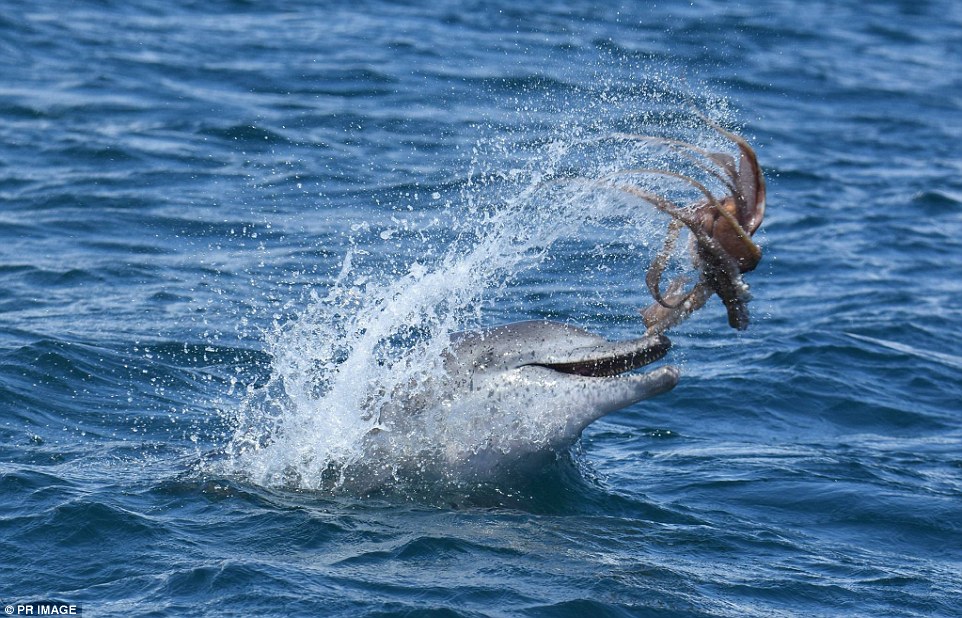
Scientists capture video of dolphins risking death to eat octopus
There's a strategy for avoiding tentacles that keep fighting even when detached.
Ars Technica
301 points · by shawndumas · 9y ago · 187 comments
I'm from south-west Australia (where these dolphins were observed) and grew up swimming along the coast, scuba and snorkelling to much delight.
Once, in a little sand hole near Yanchep, I was floating around on a particularly hot day, when I thought I saw a crayfish just lolling around on the ocean floor. Diving deeper to get a closer look, I realised it was just the head of the crayfish, long-since hollowed out, albeit with a bit of flesh still onboard.
I took an even closer look, and what I thought was a bit of weed attached to it was actually a long, slender tentacle, which I followed back to a minuscule hole in the rocky sand, and therein I spotted the rest of the octopus.
Delighted, I stuck around for a while to watch.
The octopus was fishing! It held out the cray corpse just a little, out in the currents, waiting patiently for the stupid little white fish to come and try to nail a bite!
When a particularly dumb little fish got its fangs in, BAM! Out came another tentacle, fast as light, and snatched that dumb fish into the hole. All the while, the original bait tentacle continued to just lull about, swinging and swaying, getting those dumb fish even closer and closer, ever more tantalising.
I stayed and watched it all day - it apparently had a nearly-insatiable hunger, or maybe it was just really enjoying itself. To my dying days, I'll never forget that clever little cephalopod ..
(tl;dr: don't eat octopus!)
does that mean "cut off" ?
Cuttlefish!
http://www.sciencemag.org/news/2016/07/how-colorblind-cuttle...
Now that it's become clear that the octopus is an intelligent creature capable of solving problems and making plans, I'm going to eat less sophisticated mollusks and leave octopus to the dolphins.
But there are many, many differences between humans and dolphins. We're smarter, for one. Debate philosophy. Are rarely seriously in danger of starving. Have much more culture. Etc., etc.
So, probably as intelligent as nomadic pre-historic humans. I wouldn't rate that as "highly" intelligent. Just somewhat intelligent.
These are still pre-historic dolphins, since they don't seem to record history for themselves yet. If they carry oral traditions, they seem to be limited to hunting techniques, and not specific events and personalities measured across time. There is no evidence of symbolism invented by dolphins.
Killing and eating a pig when you need it to survive is not immoral. Killing a pig because you felt like having pork rinds, and then leaving the rest of the body to rot because you'd rather have steak is immoral.
While there are dolphins who won't eat octopuses because it's dangerous or difficult, I bet there are some who won't because they empathize with them. If the humans in this thread can empathize with an octopus why couldn't a dolphin?
Cooperative hunting, altruism, care for the members of the group, and colective child care are normal.
Innate interest and sense of compassion for other marine mammals in distress, including humans, and a strong protection response in dangerous situations.
They have grandparents. This is particularly remarkable. Old specimens past their reproductive days are treated as expendable and die quickly in 99% of the animal species. Grandma's are instead VID (very important dolphins) in its societies, and live much longer than expected.
Mourning was also reported in some cases.
"The potato says these things by doing them, which is the best of languages. What is consciousness if this is not consciousness? We find it difficult to sympathise with the emotions of a potato; so we do with those of an oyster. Neither of these things makes a noise on being boiled or opened, and noise appeals to us more strongly than anything else, because we make so much about our own sufferings. Since, then, they do not annoy us by any expression of pain we call them emotionless; and so qua mankind they are; but mankind is not everybody.
From Samuel Butler's Erewhon. (The same chapter that inspired the eponymous Butlerian Jihad in Dune, incidentally.) I don't agree with the conclusion here, and I doubt Butler did either, but the whole book is a great read.
[1] http://www.online-literature.com/samuel-butler/erewhon/26/
maybe it's just they like the taste? it's not like we don't go out of our own way to find some delicacies just because we are in the mood for them.
I know anthropomorphizing animals is a no-no these days, but trying to explain everything based on "nutritional value" seems a bit narrow minded...
Well, I think you are making a good point here, so I wouldn't write it off on that basis. In the rush to avoid anthropomorphizing animals, people sometimes go to the opposite extreme and assume that things like "taste" are uniquely, exclusively human experiences and can't be extended to animals.
That seems to attribute full ownership of a category of experience to humans, and to me that kind of assumption is more problematic, if we're talking about the excesses of anthropocentrism. I think your explanation makes perfect sense.
'Why do you keep having sex? You already have all the kids you want!'
Do dolphins get high on octopus?
"Pufferfish produce a potent defensive chemical, which they eject when threatened. In small enough doses, however, the toxin seems to induce "a trance-like state" in dolphins that come into contact with it"
Although I just learned from Wikipedia that apparently we figured out how to raise non-poisonous pufferfish. Neat.
Perhaps it's only worth eating for the thrill?
It makes sense that earlier ancestors who maybe found bitter very enjoyable and sweetness not so enjoyable died off from a lack of calories or eating poisonous things before reproducing. And it makes sense that while across cultures people eat very different foods, you see the same patterns in terms of umami and sweet being considered desirable and bitterness often rejected.
In fact the human tongue is considerably more complex than traditionally assumed. For example, besides the umami taste receptors recently proven to exist there are also studies looking to see if we have taste receptors for "fat", "starch" and even "metallic" flavors, among other things.
The chemical reaction between molecules and how the brain decodes the signals produced by them is fascinating when it comes to the flavor of things.
[1] See a review about it that explains his findings. https://www.theatlantic.com/magazine/archive/2016/05/how-ani...
I am not really aware of any mammal behaviour that I cannot somewhat relate to at gut level. You may say I anthropomorphize, or you may say I equate, it doesn't really matter. There isn't a physiological or neurologic feature we don't share, me and all those other mammals. I have some language and some reasoning power to top it all off with, but our sensations, reactions, emotionals, motivators, fears, pains and joys are clearly of very similar nature. Of course they are - they run on the same basic hardware architecture.
And now, if you will excuse me, my dog wants to go for a walk. I know exactly what he means.
[Edit: typo]
Super dangerous and only possible when working together.
Perhaps one day, thousands of years from now, technologically advanced dolphins will one day watch us doing the same thing again, and they will have a similar article about us!
I'd be curious to know how much of human technical advancement was thanks to the ability to relatively easily smelt metal, and whether the inability to easily smelt underwater creates an impediment to technical advancement of species living underwater.
The ocean isn't a good place for tool building!
I have a feeling that what dolphins lack in material culture, they make up for in social life, poetry, philosophy, and music. They're probably looking at us with pity: "Their pod dynamics wouldn't be such a mess if only they didn't waste so much time and effort building stuff..."
(Okay, okay, I know a lot of you people love building stuff...)
If anyone's interested, I really enjoyed Voices in the Ocean by Susan Casey as a look into how advanced dolphins may actually be. She explores scientific facts and even interviews "kooky" new-age people who swim with dolphins daily to get their POV. I was convinced that at least there are dimensions to dolphins' lives that traditional marine biologists are totally unprepared to touch.
(No idea whether there's any wood equivalent underwater.)
Having opposable thumbs is a pretty big deal. One Arthur Clarke short story that has always weirdly stuck with me is "Second Dawn" - which revolves around super-intelligent telepathic horse-like aliens, who have sadly limited technology because they only have hooves.
The only reason we haven't been able to communicate with them is we haven't found a good mutually comprehensible input medium for them. HMDs could be it, positional audio might help. But either way VR as a metaphor for UI will get researchers thinking in new ways about input as we go deeper into VR ourselves.
Presence will be the Rosetta Stone for animal language. "You are here and this is happening" is orders of magnitude harder to ignore as an atom of communication than a computer screen on the wall of a talk.
We will be able to record entire naturalistic experiences of a dolphin, and then give them an AR keyboard to play back arbitrary slices of it in sequence, and do the same for their friends.
Early dolphin language will look like hip hop music or poetry in structure (a pastiche of samples), and we will quickly find out whether they have the neuroanatomy for grammar.
I think one barrier may be that we're not that interesting to them. Perhaps, rather than sending literal-minded scientists to attempt communication, we ought to send poets and musicians.
I read of a recording of an upset, irate dolphin's sounds. When slowed down significantly, it was clear the dolphin was mimicking it's trainer's reprimands. So, one clue is that their processing speed is way higher than ours.
I also read of a researcher who set out with a box that could make dolphin sounds, and she wanted to teach dolphins to say names she has made up for three objects, with disappointing results. But I'm wondering... these are creatures that can be taught a command that means "innovate" - do something different that you haven't shown me yet today. A rule of their language might be never to use the same word twice.
Also, dolphins are aware of one another's sonar. So, they would never need to vocalize "Look at that over there." They already know what pod-mates are paying attention to. Possibly they wouldn't find it interesting to use nouns to refer to things that are already obvious on the pod's echolocation radar. Their verbal channel might deal with less concrete things like mood, nuance, intuition, and humor.
Best line from the article :D
I can't imagine that a dolphin can throw an octopus leg at more than 15-20 mph, and at that kind of speed I wouldn't imagine damage to a soft bodied creature.
I would imagine a better technique to be to leave the octopus legs for 10 minutes for lack of bloodflow to kill it. Wonder why they don't do that? Too hard to defend a bleeding morsel of food from other predators?
I don't see why you would think leaving the legs alone for ten minutes would be as effective as hammering them for ten minutes. What's going to bleed out and go lifeless quicker, an arm left alone or an arm being beat on?
Arms work even 1h after cutting off: http://moscow.sci-hub.cc/58b56284136af39dc0eaf7491b31d759/ha...
The article reveals that dolphins can be killed trying to eat octopus in a more conventional fashion, but I don't see any "risk" involved with their throwing method.
I will totally continue eating octopus
They can bite, and that's about it. Do these look like chewing teeth? http://4everstatic.com/pictures/674xX/animals/aquatic-life/d...
This is just a thought and may not be correct.