Safari
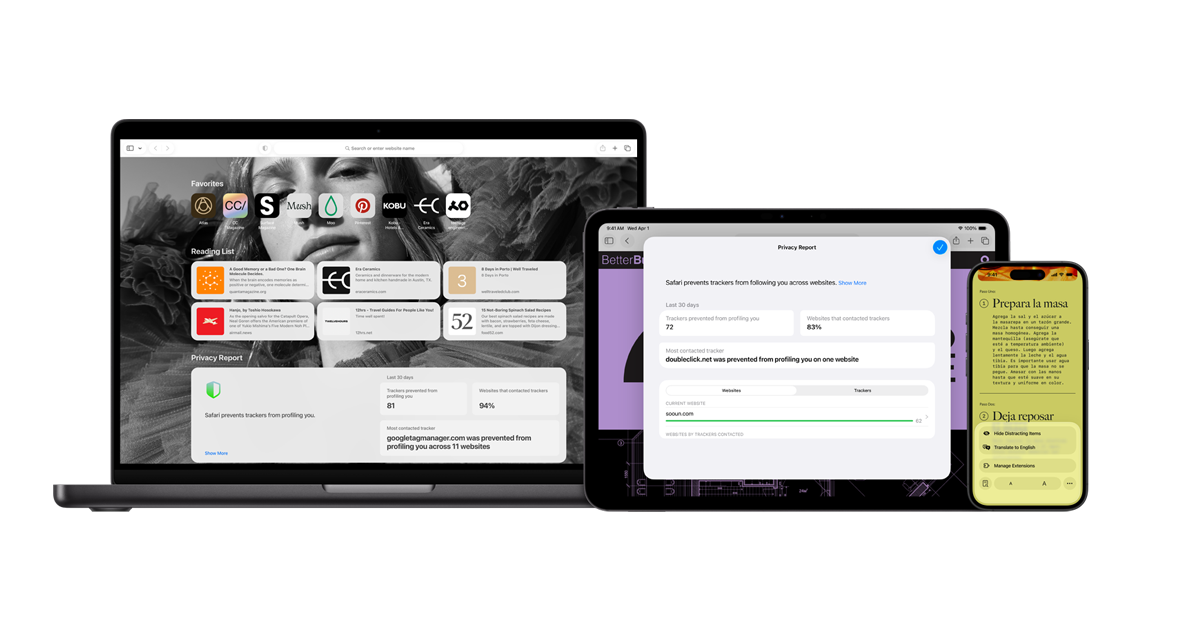
Safari is the world’s fastest browser. Enjoy more third-party extensions, powerful privacy protections, and industry-leading battery life.
Apple
63 points · by Ghost_Noname · 16y ago · 79 comments
Newspapers were dying because nobody wanted to pay for news, which they could get for free at Google News. Newspapers were told to suck it up and instead move online - to an ad supported model. No more ads.
I dont think the newspapers are the bad guy here.
It's not about good or bad guys here, it's about a business model being deprecated by technology. And part of the web's technology is that the user agent decides of everything. Including not displaying ads if it doesn't want to. Or reformatting layout. Or even displaying nothing at all and only voicing the text.
Welcome to the future, your business model is dead or dying, you might or might not survive but your model can not and will not. Unless you manage to stop the march of progress.
http://www.theatlantic.com/business/archive/2010/05/google-p...
Basically, the problem is that newspapers make most of their money on ads from "bundled" content, e.g. lifestyle, cars, sport, and almost no money on hard news.
But today people go to specialized web sites for all the economically lucrative content, leaving only the hard news for the newspaper. And the newspapers can't really get people to pay for it, because most news stories are a commodity (it is the same story everywhere).
Now look at smaller publications such as Gawker, hyper local news. They are doing just fine.
Wired sold almost as many iPad versions (75.000 at 5USD a pop) as they did paper version since they launched it. Thats excluding advertising.
Clearly there is a market for news. It's just not going to be of the NYT kind.
You need to find ways to bring your advertiser's products to the attention of your readers in a way that is both useful and interesting.
If CPM rates are dropping from your advertisers, maybe its because you are cramming too many ads in!
As far as I can tell, the point of splitting an article into more than one page was just more ad exposure. So it's a double whammy: graying out and background the ads, and decreasing the number of ad-ridden pages one needs to read the article. Awesome in my book.
I also don't like it when people here link to Print View instead of the main article page. Partly for that reason, and partly because the text columns tend to be way too wide on print view pages. There's also frequently no way to get back to the non-print-view page.
http://lab.arc90.com/experiments/readability/
Design the page for you, not for the ads.
My personal suspicion is that we're moving quickly toward a world dominated by local newsrooms covering local stories (with international distribution), rather than large international news organizations and centralized reporting. Add in a few companies (some traditional, some not: Reuters, Google, et al) surviving as international news aggregators and licensing hubs (perhaps similar to an MPEG-LA model).
However, none of this plays out well for organizations like the New York Times or other large traditional print companies. "Be flexible."
It fixes the "I want to read this, but it's hard to read" problem. If you don't have that problem, your users won't use Reader.
And an advantage (as I test-drive it) is that turning the Reader-view on/off for a given article is almost instantaneous: whereas with Readability to move _out_ of Readability-View involves _reloading_ the entire page (which I find annoyingly slow on pages like TechCrunch, RWW, etc where there are tons of ads to be (re)loaded.
I think the Safari-Reader approach may increase time I spend with a full, ad-laden page open.
Edit: Yes, talking about Safari only.
I uninstalled ZoneAlarm a few days ago and clicked "OK" as I went through the motions .. great, now the machine is rebooting and I lost whatever the fuck I was doing.
Compare that to Linux where I was developing custom file system drivers. modprobe foo, and I had a foo driver looking at an intricate piece of chipod, rmmod and it's gone ..
Wax poetic all you want about OS stability, but Windows is the wrong muse to sing to wrt stability, and I say that typing on XP.
Its funny how quickly Chrome has reprogrammed me.
http://blog.builtwith.com/index.php/2010/06/08/builtwith-saf...
Opera (v10.53): 299.8ms +/- 1.0%
Safari (v5): 314.2ms +/- 1.7%
Chrome (v5.0.375.55): 326.6ms +/- 7.9%
Firefox (v3.6.3): 716.4ms +/- 1.7%
Who deletes something automatically without a warning/permission these days?
Any sign of a portable/virtualized version yet? Or too soon?
It should be possible to use them all side by side.
Those builds should be very similar to Safari. Not exactly sure about the difference. I didn't saw any when I tried last time (a year ago or so).
Without warning or permission? You asked it to upgrade your Safari installation, it upgraded from 4 to 5, what were you expecting exactly?
I specifically changed the folder and it confirmed it.
Son-of-a-bee that makes me mad.
// EDIT: I see below you mention MSIEXEC. So never mind.
   1. uninstall S5
   2. install S4
   3. archive S4
   4. install S5 to different directory
   5. unarchive S4
update: this now works great and both versions peacefully co-exist
They just heavily advertise this new option with a huge image [1], ordinarily a feature like that would get a line or two of text or maybe not even be mentioned. I guess that’s supposed to send a message to Google, something like “We have a good relationship with your competitor so you better not fuck with us!” (i.e. stop us from using Maps or something like that).
Will they remove Yahoo from the list when Yahoo results = Bing results I wonder?