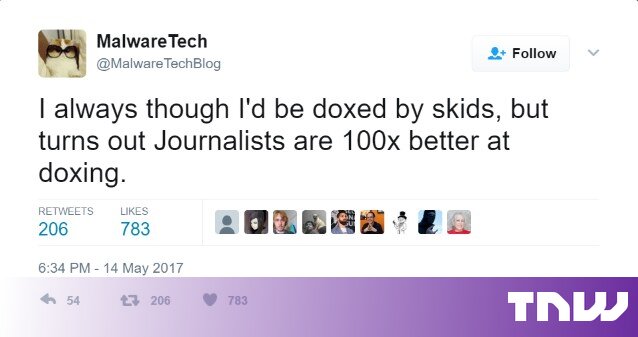
Doxing the hero who stopped WannaCry was irresponsible and dumb
Seriously, fuck these guys.
TNW | Insider
442 points · by ascorbic · 9y ago · 107 comments
What could possibly go wrong?
No, he wants to be left alone because it endangers his life to reveal his identity. Jesus, do people seriously expect someone that's done heroic deeds like this to jump out and scream "I am Batman"???
I would've liked to see the journalists find the hackers behind this. That would've been an achievement indeed.
How do you figure? Digging through information and finding out this sort of stuff is literally what journalists do for a living.
If a journalist can find it - any internet layman who knows how to Google can find it.
I would like to find a white hat site that prepares a report on what they can find about you.
(For the record, my reddit account has a different username than my HackerNews account)
News organizations have access to many non-public databases.
for lack of a better term
It's like, almost every front door lock can be broken, or circumvented by smashing a window. Leaving your front door unlocked and open however, creates opportunity, that really increases the danger of burglary.
The people behind wannacry targeted Russian banks. Chances are they already died of unexpected radioactive contamination, accidental stabbing, or unfortunate neuro-toxic poisoning.
Anyway, comparing these journalists as "sphincters of bad journalism" is probably even too positive. Unlike sphincters, that do have a useful purpose, tabloids could be wiped out of this planet without any negative side-effects.
Do you have a reference for this?
--
It's definitely weird, but there's a reason (https://www.theguardian.com/world/2012/apr/25/mi6-gareth-wil...) that they considered this as a real possibility:
> But his former landlady, Jennifer Elliot, told the inquest that three years before his death, she and her husband had heard Williams call for help at 1.30am from the annex flat he was renting from them in Cheltenham, where he worked at GCHQ.
> They let themselves in with the spare key and found the codes expert lying on his back on the bed, in boxer shorts, with his hands tied to the bed posts with material so tight it had cut his wrists.
> In a statement read to the inquest, Elliot said she and her husband had both been in shock. Her husband asked Williams: "What the bloody hell are you doing?" Williams told them: "I just wanted to see if could get myself free."
> The statement added that he did not appear sexually aroused, and was "very embarrassed, panicky and apologetic."
> The couple, who never spoke to anyone about the incident, said they concluded it was "sexual rather than escapology".
And SIS/GCHQ wonder why they have such a hard time recruiting staff.
I don't think anyone much thought it was anything but an extremely suspicious death. In many ways matching almost too perfectly the imaginary world of Spies we like to watch/read about.
https://www.malwaretech.com/2016/05/infosec-without-degree.h...
Also can anyone point me to resources on preventing doxing while hosting a website? I want a checklist of things that can possibly leak my identity. For example:
- Some basic stuff is use whoisguard and don't reuse any existing hosting / cloud infrastructure or even google analytics accounts
- But for new accounts, does using real credit card information matter? I am not sure how easily a company will give that information up. For example how hard is it to social engineer or get a court order/subpoena for it?
- Even then you can still be fingerprinted by ip, browser agent, hardware if you ever even log in with the same computer. For example HN certainly knows who my alts are just by checking request logs ip.
- What about sharing similar coding style / code base? Or even just speech/writing patterns? Is NLP sufficiently advanced to fingerprint you by that yet?
Are some of these too paranoid? I really think there's no way to fully prevent doxing for anyone sufficiently motivated. What's actually good enough in practice?
With anonymized currency, then you're free to start signing up for stuff. If a site doesn't accept Bitcoin, use Localbitcoins.com to buy a prepaid debit card (Visa/Mastercard). If a site insists on a phone number for confirmation, use a darknet market to buy a pre-made Google Voice account. You can't access it over Tor or it'll get blocked, so use darknet markets to rent a Windows client box ($10-20 a month) so you have a "clean" IP and Google won't block you.
Then it's a matter of not giving away your info. You should adopt an entire persona when you're doing anything related to your site. Come up with a backstory (name, location, etc.). Ideally, none of this would matter: You're over Tor and using an entirely separate system for everything related to the site. But from the indictments I've read, it seems like a lot of first steps in finding someone's ID are just going off small hints. The way they write, mentioning the weather, etc. I would assume it to be very effective to fake these things. (For instance, notice a flood in a part of the country. Stay offline during the flood. When you get back on, write a small note that you had to be away due to flooding.)
None of this will protect you from an adversary that can correlate your home-connected-to-Tor times with site-gets-updated-times. But it'll stop people without that access, even if they're willing to fake a subpoena/warrant/etc. to your registrar/hosting provider (easier than you'd think). And hell, it doesn't always take a legal order to get those details; social engineering can do it just fine.
The Whonix wiki goes into lots of details on all this: https://www.whonix.org/wiki/DoNot
1: I asked Wells Fargo and they claimed they don't keep track of serial numbers and have no way to do so, but it seems so trivial I wouldn't believe it.
> MalwareTech doesn’t give out his name on his Twitter page or blog. There are no headshots. It’s obvious that he just wants to be left alone to get on with what he enjoys – hacking shit, and figuring out how stuff works.
For a modern mainstream internet user, who sees that everybody goes with their real names and photo (except trolls), it's not obvious.
> stalking other people’s Twitter and Instagram accounts
How can reading information that people have voluntarily posted online for everyone to see can be called "stalking"?
> The weird emphasis about his fondness for pizza, and how he works from a small bedroom in his parents’ place? That shows they don’t actually respect him, or what he’s accomplished.
To me, it shows just that they were interested to paint a picture of a human being instead of just a username. I feel that HN audience is very used to talking to someone whom they know just by a nickname, with no personal details or information - but for the general public, the concept of "anonymous hacker" is not associated with anything good.
> Why do I need to know his age, and that he enjoys pizza? Why do I need to know his name, or know what he looks like? Does anyone care that he enjoys surfing? It adds nothing to the story.
Look at any NYT or Guardian longread about a complicated issue that touches a lot of people - instead of analyzing statistics (as I personally would prefer), they always include an individual story or two, with unrelated personal details, to make the reader feel "connected". Only logical to assume that, while to me, and probably, to HN reader, this is just irritating and distracting, that's what "general public" wants to read about.
An association that's largely created by these tabloids in the first place.
"that's what "general public" wants to read about"
Maybe, but if that's what's required, they should be requesting an interview with him and only reveal what he agrees to reveal. If he wishes to, that could lead to a more insightful look at a man and his motivations rather than random paragraphs about pizza and surfing.
If he chose not to reveal anything, a responsible journalist would accept that and understand that the man has reasons for wishing to stay anonymous. Not dig into his information and publish it anyway, leading to both him and his friends being needlessly harassed for preventing crimes. At the very least, this could lead to future would-be Samaritans from deploying fixes or publicly detailing their methods.
At least they manages to increase their clicks with some facts rather than just making things up, I suppose.
I'm not saying that the current state of affairs is good or defending it; however, I think that the blame is misplaced and the problem lies in culture clash, not in malice (as often happens with the media).
I mean, you're right about his age and pizza and hobbies. They turn a tech-news story ("Major malware attack stops") into a human-interest one ("Meet the man who saved the internet"), which plays way better for these papers. The general public, or at least their readership, probably does enjoy those details.
And I suspect they didn't exactly consider this 'doxxing'. It's a less invasive piece than a lot of what they run, and the information was available via public sources. The Sun in particular considers felony phone-tapping fair game, so this is almost chivalrous by their standards.
---
But... none of that justifies a damn thing. The general public wants plenty of things that are harmful or illegal, and we don't accept "people wanted it" as a defense of those things. The Sun, as I mentioned, proved that point in spectacular fashion.
Even conceding that the information was available, this isn't something excused by decent journalistic ethics. Publishing nominally-positive personal accounts about people without any attempt to contact them or let them request redactions is pretty odd. Showing up at their friend's houses without notice or interview requests to the main player is bizarre and unwelcome. Offering real name and location info on someone who just interfered with a major criminal action is downright irresponsible - he made the info available in the past, but might have felt pretty differently after interfering with this attack. Using his Twitter photos (unembedded) is comparatively harmless, but it's also illegal!
So yeah, I see why there was a human-interest piece run here. But that doesn't actually justify how the thing was handled.
Really, a remark like that is on the same level as someone calling mathematics "pointless and kind of boring".
What makes it particularly not-pointless, is that it allows one to discuss these things without you having to feel any need to defend yourself because indeed you didn't say anything about "excuse" or "justify".
Similarly, math allows us to say "two plus two equals four" without anyone having to jump in and clarify that they never said it wasn't four.
It's absolute no excuse for the doxer.
http://www.telegraph.co.uk/news/2017/05/14/revealed-22-year-...
The reasearcher's blog (posted on HN earlier) said that although originally he thought it was a kill switch he now thinks it was just a clumsy attempt at detecting whether the worm was runnign inside a sandbox.
Apparently, worms will often do that sort of thing- call out to an unregistered domain to check whether they get a response indicating that they're not really connected to the internet. Except the ones that do it right call out to some random domains and this one had it hard-coded (either because the creator of the worm was a numpty or because they forgot it) (and therefore, a numpty).
So it probably wasn't a kill-switch in the sense of a failsafe, as it was reported in the press.
No, actually. They're showing that he fits into the archetypical British bedroom hacker/programmer genius, which is very highly respected in the UK, and produced the likes of Matthew Smith, David Braben, etc. It looks like the author of this article wasn't around in the 80s, so perhaps he's not familiar with this history.
edit I fit into this category myself, and I'm not offended at all.
It was a pretty shitty thing to do.
Once you personal preferences because you happen to be ideologically aligned with a particular news source, I have a hard time seeing how pretty much any of the major mainstream media outlets is better or worse than any of the others. (Yes, this includes the New York Times, too.)
Ironically, I was just complaining on HN a couple of days ago about the near-death of investigative journalism and how when historians go to assign a date for that event it'll probably be in the past. So it's even more egregious in some ways than I think it initially sounds that these journalists dox'ed this guy... they don't seem to have the resources to do much truly investigative journalism nowadays, and this is what they spend those scant resources on! Why not just come out and tell us all that they're too afraid nowadays to do any investigative journalism on anyone with even a hint of power?
Tabloid journalism doesn't exactly have a stellar history of responsibility. Unfortunately this sells for some reason.
1. The fact that it was disabled so trivially was ultimately their own fault.
2. As we have seen, it was easy enough for them to change the logic to remove the web request on the nonexistent domain and start spreading again.
3. Retaliation would not be without cost and risk. Acting on #2 instead is a less costly, less risky action.
Sucky journalism strikes again.
My bad!