257 points · by nwrk · 9y ago · 128 comments
I was based in the Kathmandu AP office for over two years. Every week during climbing season I heard of the fatalities on the mountain. I understand why people attempt it, the varying reasons are immense from personal lifetime goals to fundraising to pure ego.
Many attempt it on the cheap with poor training and physical fitness. Remember that altitude sickness and frostbite is a great leveler of people regardless of your race, financial status or intelligence. It can strike anyone at anytime.
Say goodbye to your loved ones and ensure your estate is in order before you do this trek, there is a huge chance that you might never see your family ever again.
By the way, I'm heading to base camp in two years and have an apartment that I rent out in Patan if anyone is coming for a short trip over. Though the startup scene is small in Kathmandu, we exist...
I've never seen the point of behind giving someone money "for charity" to do something they can't afford on their own. It's all about them and not the charity.
Fundraising for yourself is a little strange, even if you use, "part" of the money raised to donate to a charity. Technically, the money you collect is taxed, which is a big chunk of what you've raised. You would need to start a non-profit for this to be 100% kosher IMHO, but even then, I've caught "organizations" that just say they're a non-profit or are, "waiting non-profit status" and it turns out to be a big scam. It really irks me, as it casts a bad shade on people doing it the right way. Just sell something to raise the funds - anything: stickers, a t-shirt, a dinner date, and drop the whole charade. Using a platform like Go Fund Me sounds fine with me, as long as you're giving everyone deliverables. There's too big of a chance that you won't put on the trip altogether, and it's tough luck for your backers.
Saying that, I have done something similar - partially funded a trip and gave some to another org, but it was for a local needle exchange organization, which operated in a major grey area as what they were doing wasn't legal, but was done with the knowledge of the local police. Since then, needle exchange has become legal. The experience was rough - fundraising is just another way to employ yourself - it's just easier to find another job, honestly.
Alan Arnette is a standup guy. Wish him luck with his unfortunate leg injury and recovery!
http://www.alanarnette.com/blog/2017/05/05/broken-leg-update...
Well, some of it does, but a massive chunk goes on paying for the slot they're running in. Because they want to do it for fun/validation/other.
With the London Marathon, charities buy their spots for £300 each[1] and get well over £1000 (sometimes much more) in return for each spot. Marathons are very expensive to organize, so it is not unreasonable for the organizer to charge for the entires. In addition, many spots that charities get are given out totally free of charge.
In all, millions of dollars and pounds are raised through these programs.
https://www.virginmoneylondonmarathon.com/en-gb/news-media/m...
TBH a lot of people see startups in the same light.
Cannot stress on this enough.
Dimox is usually advised for anyone doing a high altitude trek in which case one has to drink more water than usual.
Do such drugs safely assist with acclimation, or do they mostly mask symptoms? It would be very dangerous to take them if it's the latter. I'm thinking of any similarity to pain killers - just because you can't feel the pain does not mean you should be running around trying to operate at 100%.
FYI, this is true anytime you go from sea level to any altitude. Live on the coast and go to Denver for ski trip? Drinking a ton of water will help your body acclimate faster.
Amazing trek though. One of the greatest experiences of my life.
Probably less if you just count clients not guides/Sherpas, and less if you expand to include climbers that don't end up attempting the summit.
http://www.smithsonianmag.com/smart-news/sherpas-evolved-liv...
But I did read their incredible carrying capacity seems to just be training. Which makes sense since that's a recent thing.
Well, finally, this climber's blog has the answer: it's 30 square feet (or about 3 ㎡).
Found the answer here: http://www.alanarnette.com/everest/everestsouthroutes.php (search for "30 square feet").
I thought this had recently become regulated but I hear conflicting reports on these.
These are few years old but both worth a read on the subject of Sherpa insurance benefits:
https://www.outsideonline.com/1928326/disposable-man-western...
http://www.pbs.org/newshour/bb/mt-everest-disaster-raises-qu...
Note: I'm not saying it's a fair amount (I don't even know how you'd judge that) just that the information you linked might be outdated.
https://www.theguardian.com/world/2015/jan/04/-sp-sherpa-fam...
Edit: it appears to have gone from $400 to $5000.
[1] http://www.amazon.in/Everest-The-Unclimbed-Ridge/dp/03930187...
Summitting Everest as most people do it now simply isn't that impressive--anyone with a mediocre level of fitness and a deep enough wallet can do it. It's more of a status symbol than an achievement. And in the process you'll end up supporting and industry that pays sherpas a fraction of the profits to risk their lives doing all the difficult and dangerous parts of Everest climbing for you.
Sure, an Everest summit photo will impress your dentist and your mom, but people who climb are just going to laugh at you. There are more difficult faces on every continent, and you can climb an equivalently difficult climb near where you live for a fraction of the cost. People in the know will be much more impressed if you tell them you climbed Rainier than Everest.
Those "in the know" would be impressed by climbing Makalu long before Rainier would be even on the radar. Rainier is a three day climb at most, while operating over 7000m for weeks at a time is an entirely different universe.
Sorry for the rant but that condescending tone some people take when they imply that Everest is just a walk-up has gotten pretty old. When you summit Everest, then perhaps you can belittle those that dream of doing it.
To your point about "more difficult faces on every continent" -- I beg to differ, Killamanjaro is an easy walk up and unless you're doing the north faces in the Alps, they still barely compare with the mental difficulty of Everest. South America has a few nice mountains, but it's an entirely different world above 8000m. I've done a dozen 4000m peaks in the Alps and they don't even compare for a second the difficulty of just walking around at 7000+ meters.
Real climbers (who have summited Everest) don't laugh at anyone who has summited Everest. They might not buy you beers in Kathmandu, but they certainly respect the accomplishment. Everest is really really hard -- guided or not.
It's basically a warning to people who think they have the ability to do something, only to find out when the rubber hits the road, they were completely unprepared for what happened.
FYI:
Aconcagua - elevation: 22,841
Everest - elevation: 29,029
Aconcagua is the highest mountain outside of Asia. Thus, it is the highest mounting in the Western and Southern hemisphere.
By the way if anyone's interested in trying I recommend chatting to my organizer, Dan Mazur. They sometimes run free Mt Rainier climbs if you are over that way. https://www.summitclimb.com/climb/seattle-glacier-school/
Good reason to visit Seattle.
I hope people are never denied such opportunities based on the opposing rationale that they're unsafe. Sometimes a self-unactualized can be worse than death.
Like many things in life, it probably has more to do with the weather conditions and the phase of the moon than your abilities as a person. To derive your self-esteem from external things which are almost entirely outside of your control makes no sense to me.
Self-actualization for many is not about standing out in comparison to others, it's about simply doing the experience itself for oneself.
You could say that about sailing across the Atlantic solo too but it wouldn't make any sense. It's all part of the journey and the accomplishment.
The "abilities" you speak of also encompasses emotional fortitude, decision making, pushing yourself, etc. The challenge doesn't need to be about being a world class mountaineer. For most - it's reaching a personal best and accomplishing something that scares you. That can make you feel even more alive.
When I rest I feel utterly lifeless except that my throat burns when I draw breath...I can scarcely go on. No despair, no happiness, no anxiety. I have not lost the mastery of my feelings, there are actually no more feelings. I consist only of will. Messner on the first solo ascent of Everest
Changing weather is part of the risk, but I doubt anyone heads out knowing a storm is on the way.
6.5% overall. https://www.thoughtco.com/death-on-mount-everest-755907
One from today,
Mount Everest: Bodies of four climbers found in tent http://www.bbc.com/news/world-asia-40025553
Yes, he took drugs but then again, who didn't in a 4 day bike race.
21 days for the Tour de France, most other races in the season are 7. 4 days is a really nice amatuer stage race :)
Regardless of the ratio of Sherpas-to-tourist deaths, almost every year a few Sherpas die performing the real dangerous work of running up and down the mountain making the climb manageable for the tourists, installing ladders and carrying oxygen to base camps and such.
So for the tourist, the death rate is probably much lower, likely in line with other dangerous activities such as skydiving, base jumping or race car driving.
This isn't really specific to basecamp. A lot of people in the area generally come down with "Khumbu Cough" due to a combination of altitude, dryness, cold temperatures, and exertion.
That "cough" has nothing to do with pollution, it has to do with being at high altitude for prolonged periods.
To your other point, you're of course correct. You can't exactly wake up one day and whip out your credit card. Controversy about the degree of assistance provided by some guided trips notwithstanding, it's still a very challenging endeavor. I'd be very surprised if just about anyone summited Everest without other significant climbs (even if not other 8,000 meter peaks) under their belt.
Sure some save years for the chance but there's a good percentage that have sponsorships to try to summit.
But then I read this money angle and I am just repulsed by the idea of spending this kind of money on something like this. For this kind of money, I could basically pay cash for a small house (and would do so, if I had a chunk of change like this). I am appalled by the idea that anyone spends this kind of money on climbing a mountain.
And yet the articles about the climbing experience that I found so very meaningful would not exist if no one was willing and able to spend money like this.
My boss gets really upset when I kill just a single customer.
I don't have personal experience as I've never been that high. They're relatively small tanks (mostly 3 liter) that weigh about 2.5 kg full.
Edit: from the article, "Alpenglow unapologetically offers a climb from the Tibet side for an astonishing $85,000 per climber... They have a high western guide ratio, and include pre-acclimatizing in an altitude tent at home." So it sounds like pre-acclimatizing exists, but with this particular deal it's not cheap either.
Of course not.
Some people can and do arrange their lives and their employment so that they can do this sort of thing. Even if not Everest, other types of extended climbing/trekking/walking/traveling sorts of vacations. I haven't done it for years but I've taken several month-long treks in Nepal during an earlier life.
Some people do focus their vacation on an extended annual trip--which is pretty much what I did at the time. Others make arrangements to take additional time off unpaid. If that's a priority, you find an employer willing to allow this.
Senior people can take extended leaves but it tends to be on a one-off basis.
As a "lowly employee," assuming you have some degree of power in your employment position, this is exactly the sort of things that you have control over. You may find that you really can't earn enough to take a bunch of the year off. But I've known plenty of people (and have myself to some degree) who can take a fair amount of time off if that's the [riority.
https://www.theguardian.com/travel/2013/may/24/trekking-in-t...
Personally, I still have a few thousand kilometres and a dozens of peaks and lakes to see in Norway and Finland before a trip around the world chasing wilderness makes sense. And if I were looking for more wilderness - Siberia is closer...
You'd also need a LOT more power than used for real spacesuits, because of the heating requirement. In space, you don't need much heat to stay warm, because there's no way for the heat to leave your spacesuit other than by radiation, which is horribly ineffective (and that's a good thing for keeping astronauts warm; it's not such a good thing for keeping your electronics cool though). Climbing a mountain, there's still plenty of air, even if it's thinner than what you're used to, and that means you'll have convective cooling, which is extremely effective (notice how it's used in convection ovens, where they blow a fan to improve the effectiveness of the heating). So your spacesuit will need some really serious insulation, and still will need to generate a lot of heat to replace the heat that's continually being lost to the the ambient air.
On top of that, you're not floating around in space, you're climbing a mountain, so the spacesuit needs to be very rugged. Of course, tearing it won't cause immediate doom like in a spacesuit, but it's going to make it much worse to have cold air streaming in, and losing your pressurization.
IMO, the whole idea of climbing one of these mountains seems unnecessarily risky and just plain foolhardy to me. If you want to see nature, go hike a nice mountain trail in a temperate climate, where you'll see greenery, trees, maybe wildlife, etc. There's nothing to see on Mount Everest except a lot of snow, rocks, and corpses, and there's a significant chance your corpse will be added to those. AFAICT, the main reason people do this is for pure ego, nothing else. That's why they walk right by people who are dying on the slope instead of stopping to help. Utterly disgusting.
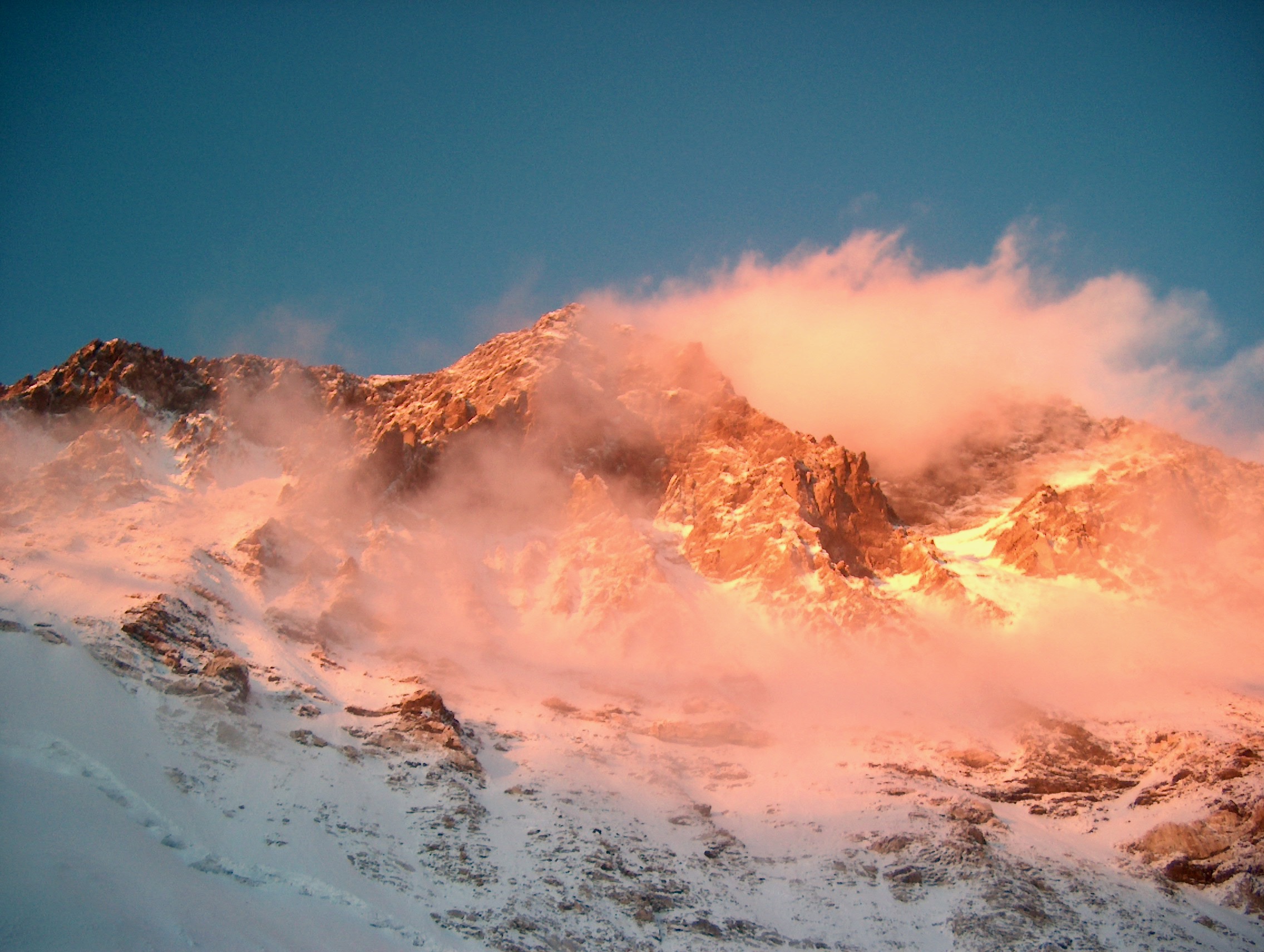
The economy of Nepal has been horribly distorted by western trekkers and do gooders.
If you're comparing someone climbing Everest in 2017 to the moon landing you have your head so far up your ass that you'll probably never see light again.
I never said the accomplishments are equal; just that they were both accomplishments that required money and resources for the people to succeed.
Just because something requires money to accomplish doesn't mean it's not an achievement. You don't spend money and ride an elevator to the top of Everest as you and others try to suggest.
It's a challenge and an accomplishment any way you slice it.
Many people could climb it, but if too many people take a flight, buy furniture, food, waste all this energy for just this artificial pride, it's really bad.
But that's exactly where the planet is heading
At least when Jornet climbs it with no assistance, no oxygen, it's interesting, because it's more eco-friendly