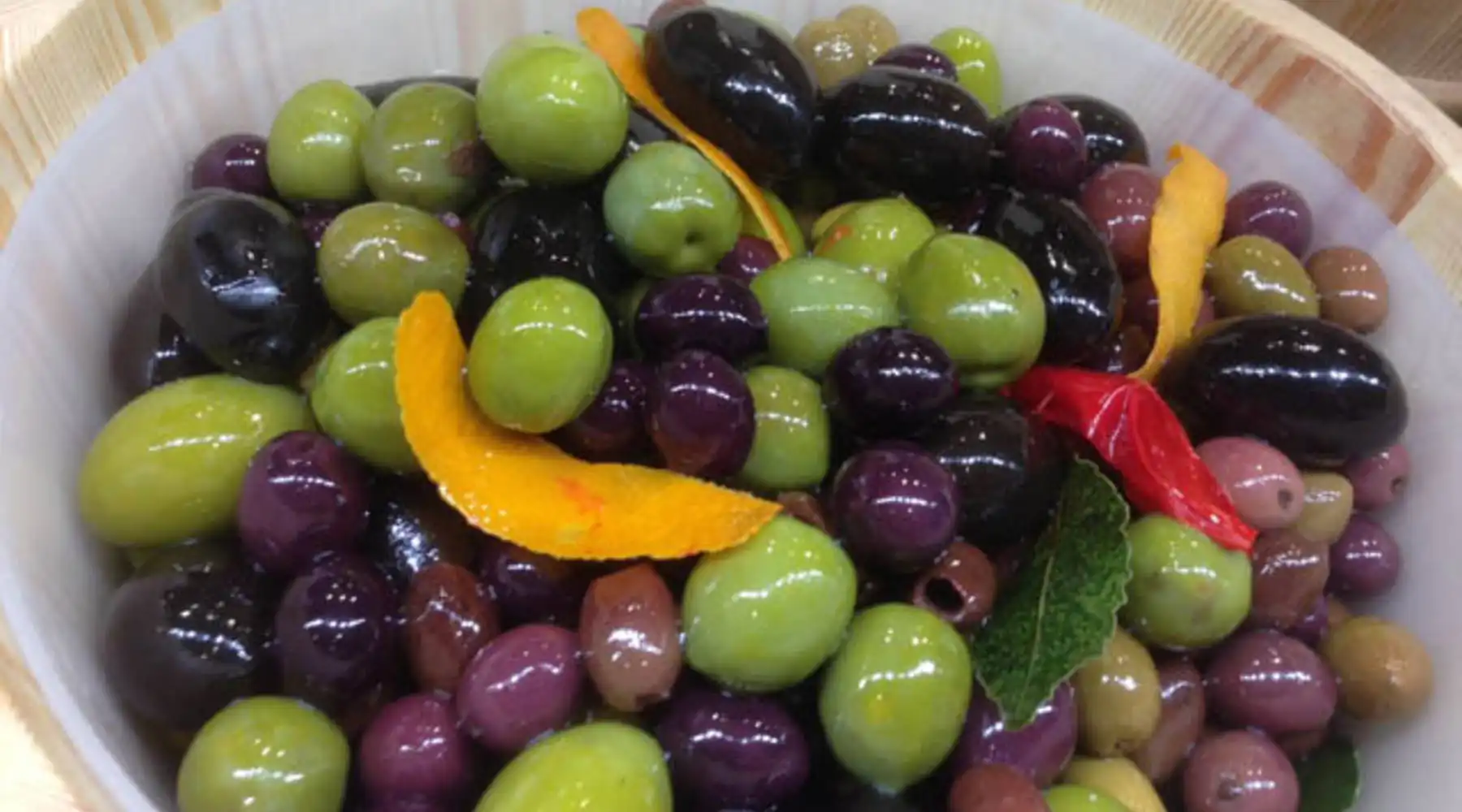
Why green olives come in jars, but black ones come in cans
A tale of economics, dinner parties and death.
marketplace.org
119 points · by bilalq · 9y ago · 72 comments
http://www.polli.it/prodotti/olive/olive-nere-denocciolate-v...
http://shop.oliosalvagno.it/vasetto-olive-nere-in-salamoia-g...
https://pietrasantaaltosalento.it/it/home/19-olive-nere-in-s...
Black olives in a can and green olives in a jar are also available in commodity style qualities. So this is better labeled as "why are commodity black olives in a can while commodity green olives are in a jar".
Also, I think the botulism issue is prevented by having an acidic environment.
In India too.
Watch the end of the embedded video:
https://youtu.be/xKWBJkaoRjM?t=1m7s
Black olives enter the canning facility unripe and green. Bubbling air blackens them.
This part of the process isn't mentioned at all in the article, and it's hard to know whether this was the process being used by Freda Ehmann, or whether/how this oxygen treatment resulted in the botulism cases.
All in all, not the best in technical reporting.
However, the gap between why black olives are prone to botulism and green olives are not prone is not covered. I wish that was expanded on.
http://enquirer.com/editions/2001/06/25/tem_ask_a_stupid.htm...
http://www.straightdope.com/columns/read/2885/why-is-it-that...
http://lacrossetribune.com/tomahjournal/lifestyles/ask-your-...
It seems more like it has become a tradition of some kind in California.
More here:
http://oliveoilsindia.com/California-Olives.htm
it only applies to artificially made ripe olives.
... and seemingly this "high temperature" sterilization (which is still within 110-120 degree Celsius, so perfectly doable in glass containers) adds acrylamide:
https://www.ars.usda.gov/research/publications/publication/?...
in almost unbelievable amounts:
http://pubs.acs.org/doi/pdfplus/10.1021/jf5022829
Heck! 410 micrograms/Kg vs. 1.4 (Greek Olives) and 0 (Spanish Olives)!
http://www.whfoods.com/genpage.php?tname=george&dbid=260
>What About Acrylamide and Olives?
Research on olives and their acrylamide content has shown some inconsistency over the past several years and this inconsistency has sparked controversy in the public press about olives and their health risk with respect to acrylamide. In data assembled by the U.S. Food and Drug Administration (FDA), we've seen more than a dozen different kinds of olives, including Spanish, Greek, Kalamata, Nolellata, Sicilian, d'Abruzzo, and Gaeta, and di Cerignola that were determined to contain no detectable level of acrylamide. Yet we have also seen FDA data showing levels of acrylamide as high as 1,925 ppb in some canned, nationally distributed brands of black pitted olives. Based on this data, we suspect that these higher acrylamide levels in select canned black olives were related to specific handling, storage, processing (especially preservation and darkening methods), and heating steps that favored formation of acrylamide. It's also important to note here that we are not aware of any data showing problematic levels of acrylamide in any extra virgin olive oils available in the marketplace.
At present, we are not aware of any foolproof method that consumers can use to avoid purchase of canned black olives that contain unwanted amounts of acrylamide. Since the FDA data has shown no detectable levels of acrylamide in numerous samples of important olives packed in brine, those olives may be worth considering as options that may help avoid unwanted acrylamide. As stated previously, extra virgin olive oil is another form of this nutrient-rich food that, to our knowledge, has not been shown in research to contain unwanted amounts of acrylamide.
The last cited article reports however that as much as 1,925 ppb have been found in some specific canned olives.
Green olives are pickled, so didn't require such high pasteurization temperatures.
Green olives are unripe olives, black olives are ripe olives. Unripe olives contain very high levels of oleuropein, which is especially bitter and thus green olives cannot readily be eaten. Ripe olives have little, if any, of this compound.
To make green olives edible, they have to be cured (typically using a lye-based process for speed, but can be done with plain water over a longer period of time) to remove the oleuropein, and thus making them edible. After curing, they are typically kept in a salty brine to extend their shelf life.
Black olives do not need the curing process, but can be brined in either a salty water brine, or oil, or no brine at all via pasteurization.
> The whole industry switched to a new standard for the ripe California olive.
> "It has to be heated to 240 degrees. And only a can would tolerate that, physically—you couldn’t do that with a glass jar."
> Eventually, California olives came back. In cans.
>The whole industry switched to a new standard for the ripe California olive.
"It has to be heated to 240 degrees. And only a can would tolerate that, physically—you couldn’t do that with a glass jar."
Eventually, California olives came back. In cans.
Even if it was 240 Celsius (which I doubt), glass can bear it just fine.
Edited to add, and the jar too.
The Ball Perfect Mason Jar was introduced in 1913 with a bead for the seal to rest upon. That would have been under patent and expensive in the 20s. So the tech (barely) existed to vacuum seal pressure cooked canned food in the 20s but it would have been patented and too expensive compared to cheaper cans.
So if you ever get flung back in time, probably your best best is evaporated sea salt. Then work your way up into simple cosmetics. You don't have the ability to create the supply chain necessary to create canning.
Perhaps not in the 1920s though.
If I remember correctly from making jam with my mother, it's important to pour the really hot jam into the heated jars to ensure everything stays sterile -- so the jam going into the jars is around 105°C.
Green Olives are only processed by being in a high salt solution that also contains some vinegar.(Or are lacto-fermented to create the acid.) Essentially they are brine-pickles.
Black Olives are soaked in Lye(very alkaline) until they are uniformly soaked, then put into a acid solution that helps develop their color(They are dark normally, but not uniformly black). The brine is lower in salt also. In order to make it safe for canning, they pressure can it to get to hotter than 240(I've always heard 250, but the article says 240).
Until the advent of modern polymer lined cans, salt would corrode the metal at the concentrations in green olives. So I doubt its a Black = metal can thing so much as...
* Automating pressure canning is easier/cheaper in metal. * Green Olives High salt, High acid, would corrode the metal. * Black Olives Lower salt, lower acid, could be metal canned.