115 points · by revorad · 16y ago · 64 comments
One can't help but think that the company started by some guy who was watching a bunch of spy movies and said "why don't we build that product and sell it to the government?"
Really impressive product, and they honed their demo to be pretty jaw-dropping.
My understanding is, that when they deploy they build a pretty sophisticated ontology for the customer. It's not a comprehensive ontology, but one that's domain specific to that customer -- which actually has the potential to work really well. So for example, the FBI would get one that targets law enforcement (people, places, addresses, license plates, violations, prior convictions, gangs, etc.), while the Army might get one that's focused around military operations (people, places, rank, equipment, unit, etc.).
They then custom write Java software that connects one of the customer databases to theirs, and probably either mirrors it and links it all to some metadata, or if it's federated, generates a pile of metadata with pointers/links back to the original data. The meta-data itself can actually be very very comprehensive. For example, assume the original data is a news report, that report might have everything from tagged people and their attributes to photos of some of the people, videos, maps, whatever (actually I think they just store a list of entity IDs and then store the rest of the junk oriented around the entities, but it's not that important). But basically it's a custom ETL tool for each data source.
I believe it's in that code that they also tell the Palantir enterprise backend how to map individual fields from the incoming data to entity types in the ontology. Assume instead of news articles, you are connecting to a phone book. You have to map names to people, numbers to phone numbers and addresses to locations (or whatever they have it called in that particular instance of the ontology at that site), etc. If it's a yellow pages, you can map names to businesses instead of people, etc. The ontology itself is mutable, so they can decide post-facto that they would like to add a new attribute to a person "place of birth". So if their knowledge base has phonebooks AND birth certificates, when you go to inspect an entity, like a person, it'll retrieve the place of birth and build you a nice dossier of that person.
In cases where they're consuming unstructured data (the lions share of government reports), there's no fields to map to the ontology. So analysts have to sift through each report and do the mapping with the front-end tool while they are conducting analysis. I know of at least one site that's in the process of hiring out a bunch of low-paid data entry people simply to go through and do this tag-map operation on their reports.
If ahead of time, the reports have been run through an enterprise named entity extractor, they can leverage those to populate the knowledge base. But in practice, quality is low, and the named entity extractors tend not to do a good job of determining different subclasses of entities. For example, you'll get a giant list of people from a document, but no indication if a particular person is a scientist, a politician or a terrorist (and all three of those categories might be entity types in the ontology for that site). In addition, the key factor here is the relationships between entities and between entities and their attributes. And most named entity extractors do an even poorer job determining that than just finding the entities. So the default at most sites is to have shifts of analysts manually tagging and mapping documents.
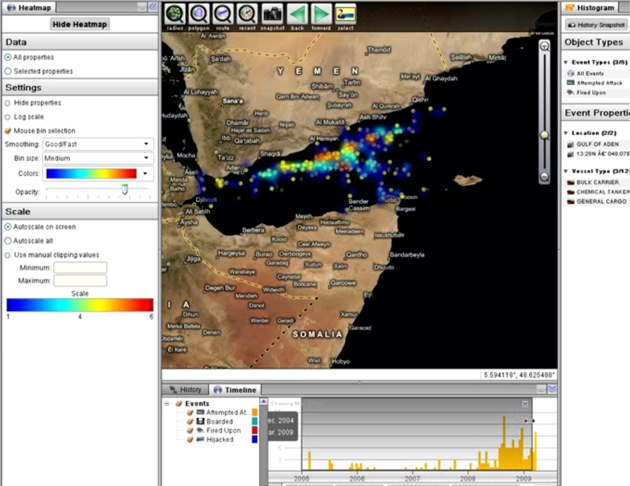
On the front-end, when you search for a person in the little search box, you can not only get documents that name might appear in, but you can call up a dossier on them with all the little various attributes and other bits and pieces filled in for you. Imagine a police record like you see on TV, with the person's photos and other facts and figures and such -- except that it's generated dynamically based on all the tagged and mapped meta-data, and come be composed of data from several different sources at once, like a phone book, a DMB database and a million news reports.
I'll be the first to vouch for the fact that this is the most amazing place to work. Interesting technical work, huge impact on real problems in the world, great culture, talented coworkers, and stock options that mean something.
The other reason I say it's relative is because your market value after working for Google at a couple years is significantly more than when you joined. After all, you made it through their hiring process, and then you've had a couple years to learn all about their search algorithms and infrastructure and data-driven culture and tons of other stuff that makes you more valuable to prospective employers. But if you haven't gotten a promotion (and promotions can be kinda difficult at Google, because all your peers excel too), you're being paid maybe 6-7% more than when you started, barely above inflation. So your salary - which was probably significantly above other offers when you joined - is now probably significantly under what those companies would pay you now.
Curiously, barring people that didn't fit in with the culture and left in their first 6 months, I know very few people that ever leave for another job. Most of the coworkers I know that have left (and that I miss) went to found startups. One is in YC WFP10. Ex-Googler startups seem to be getting picked up a lot for $5-10M nowadays, which is of course a whole lot more than a Googler would ever make in salary.
If they aren't making money yet, and at their tremendous burn rate, is another $90million really going to bring them to self-sustainment? I'd bet that the curve on their growth rate is starting to drop off now, the next logical place for them to push into is local law enforcement. But at their prices, compared to the de facto competitor (i2) I can't see them getting much traction except for maybe the very largest municipalities (I know they have one in the DHS funded NYC Fusion Center for example).
Their going to have to put more resources behind their non gov/intel verticals I think for this to make sense.
I think at their last conference they said they had ~200 staff and still growing. So their burn rate is ~$30-$40 million a year.
This latest round will keep them alive for another year or two.
There is no publicist, no sales or marketing team and Karp adamantly believes that there will never be one. He says he is perfectly content to let word of mouth drive his business, in press and in sales.
It means they are completely rewriting the rules for selling enterprise software.
About half the titles advertised as open positions on Palantir's website, across all locations, fall under the 'Business Development' category. They're requesting engineer-level technical aptitude, sure, but the work is lots of pre-sales customer contact.
When the press call to ask for an interview, or just for info about the product, who do they speak to? That person/those people are your publicist(s).
Who writes copy for the website? That's your marketing team.
Who do I speak to when I want to buy? That's your sales team.
Not labelling some thing doesn't stop it from being that thing.
Palantir Finance sells to hedge funds and financial institutions, but the whisper referrals work in that insular industry just the same.
These guys need salespeople and marketing folks like I need a hole in the head.
EDIT: turns out I was wrong about the GSA schedule: http://docs.google.com/viewer?a=v&q=cache:ffLq8fxcGdAJ:h...
EDIT 2: Ha! The last page has their pricing. And it comes with a 90 day warranty!
EDIT 3: Double ha! "Implementation Ninja Services" is the official name for their lowest-level customer support.
The government is not a monolith, where everyone shares the same hallway (although the Pentagon might come close...).
There is a well-established game around enterprise sales. It involves golf, steak, strip clubs, and (as tptacek memorably put it) gnawing off your own toes. If these guys are succeeding at selling big-box enterprise software while refusing to play it, then they are rewriting the rules and others will follow. I don't want to be over-optimistic about this, but it sure would be a good thing, and I find it more interesting than either their analytics platform or their bubble machine.
"We don't have one"
"Who cleans the floors?"
"I do."
"You're the janitor"
FWIW I'm the cleaner, kiln technician, website team, chief scrubber and bottle washer, etc., for a company too.
I realise they're doing things differently. If people come to them all ready set to buy they still have to go through some process even if that process is only payment - someone manages that in some way. Maybe they take online payment and do delivery with no human interactions from the company side but someone still set that up, they still have a sales person.
If it's BS, perhaps it's BS designed to hoodwink engineers. It certainly got me excited thinking that it might be true.
Their last conference had ~700 attendees, fully 100 of the attendees were Palantir employees flown out from the home office to fill out the space and make a big presence felt. That's fully 50% of the staff at the time. Oh, and to helpfully answer questions I suppose, but very few were able to coherently answer questions beyond a superficial level. Me and some of my colleagues kept getting passed off to probably the same half dozen engineers over and over again -- sometimes humorously so ("didn't we just meet upstairs at the breakout and talked about something completely different?"). It also doesn't help when there's so many Palantir people hanging out in reception area that it's impossible to walk a straight line from one part of the conference to the next because of the clusters of track jacketed employees lounging about and giggling excitedly whenever a uniformed Army officer walks by.
And let's not forget the conference itself, two floors in the Ritz Carlton, with catered lunch of Filet Mignon and similar fare for 1000 people? With an open bar after the conference? (Thanks for the coffee cups guys! They're actually pretty nice!) That's not a DBA running that.
Some other colleagues of mine at a different site described a team of "slick haired, googly dressed, sales guys" (actual quote) descending on their facility to hawk their wares. The brass was impressed that "even the sales guys knew the technical stuff". Which of course happens when your sales guys have engineering degrees -- I'd actually like to see more of this in the future in general, so it's a trend I like.
Direct personal experience? For every decent engineer of theirs I find at a site, I find 2 or 3 that don't seem to do anything except hand out stock business cards with direction to go check out operation tradestop or whatever their online demo is called.
If that doesn't persuade you that they have invested large dollars in a sales and marketing apperatus, my own interactions have been through people with "Business Development" in their titles.
Yes my friend, just because they happened to have graduated from Stanford or CalTech or wherever with an Engineering degree does not prevent a person from being in sales and marketing.
Like most things that come from the company, there's actually a pretty interesting kernel at the core of a giant pile of BS. The fact that their sales staff actually are engineers by training is a great thing to see in a large company. I've been on the receiving end of too many pitches by clueless sales guys with marketing degrees, when what I needed in that hour I was able to allocate to hear the pitch, was some hard technical answers. Having guys who know their stuff getting out there and pound pavement is no doubt a big part of their rapid success. But let's not be mistaken, they are salesmen, and the company does spend large amounts of money on marketing, press releases, advertisements, etc.
They actually stand out as much for their product as they do for the fact that they're by far the most "present" company in their competitive space on billboards and marketing materials in the entire area.
I can categorically confirm that this is not BS: we don't have sales people, we don't have marketing people. This doesn't mean that we don't have people performing those functions -- of course we do! However, the people performing those functions are all technical folk who have stepped into the breach to do the needed work to grow our business. As a commenter in the TechCrunch article mentioned, "I'm the founder at my startup. Just because I sweep the floor sometime doesn't mean I'm the janitor."
I think what we said got a little garbled as it was distilled into the TechCrunch article. When we said, "we have no sales people", what was meant was that we don't have people who know nothing about the product, worrying about their commission and their quota and adding essentially zero value to the process. The people who come up with our marketing messages are not people with marketing degrees -- they're engineers who intimately understand our technology and the benefits that it brings to our customers.
Even I've stepped up into that role: along with writing our backend data importer and authoring our XML formats and processing pipelines, I also run our college recruiting program, and write for and edit our tech blog . Does that make me a recruiter or a blogger? Not in the sense of the word that most people would use it. I'm an engineer, proud of it and my technical achievements, and anyone who calls me otherwise better do it when I can't hear them. I'm an engineer that does recruiting and blogging, just like we have other engineers that do sales and marketing.
I look back over my time here and I marvel at the amazing place that we've built. It's an engineer's fantasy land that really exists - I can only think that this is what Google was like, circa 2000.
But don't just take my word for it, come and check us out for yourself. Shoot me an email to ari@palantir.com and I'll set up a visit, a proper interview, or whatever is appropriate for your situation.
Or we're hearing about it because this approach just happens to work for them; others trying it out may not fare so well and quietly go away.
Saruman: Why should we fear to use it?
Gandalf: They are NOT all accounted for. We don't know who may be watching-
In other words, we're not talking about the typical government paper pusher.
That being said, it's still a complicated tool requiring the training and understanding of some pretty complicated concepts that most analysts don't know about or understand (like ontologies).
http://money.cnn.com/2010/01/21/technology/sas_best_companie...
http://blog.palantirtech.com/2007/09/11/palantir-screenshots...
Does anyone have any insight as to how this might work technically?
https://devzone.palantirtech.com/display/pgdz/Integrating+St... has a pretty useful overview of how you can take raw data from an existing source (granted, this source is XML data, but it could just as easily come directly from a regular database) and map it into a Palantir stack.
So basically, the heavy lifting palantir does is in the presentation and data abstraction. With a person still needed to define mappings across data sources. Is this a correct statement?
With (seemingly) limited off the shelf mapping abilities I'm surprised that they are looking to sell more as an appliance, and less as a turn key service with consulting engagements etc... Neat product.
Yes, you definitely need a person to define the mappings across data sources. However, this is basically a one-time setup task; once the mappings have been established, new data from the existing databases can be continuously imported. I don't have any stats on how long this initial setup phase takes at real customer sites, and if I did I'm sure I couldn't share them publicly, but the goal is definitely for it to be something that doesn't require an entire team of consultants to deploy and babysit.
If you want to see the actual government product, and how it works, you can sign up at https://analyzethe.us/ for an account. This is a real live Palantir instance with real data from data.gov and it's open to the public.
The problem is that it scales incredibly poorly. Imagine hilighting every person, phone number, location, etc. in a document. Then linking them all together manually. Then imagine having a few million documents you have to do that on. It's been an enormous problem at all the sites I've seen it deployed at.
If you want to try it, they have a training instance online at https://www.optradestop.com/
Hmm... better that a private corporation has this power or the government? Jump ball.