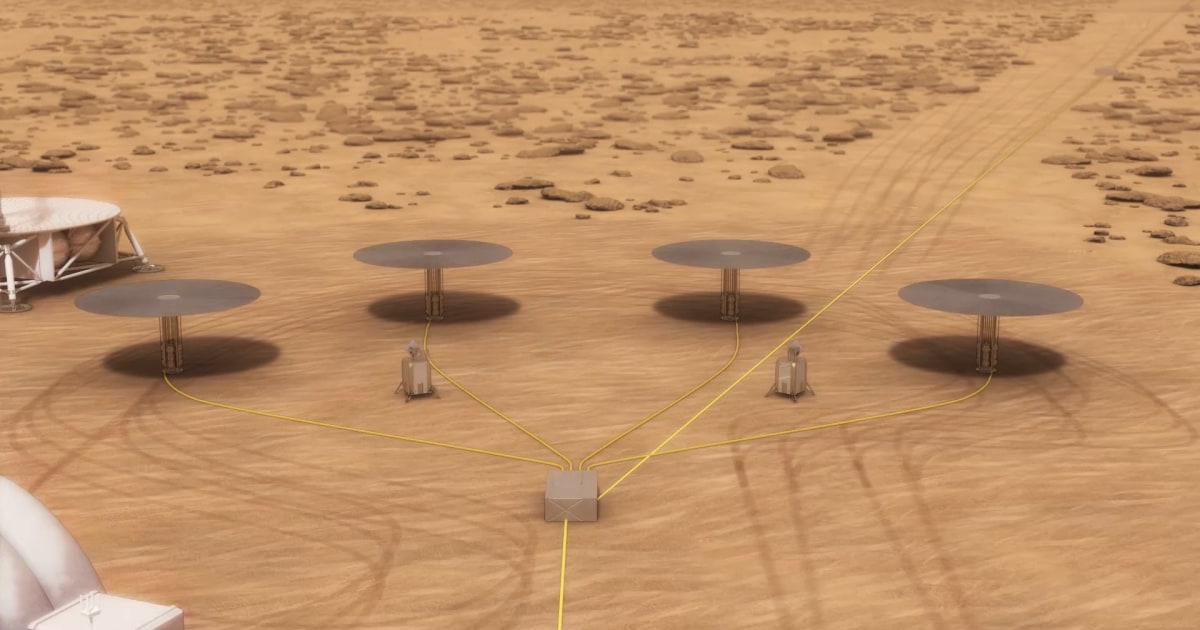
NASA revives plan to put nuclear reactors on Mars
For the first time since the 1960s, NASA will be operating fission reactors that may be used in space.
NBC News
204 points · by curtis · 9y ago · 153 comments
I'd also consider putting satellites in Earth and Mars lagrange L3, L4, and L5. It's the start of a solar system based internet, even if it is rudimentary. Think of this as a store-and-forward network where signals may be too weak for Earth to pick up, but can hit Jupiter L5 to Mars planet, to Earth L3.
And greetings, all, BTW.
We already do.
> Once we have a half dozen satellites circling Mars...
We already have half a dozen active satellites circling Mars:
https://en.wikipedia.org/wiki/2001_Mars_Odyssey
https://en.wikipedia.org/wiki/Mars_Express
https://en.wikipedia.org/wiki/Mars_Reconnaissance_Orbiter
https://en.wikipedia.org/wiki/Mars_Orbiter_Mission
https://en.wikipedia.org/wiki/MAVEN
https://en.wikipedia.org/wiki/ExoMars_Trace_Gas_Orbiter
All of these (including the European satellites) except the Indian MOM orbiter contain a communications relay radio (for relaying from Mars surface to Earth) provided by NASA: https://en.wikipedia.org/wiki/Electra_(radio)
We actually have quite a bit of infrastructure built up around Mars already. All these spacecraft are referred to as the "Mars fleet" (which is frakking awesome...).
>Data rates up to 1 Mbit/s
That's a bit of a problem. It only seems to be a relay for other spacecraft and small surface craft. Much more data will need to be exchanged between Earth/Mars when humans are involved (weather, video, entertainment, collected data, software, etc.)
You'd probably want several brand new satellites dedicated to communications for an initial colonial undertaking.
I realize it's not the same situation, not the same expectations, a different world than 500+ years ago, but real progress doesn't happen in a cleanroom.
The bandwidth back than was more than adequate to handle a website like Hacker News, and the store-and-forward protocols that were developed back then to preserve bandwidth, like SMTP and NNTP, will probably come back into play for a Mars/Earth link. Any video would need to be highly compressed and low quality by today's standards, but in the 50s and 60s TV was far lower quality than it is today and served its purpose just fine. Audio recordings for voice messages likely would be just fine without any quality reduction.
You have to remember that the initial colonists are going to necessarily be a fairly independent bunch. They're not going to need, or care, to keep up with the latest shows, music, or social media. They'll be too busy with surviving, collecting and transmitting scientific data, and writing letters to their loved-ones back on Earth.
But indeed, NASA intends much higher bandwidth for future missions using laser communications.
SpaceX would likely use a variant of their constellation satellites which should be capable of multiple Gbit/s using laser communications.
https://www.nytimes.com/2015/01/21/technology/google-makes-1...
Musk wants satellite internet as it lets Space X lower cost per launch by launching a lot of satellites.
Why? Wouldn't it be easier to bootstrap by mining asteroids, and manufacturing in micro gravity, then dropping nearly finished goods onto the planet? That'd also allow you to use the same bootstrapping infrastructure for several surface sites.
If there isn't already a patent on space strategies, it may be a good idea to create a patent agency. The first intergalactic agency.
If there's a big push back from the general population it will be hard to convince the politicians to invest billions in an unpopular project with no short-term dividends.
And running away won't solve our problems. How long until our current earthly political and environmental issues are reproduced on Mars? We have "human" issues, not "earth" issues, simply moving the problem is not a solution. If we can't sustain our development in a civilized manner on a lush and hospitable planet I don't think we'll fare much better on Dune.
Not that I'm against colonizing Mars but I'd prefer if we did it out of a shared dream of a trans-planetary humanity rather than out of fear of self-destruction.
Because, you know, there's a chunk of me that thinks we can be less risk averse in trying to do things on an uninhabited planet. Nuclear meltdown is pretty awful on earth, on Mars I don't see it with the same fear.
I also feel like this is not dissimilar from dumping rubbish in the neighbours yard because who cares it's not mine but on a planetary scale. Which seems bad but I want to rationalise it away and say "but this is different".
By humans. By other life-forms is yet to be proven one way or another. There is already discussion of treaties to prevent contamination of any Mars biosphere by human missions there.
Also: what about the future? There's no point in sending a nuclear reactor to Mars if a future colonisation mission can't go ahead because the reactor has melted down...
Solar irradiance is approximately 50% less than on Earth. PV with high efficiency modules (the same ones they use on satellites) is also viable. I wonder if anyone has run the numbers on the cost of shipping a reactor Vs. the cost of shipping a football field of PV modules there.
Now imagine how many such cubes would fit inside your favorite mountain.
It must have something to with the state of technology and not being able to do it safe until now.
Most of the space flight technologies using nuclear power were devised for manned flights beyond Earth's gravitational influence, and were on the drawing boards as early as the fifties. Once America successfully landed on the moon and the Soviets gave up, there was immense political pressure to scale back the US space program. With the Space Race won, it was harder to justify the costs of manned interplanetary spaceflight, so a lot of more exotic (read: expensive) plans were shelved. This included more than a couple nuclear propulsion ideas for spacecraft, including one for a nuclear thermal rocket that had been successfully prototyped in the lab and was ready for an actual launch.
Lots of stuff we could have done and could be doing in space if there was money for it.
Kilopower (NASA's research project for a Martian nuclear fission reactor, from the article): 7,200 kg for 40 kW. [1]
ISS solar arrays: 14,515 kg for ~100 kW in Earth orbit. [2] If we assume 40-50% Earth solar insolation on Martian surface, the ISS PV array probably isn't far off 40 kW output on Mars
Conclusions:
Nuclear reactor would have approx. 50% launch weight. SpaceX estimate $45/kg payload with a Falcon Heavy, so about $324K for Kilopower or ~$600K for the ISS arrays.
The build cost of the ISS arrays was around $300 million (space PV is way more expensive than terrestrial). The development and test costs of Kilopower is around $15 million; build cost of final units is unknown.
You would have to automate and/or remotely control all of the nuclear power plant operations. Dust storms would be a challenge to a PV solution, though not insurmountable.
They actually look very comparable. Nuclear has an edge due to it weighing half as much as the equivalent PV generation system. I think there is definitely value to a simpler system that's more decentralized... but that's harder to quantify.
Edit: people noted I forgot to factor in batteries. 40 kW = 480 kWh per 12 hours. 1 Tesla PowerPack = 220 kWh @ 50 kW. Let's assume a worst case that the base needs the same electrical power during the night as it does in the day, so we need around 5 PowerPacks to get us through each night. 1 PowerPack weighs 1,622 kg, 5 = 8,110 kg. Wow, we need another Falcon Heavy trip just to bring us enough batteries for 1 night! Let's not mention those dust storms that can last for a month or so...
Now nuclear looks much better... and that has its own complexities. Colonising Mars is going to be very hard. :)
[1] https://ntrs.nasa.gov/archive/nasa/casi.ntrs.nasa.gov/201600...
[2] https://www.nasa.gov/mission_pages/station/structure/element...
You should use Ultraflex or similar as a standard. Instead of the ~7W/kg you used for ISS arrays at Earth orbit, you'll get ~150W/kg at Earth orbit:
https://www.orbitalatk.com/space-systems/space-components/so...
We have commercial satellites that also use much cheaper arrays with much higher efficiency.
Using 30 year old solar tech with a very mass-inefficient design is putting your thumb on the scale of such a comparison.
I like kilopower and am a fan (it really helps for super deep space missions that currently have to rely on the tiny amount of Plutonium-238 we have and can make), but we're going to use a LOT of solar power on Mars just as we do today.
On the moon it would be. Half-month long nights mean you'd need a lot more batteries if you're making a permanent settlement and aren't at one of those spots on the south pole where you can always see the sun traveling along the horizon.
EDIT:
I think solar panels have gotten a lot lighter since the ISS went up and when I last did the math nuclear and solar were a lot closer.
That was 20 years ago, on a government contract, for panels that must survive the rigors of actual space.
Panel manufacturing costs have dropped almost 10x since then, and the environment (assumed under the protection of martian atmosphere) which they will operate will be far less extreme than Earth orbit, necessitating less expensive materials. I'm not so sure your numbers account for this.
Process of producing c-Si panels has become a lot cheaper but this doesn't apply to GaAs process.
https://www.nasa.gov/mission_pages/station/structure/element...
Space applications are now mostly using triple-junction cells with GaAs as one of the layers. Spectrolab, Azur Space, and SolAero's product lines are dominated by triple-junction cells. Azur Space also still sells space-qualified silicon cells (lower efficiency and much lower radiation tolerance, but cheaper):
http://www.azurspace.com/images/pdfs/0002162-00-03_DB_SIA.pd...
The Martian radiation environment is mild enough that crystalline silicon might still be competitive if you needed large stationary arrays. But on the Martian surface, where you can't rely on near-constant sunlight, nuclear is going to be tough to beat. (Orbiters are a much better match with solar.)
Dust will need to be cleaned off of the panels daily, which adds further expense associated with dedicated external missions to the array of panels.
Most of the ancillary considerations weigh in favor of the nuclear option.
Renewables are part of having a diverse power grid and because of the investment needed they are situated in areas with consistent/reliable wind/solar radiation.
I drive past the massive wind farms of Minnesota and he Dakota's regularly - they are almost always generating electricity. My understanding is that the US has significant potential renewable energy reserves.
Edit. Wikipedia suggests that about 14% of the US grid is currently renewables (https://en.m.wikipedia.org/wiki/Renewable_energy_in_the_Unit...) - that seems far from "barely sustaining".
The map of potential for wind alone suggests great potential - https://en.m.wikipedia.org/wiki/File:Wind_power_potential_ma...
http://permalink.lanl.gov/object/tr?what=info:lanl-repo/lare...
Tracked via Wikipedia, which has a brief article:
The fact that we're going to have to use some sort of atomic batteries is one of them. Another is that we can't search the entire planet for life before we go visit. It's impossible to disprove a negative.
My preference would be to see every piece of gear have an integrated solid-state nuclear battery and O2/H2O generator. That way we design one cheap, rugged, relatively low-weight and low-volume piece of gear and then just mass-manufacture it. Also no astronaut would ever be far from water or air, and there becomes a zero chance of death by asphyxiation or dehydration.
I think you meant, it's impossible to prove a negative. More specifically, to prove that something does not exist.
https://en.wikipedia.org/wiki/Mars_Design_Reference_Mission
MDRM 5.0 PDF (big file; power generation is 7.3.4, page PDF-pg#85): https://www.nasa.gov/pdf/373665main_NASA-SP-2009-566.pdf
You need fully mature steel, aluminum, and electronics industries on Mars before you can think about UF6 centrifuges. The rocket equation just murders any idea anyone might have about shipping any kind of factory-in-a-box to any other rock in the Solar system--except one that takes in the local regolith and produces a copy of itself, or a similar factory-in-a-box with a different combination of inputs and outputs.
You're trying to jump right from putting the ore in at one end, and getting reactor fuel out at the other, but you apparently need at least a North Korea-sized economy inside the black box to do that, and Mars currently has an economy smaller than Sealand. There are no humans on Mars, and the robots currently there don't mine or farm anything in excess of their own immediate needs.
So a 4MW u-battery would use around 8kg fuel per year.
Thermoisotopic generators generally rely on plutonium, which is in very low supply, and generate only about 100-200We output AFAIU.
That's enough for electronics and comms on a deep-space mission, but doesn't offer a whole lot of surplus power for planetary activity. Among the reasons that lander craft are so slow-moving (they basically manage a slow crawl) is power demands, though other factors, including navigation and stress, are considerations.
https://en.m.wikipedia.org/wiki/Radioisotope_thermoelectric_...
> plutonium, which is in very low supply.
That's just because we haven't been making more plutonium recently, because we haven't needed it. We could simply make more.
You have to be pretty insane to launch large amounts of nuclear material from earth in a rocket that can randomly explode in our atmosphere.