391 points · by phr4ts · 9y ago · 158 comments
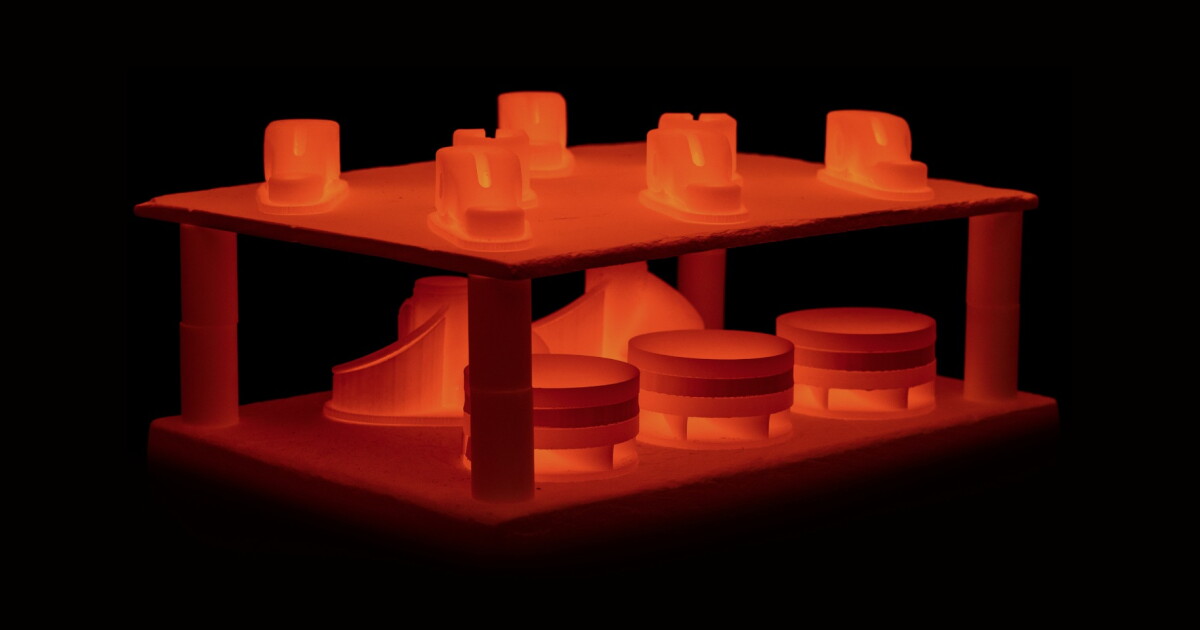
Desktop Metal's big claim is that they can lay down "up to" 8200 cm³/hr of metal. The "up to" weasel words are a problem. They're vague about the layer thickness. 3D printing has a basic trade-off between speed and precision. Most of the commercial vendors go for high enough precision that you can make working parts. Desktop Metal doesn't offer many pictures of their finished parts, but I did find one.[4] That looks like it was made with layers of about 0.5mm. The furnace step provides some surface smoothing. That's not bad for casting.
It's nice, but it's not clear that it's 100x, or even 10x, better than the competition.
[1] https://www.youtube.com/watch?v=rEfdO4p4SFc [2] https://www.youtube.com/watch?v=2vsaSzrhvcw [3] http://www.exone.com/Systems/Research-Education-Printers/Inn... [4] https://embedwistia-a.akamaihd.net/deliveries/5c8aec78d82aa1...
The way I see it, Desktop Metal's main innovation is their furnace technology. Furnaces are typically large, expensive, industrial machines that cannot be operated in an office environment. Having a compact, easy to use furnace is a BIG deal. They also combine classic convection sintering with microwave sintering technology. Microwave sintering is a fairly recent technology (developed ~2 decades ago by folks at Penn State) that has a gigantic amount of promise (volumetric heating, finer metal microstructure, and more energy-efficient). MW sintering has seen fairly limited adoption in the industrial space so I am happy that DM is pushing this technology further.
The are pursuing two major technologies, an extrusion-based process (Studio system) and an inkjet-based process (Production system). I have seen parts from their Studio system and, from what I have seen, they are highly functional (comparable to casted parts).
Whether $1 billion is the right valuation is a question for the VCs and the market to answer. But, in my opinion, they are developing a very compelling set of technologies (if they end up working as advertised).
Sure, you can do that now with Shapeways or a crooked locksmith, but it would be fun to do independently.
But this is kind of shocking for software-oriented people who might think that "manufacturing" "hardware" is a super-tough black art that can only be done by professionals in factories. And indeed that's pretty much my intuition as a software person who hasn't done woodworking since middle school shop class and never learned any of the other manufacturing skills that humanity has been working on for the last while. (Reading Bunnie's new book about manufacturing in China has been fascinating for me, because it's like "oh yeah, so all of these objects just come from people doing different tasks to fabricate them"!)
So people said about gun manufacturing that there was this funny intuition that 3D printing somehow allows people to casually manufacture complex objects at home which they otherwise simply couldn't do. But in fact, if people were moderately motivated, they could easily learn some of the other techniques that let them manufacture and/or duplicate objects. So we may tend to exaggerate the impact by thinking that other methods represent a huge, hard barrier while 3D printing represents true "push-button manufacturing". Neither side of this intuition is necessarily the reality.
For the problem of duplicating proprietary keys, it seems like anyone could already do this at home without especially expensive equipment and without especially extensive training. I remember reading a Mickey Mouse cartoon from many decades ago where a key was supposed to be duplicated from a negative impression taken in some clay (or something), and this was presented as a basic skill of a generalist mechanic!
On the other hand, maybe this intuition is partly right if some significant population of would-be home gunsmiths or key-copiers is intimidated enough by hardware and manufacturing that they're sort of waiting around for the pushbutton solution.
Edit: looks like other people in this thread have said this a lot more concisely. :-)
That's actually a substantial barrier. People are lazy, and pressing 'print' on some design fed into a cornucopia machine (of which a 3D printer is a rudimentary fore-runner) substantially lowers that barrier. It requires no special knowledge beyond the feeding of raw materials into hoppers.
That's a lot less than what would be required to safely turn on a lathe, let alone making something with it.
I help run a Makerspace, a couple of times a year I get a teenage boy (and it is always a boy) come thru the door wanting to print a gun .... after I've given him the lecture about how stupidly dangerous that is, I then remind him that a) here in NZ hand guns are illegal, and b) he would still need to be police vetted and obtain a firearms license - the law doesn't change because you used a 3D printer
I get my keys cut at a convenience store down the street. Key cutting is not exactly a sophisticated service market run by specialists. So I doubt there is much stringent ethical procedures or industry reputations to lean on.
Meanwhile someone copying fobs in Toronto for people was publically shamed, which is silly because anyone can buy an RFID copier on Amazon for $30. http://www.cbc.ca/news/canada/toronto/condo-key-fob-copy-1.4...
Amazingly the building I live in charges $100 for replacement fobs.
This exact technology has existed for decades but hasn't seen widespread use because it has serious problems. I don't see any evidence that Desktop Metal solved these issues either. The resulting parts have high shrinkage, poor dimensional tolerance, and poor mechanical properties. The sintering process leaves voids inside the material that serve as stress concentrations, causing the material to fail well below its rated strength. Also sintered parts tend to fail catastrophically rather than yielding since the adhesion between particles is much weaker than the yield strength of the metal.
https://www.desktopmetal.com/company/about/
I see a bunch of PhDs with backgrounds in material science (among other things). It's just possible they might have a clue.
I have no clue whether these prototyping machines will produce parts of that quality, but the important observation is that 'good enough' is the key threshold. Many times you don't need the full strength of a machined steel part, just something a bit better than plastics can provide.
Is that still considered MIM?
With $200M+ they better be doing something new! So far, we know they are very good fundraisers and marketers, but I do think it could be different this time (i.e. maybe they'll crack it).
Will this cause more accidents?
>Maybe by the time my car is self-driving and earning me money instead of sitting in my garage, I can get that microfactory set up affordably.
Have you ever thought why there are no cheap capital assets sold in mass markets for public that provide good ROI for no additional effort? (this is good question for armchair economists)
Pretty much for the reason you covered in paragraph one to be honest.
If I can achieve good with 10k and someone else can achieve awesome with 100k then the person with 100k will win (assuming they can handle demand).
It's pretty obvious (if you look at..well every economic system ever really) that capital begets capital.
It's not a huge thing, the US had this issue at the turn of the 20th century.
Bitcoin mining was a good example. Everyone has a graphics card, and mining was pretty trivial. Great example of a cheap capital asset with low effort to monetize. Quickly, the ROI slimmed until only large scale operations with low costs and good economies of scale were profitable.
A) < $100
B) Saving $1000/year relative to a certain level of cuisine consumption.
From a marketing standpoint alone the ability to rapidly produce metal cases for things would give products an air of quality that you could never match with a plastic 3D printer and might cost too much to CNC. Between this and the costs of pick-and-place machines coming down I'd love the ability to design/build my own consumer electronics products and sell them out of my garage.
For better or worse it's a long ways from "machining/printing a part" to having something ready to sell. Even just dealing with aluminum (easy to machine), you have deburring, polishing and/or tumbling, and (probably) anodizing standing in the way of selling your new consumer part. Some of that is fairly easy to get going with - small scale anodize is problematic.
I can imagine those companies buying these machines and passing on the cost savings -- I would definitely start to think about using it instead of CNC.
The ability to rapidly prototype in low cost, low latency iterations will be a boon across many industries - regardless of whether or not you end up outsourcing production.
And of course, you may just end up outsourcing down the road.
I can think of a few things where printing 50 of them in an hour would be adequate to recoup a $100 equipment rental.
The rate at which the price of this technology is falling is fantastic.
At 360k, most machine shops can easily afford it if they can justify the purchase with demand. Also, almost no one buys these outright because they can easily finance it with a loan secured by the machine itself. We're talking a midlevel machinist's salary and overhead for five years. Since the majority of domestic metal manufacturing is for high margin industries with poor turn around times, these machines would pay for themselves very fast.
Still, doing so and offering "3D metal printing as a service" (3DMPaaS) might actually be a useful investment.
> ...Desktop Metal's Studio machines are also a ton more practical to have in an office.
> But there's a ton of metal options...
I'm guilty of this too, but I think there are more ways to describe a plethora of items than "a ton". Unless, of course, there are actually 2000lbs worth.
The US Treasury says that $1 million in $100 bills weights 22 lbs[1].
The $115 million that they raised in the last few months would weigh about 2200 lbs.
[1] http://answers.google.com/answers/threadview?id=441929
edit: grammar
It still might work in this context though, if you think the company has raised too much capital...
"Strictly, a plethora is not just an abundance of something, it is an excessive amount."
> Depending on the nature of the part, it might be necessary to do some post-print surface finishing like sanding or bead blasting to smooth out the layered surfaces
If this is anything like the powder-bed parts I've handled, the layers are going to be pretty rough. I wouldn't be surprised if they need some degree of post-machining. Don't sell your CNC mill just yet.
Furthermore, 15% shrinkage during sintering? What's the dimensional tolerance on the finished part then? I'm guessing it's not great.
For low volume production and prototyping this technology is great and cannot become mainstream soon enough. So what if it has to be finished. A casting or forging is the same way.
Back when I worked in the aviation industry, sinking a die for a part cost a cool quarter million.
I corresponded with a guy who was making his own intake manifold for his mopar. (A very cool project.) He made his own molds. I did some calculation, and said he had to make the mold about 10% oversized. He told me I didn't know what I was talking about, he couldn't believe it would shrink that much. His cast manifold wound up 10% undersized :-)
Anyhow, dimensions that require tight tolerances get machined to spec after the forging/casting.
1.https://physics.stackexchange.com/questions/14635/what-will-...
Heavy use metal parts are often milled/shaped into a blank, then forged.
Forging involves heating the part, then hammering it into shape using specialized jigs (reverse imprint of the part). Most metals have a grain structure, similar to wood. The combination of heat and pressure bends the metal's grain structure around the contours of the part. This imparts a tremendous amount of strength compared to milling or casting. Since milling generally cuts into the grain at arbitrary angles, while casting often creates a disorganized grain structure (there are newer casting techniques which give better results).
The parts are often milled again, to ensure exact dimensions. Then finish/treatments are applied.
And Swedish ones: https://www.youtube.com/watch?v=tEF2erBBVZ4
The production system is cloud-connected
Seriously, that's a selling point nowadays? I have to buy a hyper expensive piece of hardware and if the company goes under I might not even be able to use it anymore?
Not everything needs to be on a bloody cloud.
Not very true at all. You can get PLA for $20/1kg or less. Even resin for SLA printers is often possible to find for affordable prices, especially considering that you can sometimes use less material without the need for infill.
I'm really not even sold on the idea that so many people "need" metal printers. Seems like most people would be way better off with the incredibly cheaper plastic options.
>...it's going to compete with traditional mass manufacturing
>...the hype is real
The team, tech, results, deals already signed, all seem really impressive in their own right. No hyperbole needed to get a more views.
It's not my area, if someone tells me this really has a shot at competing with mass manufacturing in the next 5 years I retract everything.
What's the relative strength of 3D printing?
However a ton of materials are explosive if made into a fine powder then dispersed, so this is more of a general fabrication issue, than something unique to 3D printing.
Production is always judged by how much time it takes for raw material to become finished parts. Additionally that is split between 'operator time' (person required) and 'machine time' (just the machine running).
'Operator time' is a function of how skilled the operator has to be (machinists cost a lot more than technicians).
'Machine time' is a function of operating cost and depreciation.
So anything that shortens those times, or cuts those costs lowers the cost per part. Parts "have" to cost less than a threshold amount to meet the sales price of the final assembly + margin.
That is all basic manufacturing. The key is that costs have typically been reached by doing things in volume with 'tooling' (investing in dies and jigs to configure the machine to easily make the one part). That essentially makes the production line 'single use' while it is tooled that way.
These guys are proposing that they can make metal parts at the same cost as the tool and die folks in smaller quantity and with no setup costs. That changes several things;
1) You can make warranty/repair parts "on demand" so cut the cost of making a million widgets and storing them in a warehouse.
2) You can make 'small runs' of products for more specialized markets at a price that the market will accept.
3) You can support more variations of a given product without your spare parts inventory exploding.
4) Production can be parallelized from small scale shops so a large 'mega factory' isn't needed, instead you can get a dozen shops with this gear to work in parallel to meet your production target.
If they can pull it off, it really does change a lot. If they can get the costs down further it opens the possibility of domestic delivery of parts from a certified vendor rather than a warehouse somewhere.
If you don't have the design then a human needs to spend a bunch of time dialling in the geometry.
I can imagine manufacturers wanting to find ways to "DRM" spare parts. One way to do that might be to make it more costly to produce designs from first principles. So having for example specific complex bits of geometry that ultimately force you to license the authorised design if you want to "economically" fab the part at low volume.
More seriously: the main innovation here seems like accelerating the print volumes and decreasing the per-item cost to the point that this could be used in production rather than just for prototyping. That's a kind of "mainstream", though still on the high-end business side, not consumer.
Current metal 3D printing machines cost well over $1 million, and have some significant caveats for part design. Due to the residual stresses in the parts, supports structures are required for many part geometries. This means your parts that have been designed to be unmachineable, now have support structures that then need to be machined off. The easily removable supports are a huge win for Desktop Metal here.
Repeatability has also been an issue in metal 3D printing. This is partly due to the nature of the sintering/melting process, but mostly because the majority of parts produced on metal 3D printers are actually designed to be manufactured using another process. I have higher hopes for the production system than the studio system for improvements in that area, but remains to be seen at this point.
Like many hyped new techniques, they end up as techniques that are almost good enough to be practical.
Then again, those guys really loved to say stuff like "no, that's not how it's done." - so maybe they're wrong / tech has improved significantly.
That is 124 iPhone 6 sized solid blocks per hour. Incredible indeed!
Of course, this isn't supposed to print easily stamped iPhone backs, it's supposed to print fuel injectors, retention brackets, integrated linkages, etc. Parts that are complex and costly to produce through traditional machining but trivial to print.
a threephase supply is much cheaper.
I don't see this being used with a lot of exotic materials yet, but for stainless steel this is great.
I think this process replaces sand casting, a process that also has many slight deformations. You just make the parts a little big and then machine the important sides to the exact side you need. The downside of sand casting is it often leaves a little bit of sand embedded in the metal which will destroy your tools. If the internal metal quality is as good as sand casting, the ease of doing arbitrary shapes and lack of sand in the metal make it a winner. That you have to have a lathe/milling machine to finish the part is not a change.
If the above is right (it seems reasonable, but I don't know if it is), then beams and and flat stock will continue to be made with existing process. However odd shaped things like an engine blocks it could be a winner.
http://www.computerworld.com/article/3188899/3d-printing/boe...
http://www.additivemanufacturing.media/articles/the-aircraft...
Given this change in volume (which I assume would be highly nonlinear depending on design density and geometry?) I wonder what repeatability is like.
Perhaps for the manufacturing (non prototyping) printer they have a closed loop feedback mechanism to build a few outputs and feed any dimensions out of tolerance back to the input stage.
Could be a minor surprise when you check that you have a 200x200mm work area, design a 100x180mm part, and then get told that it won't fit on the build area.
You have to design for the manufacturing process. Parts designed for CNC machining will always feel like a square peg in a round hole for 3d printing. Once you start designing for 3d printing, though, things get more competitive quickly. You can design parts to have hard to machine shapes, or parts that would have too much waste to machine from a solid billet of material and 3d print them without the waste.
Your computer case is bent up from sheet metal instead of machined from a solid block of steel for a lot of obvious reasons, and it makes no sense to compare the processes for a design like that. 3d printing will enable similar shifts of design.
Wake me up when metal printing reaches that point.
People can also use current 3D printers to (mostly) print unconventional guns anonymously. Do these printers also concern you?
Reaction to technology should be with reason, not fear mongering.
No fear mongering, just making an observation.