138 points · by _pius · 16y ago · 78 comments
What troop movements was he observing? What logistics was he disrupting? How effective could he possibly be gathering intelligence if he couldn't even report his findings to his superiors? Even if the war was still going, his contribution to the war effort was minimal compared to the effort the Allies appeared to be putting forth to "capture" him.
Apply Occam's razor: news of Japan's surrender is a (probably not uncommon) Allied trick vs. the US created a magic secret weapon that would force Japan -- a country so dedicated to winning they crash planes into boats -- to surrender shortly after Hiroo left it.
In Hiroo's Japanse solider's shoes, which seems more likely?
So, true, you'd think he'd eventually figure it out (i.e. give up), but perhaps his grip on reality became a skewed after living alone in a jungle for decades (i.e. he's made of tougher mettle than I am).
Still doesn't indicate dumb to me though.
(Edit: Added epiphanic id ests to last paragraph.)
It's common enough to fight a losing effort to get better surrender terms, and that's probably what would have happened. The United States never wanted to land invade Japan - the second option to bombings was a blockade to starve the army out. Do the Japanese still unconditionally surrender if they go that route? Could the Imperial Japanese Army be enough of a menace that the U.S. leadership takes less than unconditional surrender for terms? Maybe.
The most interesting question is what happens if Japan doesn't unconditionally surrender, become occupied, and have the MacArthur transition government put into place. It was hell at the time for Japan, but then Japan became an American protectorate and was able to run their government with one of the lowest military expenditures in the Western world. They were also well-protected from the various brutal Communist regimes in the area. Could Japan have been invaded by Red China or the Soviet Union if the Empire had kept more sovereignty and wasn't an American protectorate?
Interesting questions. After the Battle of Midway, the Japanese had already lost to the American forces and it was just a matter of time. The war was going to end, nuclear bombings or not. The question is when and on what terms. Japan got the worst possible terms - unconditional surrender, full disarmament, dissolution and loss of all colonies, and foreign military occupation - but then it works out that it becomes the most prosperous place in Asia. Funny world.
Japanese manufacturing concepts of kaizen (continuous improvement) and muda (waste), among others, were copied by the rest of the world. The Japanese got the concepts in the first place from American manufacturing processes during WWII, used to rush Sherman tanks and other mass produced military hardware into production.
Sticking with the Axis powers post-WWII, Germany now produces it cars like it produced it's WWII tanks - big, powerful and expensive. The Tiger tank, for example, was a fearsome machine for it's time - one German tank ace in a Tiger laid waste to over two dozen vehicles in a single afternoon. It's 88mm main cannon could easily kill inferior American Shermans at over a mile away.
It's interesting to note how well Germany's economy fared after WWII also. To this day, the German economy is managed by keeping inflation under 2-3% (if I remember correctly). This is as a result of the rampant inflation in the Weimar Republic - conditions that lead to Hitler's rise to power. Germany today dominates the ECB (European Central Bank) so that mindset is at the forefront Europe-wide also, which contrasts with the slightly more laisse-faire economic approach in the US.
Very funny how things work out, indeed. Also it's fascinating for the historical reasons for the way policy, culture and attitudes are today.
I don't think that's correct. I've read that the alternative to the bombs was a huge invasion called Operation Downfall. According to Wikipedia: "The U.S. Navy urged the use of blockade and airpower to bring about Japan's capitulation...The U.S. Army, on the other hand, argued that such a strategy could "prolong the war indefinitely" and expend lives needlessly, and...supported mounting a large-scale thrust directly against the Japanese homeland...Ultimately, the Army's viewpoint won."
http://en.wikipedia.org/wiki/Operation_Downfall#Consideratio...
but then it works out that it becomes the most
prosperous place in Asia. Funny world.
But didn't it already start the war as the most prosperous place in Asia (not counting tiny Europeans colonies such as Hong Kong)?If Japan didn't surrender after the first two atom bombs, the next half dozen would have undoubtedly caused much, much more damage.
Had the allies then lacked the courage to mount a landed invasion and been satisfied with a negotiated peace instead of an unconditional surrender, Japan would have become a devastated country with few allies and many enemies, it would not have been rebuilt with foreign assistance and would almost certainly be a 3rd world nation or perhaps even a failed state today.
That is true, but for reasons that have nothing to do with Japan. As far as Japan is concerned, the theories about how they would have fought for every house, etc. are false. The Japanese were trying to negotiate a surrender even before the first atomic bomb fell.
One of the most astonishing facts about the Pacific War was how few Japanese soldiers ever surrendered to the Allies (before the war officially ended). The Japanese sense of honor demanded that they fight till the end and never surrender. I no longer have the exact number, but IIRC, the total number of captives was less than a few thousands. Compare that with the number of German, Italian, Croat, Romanian, etc., prisoners taken.
This was so extreme that on Saipan, Japanese troops murdered ethnic Japanese civilians by forcing them to jump off cliffs to their deaths.
The Japanese were trying to negotiate a surrender even before the first atomic bomb fell.
One minority faction was. Bear in mind that, even after the first fission bomb fell on Hiroshima, they still didn't surrender. It took another bomb to force them to quit.
Also, even before Hiroshima, the Japanese has already trained millions of civilians to fight against the Allies. Many were expected to use nothing more than bamboo spears. BTW, as I recall, the Japanese government expected ten million Japanese civilians to die fighting the invasion. The US expected to take up to one million casualties.
You know, the ones the US tried so hard to stop with those bombs.
Genius!
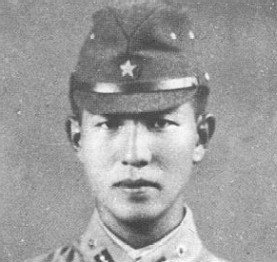
"You are absolutely forbidden to die by your own hand. It may take three years, it may take five, but whatever happens, we’ll come back for you. Until then, so long as you have one soldier, you are to continue to lead him. You may have to live on coconuts. If that’s the case, live on coconuts! Under no circumstances are you [to] give up your life voluntarily."
EDIT: "When he was 20 years old, he was called to join the Japanese army."
He was in fact a conscript.
Funny thing is that at war time being idiot murderer of innocent people is just fine. I think there should be much more footage from war zones. Maybe then people would stop looking at war as sane and sometimes appropriate option.
The Nazi regime convinced ordinary people that they had to fight against an internal Jewish threat. That was a lie. If ordinary Germans had let "the other guy" go to war, nothing would have happened because there was no internal threat. Likewise, if Americans had ignored the terrible threat that Iraq posed to the US in 2003, then nothing would have happened: Iraq wasn't a threat to the US. Claims that it was trying to do destroy the US or had the capability to do so were lies. Ignoring the lies is not surrender.
The first rule of honorable war fighting is to figure out which justifications are true and which are lies. A people that can't or won't do that can never be honorable since sooner or later, they'll end up exterminating lots of innocent people in a war based on lies.
As reference: see most of human history.
One part of me gets it how war can be honorable. Thoughts about protection, bravery, planning, cunning, destruction of evil enemy. On the other hand I think that this thoughts are cultural imprintment reinforcing primal instincts embedded by evolutionary means in times way before industrial age.
Concept of honorable war in our heads is with such contradiction with any serious war fought with modern equipment that I feel that it's one of these things that made sense in early days of humanity, like seeing danger in dark barely visible shapes, but unlike those harmless artifacts when mixed with modern technology our glitch that makes us think that war can be sane misguides us into doing really harmful and dangerous things.