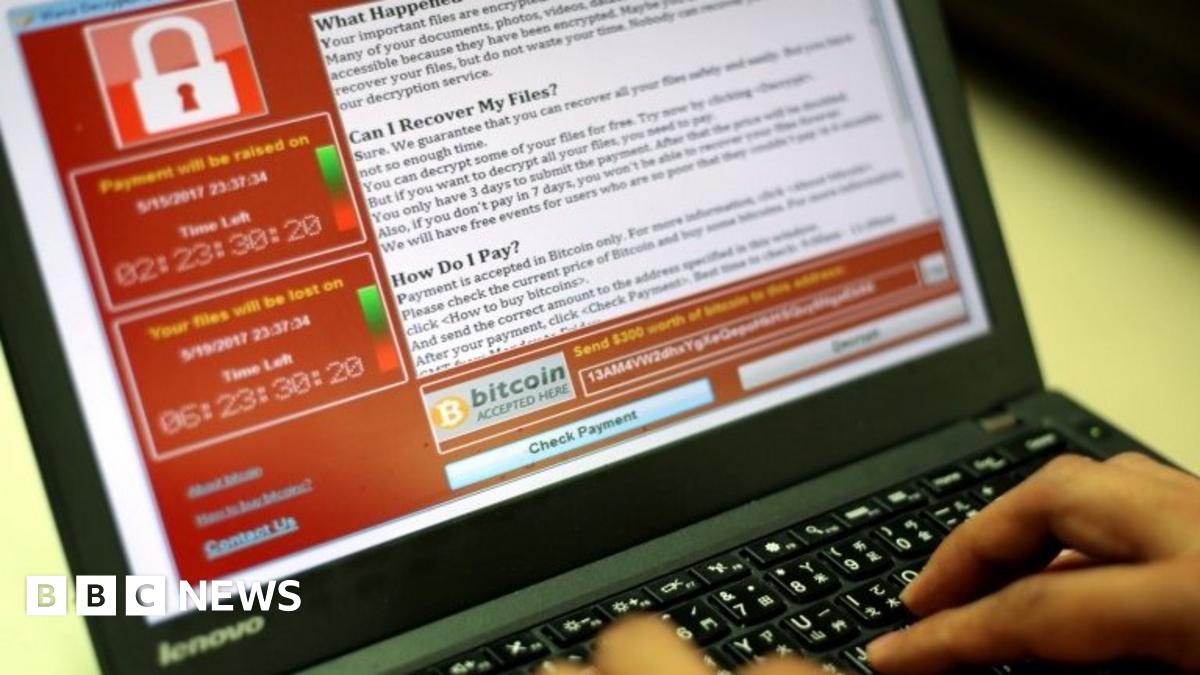
WannaCry ransomware bitcoins move from online wallets
WannaCry hit organisations worldwide - including the NHS - and now the funds are moving.
BBC News
118 points · by sjcsjc · 9y ago · 137 comments
In this case how will the tumbler/mixer not be punished by authorities. Since because they take a cut of the illegally acquired funds they can now become an accessory to the misdeeds.
Enter destination address, they give you an address to send stuff to, send btc, wait. That's basically all a service like this needs to do.
Just because it's operators are anonymous doesn't mean the consumers operate in a limited information marketplace. Word travels quickly.
The simple fact is you can make far more money not scamming people by running a real mixing service than by scamming a couple people once. So ultimately the real services with get built and gain a reputation and a large audience.
People will get burned more often with BTC but it's a cost of doing business in black/grey markets. But that hasn't stopped billion dollar black markets from existing for the entirety of modern advanced human economies.
it's not like the owners will be able to complain. not even in forums to lower your cred.
You can't buy anything directly with it because as soon as you receive the goods the police will force the person who provided the goods to you to give away your details.\
You can't take it out into your bank account because that will also identify you.
So - a bitcoin mixer would seem your best bet, but even then it just makes it "more difficult" to trace. Not sure I'd want to risk many years in prison on that.
Second of all, you can mix them with other coins, which instantly crushes all hopes of traceability.
Example: Imagine you have wallets A (clean) and B (stolen) with 1 BTC each. You put them both into wallet C, and then you split it again equally into X and Y. Where is the stolen money now?
And then there are altcoin exchanges.
That's the distinction. Is it money or is it a fenced good?
If I'm receiving currency (be it real money or bitcoin), I'm not going to think about where it came from. It's fungible.
Exchanges do know the identities of a small fraction of all addresses, that's true. But if someone wants to remain anonymous, and has a relatively small amount (in relation to exchange's liquidity), it becomes trivial to hide the money.
Something like MtGox amounts are much much more complicated to clean in their entirety, that I agree with.
In your example the stolen coins are in wallet X and Y and using the blockchain we can determine exactly how much in each wallet comes from the stolen coin.
A true mixing service takes the coins into a wallet and sends you coins that are from another wallet that has never had any contact with the coins you sent in. This is what breaks the chain you can trace.
Altcoin exchanges let you clean your coins by using an altcoin as the mixer. Essentially you send BTC to an exchange, buy an altcoin, transfer altcoin to another exchange, buty bitcoin. You now have much harder to trace bitcoin.
A mixer or exchange is the best bet, but then you're relying on a third party. A mixer may record it's transactions with people to say which coin was given out for which coin moved in.
At least this is my understanding of how the blockchain works. I may be wrong (likely!)
So if you move 20 coins from wallets A and B to wallet C, and then Wallet C moves those coins to wallets D and E, there's no concept of "whos" coins from A and B you moved into each wallet, it's just a count.
That's why I asked - where is the stolen money, is it in X or in Y or in both?
The best we can do to reduce crime is to convince most of the exchanges not to take the stolen coins (or take them, but give them back to the real owners). But there are so many of them, and many of them are anonymous, I don't see how we can do that.
Even if you go further and say, split Y into Y1 and Y2 and only cash out Y1, there is still some information retained.
http://www.reuters.com/article/us-hsbc-probe-idUSBRE8BA05M20...
Also mixing is not laundering. Mixing only allows you to stop the tracing. Converting these mixed coins on a large scale to something like dollars is very very hard. Most exchanges that interact with the traditional banking system do check where you got the money from. It's not like you can send $1M worth of tumbled coins to Bitstamp/Kraken/Coinbase and convert them to dollars without tons of paperwork. And it's not like you can buy a house/car/boat with these coins and expect the IRS not to show up.
Or use BTC mixers.
How does one stay anonymous without being perceived as a threat by authorities is the million bitcoin question
It shouldn't matter if you're perceived as a threat by authorities if you're anonymous. Bitcoin's biggest selling point is that it's supposed to render governments and law enforcement impotent to interfere with transactions, regardless of their legality.
Okay, now according to the rules here I have to say something helpful, see below:
The primary goal is to - unlink - your transaction.
First, the mixers are primarily hidden services on TOR, but even if they aren't, you would use a mixer over TOR. Ultimately, you get different bitcoins back over time. Mixers have reputation and you hope they don't undermine that reputation this particular time. Its a slow process and pretty bad experience. The mixer's "tainted" coins are liquid and fungible enough.
Second, well mixing on the same blockchain kind of sucks. But wait how would you even know if the person trying to obfuscate and unlink is even using the same blockchain? Again, its not 2012 anymore and there are thousands of blockchains they could have been paid out in, and you wouldn't know because you are an armchair sleuth clicking across bitcoin addresses in 2017 playing detective. Such high tech chain analysis.
Third, but okay, some service is probably still keeping records of these blockchain transfers, this just delays the detective work as people wise up to cross chain movement ... maybe in 2022? Rhetorical question. Turns out, some blockchains aren't like the others, and some cryptocurrencies don't use blockchains at all.
Enter Monero. Monero does use a blockchain. Monero's blockchain does not contain:
- sender's address (or any plain text addresses for that matter)
- recipient's address (or any plain text addresses for that matter)
- transaction amounts
so now you just need a "mixer" that lets you swap your unfungible coin to a fungible coin like Monero. Hm, well since its already 2017, as you've realized, what services do that?
www.shapeshift.io - Many to many asset exchange. No accounts needed. Doesn't store funds, just a pretty GUI on a mixer. Low transaction limits.
www.xmr.to - Monero to bitcoin, bitcoin to Monero transmitter. No accounts needed. Doesn't store funds, just a pretty GUI on a mixer. Decent transaction limits.
www.changelly.com - Many to many asset exchange. No accounts actually needed. Extremely high transaction limits, but the spread just gets worse.
no accounts needed on any of those, and if they pretend you do, just use TOR and a fake email address. You'll still get your opaque coins.
Unlike most cryptocurrencies that you've never heard of, Monero has USD markets on well known exchanges and is a very active market. The project hopes its fungibility improvements make it more valuable than bitcoin-style blockchains, while the technology advances to get the scalability improvements as well, eventually.
One of the rebuttals posted here was that all of the services will blacklist the bitcoin addresses that are tainted. This is not true, even the ones that are interested in doing so just don't update that fast.
There have been several times in the past where I paid bitcoin invoices, using a mixer/exchange like xmr.to. I just put the service provider's bitcoin address as the recipient, and I sent Monero to the mixer. Why would you want everyone knowing how much you ever had in any address? I didn't want that and I opted out. You wouldn't know if a hacker that accepted bitcoin was doing the same thing.
Sounds pretty easy to connect the dots to me...
So now the hacker has 10BTC in the mixer, he requests to be paid out to a list of 20 addresses. These addresses are sent between 0.1 and 0.9btc until the mixer has sent out 9 BTC (taking a 10% commission for the service).
None of those hacker controlled addresses have any connection with one another and they have zero connection to the original deposits made by the hacker.
There are also another 10 hackers doing exactly the same thing, so now we are looking at hundreds of transactions. So it becomes very difficult to connect the dots, also if you really could connect the dots easily I imagine that the FBI et al would really like to speak to you.
Still obfuscating the source of funds or making it harder to trace is what both Money Laundering and Privacy are about.
Sadly, politicians don't make it easy to be 'almost private' (to everyone but the government it's a secret).
https://cointelegraph.com/news/bitcoin-exchange-shapeshift-h...
Thus, everyone knows that the coins that were in this particular wallet are hot. Even if the owner "cashes out" in a few years, the buyer is holding hot coins and can't do much with them.
if this is true, then there shouldn't be any bad guy selling stolen credit card numbers online.
People understand things a lot more now, but from this thread, in my opinion people still don't 'get it'.
The traceability issue is not magically removed by mixing - at least not in steady state, once the system matures.
To see this, consider a future where a single large exchange, lets call it Xchange, has substantial market share - (maybe like Coinbase). Let's assume they are a respectable company regulated by the laws of the USA, and that law enforcement tells them they have to comply with existing laws on stolen property.
Some company Bobcorp has $10M of bitcoins stolen, and pays someone to follow the coins. If those coins ever show up in the Xchange's addresses, Bobcorp is going to call the police and file suit to recover them.
Obviously there aren't literal coins in bitcoin, but Bobcorp is going to go to court and explain their block chain analysis to the judge, and the judge is maybe going to ask Xchange where the coins come from. And that'll be an interesting court case. But it seems unlikely the judge will be persuaded by ideological arguments about how this not-really-fungible currency should be treated as if we all pretend its fungible, and will instead be asking Xchange for its KYC records about the customer that lodged the coins.
Now, here's the important bit: the above doesn't have to actually play out. All that has to happen is that Xchange starts worrying about the above playing out, and starts getting a tiny bit wary about accepting funds that come from reported thefts - starts seeing them as a tiny bit riskier, a tiny bit more likely to end up in court, than other bitcoin.
Once any non-trivial amount of entities start thinking like this, (and it seems obvious they will - I would if I was running any business; but imagine the most conservative bank who eventually reluctantly participates in the maturing ecosystem) then the 'stolen' coins instantly become worth less than obviously clean ones.
And as soon as you live in that world, what happens mixers?
Suddenly you run the risk of putting in your good clean coins, into the mixer, because you care about privacy, and getting back tainted coins, implicitly worth less.
Suddenly mixers become a lot less useful.
It seems inevitable to me that if bitcoin continues to grow that this is how things will play out. It's still a super interesting system but, like I've been saying for years, it's got a ton of downsides around anonymity and privacy, and in steady state may be the perfect Orwellian currency rather than the perfect cypherpunk one, and I don't think mixers make this go away.
As a side note, it's interesting to think that those "dirty" coins/wallets will be destined to circle around the black markets forever.
I'm not saying a centralized system will enforce this, just it seems like a natural consequence that will emerge.
What if someone cashes out before Bobcorp notices? At which point does Bobcorp get to file a theft notice? It can't just be an open registry since then anyone can temporarily block anyone's coins. After a court order? That could take forever. What about when they wanna seize money from Silk Road 5 or MegaUpload3? Plus you'll end up with coins dirty in one country but not another. China and Venezuela probably want to claim any coins that went through their country in some way - they're violating currency export controls no?
At least Monero provides far more fungibility.
People (exchanges etc) will be wary of accepting large transactions which have moved a lot recently from untrusted sources, whereas coins that have sat in the same wallet for a few weeks won't be discounted against as much etc.
To give some intuition advice here, think of it like how a risk management department of a financial institution would, trying to price grey risks; not like a distributed systems engineer does, trying to reason about edge cases as either Boolean correct/incorrect. ("Hmm, guess we'll have to discount fast moving coins from people we don't know" vs "If the hacker sells it fast enough the whole taint thing is unworkable and everything will be fungible again") Analogous to https://xkcd.com/538/ - regulators and financial institutions will take the $5 wrench approach!
(This is also in my profile.)
https://www.bloomberg.com/news/articles/2017-08-03/wannacry-...
[1] https://www.law111.com/coinbase-faces-possible-liability-in-...