253 points · by explore · 9y ago · 79 comments
It will be interesting to see the cross-section rates and maybe hopefully some new physics (as the wikipedia page weakly hints).
So the new science here isn't unexpected confirmation of new physics, it's our ability to probe our existing understanding of the vacuum with new interactions.
Or could it be that a photon bends space-time as though it had mass, and they simply follow the local curvature and it looks like scattering? Just speculating, because for some purposes photons act like a solid particle with their energy equivalent mass traveling at speed c.
https://www.physicsforums.com/threads/laser-to-ionize-air-to...
In short, I think your conclusion is likely correct...
in the thickness equivalent to 1cm lead sheet for a gamma-ray-screen factor of 2
This is totally impossible in the classical view, but is fine in the quantum electrodynamic (QED) view.
doesn't the energy need to be at least the mass of the virtual particle?
Not having charge doesn't imply they don't interact. They just don't through the electromagnetic force. Neutrons also have no charge but interact via the strong force, for example.
Can someone here give us some insights?
However, by studying and understanding such events, we can test and improve our theories of physics, which may lead to breakthroughs in technology we can only dream of.
For example, general relativity would have been considered completely useless knowledge for any practical purpose when it was first formulated in the early 20th century. It only has any measurable impact at extreme velocities and gravities. In the late 20th century, it proved instrumental to creating accurate enough models for measuring the time delay of signals from satellites, creating what we now know as the GPS system.
A quick note from: (i'm too lazy to do the calculations right now) http://www.astronomy.ohio-state.edu/~pogge/Ast162/Unit5/gps....
If these effects were not properly taken into account, a navigational fix based on the GPS constellation would be false after only 2 minutes, and errors in global positions would continue to accumulate at a rate of about 10 kilometers each day! The whole system would be utterly worthless for navigation in a very short time.And hence have discovered GR in the process. Alternatively (and more likely) we would have decided the idea simply doesn't work.
Without that, you don't have much opportunity to discover the basis of the correction (which, as others have pointed out, is just discovering GR, anyway.)
The reason is that for econmics reasons, GPS developers work hard on noise reduction. Once you eliminate all the "technical" forms of noise, you're left with the "scientific noise".
In every kind of clock.
I would hope in this scenario that that would have been noticed and it would have aroused sufficient curiosity to investigate and eventually discover that the effect was due to time itself flowing at a different rate.
Modern cryptography would be impossible without number theory, yet all the breakthroughs that made it possible took place decades and centuries beforehand. All they needed was "with a computer" for it to become vital to our everyday lives.
Cryogenic freezing of magnets so that they would be useful as superconductors allowed people to create MRI.
Also, do you not think that current implementations that use eye tracking are not real holograms?
What's to say that holograms similar to those of Star Wars could not be produced by inspecting the environment and automatically determining where people's head and eyes are, e.g. via a combination of technologies similar to the following:
Eye-tracking holographic table requiring 3D glasses: http://www.euclideonholographics.com/
3D TV not requiring special glasses for the 3D effect: http://www.ultra-d.com/
And what about things that have been called and accepted as holographs created since the mid-20th century?
Star Wars-style holograms implies that I don't need additional equipment or special angles or anything, just a (basically) magical "hologram" projector. As that link shows, it may not be entirely out of the question, but, well... I'm not sure I want to be in the same room as one of those.
Stereo imaging we see in current VR and TV technologies do not simulate that effect, which makes it hard for some people to use as everything is focused at infinity or on the screen. What the lens (in your eye) is currently focused on is a very important depth cue for our brain and the conflicting information coming from the lens and stereo vision make some people unable to use stereo imaging or cause eye pain and headaches.
Unfortunately, real holograms are currently restricted to static images meticulously constructed using very advanced equipment that produces seemingly random images on films that interfere with each other to produce the hologram. Doing the same thing with moving images in real time would require too much computing power to currently be possible.
Another way could be to track the lens refraction properties and the pupil size in real time and fake some depth of field on the projected stereo images.
I'm keeping my money on expansion and dark matter being hooey brought about by incomplete of incorrect understanding of light.
Only recently there was that rather interesting piece about simulated momentum transfer from photons in media.
It's exciting - we'll potentially be lopping off a huge branch of dead wood from the tree of science, from which new ideas can grow.
That's a very interesting hypothesis. Unfortunately, it's easy to verify that photon-photon scattering doesn't explain the expansion of the universe.
1) photon-photon scattering is elastic, so no energy is lost, and no redshift is occuring
2) if it isn't elastic, the scattering is a random process. So different photons will lose a different amount of energy, which means that measured spectra are going to be blurred.
3) rather than seeing redshift, due to photon-photon scattering, you'd see fog, which gets cloudier and cloudier with distance.
I wish I had someone else to chat physics with - isolation leads to screwy notions which can easily be quashed by the right counterpoints.
Edit: a thought. Please (genuinely!) tell me where I'm wrong. As it's elastic, could we not end up with groups of lower energy photons with the same vector as an original high energy photon, which would similarly explain redshift? Doesn't address your point re: fog, however, unless they're universally tightly grouped.
If you look at the abstract on the linked nature page the interaction has a cross-section of 70nb, which corresponds to a circle of radius 1.5e-9 nanometer[1]. It might occur a few times near a supernova or the swirl of a an accretion disk but I doubt it has a meaningful effect in deep-space.
A more exciting result would have been if they wouldn't have seen this effect. That would mean the theory was wrong and we had a new datapoint to look at.
[1]: these measurements are only for a specific energy range, they might vary dramatically with different energy levels but the key point is that this result agrees with theoretical predictions meaning that is should also be possible to calculate the contribution to redshift due to photon-photon scattering.
Don't underestimate how often unlikely events can happen in a big enough space...
As to photon-photon scattering, I might be wrong, but I don't believe it's considered in any models for expansion - similarly, if you do build light momentum transfer into your model, then expansion goes away - but because we "know" expansion to be true, those results aren't considered or published.
I think our givens are wrong. It'd hardly be the first time. I think I might be wrong. That'd hardly be the first time either.
But, as a betting physicist, my money is on expansion (at the very least acceleration) being bunkum.
That's true but the density of photons (from a given source) also drops of cubically as you move away from the source.
> imilarly, if you do build light momentum transfer into your model, then expansion goes away
I'm not really a cosmologist, but I know some physics (QFT in particular). If you have a derivation for a formula giving the impact of YY-scattering on redshift I'd love to read it.
> but because we "know" expansion to be true, those results aren't considered or published.
We know redshift to be true, and we have evidence for expansion based on measurements. Something that simply denies this will have a hard time being published. A theory that explains those findings without using expansion however would certainly make waves.
As and aside, since the cross-section of photon-photon scattering is energy dependent (and, as far as I can tell cosmological redshift is not), wouldn't that be a way to distinguish them? Scattering should occur more often at higher energies meaning that after a significant amount of scattering a bundle's spectrum should clump up more into the red.
I'm sure there's more rigor to it than that, but it always seem s like a pretty big conclusion. A mildly surprising claim explained by a wildly surprising theory.
If you look at the world only through green glasses, you could be forgiven for thinking that everything was green. Your interpretation of observations is only as good as the theory you use to interpret. Think of epicycles, which for millenia seemed obvious and correct, until heliocentricity (for all bodies, not just earth) became the dominant model due to improved theory - but no new observations.
If light behaves even slightly differently to how we currently believe, everything from galactic rotation to expansion goes out of the window.
Here's the bit on momentum transfer - they even explicitly cite the implication for Hubble expansion.
https://www.sciencedaily.com/releases/2017/06/170630085627.h...
The momentum paradox you refer to is (possibly?) the Abraham-Minkowski controversy ( https://en.wikipedia.org/wiki/Abraham-Minkowski_controversy ) about electromagnetic momentum in dielectric media. I'm not an expert on this subject, but I would doubt that this new work definitively settles the controversy. Of course this is, no doubt, work towards settling the issue. My (limited) understanding is that the controversy is really about interpreting certain quantities that behave like momentum in certain contexts, and which contexts apply in certain experiments to measure them. I do not believe it constitutes a crisis in our understanding of light; this is a very technical detail.
Of course, using the mechanism of momentum transfer to the transmitting medium as an explanation of redshift - and by doing so, refuting the expansion of the universe - is just yet another "tired light" explanation. (This refers to the idea of explaining redshift through a path-dependent loss of energy for photons traveling from great distances.) This is not a new notion, dating at least to Zwicky in the fifties. This article ( https://arxiv.org/abs/astro-ph/0106566 ) details efforts to demonstrate the reality of this expansion. These efforts do not assume anything about the exact mechanism responsible for tired light, merely the notion that light loses energy as it travels. They refute this to better than 10 sigma.
>with our understanding of light physics in the mid 20th century. >If light behaves even slightly differently to how we currently believe, everything from galactic rotation to expansion goes out of the window.
I... suppose I have to admit that if the current theory of light is wrong, then there may be changes to how we interpret these results. You should know though that this would be extremely unlikely. Generally revolutions in physics tend to subsume the effective results of the theories that are replaced. Quantum mechanics provides a good example: if you take the limit h -> 0 (making Planck's constant zero), you recover classical mechanics. Relativity provides another: if you take the limit c -> infinity in relativity, you also recover classical mechanics. Our understanding of light is quite good.
Forgive me, but I'm detecting a little bit of an "international scientific conspiracy" vibe here. Unpopular work is published all the time, provided that it withstands scientific scrutiny. I know that sounds like I'm dodging the issue, but really, you can apply a cui bono here: what do scientists stand to gain by propping up "wrong" science? We don't get paid a lot, you know.
>Think of epicycles, which for millenia seemed obvious and correct, until heliocentricity (for all bodies, not just earth) became the dominant model due to improved theory - but no new observations.
I don't mean to pick nits, but it was improved observations (Kepler, Brahe, etc.) that drove the acceptance of the heliocentric model. Kepler was famous partly due to his unprecedentedly accurate measurements. Theory was not necessarily rigorous at the time, often referencing theological arguments; heliocentrism was hotly debated, but not novel. Later it was realized that epicycles form a basis set for any trajectory on the surface of a sphere; any trajectory can be reproduced using a sufficiently large number of them. This was a pitfall that astronomers of the time could never have known. Remember that they did not have Newton's insights yet.
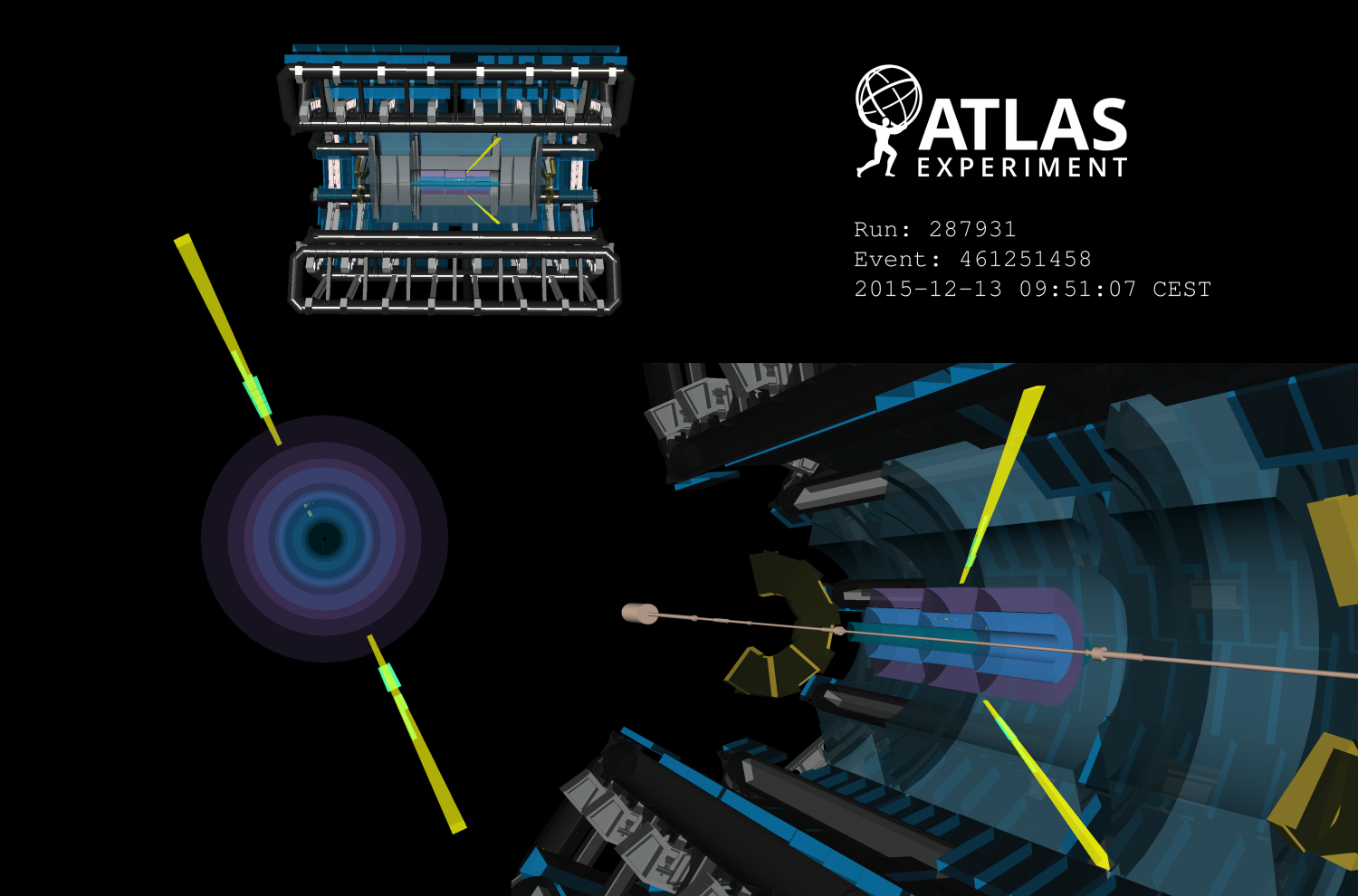
On a final note, its great to hear that ATLAS has some good evidence for gamma-gamma interaction!
edit: fix link