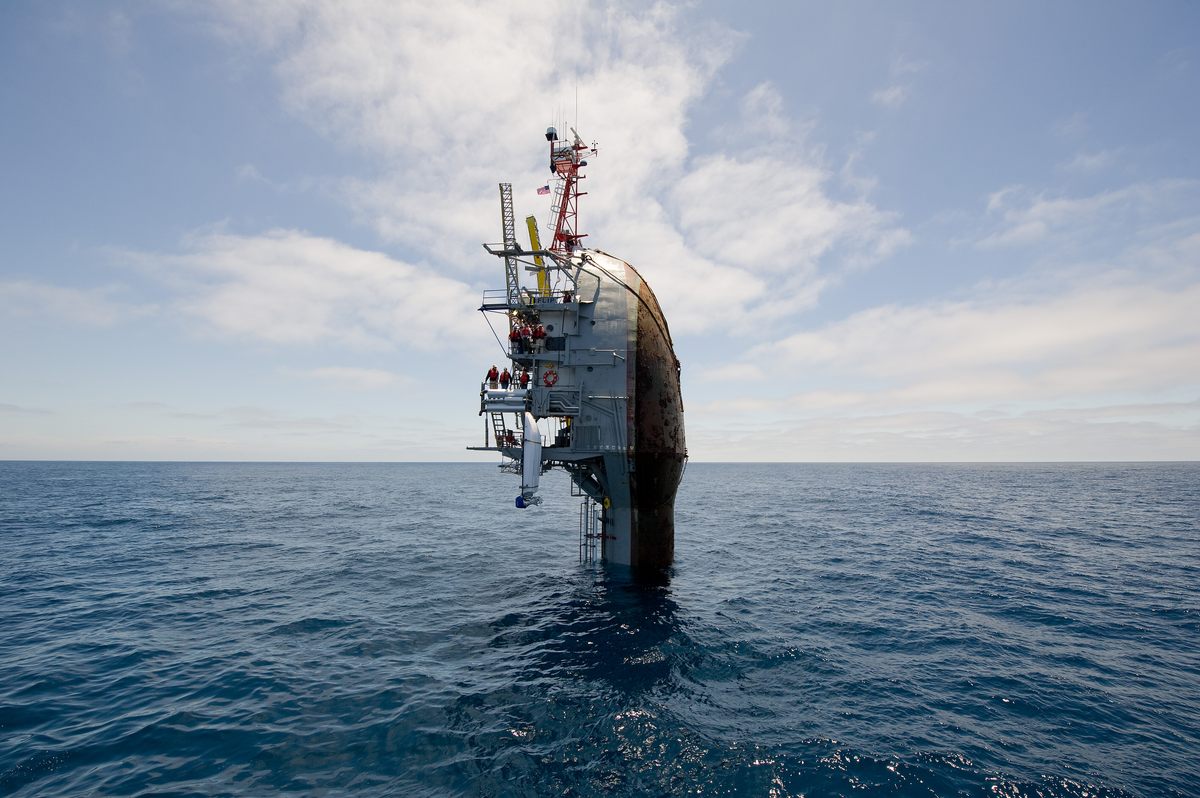
This Ship Is Not Sinking—It
FLIP sits up to provide a stable, quiet research platform.
Atlas Obscura
257 points · by sohkamyung · 9y ago · 75 comments
Someone must have looked at installing a gimballed basin, realised how complicated the custom-made gimbal and plumbing would have to be, and thought "screw it, let's just order a second basin".
Also, someone really needs to put a lid on that soap container!
The same should work for toilets and showers.
Run all your drain piping toward the corner of the ship that's always under water.
Install these on your showers.
http://d2ydh70d4b5xgv.cloudfront.net/images/2/7/shower-head-...
You might want to let things move more than +/-45 or install pins to lock stuff. Taking a crap in rough seas could get weird when you and the toilet can stay level as the ship moves but only in one direction.
It all comes down to weight vs tolerance for squeaks and rattles. Maintenance should be in the same ballpark. Greasing hinges and more flexible plumbing/wiring/infrastructure to worry about is probably not much worse than twice as much everything.
Lots of custom moving parts in salty air should be of similar difficultly to maintain as commonly-made things fixed in place twice?
Probably more sinks, it would be interesting to see the actual numbers of duplicated fixtures. I didn't find anything with a brief search.
At the time, an older engineer pointed out that if you didn't fill the bottom with sea water it didn't flip. So really the tourists would all have to wear scuba gear anyway :-). Which crushed my young dreams of a Captain Nemo style encounter in the tidewaters of the great barrier reef.
Why is it that budgets everywhere from businesses public/private to government to scientific research are always shrinking?
It's like it's the invariant of our age: well you know, budgets are shrinking...
My own field of civil engineering has seen much better days in terms of research and innovation. The field is now seen as ancient and specs are top heavy. Well, the brighter minds have turned to other areas and our field has flatlined.
At least this is the understanding I have usually been given.
Basically, we are down ~45% relative to GDP since 1980 but there are years with minor increases.
Worldbank and the OECD paint a much less bleak picture:
http://data.worldbank.org/indicator/GB.XPD.RSDV.GD.ZS?locati...
https://data.oecd.org/rd/gross-domestic-spending-on-r-d.htm
These data sets include all forms of R&D spending, not just federally funded ones:
"Gross domestic spending on R&D is defined as the total expenditure (current and capital) on R&D carried out by all resident companies, research institutes, university and government laboratories, etc., in a country"
In 1980, US nominal GDP was USD 2.863 trillion. Today it is USD 18.625, which gives out an average growth rate of 5.34% and thus an 650% increase over 36 years. Real growth over the same period is around 2.69%, which gives out a 259% increase in real GDP, which is still way above a 45% decrease. In real terms, research budgets are actually 42.45% higher than what they were in 1980.
Which says nothing about how much they should be. But still, parent went on about sinking budgets, not budget-to-GDP ratios.
GDP figures: https://www.thebalance.com/us-gdp-by-year-3305543
http://www.telegraph.co.uk/men/the-filter/virals/10583550/Ho...
Why do you need to build a flipping (no pun intended) ship?
Couldn't they have just as easily built a tall floating rig that could be dragged by the same tugboat? Why do they even need to change to boat form? Can't they tug it when it's vertical?
Drilling platforms are stable floating structures aren't they? They consist of a stable floating upper platform.
Gigantic drag, low stability, and inability to enter ports and harbours when you have a 100ft draft.
> Drilling platforms are stable floating structures aren't they? They consist of a stable floating upper platform.
"Truss and spars" platforms usually have the truss floated on its side and the modules mounted on top of it once it's been floated and ballasted in place. Semi-subs can be tugged into place but that requires big tugs (multiple ~20khp units) and is very, very slow, to attain the speeds at which you can tow RP FLIP (7~10kt) you need a heavy lift ship.
These are not the kind of expenses oceanography can usually afford. Not to mention the semi-sub itself would be significantly more expensive than RP FLIP was, a semi-sub is more than half a billion, FLIP's original cost was about half a million.
300 feet is awfully deep. If you believe that 300 feet of draft is needed to get the stability they need, then this seems like the only way to get it. There are no ports, or even semi-protected waters, where you could build, launch, or dock something like that without it running aground.
Some quick research shows that the deepest draft on oil platforms is in the range of 25m (1/4 of the FLIP ship), and further that this ship was built a decade before the development of floating oil platforms.
Drilling platforms are large and not designed to regularly circumnavigate the oceans. They float but they're shitty boats.
Edit: the bending stresses when its being towed horizontally could be quite large too...in long-wavelength swell you'd have either the center more bouyant than the ends or the ends more buoyant than the center. Once you flip it it's supported by bouyancy and filled ballast water.
I would guess to reduce roll when it is horizontal.
Makes me think like why would they design a hovering rocket crane to lower a Rover autonomously on another planet. There is a reason/it worked, and with this ship hmm, like is that the only solution?
You could have floating bouys that have either neumatic or electromagnetic suspension stabilized... But then again the scale/weight of this thing... I guess the design makes sense as far as being able to operate in shallow waters then go out and do it's thing.
The surface wave motion decreases with depth, so having so much mass deep under water makes for a very stable platform.
"Development started in January 1960 after a conversation between MPL researcher Frederick H. Fisher and MPL Director Fred N. Spiess regarding stability problems that Fisher was encountering when using the submarine USS Baya (SS-318) as a research platform."
I'm not clear however why a submarine was too unstable for the research they were doing.
Based on that, my guess is either surface tension, or the fact that an object that floats on top of a medium is much less dense than one that floats within it. It would probably be a pretty easy to quantify if you had several liquids with known surface tension, so I'm guessing the information is out there already.
http://funnel.sfsu.edu/courses/gm309/images/Owave.gif
Essentially, motion starts with wind. Energy propagates downwards into the water column resulting in the circular orbitals (you see this if you float in the (deep) ocean and you bob up and down in a circle but you don't really go anywhere). But at a certain point, no more energy propagates downward; so your submarine if its deep enough (tens of meters) will not feel a thing from what's happening on the surface.
This is also what the FLIP takes advantage of; the base of its deep spar hull lies so far below the surface that it has nothing forcing it to move up and down. This is why it's stable in big waves, and why I'm confused how a submarine is too unstable.