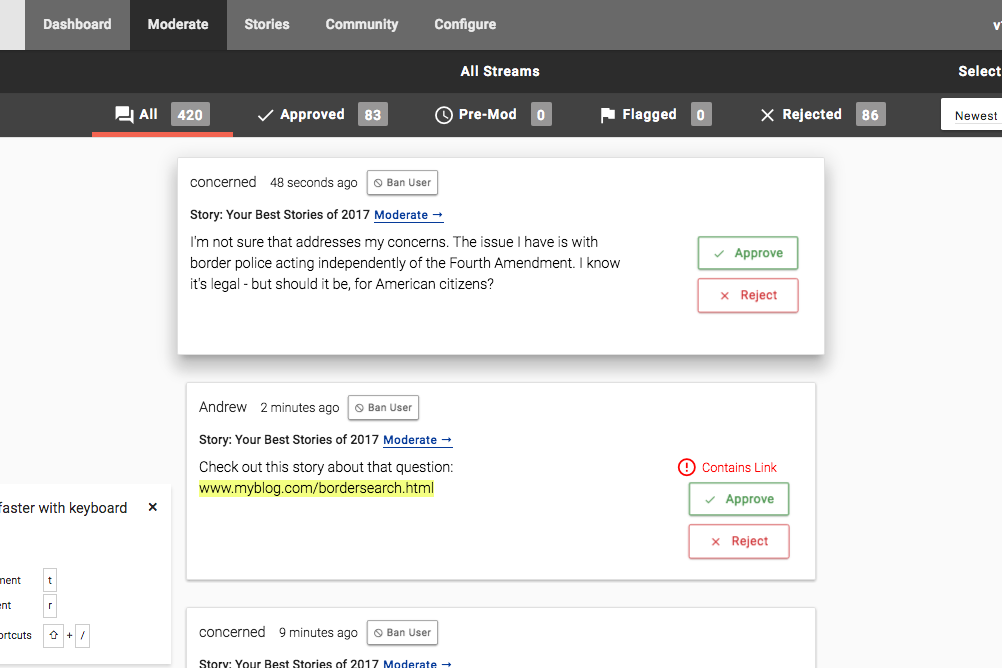
Mozilla and the Washington Post Are Reinventing Online Comments | The Mozilla Blog
To engage readers, build community, and strengthen journalism, Mozilla’s open-source commenting platform will be integrated across washingtonpost.com
blog.mozilla.org
564 points · by mwheeler · 9y ago · 334 comments
I know I'm super biased, but I still find Reddit comments the easiest to read and follow (HN is a pretty close second, especially after they added comment collapsing).
Is it really just bad marketing it on Reddit's part that keeps others from using their embeddable comments? As a site owner, you can fully moderate the conversation by only embedding comments from a subreddit you fully control. You may not get quite as much data as Mozilla's solution, but in exchange you get the benefit of Reddit's 12 years of spam data that train its filters.
I just don't understand why more sites don't embed the reddit comments.
While smaller sites are happy to give up some control for the sake of easily adding a major feature to their site, larger businesses are probably going to want to own their own content and self-host their code as much as possible. Reddit has a non-trivial set of dependencies (https://github.com/reddit/reddit/wiki/Dependencies), so it's not very attractive as far as that goes.
My from-my-ass guess is that once Reddit ended up in the mainstream news a few times for some drama or another, it lost the opportunity to be taken seriously as an embeddable feature by other major sites.
You don't have to accepts reddit's culture to embed it's comments. You can have a subreddit that you control where you can moderate it and remove any content you don't like.
As a site owner, you can have full control over the content if you want.
To an extent, "just use the subreddit's moderation" is a product fail, too. It needs to feel like a standalone product, not embedding another site that you might not completely understand.
So even if we set aside the question of self-ownership of data vs. embedding, WaPo would look at this as an opportunity to either create their own culture, with their own weirdos and brilliant people, or to start with Reddit's and try to moderate their way towards the culture they want. Framed that way, I think Reddit's at a disadvantage.
If Slashdot had provided the option of just embedding their comment system onto Reddit pages, would Reddit ca. 2004 had done that instead of building their own?
Or your very own installation of https://github.com/reddit/reddit ?
Are the moderation tools up to it? I've always thought they had the reputation of being underpowered. Or is that just another marketing fail?
Which culture? Outside of the default subs, I'm not sure its really accurate to say that Reddit _has_ a singular culture, except perhaps in the same broad sense we might say that "the internet" has one.
Rather, each subreddit has its own unique culture, and there can be a _lot_ of variance between the cultures of different subreddits.
>As a site owner, you can fully moderate the conversation by only embedding comments from a subreddit you fully control.
I agree that moderation is necessary (hate speech, spam, etc.), but allowing any individual(s) to create arbitrary rules feels really awful. I wish there was an overall "moderation guidelines" for popular subs that enabled discussions to occur, and some recourse if mods abused their powers. Right now it's an echo chamber machine and I'm starting to hate it.
On Reddit, if the top comment is a joke, you need to wade through a million other jokes before you get to the next top level comment (which may be interesting)
Categorising (a la slashdot) comments is interesting, you can filter out 'funny' and keep 'informative' etc. But I guess it puts a burden on the users to select the right 'up vote' .... do you have a funny button, an informative button, etc?
Facebook has solved this with their 'reaction' icons (like, funny, shock, heart) so user apatite is there for this kind of classification.
You can just collapse it.
I agree with you that the categorization on Slashdot was nice, as was the metamoderating. But when I find myself on Slashdot these days, I find it impossible to follow a conversation with so many collapsed comments.
Yeah, but I've usually swiped down and I don't know if its worth going back up to collapse it.
Default sorting by category would be nice, push the funnies down and pull the interesting ones up.
The Globe and Mail (Canadian national newspaper and growing media company) has executed something similar.
They actually have some pretty innovative work going on (at least with respect to the rest of Canadian media), and maintain a lab for this express purpose.
example (scroll to the end of the article, comments are expandable):
https://beta.theglobeandmail.com/opinion/recognizing-indigen...
disclaimer: I work for a national media outfit in Canada that isn't the Globe
https://www.reddit.com/r/GeoPolitics has a very nice CSS in which the collapse toggle runs down the side of a thread. You can collapse, and set the level you want to collapse, from within the thread. It's genius, seriously.
The bar appears on mouse-over, running vertically.
See for example: https://www.reddit.com/r/geopolitics/comments/6z27gx/rgeopol...
It's not the sort of place I'd go to for serious conversations about anything.
Reddit's comment structure remains by far the best on the internet. You should definitely be proud of that.
The ability to promote certain users comments (and vice versa) is good too; but you have to use that carefully.
Would love to have that with the content and users here.
(And then HN replaced that because of the quality of comments here)
I'm trying to remember if it had the ability to filter comments below a threshold, though I'm thinking it did.
Really? I hate the tree style of comments. It's all well and good when you're reading a chain of replies, but then you run into a comment that's halfway back up the tree and have to make several attempts at collapsing comments to figure out which one is the sibling.
I much prefer a comment system like 4chan, where the post you're replying to is linked and previewable, as are posts replying to yours.
(I'm developing it.) It's inspired by Reddit & HN, and has some additional features that makes it simpler to navigate large discussions, e.g. instantly jumping to the parent post (if it's far away) to refresh one's mind, and then jumping back. I made a video: (scroll down to "Jumping to the parent post, and back") https://www.effectivediscussions.org/-32/how-hacker-news-can... (everything not ported to embedded-iframes yet, though.)
Maybe Reddit aren't advertising their embedded comments, so no one knows about it? A while ago I searched for embedded comments alternatives, and I found some abandoned projects (that had gotten super many upvotes here at HN), + Isso, + Disqus, + Talk, but cannot remember having found anything about Reddit. I wonder why they build it, but then won't focus on marketing it. Maybe they haven't thought about any way to make money from their embedded comments, yet. Hmm.
You know what? I can't find anything helpful on Reddit about how to do it.
I found how to embed reddit buttons easily enough (from the link on the bottom[1]). Checking the FAQ eventually led me to a page that says: "We’re working to support comment embeds shortly. We will update the publishers page and the FAQ when it’s out." [2]
Googled for it, and found an announcement blog[3] that made me realize "embed" exists under each comment. That only seems like a peculiar way of quoting a specific comment though -- and if there is some way of replying to comments through it or upvoting, I don't see how. I can't imagine anyone would want to have to comment on their own post in order to start a comment chain on their own site either.
Finally realized that "share" existed under each post as well. (Like 'embed', my brain just tunes that stuff out as junk -- seriously, why would I need help emailing a thread when I know how to copy and paste?) In addition to social media icons, there's a weird icon that seems to give you the option to embed a fancier looking link to a reddit thread. I don't see any comments attached to that in the preview though. This seems like the most likely place to find the functionality, but I'm not seeing it.
So, jedberg, I'm going to have to go with "no one knows how to do it" as the main reason that nobody embeds reddit comment threads for their own comment sections.
(Honestly though, I'd rather read reddit comments on reddit than have them embedded.)
[1]: https://www.reddit.com/buttons/
[2]: https://www.reddithelp.com/en/categories/reddit-101/post-emb...
[3]: https://redditblog.com/2015/03/23/announcing-embeddable-comm...
Isn't comment collapsing in HN the same as downvoting? I find this confusing - or maybe I just don't have enough karma for the actual downvote button.
With enough karma you get a downvote button.
https://www.cnet.com/news/reddit-ceo-admits-to-editing-user-...
1. You can't leave comments after an amount of time has passed on Reddit. On even my blog, conversation will spark up 1+ years later. Why would a website want to inherit that limitation?
2. Users have to have a Reddit account. Some of the best conversations in my comments section are anonymous.
Sometimes their comments are good, but then there's the guy who writes a poem every single time, or 'Socrates' who posts the same cookie-cutter 'blame-the-GOP-all-the-way-back-to-bush' comment with the most dramatic rhetoric possible, trolling for likes of course.
Having said that, I'm pretty satisfied with the Times comment system, everyone does get a voice even though the top comments are absolutely fixed.
Then the hack: this is a newspaper. They have no reason to be fair. Give community moderators super-credibility. So they can upvote people and not just give their comment visibility, but by upvoting they incidentally give them credibility for future comments. And in turn, those commenters' upvotes are more powerful as well, thanks to the credibility lent by the community mods.
It creates an echo-chamber, of course... but ultimately, that's what people want.
I want to eat ice cream every day, but I also want to feel good and be healthy.
Let's give people a little credit--if they're aware of their biases and are given tools to overcome them, a lot of folks might make the right choice.
When people's needs are satisfied, they want more of that.
So let's satisfy their needs instead. Echo chambers are ultimately self-defeating as they bring on more divisiveness and intolerance.
But they are excellent at driving activity => pageviews. Which is where the money for newspapers comes from. Nothing to be said beyond that - the induction of outrage and divisiveness is a desired feature, not a bug, from the POV of media companies.
separate buttons for "this is a good/bad argument" and "i agree/disagree with this"
then give more voice to people whose votes on these two axes are orthogonal.
this rewards policing bad arguments on your side, or finding good arguments on the other side.
Done right, it will allow diversity of opinion without turning the comment section into an unreadable ranting mess.
Do you really want to read a commentator who post the same screed about republicians or democrats on every story?
What I'd love is to see a tool that allows you to see fact from opinion and the ability to see multiple perspectives.
In Australia there's a government run TV channel that have programs that attempt this. Good journalism is hard to find though.
As technologists we've built this system that optimises for page views. Surely we're capable of building a system that optimises for the truth instead.
Are there site that do that? I know hackernews limits your voting abilities until you get so much karma.
Sounds like some variation of the above ideas would work great. The vote from a random troll who doesn't understand the community's rules shouldn't count as much as other votes but I'm not sure how you would implement it in a way that wouldn't be abused.
Not news or commenting related, but a site like Newgrounds [0] (i.e. flash games and videos) has this feature. As you participate in the community more and contribute high-quality ratings, enforcement, etc. you gain more influence, making your votes carry more weight. Therefore an account that has been involved with the site for some time may carry more weight than a few new troll accounts.
It seems like a good model, but may still need occasional moderator intervention to prevent abuse here and there.
Not sure how the results were used though.
Someone on the team got annoyed by this so for a while we would post the top comment before publishing such that they couldn't post their personal fundraising link. Then we ran some numbers and realized how much money it was costing the campaign (a lot).
Moral of the story: comment sections are weird.
I don't miss them. I'm sure commentcowboy236523 from Atlanta has some important things to say, but I don't need to read them. If I want conversation, I'll come to a place like Hacker News or reddit, where conversation is the goal. I can find that when I want it.
But I don't need it when I'm trying to relax and enjoy the paper. Comments simply don't add any value to the experience. We don't need better comments. We don't need them at all.
Comments tell me "what's wrong with the article", and in doing so, give you a good picture of what the article is about.
As for the "what's wrong" part itself: generally speaking, you can really tell by how the comment is written whether it's legit or not. That way, you kinda get two sides of the coin, and you can decide for yourself what's going on.
Whether comments are valuable very much depends on the kind of people you have writing them, and I believe it's worth trying to maintain a good commenting community.
Would just as soon not give armchair phd a platform. There's some research (don't feel like pulling it up - bullshit?) that talks about how the decline of valuing expertise has had some negative social consequences, but that's probably obvious.
At Slashdot, chances are that I haven't read the article. I go straight to the comments and read those.
Curiously, I can't do that as often here on HN. Here, the quality of article is often higher and the comments are usually more on-topic and, often, more specialized. I do end up reading many more threads than I comment in.
But, yes... I learn a lot more from the comments (frequently) than I ever do from the article. HN is particularly good at this, and it's one of the reasons I visit.
We have already seen examples where people run the same story on extreme left and extreme right web sites to get clicks and rage views and their toning, and changes are fairly algorithmic. That makes me wonder if you could build an echo chamber of one. So that what you read was always something you really agreed with, even if it wasn't written that way for anyone else. (same data and facts mind you, just slanting it toward the reader's preferences).
I'm similar. You could think of articles as one giant comment from a single person. I'd rather read comments from several people as it's much easier to spot bias and get a variety of viewpoints.
https://www.nytimes.com/2016/11/13/us/elections/to-our-reade...
> ...we aim to rededicate ourselves to the fundamental mission of Times journalism. That is to report America and the world honestly, without fear or favor, striving always to understand and reflect all political perspectives and life experiences in the stories that we bring to you.
I've taken a different approach, which I don't think is superior to yours, just more enjoyable for me... I intentionally watch openly biased news aggregators. For left wing commentary I will watch The Young Turks or Jimmy Dore. For right wing commentary I like Ben Shapiro. The truth usually lies somewhere in between.
Oh, I notice it. I think it's a fun game to root out the bias in the Times. It's really how the news is meant to be read (i.e. confrontationally).
> We feel that rather than approaching the problem with a collection of algorithms and an army of moderators, our engineering and editorial resources are better utilised building new storytelling formats that resonate with our audience.
Modern media do this every day already with their yellow-journalist hit pieces, biased comments to drive a narrative aren't even a skip away from that.
Then again, I would be shocked if PACs of all flavors didn't have pay groups of subscribers to crash the comments sections of the most prominent publications (NYT, WSJ, etc). Especially during the primaries last year. When you consider the amount of traffic they get, the top comment is valuable thought capital real estate during election season.
I agree about Socrates. Overwrought.
I don't read WaPo comments anymore, the signal/noise ratio is too poor. I learn something occasionally from NYT comments.
It's down to an organization's willingness to spend money on quality. NYT spends $ to improve the comment experience, WaPo doesn't.
I have no idea how well this worked.
What is this all about? Feature-wise it doesn't sound better than a comment system from HN, Reddit or StackExchange.
Besides, Mozilla is really lacking communicational skills. This blog post feels like the documentation at MDN, tedious and unclear.
Of all things Mozilla may be doing wrong, the MDN docs on html / javascript is most definitely not one of it. They are by far the best available.
This feels like an undeserved swipe to me. How many developers prepend their searches with "mdn" when they need info on browser APIs?
Plus with GitHub single sign-on it's actually very easy to contribute to or edit an article (assuming most web developers have a GitHub account). I was surprised when I found that out.
Stackoverflow is my preferred source of course.
(Just kidding!)
> We’ve created a streamlined system that can improve how people behave and interact in the comments space, and allow moderators to more easily identify and remove disruptive comments.
Seems like one of its primary functions is a censorship tool. "Disruptive" is a very subjective term.
If you're struggling to grasp the importance of plug-ins for commentators, there's a good explanation of their relevance in the article.
https://digiday.com/media/times-london-finds-commenters-valu...
1. Improved controls for filtering comments on prominent news sites.
2. A step towards the decentralisation of the web.
Both have potential benefits, especially if the comment filtering is user-driven.
Without comments, people go elsewhere to discuss the issue - elsewhere that you don't control. With comments, they discus it on your site, where you can completely control who can say what and how visible those comments are.
Done correctly it's a form of soft censorship by controlling of the discussion and manufacturing consensus among the "commentators".
Hard censorship has more immediate backlash than this does.
It's part of a larger narrative being sold to the 21st century investor, that AI are taking everyone's jobs, so buy your robots before someone enslaves you with theirs. (It's all still leading to the Butlerian Jihad of Dune.)
I think that's the problem with comments on any website. The questions are 1) how to bring out the best from people, and 2) whether that is sufficient.
The same person will behave very differently in different contexts. They may be professional but constrained in a business meeting or around superiors; intellectual, curious, and challenging in a classroom; and obnoxious and loud in a bar. How do you make your comment section, and website in general, bring out the qualities you want in your comments? I'd guess that many websites are not so altruistic as to want intelligent comments more than provocative ones, to generate traffic. I recently read an interesting history of the NY Times Op-Ed section, which said that provocation, rather than wisdom, was the intent.
And even if you bring out the best in people, is that sufficient? I find almost all columnists and op-ed writers to be a waste of time; how much time do I have for uninformed, random people? (And I appreciate the irony of saying that in my comment!)
Better tools to filter out trolls leaves more space for healthy debate.
The very nature of US political discourse itself leaves no space for healthy debate. I'm sceptical that removing the trolls is going to be sufficient to fix that.
I am quite convinced that the nature of US political discourse is largely determined by the predominant media, and not by the individuals participating in the discourse.
–– Cable news is incentivized to sensationalize any minor event, and to frame stories centered around conflict
–– Social media rewards the most emotionally potent messages, consistently pushing aside calm discourse in favor of messages that hit emotional hot-buttons
–– Newspapers, magazines, etc have adapted their style of writing in order to gain more traction on social media, furthering the cycle of increasingly strong emotional engagement. Sure, newspapers are also often quite dispassionate, but those stories rarely gain much attention in the political realm.
–– Social media also increasingly creates identity bubbles, where like minded individuals can support one another's beliefs. This grouping of people has lead to identity being the primary consideration; facts are secondary.
It's hard for me to imagine what a comment on a Washington Post article could add to the article or to anyone's knowledge. It's user involvement for the sake of user involvement. "Healthy debate" is maybe unobtainable at that scale.
HN can get pretty ignorant and off in the weeds (hey we're all guilty) fairly often, and that is despite being topical, relatively small, having relatively informed users and active moderators.
People are running pell mell into this arms race and are stopping to imagine how their tools could be put to ill use.
The best option for moderation is trained man power.
By far the worst UI in a comment system. And they still do the slider and "load all comments" bit, but at least the UI feels a bit better than some years ago.
If you require someone to post really blatant stuff like "Hitler did nothing wrong" to be ejected from the discussion, then your discussion will be filled with ideological trolls who don't argue in good faith but insist that any moderation to their participation is censorship and echo chamber creation.
Their theory that Global Warming is a big conspiracy demands attention, and they have plenty of links to "studies" to back it up.
The reality is that any social space needs to have a set of norms, including ideological norms, that are enforced to a degree to ensure they're followed. The idea of purely "open discussion" is a fantasy; if you ever have something that feels like that, it's because the participants have internalized the enforced norms sufficiently that they never run into the enforcement.
The difficult problem is picking out a set of norms that successfully produce the quality of space you want. Sometimes that is an outright ideological echo chamber. (In fact, it almost always is, to at least the limited degree that there is some ideological position that would be rejected without consideration by the participants and met with hostility. This is a good thing.) Any talk of "open discussion" must always the include the important context of "within what boundaries".
Some people might set "funny" to zero, and some might give it +2. Some people could set "inflammatory" to -10, while others might want it at +1.
You don't need many dimensions, and only one tristate control for each: humor/gravitas, inflammatory/huggler, informative/fluff, religious/factual, lefty/righty, vegan/meaty, etc.
Of course, it takes some work to read through the trolls, but their moderation system is cushioned by the meta moderation impacting who gets mod points and who does not.
I have, for example, been given great scores for comments defending Microsoft and even systemd. It's not just what you say, it's how you say it.
Also, I was often curious to read what was "beneath my threshold" and often clicked. Which played a big part in convincing me that slashdot's moderation was top notch was that I usually did not find anything of interest.
For example, I've posted a number of "controversial" comments on HN that were purely technical and resulted in substantial discussion of the intricacies of the solutions discussed. Because these comments condemn the listless tech-hipsterdom that many devs rely upon to feel valuable (and that many important companies subtly leverage), people complained to the mods, seeking protection of the echo chamber. Apparently some of these people were important enough that HN reacted by throttling my account, initially by claiming my posts were too "tedious" and later revising the rationale to the facially spurious explanation of "engages in flame wars".
I haven't flamed anyone, but now I can't participate much in active discussion threads, hitting a something like a 3-hour throttle at something like 5 comments within an hour. Because my voice was drowning the chorus of echoes a little too much for comfort, and this displeased people whose opinion HN values.
This craving for echoes of validation is why reddit can't shed its negative image. reddit's concept of a unified identity with "default subreddits" severely limits the site's appeal, because anyone whom doesn't find the front page appealing is going to leave. Since the front page frequently contains acerbic content that is either critical of a large section of the public or presented in a manner that is conventionally considered crude, hostile, or defamatory, many leave not only uninterested but actively offended. How would your mom react if she loaded up reddit.com and looked around?
This is why the big players like Facebook and Twitter start each user with a blank feed and suggest only the most generic initial follows (usually late-night talk hosts, reality TV stars, and sports figures), and proceed to give each user total control over what they see. People demand echo chambers.
It surprises me to see jedberg still confused about this after all these years.
In an ideal comment system I believe that articles, comments and moderation events should come from three different, decentralized streams (like Atom) that the end user can subscribe to individually and that are joined at the end users client. That would would provide transparency to the moderation process, ability to comment anywhere, and it would allow moderators to become effective spam-filters without giving them the power of censorship. Now, imagine if this system was built into the browser and it became the default commenting platform for all websites...
Imagine you know someone in the public eye, let's say a musician, with their own website. They enable comments, and site now has comments all over it that they have no editorial control over whatsoever. People are posting a high amount of offensive content. What do you advise that this musician does?
I'd perhaps do most of my commenting in a private comment stream with 2 or 3 friends.
https://coralproject.net/products/talk.html
The only explanation of their approach is that they did "an enormous amount of research". This sounds about as convincing as someone claiming "Oh, I took a class in that."
[1]: https://coralproject.github.io/talk/docs/plugins/server/
E.g. "I don't want to see comments posted by user XYZ, or containing regexp W. Any comments by user ABC, or upvoted by ABC, or containing regexp D, go to the top. I trust the moderation of site trollblocker.com"
I don't see these kinds of ideas represented in the user engagement research.
[1]: See a demo GIF on https://www.washingtonpost.com/news/ask-the-post/wp/2017/09/...
This article is too shy from actually showcase the product. Half of the article is devoted to PR announcement (which IMO is really a waste of time for most readers, even for the non-technical ones). Just first paragraph into the article, I had already given up reading through, but instead put my effort in spotting keywords to understand the motivations behind this new system, instead of jargons.
The second half is a brief overview of the new system, but only two lines are relevant to what I was looking for.
     It’s filled with features that improve interactions, including functions that show the best comments first,
     ignore specific users, find great commenters, give badges to staff members, filter out unreliable flaggers,
     and offer a range of audience reactions.
I suggest next time the writer should:
* tell readers the challenges/flaws in existing system concretely and perhaps showing examples
* the finding from their research participants, the hypothesis ,and how they conducted their experiments
* explain concretely how the proposed system will help address the prominent flaws and issues
This perhaps should turn into a research paper, but even as a blog post it should have more substances. At best, this article feels like a company quarterly performance announcement, which I just scan for keywords and move on, then I forget about all of it. So, what is the point of reading this anyway? README would have been far more interesting. I am disappointed.
----
Anyway, I don't really read comments on news sites. I can't explain why exactly but I feel disconnected and buried (much like what @creagpatr said about fixed commentary). I'd rather go on FB and comment there, even though there is a fairly good chance no one can read mine. Perhaps the social part of FB feels more lively and often comments are funny as hell. Yes, I know that comments on FB are just as echo chamber as many other places do.
There is a site allows people to take side and debate to death. I forgot the name though...
> perhaps showing examples
Killer feature - in that its going to kill the process.
This is chat. Or close enough to chat that its going to be used as chat.
Chat is terrible for comments. A flame war on chat escalates at the rate at which someone can hit enter.
like the wake of a ship, the comment area will expand, and defeat moderation ability to clean it up.
Flame wars are bad enough, flame wars on chat which persist like comments are a bad idea.
Make it update in non-real time.
Something I find a lot of people carelessly shrug off - moderation isn't always a good thing. The act of moderation is, at its essence, censorship. That's a lot of power to be misused by the wrong sort of people.
(and who is the wrong sort...?)
Example: I go to a mailing list for pick-your-favorite-old-grumpy free software project. I click through the ancient, craggy mailman web interface. Hey, there's a button that says, "download the full archive (x MB)." Now I have all the things.
Real World Use Case: The Guardian once deleted some comments on a Greenwald op-ed because of insert-old-craggy-British-law-here. Archive access would have empowered users to periodically archive the comments so that they have control over content they want to read, while the publisher is still able to remove comments from flow and archive when forced to censor.
Some people have informed opinion/interesting things to say and some people just contribute noise to the discussion. The system can learn both from the language and reactions from people.
Just like in "real life", if someone is always talking out their ass, you learn to listen to them less and less because they don't have anything meaningful to say. It's just noise.
The comment system should do the same. It learns from multiple comments and their reactions to determine a reputation. Obviously, if your comments are always seen as "not-relevant" and "toxic", then your contribution is worth less than other "insightful" and "interesting" contributions, so past a certain threshold, you stop being able to comment.
This thing writes many messages to the browser console. The last line apparently prevents even displaying comments.
    STARTING Paywall  c4d7fa1f35.js:41:468
    PAYWALL CHECK STATUS:   c4d7fa1f35.js:42:331
    "PWAPI URL: https://pwapi.washingtonpost.com/news/josh-rogin/wp/2017/09/12/state-department-official-quietly-visits-moscow-to-discuss-north-korea/?rplapisplit=1&referrer=https://www.washingtonpost.com/"  c4d7fa1f35.js:42:405
    PAYWALL ACTION: 0  c4d7fa1f35.js:43:138
    PAYWALL URL: N/A  c4d7fa1f35.js:43:218
    PAYWALL SUB: Unsubscribed  c4d7fa1f35.js:43:292
    PAYWALL METERED: Metered  c4d7fa1f35.js:43:393
    PAYWALL METER COUNT: 4  c4d7fa1f35.js:43:498
    PAYWALL MODE: 1  c4d7fa1f35.js:44:49
    PB Debug: Fired comment_count_target.init:[object Object]  c94e09db1d.js:381:443
    boomerang.nt: [info] This user agent supports NavigationTiming.  wprum.min.js:1:10101
    pt.fetchStart: 1505251033854  wprum.min.js:1:10803
    boomerang: [debug] Checking if we can send beacon  wprum.min.js:1:10101
    boomerang: [debug] Sending url: //rumds.wpdigital.net/metrics/?rum=%7B%22redt%22%3A0%2C%22nl%22%3A285%2C%22dns%22%3A0%2C%22tcp%22%3A0%2C%22rest%22%3A195%2C%22domt%22%3A904%2C%22uplt%22%3A3052%2C%22url%22%3A%22https%3A%2F%2Fwww.washingtonpost.com%2Fnews%2Fjosh-rogin%2Fwp%2F2017%2F09%2F12%2Fstate-department-official-quietly-visits-moscow-to-discuss-north-korea%2F%3Futm_term%3D.b5cb34fc201d%22%2C%22site%22%3A%22www.washingtonpost.com%22%2C%22title%22%3A%22State%20Department%20official%20quietly%20visits%20Moscow%20to%20discuss%20North%20Korea%20-%20The%20Washington%20Post%22%2C%22domn%22%3A940%2C%22section%22%3A%22opinions%22%2C%22cntt%22%3A%22blog%22%7D
	v=0.9
	u=https%3A%2F%2Fwww.washingtonpost.com%2Fnews%2Fjosh-rogin%2Fwp%2F2017%2F09%2F12%2Fstate-department-official-quietly-visits-moscow-to-discuss-north-korea%2F%3Futm_term%3D.b5cb34fc201d
	if=  wprum.min.js:1:10101
    PB Debug: Fired sticky-vertical-sharebar.collides_with_main_content:false  c94e09db1d.js:381:443
    PB Debug: Fired nav.start_close:true  c94e09db1d.js:381:443
    PB Debug: Fired nav.finish_close:true  c94e09db1d.js:381:443
    Comments load: timer startedtwp-comments.js:1
[Echo.UserSession] error : Unable to initialize user session, error response from IdentityServer API received | args: Object { response: Object } 499c2b4a02.js:294:297This seems like it would have been a good use-case for Persona, but that project was cancelled; is there any good replacement these days, besides the ubiquitous "sign in with your facebook account"?
I was so opinionated about my comment system I decided to build my own called Remarkbox (https://www.remarkbox.com)
Its embed-able like discus but I want it to feel more like hacker news or reddit (deeply nested threads). My system is still a work in progress but I'm actively dog fooding it on my own websites and so far its working well.
One major take away I've learned from this thread is that people really like to use the collapse feature here on hacker news and reddit to narrow in on the conversations they care about. I actually never used this feature on either site (I didn't even know what that [-] was on hacker news until today)
I hope the new system fixes that. It is otherwise about impossible to hold a conversation, so it reduces the incentive to leave a comment in the first place.
This makes me feel old. Is 300kb really considered small these days?
Disqus seems to be 600kb (I summed the size of the "disqus" scripts on a blog that uses Disqus).
There is literally a good hundred of solid solutions out there for web commenting - hosted, embedded or app libraries -, and Talk doesn't seem innovative at all.
https://www.kajmagnus.blog/new-embedded-comments
(example feature: click the arrows to jump to the parent post and refresh your mind, then click "Back" to jump back down & continue reading. But haven't ported the Back button to iframes yet.) (submitted yesterday, got zero attention :-/ )
Maybe for the staff at the newspaper, moderation features are more cool innovations, because that's what they will be using the most?
Particularly ones that are open-source and framework-agnostic.
There, problem solved with no need for fancy machine learning algorithms or other institutions to play big brother for the internet commenting culture. Voting based systems generally seem to do a pretty decent job most of the time, especially when the community can be segregated by topics/interests like on Reddit.
If a site allows a near-infinite number of anon or sock-puppet accounts, individual or even distributed blacklisting amounts to trying to empty the ocean with teaspoons.
If posts or comments were strongly associated with an individual identity, then a distributed scoring system could help produce a more useful set of content, but would be likely to make an echo chamber. But, the scoring system could be gamed by persistent vandals.
Also, anonymous or persistent pseudonymous posters may contribute valuable content - how can one allow for that content but defend against abuse?
Even simple measures, like preventing multiple accounts being registered to the same email address, can already greatly cut down on the trolling potential of most garden variety trolls.
Nothing about this "problem" is new except for the perceived scale due to Internet-access having become widely available and more people being exposed to Internet culture, but the problem itself is pretty much as old as human interaction in general: How to deal with people whose views seem to be utterly incompatible, even offensive, to mine?
Germany has been down this road for quite a bit longer, the only result so far: Comment culture is dying out, in many places it doesn't even grow in the first place anymore because there's isn't even the chance for it, as more and more site operators decide not to implement comment options at all because it puts them in muddy waters, legally speaking.
Censorship is never an option, even less so when it's outsourced to some unaccountable entity, even worse when it's some machine learning algorithm where nobody understands how it actually works but people rather like the outputs they got from their inputs, it's basically a censorship blackbox.
Honestly, I don't see the need for any of this and it's quite scary how this kind of authoritarianism has become so popular in past years. We used to look at China as a negative example, something we would never want to emulate, this has changed and now increasingly politicians are openly voicing their opinion that a system like China's might actually be "good".
Maybe it's just me having gotten a thick skin for this kind of stuff, after 20 years on the net, but I neither see the need for any of this nor the "good" this is supposed to do, all I see is lot's of potential for making the Internet a worse place for open discussion, especially across ideological lines. All I see is yet another move towards more echo-chambers and less diversity of opinions. Which is important regardless how shitty some of those opinions might be, they can always serve as a bad and educational example, censoring them out of sight like they don't even exist, does none of that.
But, as petty and selfish as it sounds, I wish it were built in my development language of choice. Then I could modify and use it myself, or contribute, without that irrational dirty feeling.
I know, node is very popular, and no disrespect to you if you use it. It's a personal failing. I just can't put my personal time into it any more. When I see a great project I get excited, and search out the source to see what it's written in. Then I often feel disappointed. Maybe I need to gain some flexibility.
Here's an alternative to Talk, with some new features / "techniques"?, directly visible to the reader: https://www.kajmagnus.blog/new-embedded-comments
E.g. makes large discussions simpler to read / navigate, by using arrows, which one can click, to jump to the parent post (if it's far away), and then Back to jump back down and continue reading. (I'm developing this.)
Hopefully that's not the client size
I was super excited when I came across that first sentence in bold (italics here) on one of the points under "Here’s what makes Talk different".
Wow, I thought to myself, does this mark yet another step in the revolution of the re-decentralization of the internet? Is Talk a product sharing the same ideological foundations as awesome projects like Sandstorm (https://sandstorm.io/), Matrix (https://matrix.org/), remoteStorage (https://remotestorage.io/), Solid (https://solid.mit.edu/), and many others that I'm doing a grave injustice to by not mentioning here (please do remind/enlighten me in the comments if you're aware of others!), that strive to give back to users the ability to control their own data to whatever degree technically feasible: where it lives, who has access to which pieces of it, how they may access/manipulate it, under what circumstances, and for how long, etc, etc.
The concept of apps built on user-provided and user-controlled data-sources, envisioned by projects like these, has always been immensely appealing to me. If users truly controlled their data, and only granted apps access to the data they need to function, instead of depending on each individual app to host user data in their own locked-off silos, then switching to a different app would be a simple matter of granting another app access to the same pieces of data! Lock-in would completely stop being an issue!
Imagine that! We could have a healthy and highly competitive app ecosystem where users choose apps by their own merit instead of by the size of their moat built on nothing but network effects. Newcomers could unseat incumbents by simply providing a better product that users want to use! Like a true free-market meritocracy!
And then I read on:
> Unlike the most popular systems, every organization using Talk runs its own version of the software, and keeps its own data. Talk doesn’t contain any tracking, or digital surveillance. This is great for journalistic integrity, good for privacy, and important for the internet.
And I realized, No, they were not talking to me, a lowly user hoping against hope to one day live in a world where we can truly own and control access to data that rightfully belongs to us. Rather, they were talking to platform owners like Washington Post, loudly proclaiming that with Talk, that they get to own my comments, my profile, my data, and that somehow it is "good for privacy, and important for the internet".
Sadly, this is just yet another data point in the unrelenting trend in silo-ization of user data, and stopping that trend is becoming more and more of a distant dream because both newcomers and incumbents today realize the massive competitive advantage lock-in and network effects afford them. Incumbents will never give up their moat and allow the possibility of interop without a fight, and newcomers all end up racing to build up their own walled-off data silos because they have ambitions to become an incumbent enjoying a moat of their own one day. Even products that are built on top of open protocols and allow non-trivial interop tend to eventually go down the path of embrace, extend, extinguish, once they reach any significant scale.
Regardless, for this particular instance, my rational mind realizes that platform owners are the group that Mozilla must appease and market to, in order for Talk to stand any chance of success, and that Talk as a product is definitely the lesser of many evils in the same space, and that fundamental change usually manifests itself as a series of small, incremental improvements, much like in this case where an open-source, privacy-respecting product manages to defeat numerous much more deeply pocketed and deeply entrenched rivals to secure a foothold in a competitive market. But as a longtime Mozilla Fanboy, however irrational it may be, I can't help but feel a little bit betrayed when even they are forced to send messages like this in a painful compromise that confirms my lingering suspicion that we're still a long way off from winning the battle for a user-centric internet.
Moreover I think that it would be great if it worked without any js (or if at least worked with addons like librejs) - knowing mozilla however they will probably not care about these.
https://www.forbes.com/sites/quora/2014/04/11/did-mozilla-ce...
So in other words, he was told if he didn't resign he'd be fired. Let's not play games, he wasn't going to survive that episode.
> The Mozilla Board that appointed him knew about his donation
I seriously doubt that, unless checking a person's political donations is a standard course of action Mozilla takes -- which would open a major can of worms (you didn't promote me because I donated to Trump). The whole episode reeked of someone digging around and raising a stink shortly after he made a highly visible move -- otherwise, why did no one in the "community" take issue with his donation in the several years prior?
“Eich also stressed that Firefox worked globally, including in countries like Indonesia with “different opinions”, and LGBT marriage was ‘not considered universal human rights yet, and maybe they will be, but that’s in the future, right now we’re in a world where we have to be global to have effect’.
It is most certainly standard to check the political donations, statements, and affiliations for the person you are promoting to CEO. This is not a mere promotion from SDE; this is the face of the company, and a company that specifically touts inclusion as a core tenant.
External pressure, not internal.
> I seriously doubt that, unless checking a person's political donations is a standard course of action Mozilla takes
No need to do an investigation, it had been raised by people who were upset by the action years earlier.
> otherwise, why did no one in the "community" take issue with his donation in the several years prior?
They did, years earlier.
You could've found this out yourself, but instead you decided to make trouble here instead. It's best to stick to topics you understand.
The company should've given more support given it was a ridiculous situation, but it's understandable why he'd resign given how much noise was being made.
Edit: I'm not disparaging this, I'm asking a question...
I think comments -- and really the nature of online interaction -- is ripe for disruption using new technical solutions that alleviate many of the older pain points.
As an example, people propose social solutions to problems like trolls on Twitter, but that seems to stem more from a lack of imagination in technical solutions. Social solutions are things like banning trolls. A technical solution would be something like spam filtering to categorize content and then allow people to have filters built around those categorizations.
Of course, the reason people don't advocate those technical solutions is actually simple: they don't provide power to a centralized authority to enforce their will on others.
I'm leery of most of these "social solutions", because at heart, they all seem to be dubious people arguing why they should have control over the material other people can interact with. I don't think it's accidental that people are proposing dominance and control over freedom and technical solutions.
[1]: http://coralproject.net/products/talk.html [2]: https://www.perspectiveapi.com
> Talk doesn’t contain any tracking, or digital surveillance.
> Talk is small — about 300kb — and lightweight
Both are an improvement over FB IMHO
https://www.kajmagnus.blog/new-embedded-comments (I'm developing it, ... submitted yesterday, no one noticed)
So I broke down, and clicked the link to actually read the source article. Still couldn't find any meaningful information about the thing.
At this point I considered this a personal challenge. So I clicked the link at the bottom of the article, to ITS original source (http://coralproject.net/). Still couldn't find any solid non-marketingspeak information about the thing.
The Internet in 2017, folks. It's just turtles (comments) all the way down...
B.t.w., Steve (the grandparent poster): Mozilla makes a super famous browser named Firefox. That's maybe the main reason "everyone" knows who they are.