Is This Tiny European Nation a Preview of Our Tech Future? | Fortune
In Estonia virtually every process is digitized—and the startup scene is thriving. What can the world’s largest economies learn from one of its smallest?
Fortune
137 points · by breck · 9y ago · 96 comments
I have the feeling this is generally true in the other conservative parts of the EU as well. Eyes are very much on Estonia in the EU for this reason. It's all very sluggish, but the wheels are starting to turn, I think.
The Estonia e-residency is very good for ‘nomads’ ; if you travel a lot (say you do not reside in one country 6 months + 1 days and (but this is debatable somehow) are not in a country more than 60 days continues, you can have a company in Estonia and declare tax for that company there. Which is to say, no tax until you take money out. If you don’t travel like that it is far more complex.
They try to make everything anti-cheat, but in the end cheaters cheat anyway, and in the process they make everything slow and painful.
I'm interested in reading more/a list of the highest taxed nations as a way to easily counter the claim that the US is the highest taxed. Do you have a link/citation, so that I can verify that?
http://stats.oecd.org/index.aspx?DataSetCode=TABLE_I6
Germany 39%
USA 26%
The early time in life when you build the foundation for your financial freedom. In Germany you won’t get the chance. You will be conditioned to pay into all the nice, costly systems that mathematically will fail due to shrinking population and longer life spans (medical/care costs) long time before you will be able to get „something back“
We here in the US enjoy very, very low taxation. What is strikingly odd, to me, is that many of my fellow citizens believe we are taxed at comparably high rates.
At any rate, I'm still not able to find anything that puts Germany at the top, even for corporate/business taxes. It looks like some of the Scandinavian countries are pretty find of taxation, though they do enjoy quite a few benefits from that system.
Edited to clear up some verbiage.
I'd also like to see such a list, but with several different measures of highly taxed, and some plausibly unbiased attempt to aggregate them together. I am curious how the overall taxation compares among countries.
Wikipedia has some good tables but, like you suggest, compiling that data is not that easy due to biases. There are also different names for the taxes, different categories, differences in reporting, etc... About all I can conclude is that I don't pay much, compared to what I'd pay elsewhere, in taxes.
I actually don't mind paying taxes. I do mind how the money is spent, but that veers into a digression and politics. So, I'll skip that for today.
It doesn't immediately seem that difficult for a group to gather, if they're interested in declaring average tax by country; and it seems like an interesting enough question that someone should have done it by now
They got it from the same place they found out they found that Germany also had "more than 300000 laws and rules for everything". You know, the "it feels like it must be so, therefore it might as well be so" place.
Also, if we count all the various regulations, even at just the Federal level, I'm pretty sure that '300000' is not actually a big number. The US tax code is larger than that.
But, hey! It looks like a big scary number. So, there's that.
Health insurance: if you're freelance, your health insurance is preferably private (cheaper) and you're free to cancel it if you please.
Capital gains: is for speculations, can choose to "be a saver not a gambler".
Church tax: is for church members, don't join.
Gewerbesteuer: is for LLC/Ltd/GmbH/UG etc --- not for freelancers/Freiberufler
Pflege: never joined that in my whole life. Seems to be optional then.
Rundfunk: this becomes an issue when you register as a resident or fail to deregister as a resident. Now, not being registered as a resident while residing qualifies as "offense"/"misdemeanor" (Ordnungswidrigkeit), not as a crime, last I checked =) (I registered though, when I moved back here after years abroad. Though in retrospect, I have no idea why I did --- for someone who never makes it to the voting booth, all it gives you is GEZ hassles.)
Church tax is automatically deducted with the other taxes. It's collected alongside other taxes and you don't have to file separately for this.
The corporate tax code is certainly not the easiest but common for most countries of the world.
I'd totally agree that German taxes are complicated but the number of taxes to pay says nothing about the complexity. Neither does it say anything about digitisation.
Also, Rundfunkbeitrag, Krankenversicherung and Pflegeveraicherung aren't taxes.
Nope. Not even in the EU. Not even close. Where does this myth come from? Is it that it has passed the UK per capita?
I mean, there are loads of nice things about Germany, and economic strength is one, but that's a wild exaggeration.
Per-capita in the EU is skewed by a fair number of very small but very very rich countries. Luxembourg, the leader, being a tax haven and a population of half a million (!!) does not make it the healthiest and best economy.
Germany is certainly not the richest country in Europe but it has been one of the most successful when measured vs. 15 years ago. But that was achieved mainly by keeping wages low so that Germans, while usually living comfortably and not threatened by unemployment, have much less wealth than people in the UK or US.
https://www.theguardian.com/commentisfree/2015/jun/22/greece...
But it's probably mostly network effects. The US has an extremely complex tax code and SV is one of the most expensive places to live. It still remains a favourite among founders.
Basically everybody with more than a minimum wage job in the US needs this kind of help, and regulatory (actually congressional) capture by the two giants Intuit and H&R Block mean that any efforts to fix this are squelched.
As for Estonia.. here's a golden ticket to make international internet income + low cost of living. Not to mention Talinn is charming.
I forget the exact details, but again IIRC it was well under 100 € / month (40?, 60?) and unmetered.
I was jealous.
Maybe I'm mis-remembering, but it fell into my mental category of "Europeans now getting a lot more and better connectivity for a lot less".
Contrasted with a decade or two earlier, when telecom prices over there seemed to be quite relatively high (compared to the U.S.).
P.S. Pinged him to check the details.
The only way the Estonian system is better is that the law dictates this number not to be treated as sensitive or identifying information, so you can't get a loan on your neighbours name just because you caught a glimpse of his passport.
That's precisely the issue with SSN.
If you know the SSN and a few other personal details (like address and phone number), you are assumed to be that person, and can get access to their accounts and sign up for credit cards or loans over the phone or internet.
But every company that uses SSN to authenticate you also must store the SSN, it will be visible to their employees, and recently SSNs, addresses and many other details of most adult Americans got leaked in the Equifax hack.
If this sounds completely crazy and insecure, it is. An ID number should not be a password, it should be a public primary key. And some other method should be used to actually authenticate the person - one that does not ever require handing it over in plaintext.
When someone wants a loan or anything like that then we have to show our real ID card or passport, or authenticate on the web with our smartcard and pin. So nobody can do stuff that's possible in the us - apply for credit cards and loans without authenticating properly.
It identifies someone but it doesn't authentify him. Just like shireboy is your identity but it doesn't authentify you.
FFS - I live and only have ever worked in Silicon Valley and I couldn't even get freaking DSL for five years after it was invented in San Jose!
If nothing else, it's a shining example of what can be achieved when a collective effort is put into modernizing digital infrastructure, i.e. putting a little -- otherwise [economically] unremarkable -- baltic country on the economic map. Moreover, this comes at a time during which there is much discussion of the US (and several European countries') aging infrastructures, and in which the economic opportunity of modernizing them is being scrutinized.
Granted, this kind of transformation may or may not be possible elsewhere, but to brush it aside as "uninteresting" is to suggest a lack of intellectual curiosity.
One can look at the populations in circa 1300 and extrapolate from that. Without going into details - the baltic coast had it's own catholic/pagan populations with trade ties to hanseatic cities, and those populations are the basis for current nation states.
Russia, with it's slavic culture strongly tied to the greek orthodox church was a bit further to east.
See for example
https://en.m.wikipedia.org/wiki/Territorial_changes_of_Russi...
and other wikipedia pages on the baltic states.
None of this have much to do with the current tech scene, though :)
But ultimately the biggest culprit is probably the major political, economic and cultural hangovers from over a century of political instability.
They had an insane monarchy that delayed industrialization, missed out on the middle class development and went through a scorched earth total war and communist regime.
It’s a nation of contrast and paradox. Russia is a lot like the US in many ways.
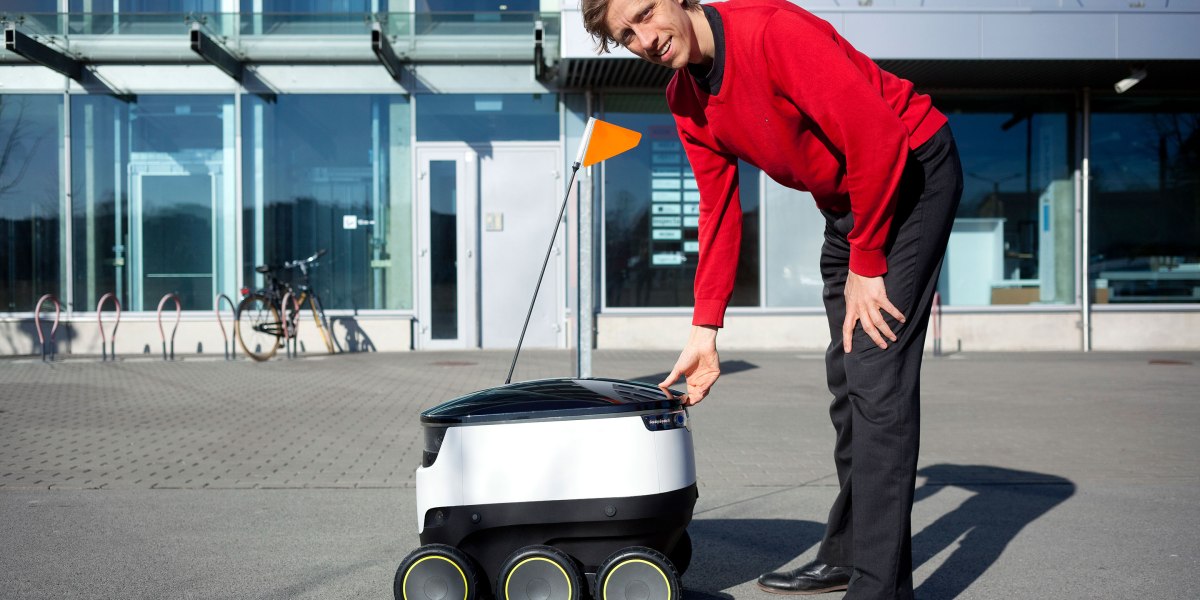
Starship reminds me of Better Place, the car battery swap company out of Israel. Too much PR, too many demos spread around the world, not enough profitable deployment. It looks like they're trying to make enough noise to be acquired by Amazon and exit, rather than actually providing a service that gets used.
"It looks like they're trying to make enough noise to be acquired by Amazon and exit, rather than actually providing a service that gets used."
I could not agree more.
Initially, all the extra money would go to the startup, but with competition, it's the consumers that would save. If it actually works.
and this is from tesla: https://www.tesla.com/videos/battery-swap-event But seems like Tesla discontinued battery swapping in favor of superchargers.
The ID card and id number make it safer than the alternatives.