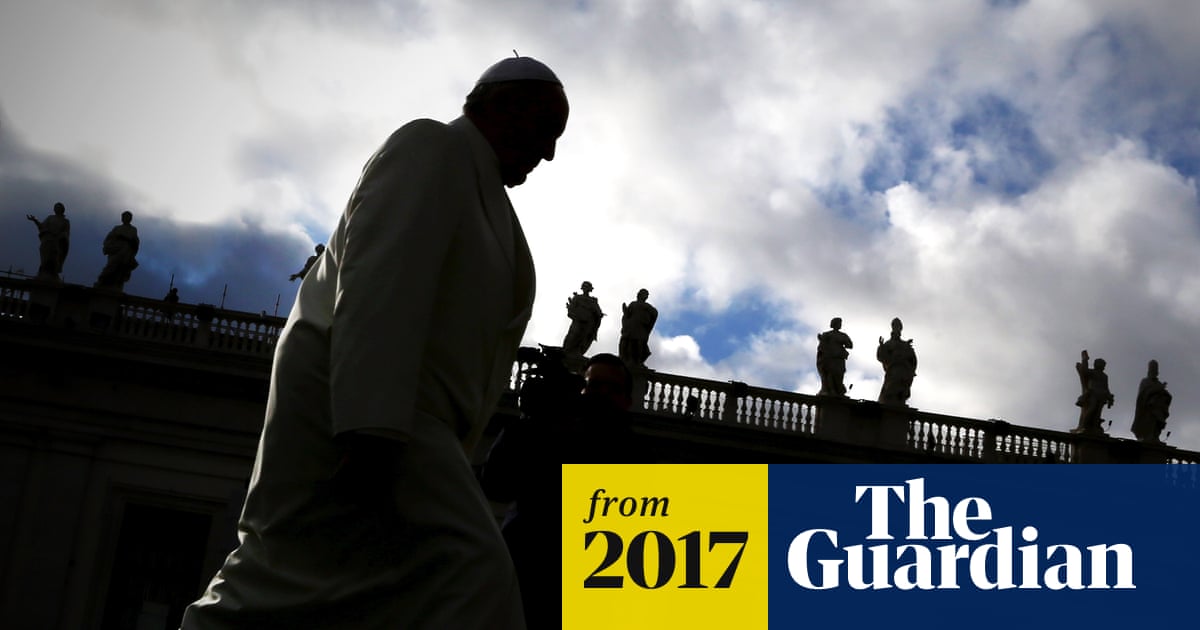
The war against Pope Francis
The long read: His modesty and humility have made him a popular figure around the world. But inside the church, his reforms have infuriated conservatives and sparked a revolt
the Guardian
103 points · by dcow · 9y ago · 159 comments
"Last year, one cardinal, backed by a few retired colleagues, raised the possibility of a formal declaration of heresy – the willful rejection of an established doctrine of the church, a sin punishable by excommunication. Last month, 62 disaffected Catholics, ...published an open letter that accused Francis of seven specific counts of heretical teaching.
"To accuse a sitting pope of heresy is the nuclear option in Catholic arguments. Doctrine holds that the pope cannot be wrong when he speaks on the central questions of the faith; so if he is wrong, he can’t be pope."
Popes write and say a lot of things but only a special few are elevated to the level of doctrine.
Pope Francis' footnotes on divorce aren't an official proclamation. (Though the article hints that he's working in that direction.)
Infallible[0] statements defining doctrine are made Ex Cathedra - From the Chair of St. Peter[1] which he hasn't done. So, in reality the conservative faction are protesting something which hasn't yet happened.
[0] https://en.wikipedia.org/wiki/Papal_infallibility [1] https://en.wikipedia.org/wiki/Papal_infallibility#Ex_cathedr...
This is a fact, but not really true in the sense you mean it.
The conservative faction were rubbed the wrong way by the footnote. The issue is that while it is not a proclamation of doctrine, it has been pointed to as justification for some German and Latin American bishops' administering of communion to the divorced.
The real problem is that Francis has remained silent when asked for clarification on the footnote, and whether or not it changed doctrine. Clarification was first requested officially (though privately) by a couple of bishops, and when no response was given for several months, those bishops published the letter to put further pressure on Francis to issue a clarification one way or the other[0]. The letter reads as a very polite request for clarification.
This went without response. In addition, there is some evidence that bishops have been privately directed to interpret the footnote in the 'heretical' sense. The evidence for this is laid out in the filial correction itself (see [1]).
The most recent document, referenced in the Guardian article as accusing Francis of spreading heresies, can be read here[1]. I would encourage anyone reading this to do so.
The document, along with the rest of the 'protesting' happening across the conservative side of the spectrum, isn't so much in response to a change in doctrine via dictum, but instead a response to the lack of clarification, and Francis' allowing (or even encouraging) a de facto change in doctrine.
[0]: http://www.catholicherald.co.uk/news/2016/11/14/full-text-ca...
[1]: http://www.correctiofilialis.org/wp-content/uploads/2017/08/...
The difference between you and OP is merely the question of which layer is discussed. The layer of facts or the layer of meaning.
I haven't asked him for details, because we have to work together in a music group and if we fall out the chances are the whole thing stops happening (it's a very small group playing instruments very few people can play). But it worries me, because as far as I can tell Pope Francis is quite keen on being nice to people, and showing mercy and forgiveness. I thought those were central tenets of Christian teaching.
Of course, as an atheist, I can't really comment, other than the slightly surreal nature of all these people worrying about interpretations of a fictional document and inspirations from a non-existent entity.
In fact, this kind of thing could be taken as further evidence that God is a fiction.
OTOH, it's been joked that there must be a God, because how else could the Church have survived nearly 2,000 years of all this [stuff]? I know, I know, the joke doesn't withstand critical scrutiny, but still ....
Riffing on that subject at the risk of going off-topic: The existence of some kind of Creator finds at least some support in the continuing evolution of the universe from the so-called Big Bang into local areas of greater and greater complexity. (This is a variation on the Weak Anthropic Principle [0].)
This continuing cosmic evolution seems consistent with the [EDIT:] conjecture that our universe is part of some kind of Great Project, in which it could be said that we're project workers — as Lutheran theologian Philip Hefner put it, we're created co-creators.
Personally I find this conjecture to be exciting and awe-inspiring — but only to the extent that it can be kept evidence-based [2].
[0] https://en.wikipedia.org/wiki/Anthropic_principle
[1] https://en.wikipedia.org/wiki/Philip_Hefner
[2] Self-cite: http://www.questioningchristian.com/2007/02/another_way_to_.... — see also the comments to that piece.
Being consistent with something is not an argument for that thing. There is an infinite supply of mutually inconsistent hypotheses you can trivially generate for anything that's yet unknown that are consistent with what is known. Universe-creating unicorn-pixies that like drinking coffee are consistent with the big bang as well (a big bang happens when they drinkg coffee!). That doesn't tell you anything.
[0] See "Synoptic Christians vs. John Christians: A Critique," at http://www.questioningchristian.com/2006/05/synoptic_christ.... (self-cite).
He was being pedantic, but not asserting that the bible speaks truth.
If you ask respectfully, I see now reason why you won't get a polite reply. Maybe you should avoid the following smug remarks, after age 16 they don't sound as good:
> other than the slightly surreal nature of all these people worrying about interpretations of a fictional document and inspirations from a non-existent entity
Anyway, since we are at it and you seem genuinely interested in details, I will give you my personal details. They may not match what you friend believes, but many Catholics have similar feelings.
As someone who left the Catholic Church because of Bergoglio, I must remind you that the Catholic faith is not just about mercy, forgiveness, kindness. I know many merciful and kind people who are not Catholic. So, when establishing a link between mercy and kindness and the Catholic faith, you have to keep in mind a few points:
- The behavior of a Christian is a consequence of some metaphysical beliefs, of following Christ's teaching and the Holy Bible. It would be an error to consider these consequences as the main trait of a Christian. As the name implies, main trait of a Christian is the belief in Christ.
- It has been reaffirmed many times by the Church that mercy and kindness alone are not enough to save your soul, believing in Jesus Christ is also required.
- Also, the Gospel (Matthew 6,1) advises Christian as follows: “Be careful not to do good deeds in front of other people. Don’t do those deeds to be seen by others. If you do, your Father in heaven will not reward you."
This said, let me come to why I don't like Pope Francis. He's kind, and he's merciful, but he's way too vague about the pillars of the faith.
For instance, in one of the first interviews after he was elected Pope, when asked: "Is there a unique vision of what is the Good?", he replied "Everyone has its own vision of what is Good and what is Bad. And we must encourage him to follows whatever he believes is Good".
This is not Christian. Christianity is about a guy, Jesus Christ, who came to say what is the Good. (John 14,6 "I am the way, the truth and the life")
Pope Francis also repeatedly stated that "there is no Catholic God, there is just one God". Again, this is in contrast with two millennia of teachings, and in particular with the Church dogma that there cannot be salvation outside the Christian faith.
One of the most sacred Christian texts, the Athanasian Creed, begins with the following sentence: "Whosoever will be saved, before all things it is necessary that he hold the catholic faith. Which faith except every one do keep whole and undefiled; without doubt he shall perish everlastingly."
I could show you many other example of Pope Francis's sloppy statements about the pillars of the Christian faith, but I hope you understand a bit better why many Christian, genuinely, do not like him.
It always seems to be that Pope Francis is much closer to Jesus's example than the Catholic church's tradition. Jesus was in the Bible stories, modest and tolerant and said things like "it's easier for a camel to go through the eye of a needle than for a rich man to get into heaven." The Catholic church seemed to go a bit away from that with ostentatious wealth, intolerance and the like so I can see why some of followers would be against Francis.
That's the view of Jesus' later followers, not of the man himself.
The John passage isn't especially reliable. [0]
Also, you're forgetting what Matthew and Luke both reported that Jesus said about just what's needed for salvation:
<blockquote>
25 On one occasion an expert in the law stood up to test Jesus. “Teacher,” he asked, “what must I do to inherit eternal life?”
26 “What is written in the Law?” he replied. “How do you read it?”
27 He answered, “‘Love the Lord your God with all your heart and with all your soul and with all your strength and with all your mind’; and, ‘Love your neighbor as yourself.’”
28 “You have answered correctly,” Jesus replied. “Do this and you will live.”
</blockquote>
(From Luke 10:25-37, emphasis added, footnotes omitted [1].)
[0] http://www.questioningchristian.com/2006/05/synoptic_christ.... (self-cite) Scroll down to "Problem: The Passage of Time." Tl;dr: From what's known about the author of the Fourth Gospel, his self-promoting account, decades after the facts and at odds with other accounts, simply isn't credible.
[1] https://www.biblegateway.com/passage/?search=Luke+10%3A25-37 (the parable of the Good Samaritan)
You are absolutely right. But the Catholic faith is not about a literal interpretation of the Bible, is about the so-called depositum fidei, i.e. how the Catholic Church holds and transmits the teachings of Jesus Christ.
You may say that all Catholicism is the interpretation given by "Jesus' later followers".
Of course, when discussing Catholicism, I was implicitly using the Catholic Church's interpretation of Jesus's sayings. It would interesting to discuss if what he meant is what the Church now means.
> 27 He answered, “‘Love the Lord your God with all your heart and with all your soul and with all your strength and with all your mind’; and, ‘Love your neighbor as yourself.’”
Sure. My point there was that faith in God is needed for salvation. It's not just mercy and kindness.
> "there is no Catholic God, there is just one God"
I've been told that this is one of the main changes that resulted from Vatican II: there is only one God and it's shared by the whole world population. On the other side, the Catholics pretend to have the "right" way to praise that common God. (but that's not what you were saying)
Francis seems to be in line with the official doctrine. (and from the article this seems to be a constant in his actions)
> One of the most sacred Christian texts, the Athanasian Creed
Never heard of that text. And a quick visit to Wikipedia tells me:
"Today, the Athanasian Creed is rarely used even in the Western Church."
After those two remarks, I don't think your statements are in way representative for a common way to understand the Catholic religion nor for the official Vatican position.
To be honest I think you are misunderstanding Vatican II, but that would open a much longer discussion, so I'll go for a simpler, more direct argument.
A Catholic must believe in the Holy Trinity, i.e. that God is one in three Persons. This is in the latest edition of the Catechism of the Catholic Church, and in more than two millennia of doctrine.
In other words: other religions adore different Gods, that don't come in three Persons. According to the Christian doctrine, this is wrong, that is not the true God, and without believing in the Holy Trinity you are not going to Heaven (this is clearly spelled in the Athanasian Creed and in many others documents, has been said many times during the history of the Church, being also confirmed by Vatican II, see also below).
So, it's not a matter of just believing in some vague, universal God. The teaching of the Catholic Church is: either you believe in the Catholic God (one God, three Person, the Son become man, died, resurrected, etc...) or your soul won't be saved.
That's why speaking of only one God may lead to confusion: you may say that the Christian, Islamic and Hindu God are the same, but only one can grant you salvation, so they are not the same!
Other religions have a different concept of God. You may stretch the concept a bit, and consider it as the same God in disguise, however it won't save you soul. That's quite a difference!
(An exception is made for people who didn't get to know the message of Christ in their lifetime, see below.)
> "Today, the Athanasian Creed is rarely used even in the Western Church."
That's right, it is not used in day-to-day celebrations, except once per year.
However it is an authoritative text when it comes to the Catholic doctrine.
Its author, Saint Athanasius, is a Doctor of the Church, i.e. a saint of particular importance when it comes to contributions to theology or doctrine. Actually the main reason he's a Doctor of the Church is because of his Creed.
The main message I was quoting from the Creed, the concept that there cannot be salvation outside the Church, has been repeated over and over during the history of the Church.
https://en.wikipedia.org/wiki/Extra_Ecclesiam_nulla_salus
Vatican II has established an exceptions in case of people who never got to know the Gospel during their lifetimes. The main point, that embracing the Christian faith is needed for salvation in case it has been announced to you, is although unmodified.
Maybe you should avoid such obviously fallacious reasons to accept something as true, after age 16 that doesn't sound as good.
Contrary to you, I didn't make any assessment of the general validity of the system.
My argument (what Pope Francis' says conflicts with the sacred texts) is valid whether you believe in Christ or not.
As a general rule, the notion of conscience is alien to people of Africa. They don't feel guilty, they only feel regret if they're caught. Now Africa is vast and this is a big oversimplification, especially that large populations of Africa are now Christian, but conscience is still an imported good in Africa and not deeply rooted in its culture. Is it a coincidence Africa suffers from corruption ?
Saying Africans have dark skin is a big oversimplification, you are basically saying that they are morally inferior.
Have you ever been to Africa? Have African relatives? Know African people? I am ashamed by your comment. I invite you to provide some kind of anecdote or proof for your statement. Otherwise don't spread ignorance please.
So, what's the US' excuse? Europe's? China's? India's?
I hate the "correlation is not causation" trope that's trotted out constantly, but it really applies here.
The gay situation is a good example.
Pope Francis has shown love and understanding towards LGBT group, just like shows towards any other group of people experiencing hardship.
He genuinely loves others, like most of Catholic priests and nuns do - that’s why they chose the carreer path of serving others.
I’m saying most, because there are exceptions and sadly we only read about the exceptions.
Pope Francis never said anything that wouldn’t be 100% aligned with the teaching of church. Never. He has shown sympathy and love, nothing more.
Francis probably won't live long enough to cement his legacy in such a way that it can not be undone. I have mixed feelings about this, on the one hand I'd like for the Church to take a more modern approach to their interaction with their subjects because they are causing a tremendous amount of grief in people's lives.
At the same time I can't wait to see their end (most likely not within my lifetime) and the harder the line they draw the more people will come to their senses and abandon this group of lying, disconnected old men.
How does a "good guy" reach the top of a "corrupt institution", passing all the gates along the way, presumably guarded by utterly corrupt people?
(The article places conservative dissenters at the recent synods at 1/4 - 1/3.)
It seems like there's a conservative third of populations that increasingly seeks to isolate itself from the mainstream (or political center, or whatever you want to call it).
Frankly, this somehow plays into the argument we are in a simulation and religions are optimization procedures to figure out which ideas will prevail in the end, driven by external actors.
Arguments can be made for either side. People are free to leave churches who hold views they disagree with.
And if you see how he leads this "war" that the article is about you can see he has the skills. The reason he's not living in luxury may be something like that he loves power more than money.
The deep state is no longer attempting to subvert Trump. A soft coup has been performed for purposes of stability, Trump is now being directly managed by the deep state. He'll give them what they want, so long as he can be handled he gets to stay. The Mueller investigation is now a lame duck, it's for show, nothing will come of it other than a few meaningless trophies.
https://www.washingtonpost.com/opinions/the-generals-have-tr...
https://www.washingtonpost.com/politics/military-leaders-con...
Doesn't matter. What other commenters here try to point out as well, a lot - if not most - organizations are built around one fiction or another. Some examples:
- Fanclubs, fandoms, convent attendees - those are literally communities built around fairy tales.
- Programming language communities - built around ever-changing artifacts of human imagination, they too have to deal with possible change of direction impacting attendance.
- Political parties - organized around some people's understanding of some ideas, + shitton of meaningless slogans that everyone interprets how they like. Exist mostly to self-perpetuate, as evidenced whenever any established party has anything meaningful to say or do; suddenly the official program takes second place towards what helps electability.
- Companies - the ultimate bubbles of meaninglessness, they in principle - and often in practice - exist as an ever charging group of people bound together by will to make money on ever changing product for ever changing market, lead by ever changing board.
I'd add nationalities, as there's plenty of crazy fiction going on in there, but they're at least usually bound geographically, so there's that.
--
The point being, many if not most organizations are built around some fairy tale or other, and what an organization is built around rarely matters to anything. What matters is how strong the community is, and that's pretty much purely social factor, without any actual dependence on objective reality.
When I look at people from $largeMainstreamReligion, I see people who will defend it as "the genesis of human life and the only source of truth" as a fact of the community you're supposed to accept. But then looking at their lives, they pay at best a lip service to the actual contents of that "source of truth", and instead only participate in the accepted traditions.
Basically, I feel that religions, fandoms, school associations ("I'm a Harvard Alumni"), etc. all work pretty much in the very same way.
What's more relevant is the differences. Funclubs' purpose is fun, I presume. Programming is serving humanity, I have no doubt. Political parties are in a way like football, a gentlemen game played by thieves. Companies are far from meaninglessness, they serve clear organizational and legal and taxes etc purposes.
Religions (edit: I'm familiar with) are built on deception to control people, they are not like fanclubs, programming, companies.
Thinking about it, the fandom that I'm part of shows quite some resemblance to a religious organization.
You don't believe that's simplistic? Is that a way to jumpstart useful dialog about that institution?
Religions are all about community, and for communities, traditions and beliefs are usually social objects, i.e. arbitrary things around which a community forms. The question of whether it's really true or false is - to most Catholics - just about as relevant as the question whether Star Trek is true or false is relevant to Trekkies. The issues those communities are debating are not about how their beliefs match reality, but how their beliefs match the canon around which the community is built.
Catholicism probably puts less emphasis on faith than pretty much any other theistic religion. Its main doctrines are supported by volumes of dense (and rather tedious) rational argumentation.
As always, money and power. At least ultra-capitalists are honest about their motivations.
You might be surprised, but brains and court records and all of that are actually physical and perfectly accessible to scientific investigation.
If I could persuade enough people that incorporation documents are invalid and that we all collectively agreed the corporations would cease to exist. This is of course an absurd notion and not practically achievable but there was a time before corporations existed and there could be a time after which they existed if we want. This is the same for any human conceived idea.
This position on marriage for priests is intriguing. Even Peter was married - see Matthew 8:14 (why would Peter have a mother-in-law if he wasn't married...?). And why does Paul warn about people who will say that you cannot marry? (1 Timothy 4:3) ???
"in this struggle it has been forced into the defence of an untenable absolutist position, whereby ..... all sex outside one lifelong marriage" is banned. "As Francis recognises, that’s not how people actually behave."
This is not true. Just because many people do not stick to their beliefs does not make the beliefs invalid, nor does it mean you should adopt the common mis-practice.
Like the Oxford versus Collins dictionary - Oxford tells you what the word means and how it should be used; Collins tells you how people typically use it (which might be an abuse of the word or incorrect usage). I'd rather go with Oxford.
Who of us likes ignoring our programming language specs and then argue that the compiler is wrong?
BTW I am not Catholic.
In 1998, a small group of American Catholic separatists elected one of their own as Pope Pius XIII: https://en.wikipedia.org/wiki/Lucian_Pulvermacher
I wonder if something similar is around the corner. The mood in America certainly has long been towards creation of shadow structures that ensure you don't have to meet with anyone who disagrees politically.
interestingly enough this could make sense (although quite likely not in the case of Breitbart commenters).
For example, the eastern orthodox church, like the roman church, defines itself as "One, Holy, Catholic and Apostolic", so an eastern orthodox christian may well refer to itself as "catholic" while denying the Pope is.
This seem to be the reason that in some places people often refer to "catholic" as "roman catholic".
That's not really why, is it -- it's because there are also the Eastern Catholic (as opposed to Eastern Orthodox) churches that recognize the Pope as the leader of the Church while using different rites (including allowing married men to be priests).
Unsurprisingly both modern "Catholics" and "Orthodox" churches claim that their influence is "worldwide" and that they are right.
So you probably can't use the old "Is the Pope a Catholic?" line anymore.
Back to the bears.
Unless Pope Francis makes significant changes officially, I’m not sure this would happen again, regardless of his popularity.
Have a look at how Civitas and the "Coalition pour la Vie et la Famille" grabbed 500k€ of European parliament subsidies for its "European policital party" with as members a hodgepodge of a Greek neonazi MP, a Slovak neofascist MP, a Polish extreme right wing populist, ... and one Latvian social democrat [2].
But now I'm really starting to digress from the topic I guess...
[0] https://en.wikipedia.org/wiki/Civitas_(movement) [1] https://en.wikipedia.org/wiki/Coalition_pour_la_Vie_et_la_Fa... [2] https://en.wikipedia.org/wiki/Mihails_Zem%C4%BCinskis
I feel this article is trying to "Stir up a storm" with sensational language. There is little behind this in my opinion.
It's possible that the catholics you hang out with are not the most conservative factions (e.g. the ones who still gnash teeth over Vatican II), which are the ones fuming over Francis.
>I feel this article is trying to "Stir up a storm" with sensational language. There is little behind this in my opinion.
While i can't speak about the part of catholics you know, nor about conservative wings of the catholic church (and the size of said wing), there are atleast some US-Conservatives claiming to be catholic with grievances about the pope:
http://www.foxnews.com/opinion/2013/12/04/pope-francis-is-ca...
A few months ago there was a radio show, with a quiz. "What town was the Pope born in ?". Naturally, Wadowice, because there's implicit understanding that John Paul II from Poland was the Pope. People rarely even mention Francis except to rant on him. There's full-blown denial. Most catholics seem to pretend Francis doesn't exist.
Poles like to brag how Catholic they are, but they're Catholic in name. Most don't follow teachings, they just went to church to avoid ostracism. Case in point: there was a media outrage when a prominent figure said Jesus was a refugee. When my brother was in primary school around 30 years ago, he was regularly beaten by his peers because he didn't want to attend religion lessons (in school, no less).
People bend over backwards to justify their xenophobic, homophobic, misogynist etc. behavior.
A major hierarch in Polish Church, Tadeusz Rydzyk, is 70% businessman 30% priest. He commands his own "schism" while pretending he is catholic. He has much influence among old, helpless, angry people. Despite blatantly engaging in politics (like many other priests), numerous instances of hate speech, antisemitism and other transgressions he remains in power, and Church doesn't expel him. The word is they deem him useful, because - although highly controversial - people listen to him. Geothermal energy, media schools, his own TV, and especially the radio station. His total income was recently estimated as 55,000,000 PLN (15.1184 million U.S. dollars). He's 88th on the list of the wealthiest Poles. And since autumn 2015 he received 26.5M + 139.6K + 250K + 710K + 200K + 105.2K + nearly 3M + 70.6K + 59.3K + 120K +11.6K + 216K PLN from various government institutions. Under various pretexts, like payment for coaching of judges, for his media school, newspapers. That's not counting tenders he regularly wins, or land he (and other priests) often buy at 10% or so of nominal value. His radio station doesn't run on advertisments, except ads of his own products and services. It runs on donations. And he constantly complains how little money he has.
https://oko.press/o-rydzyk-twierdza-ze-dostajemy-miliony-a-g... (polish)
Teachings of Jesus are hard to live by and demand self-sacrifice. Relatively poor (to the rest of Europe) and thus highly materialistic, envious, petty Poles don't like that. Love thy enemy ? If someone hits you, expose the other cheek ? Charity ? NO WAY. Once upon a time I had a twisted ankle, and walked slowly with crutches. Suddenly a car stopped by and the driver offered to give me a ride. Then it hit me - I've never received a similar offer before. You see, the driver spoke in English. It's hard to notice something is missing in your country until you've seen the difference.
Jorge Bergoglio is a good person. I feel like he hears the Holy Spirit, unlike the members of the curia from the "no new rules" camp. But I'm okay with new rules, being a member of the original revolutionary church. My group still has a lot of the old rules, but the rules should never get in the way of bringing a person into the grace of God.
Latin mass is pretty neat, and makes for some great canting opportunities, but if you give it to a group of people who can't understand, how does that open a person's heart? How does excluding people who sin make sense in the context of everyone being a sinner? Denying reality is like denying a part of Creation; denying access to the community drives people into the ranks of the atheists. And hey, at least they don't use faith as a cudgel against reality.
So, I wish Pope Francis the best of luck, and I hope that he can bring his branch of the church into a more loving, contemporary group.
Your sect still subscribes to faith as an epistemology, right? Given that that is pretty well known to be an unreliable method to obtain knowledge, and you still subscribe to it, how can you be surprised that other people are equally behind on minor details that you happen to get right?
(As an aside, the whole concept of declaring a previous marriage invalid - for various reasons - seems like it's a hack in the HN sense of the word.)
Live will continue on our world whatever Pope Francis is doing or anyone else in the catholic church.
As only one of these can be sincere given the other, the commenters who suspect that the Pope is just very good at looking like the good guy are probably right.
If you follow the Bible to the letter you get Hasidic Jews or Catholics, if you follow the Quran to the letter you get radical islam.