187 points · by walterbell · 8y ago · 218 comments
This reminds me of something that Hany Abu-Assad, a Dutch-Palestinian film director[0], once said in an interview. He was asked how it is possible that from countries like Iran, with its oppressive regime, we get such amazing directors as Abbas Kiarostami, who created beautiful humanising movies. After a brief moment of contemplation, Abu-Assad answered "society is stronger than the system."
> Would you say “Dunkirk” is your most hopeful film?
> Well … yeah. “Interstellar” is pretty hopeful. But then again, the whole world has ended. There is that. [Laughs]
Funny how one can interpret that both as "doesn't sound very hopeful to me", and "the more impossible the odds are that were overcome, the more hopeful the message inherently is".
WARNING: INTERSTELLAR ENDING SPOILER BELOW
What makes Interstellar especially tricky here is that on the one hand, saving humanity (and presumably as much other life as possible) from extinction when the entire planet is dying is about as big a challenge as it gets, and therefore makes the film feel very hopeful, but on the other hand the ending also implies that the universe is predeterministic, and that can be viewed as the opposite of hopeful.
(It's also not surprising if it did because it's modern scientific dogma that the world is deterministic. Even if you take into account quantum uncertainty, as Hawking points out, it is determined probabilities. ).
Well in the end of the movie it turns out that the future humans built the tesseract (I believe it's called) and the wormhole, leading the humans to survive and in the future built the tesseract and the wormhole, leading the humans to survive and in the future built the tesseract and the wormhole... you get the idea.
It's a time travel movie, and the whole thing becomes a paradox - if the humans didn't survive they wouldn't have developed to be able to make wormholes and time travel magic, but they did survive because of time travel magic.
So which came first? It's a paradox. One explanation is that there was nothing that actually came first but everything just happened as it should and there was no other way it could've happened, thus, predetermination.
But yeah, time travel paradoxes, fun stuff.
The other thing to keep in mind is he does not actually have any way to know who (or what) built the tesseract.
Just like how Brand earlier states the spacetime curvature hand she shakes hands with is "the first handshake" (implying first contact with an extraterrestrial), but it actually just turns out to be Cooper. The characters are confident of things they think are right, without actually being totally reliable narrators.
Stable time loops imply predetermination.
> Even if you take into account quantum uncertainty, as Hawking points out, it is determined probabilities. That the probabilities are governed (determined?) by precise equations doesn't mean that quantum mechanics isn't stochastic; it gives us only probabilities. The indeterminacy principle is a better better name than the uncertainty principle. But perhaps I'm misunderstanding you.
I like to think of the universe as a deterministic computer that is calculating its own outcome - there is no shortcut to jump to the end.
They didn't teach you in your physics PhD that stochastic != Undetermined. We may not know how to predict stochastic processes but that doesn't mean they don't follow cause-and-effect.
"There sure is a lot of music"
"This looks like a computer game"
"Those are aliens!" (a blip of crystals in the sky during the transition for Dave, little genius)
"They were happy about making tons of colors instead of a movie"
"They sure like red and green"
"Creepiest movie we've ever seen. It was boring, boring, boring, then scary."
"I should have known as soon as the monkeys, stupid, stupid." (from patient wife)
(I wrote all these down right after the movie)
They will need to "discover" these things on their own. The best thing you can do is to make sure they have opportunities to see this stuff and to talk it up when possible.
One of the best pleasures of being a teen is discovering, on your own, how rewarding a great film can be and developing "a taste" for films, music and other aesthetic experiences. You simply can't force this stuff.
True in pretty much any medium. Best you'll get from great art otherwise is maybe "yeah, I liked it", while missing much of what it offered. You may catch what you missed later when revisiting it. Much good art isn't very likely to give you even that much of a positive reaction if you watch it too early in your journey. Best way to get people into The Good Stuff is to show them one of the ones with good broad, surface appeal, then talk to them about the things that made it so good that maybe (probably) they didn't even notice, at least consciously. Show them some influences on that work, show them similar things that are worse and talk about why they're worse. Why is this character less effective, why is this similar scene so much better here than there, why did this film put this before that and how would it change if they swapped those things, why does this establishing shot make you feel uneasy all on its own (what is an establishing shot, and why are they there, and what happens if you take them away), and so on.
Gotta start somewhere, and jumping in the deep end will turn almost anyone off.
I even explained the theory behind the movie, Dave ending up in an environment he couldn't understand, like an animal in a zoo. We discussed this movie, it wasn't a throwaway experience.
And to be blunt about Kubrik, he and the film makers were self indulgent in a few places. Where it wasn't art, it was conceit.
What I find worrying about the comments on the movie was why it was disliked. It sounds like the movie doesn't contain enough "action" to spark interest.
I remember seeing a bbc introduction where Pink Floyd were introduced as a ‘pop band’ and you could see the derision on the presenters face.
> I attended the Los Angeles premiere of the film, in 1968, at the Pantages Theater. It is impossible to describe the anticipation in the audience adequately. Kubrick had been working on the film in secrecy for some years, in collaboration, the audience knew, with author Arthur C. Clarke, special-effects expert Douglas Trumbull and consultants who advised him on the specific details of his imaginary future -- everything from space station design to corporate logos. Fearing to fly and facing a deadline, Kubrick had sailed from England on the Queen Elizabeth, doing the editing while on board, and had continued to edit the film during a cross-country train journey. Now it finally was ready to be seen.
> To describe that first screening as a disaster would be wrong, for many of those who remained until the end knew they had seen one of the greatest films ever made. But not everyone remained. Rock Hudson stalked down the aisle, complaining, “Will someone tell me what the hell this is about?'' There were many other walkouts, and some restlessness at the film's slow pace (Kubrick immediately cut about 17 minutes, including a pod sequence that essentially repeated another one).
> The film did not provide the clear narrative and easy entertainment cues the audience expected. The closing sequences, with the astronaut inexplicably finding himself in a bedroom somewhere beyond Jupiter, were baffling. The overnight Hollywood judgment was that Kubrick had become derailed, that in his obsession with effects and set pieces, he had failed to make a movie.
To be fair, it is certainly a long way from a movie like The Killing.
I couldn't enjoy 2001 until I knew about all the detailed model work that went into it. The uncut version is still super boring, but it's easier to stay awake knowing what to look for. It's kind of the same situation with the various '90s Star Trek series. I am no longer impressed by long scenes of a ship passing by planets, so the intros are boring.
I find every minute of it to be thrilling (in case you were interested in another datapoint).
Furthermore I don't think those scenes you've described are there purely for the sake of impressing the audience. I think they are there to help explain the narrative. Like how in other - eg non sci-fi - shows you'll often get scenes of a car pulling up to a building to help explain that person has just arrived. Or scenes from outside a building to help explain to audiences where the following inside scene is based.
On the other hand, I watched High Sierra recently and the pre-Bullit notion of a car chase scene was, uh, less than thrilling.
We've lost the concept of sitting down for the sole purpose of enjoying a single work that is more complex than a 3 minute YouTube clip.
Kubrick, via wikipedia[1]: "There are a number of differences between the book and the movie. The novel, for example, attempts to explain things much more explicitly than the film does, which is inevitable in a verbal medium. The novel came about after we did a 130-page prose treatment of the film at the very outset. This initial treatment was subsequently changed in the screenplay, and the screenplay in turn was altered during the making of the film. But Arthur took all the existing material, plus an impression of some of the rushes, and wrote the novel. As a result, there's a difference between the novel and the film ... I think that the divergences between the two works are interesting."
[1] https://en.wikipedia.org/wiki/2001:_A_Space_Odyssey_(film)
“And because, in all the galaxy, they had found nothing more precious than Mind, they encouraged its dawning everywhere. They became farmers in the field of stars; they sowed, and sometimes they reaped. And sometimes, dispassionately, they had to weed.”
Or, that you cannot interpret it. At the beginning of the movie, the monolith changed monkeys to be intelligent enough to use tools. At the end of the movie, another encounter with the monolith causes a similar change that - to our unchanged, stupid minds - looks like a chaotic mess that cannot be understood.
Being confused about the ending was the goal.
As for 2001, it is a very meaningful film to me, but it does not surprise me that kids would have trouble with it. I think you really need to be an adult, and be prepared to think and put your own interpretation on it, in order to appreciate it.
This is how we get the JJ "uh oh, two characters talked for more than 30 seconds, better cap this bit with an action scene even if it does precisely nothing to provide characterization, exposition, or advance plot" Abrams school of film-ruining.
You want actually stage-like films you have to go back farther. Wide shots galore, with stage-style blocking. Check out the opening scene of the original Ocean's 11.
However, I'm surprised you got your family to sit through it. I don't know any kids under say 10 who could pay attention long enough. Heck, I don't know many adults that could either these days!
So I dunno, I'd say it depends on the kid. Might also depend on the era in which it's viewed, because I viewed it shortly after we had first landed on the moon. After forty years of Star Wars, maybe it doesn't seem so cool anymore.
We then watched the Soderberg cut, cause i always thought 2001 had too much dead space. Again, surprisingly, we all agreed the original was way better. Soderburgh took too much out.
It was a good call at the time, since that's what got them awards, but I'd like to see both of them with the non-critical bits sped up to see if it improves my viewing experience.
That being said, the colors comment is true.
If you can do it as an adult, 2001 is great and Inland Empire from David Lynch is amazing. Inland Empire speaks directly to the unconsciousness and goes past of any explanation. You walk out from the theater wondering what happened. It's like you have been injected with something. The experience that lingers has no explanation.
I agree, and I didn't realise the extent to which this was happening with me until a few years ago, when one of my children got interested in performance magic. Because he was young, I went to various magic conventions and meetings with him, and listened to a lot of people talking about the practice of magic as well as its technical aspect. Turns out, a big preoccupation of magicians is how hard it is to get people to just watch the magic without them being distracted by trying to figure-out how its done. If anything, its harder for magicians than film directors because what they do clearly does merit disbelief.
Anyway, I learned that it really is ok to just watch a difficult film and experience the feelings that it produces without picking them apart. As an analytical person this was both a relief and a learning experience for me.
(Also, 2001 is an excellent film.)
With that in mind, the Netflix binge is a good example of how immersion is still very much a thing.
[0]https://www.youtube.com/watch?v=5U9KmAlrEXU
[1]https://www.youtube.com/watch?v=3nj5MMURCm8
[2]http://www.indiewire.com/2013/04/interview-shane-carruth-tal...
I've seen 2001 in 70mm a few times in recent years in a nice theater (and I'll see it again when it comes back), and it's very engrossing in a dark theater with no technology. You can let the entire film and all of its implications just wash over you. You can't get up, nor can you check your phone. You have nothing else to do other than just be in the moment.
This is harder to do at home. People should see more seminal movies in theaters, and I wish more theaters showed them. I live by American Film Institute's theater in the DC area, which is how I am able to see all of this stuff, but many other people do not. I think it's a big miss that more theaters don't show older movies year around.
After leaving an afternoon screening of 2001 directors cut I felt like I'd been taking acid. I really respect Nolan as one of the best modern filmmakers, creating blockbusters with integrity is a big ask.
Eraserhead was a trip, I still haven't totally figured it out. But in terms of pure cinematic enjoyment Blue Velvet would be my favorite.
Now that I hear other Lynch fans talk about Inland Empire I'm really excited to watch it.
What have watched so far?
It didn't happen with any previous SW movies, in fact maybe this was unique experience. For both of us. I didn't question logic of anything (which I usually do), everything just clicked and hummed along the story.
When I checked IMDB, I couldn't wrap my head around why it's rated so low and first 50-100 user reviews gave it either 1/10 or 2/10 and kept repeating how disappointing it is and how it is a worst movie in cinema history. Didn't bother to check their arguments, I enjoyed it profoundly and I still smile when remembering those moments.
Maybe I was in right mental setup for it, but that would be valid for both of us symmetrically.
In fact, as writing this, I recall once I watched Apocalypse Now, and somehow, for some reason, it felt very similar. I saw it before, and I saw it after this, but it was never so intense, so 'right'
It wasn't until the blu-ray release came out that I felt the same experience and immersion in the film as I did with viewing in a theatre.
"It's not over-analysis when every stray thought about the film has to be quashed lest you realize how stupid the movie is." -- Howard Tayler
This seems terribly relevant. And it's interesting coming from a director - the leader of creative communities behind the camera while commercial success often depends on the individual standing in front of it.
It's incredibly interesting to me, coming from this director, as I class him as one of the best, up there with Kubrick, and I also will discriminate on movies based on directors and screenwriters more than any other factor, because that's how I have found quality.
His films are good and incredibly entertaining, but Kubrick is on a completely different plane.
I would disagree if you're saying the cinematography won't be remembered; van Hoytema's work on Interstellar and Dunkirk is something I remember quite positively even while typing this comment. I would also disagree on character development, as Nolan directed Robin Williams into one hell of an antagonist in Insomnia, a spectacularly underrated film.
I agree perhaps I misclassed Nolan with Kubrick. That being said, "Memento" and "Inception" really stand out to me. Could be that I just really relate to the themes of romantic loss, and as a musician I found the scores for both made a big difference to me. Granted, Zimmer's score for "Inception" was bombastic and could justifiably be called Wagnerian; I still find listening to that soundtrack cathartic, and in spots it's even very cerebral.
I haven't seen Dunkirk so maybe it will totally change my mind
A truer statement is that the last 90 years we’ve steadily diminished the value of the individual.
But it's hard to ignore the deification of certain individuals through celebrity. If some of society's foundational institutions are failing, it's fair to suggest the deification of power brokers as a root cause.
Auteur - that was the word I was looking for. It's interesting how people deride the auteur concept (including Nolan!), but "auteurship" is exactly how I have found many movies I love: I'll take a chance on something I know nothing about, and if it's really good, I go looking for other movies by the same director or screenwriter. Similarly, I skip anything by Michael Bay or McG. I've not oft been disappointed with this process.
I think the distribution for films is bimodal, one huge peak for box-office/mass-appeal hits, and another smaller peak for critical hits/film-nerd-appeal hits.
Nolan would be right in the center between these two distributions: he pushes cinema forward while keeping it accessible to all.
* Baby Driver
* Lady Bird
* Blade Runner 2049
* Logan
* The Disaster Artist
* The Beguiled
* ...
On some new movies the rating is very high, but it goes down sharply.
IIRC one of the Fast and the Furious "movies" had a stupidly high rating, which is now more sane.
https://www.rottentomatoes.com/franchise/the_fast_and_the_fu...
IMDB seems to suffer from this less.
The only useful thing on RT is their one line blurb.
If you see Furious 7, for example, it has a Tomatometer rating of 80%, but the average is just 6.6/10.
(Note: you have to open the movie page to see the average rating)
Interstellar is (by a country mile) the film that really does it for me, and is the one I'll watch two or three times a year. The strange thing about Interstellar is that after having watched it the first couple of times, every subsequent viewing gets me fairly emotional. I never ever shed tears when watching films, and I've seen a lot of movies in my 51 or so years on this planet, but this is the one that gets me welling up inside and a bit teary eyed. So well done Mr Nolan you've managed to crack a fairly hard (film) nut.
The scene where Cooper comes back from the time-dilated planet and has years of messages to catch up on really makes me emotional. McConaughey really kills it in this movie.
In my opinion this is missing the problem. Government, in a democracy, is decided by the masses. I think people, as individuals, are generally quite intelligent. But I also think people, as groups, are quite stupid. Mob mentality is very much a real phenomena and it's something we've not come even remotely close to growing out of. Similarly for tribalism.
In the instance he's referring to (film critics associations boycotted Disney after Disney blacklisted writers from an influential publication, leading Disney to rescind the blacklisting) you had a very small and very well informed demographic working together. That has very little to do with the democratic process. Most people do not know much about any given topic, and so when you query the masses on anything the majority opinion is going to be heavily influenced by marketing and 'propaganda.' What people do or think is not really based on reality, but who presented their argument in the glossiest case.
So to bring this theoretic into the practical. Imagine you ask people about a certain hotkey issue, in most recent times perhaps it would be Trump's tax plan. Many people would have extremely strong opinions one way or the other. Now ask people to actually describe, without handwaving, what the plan actually was. People, for the most part, are going to be completely ignorant. We, collectively, form strong decisions about things we don't even know the basic fundamentals of!
I don't know how this can change in practical terms. It's the nature of a democracy. But that just kicks the can to another problem. If we can't come to informed decisions on an individual policy, how are we supposed to be expected to come to informed decisions on candidates using every resource available to make us believe that they are who we, collectively, want in office? As tools and technologies for directing the masses in one way or another become ever more effective, this disconnect between reality and mass opinion is only going to increase.
Except my wife. My wife may be the only human being on Earth to not feel one way or the other about it.
(I absolutely love the movie, but I'm not going to argue with you if you find it a bore. I totally get why some would feel that way)
I absolutely love most of that movie. The pacing, the set design, the score - fantastic.
The end with the nutty lights -- I hate. It's hard for me to believe it's all in the same movie because I hate it almost to the point of anger. If that part wasn't in the movie I would probably have watched it a lot more than the two or three times I have.
That makes me feel better about my son seeing "Return of the King" 6 times in the cinema when he was 5.
Mind you - he does now want to become a movie director... :-)
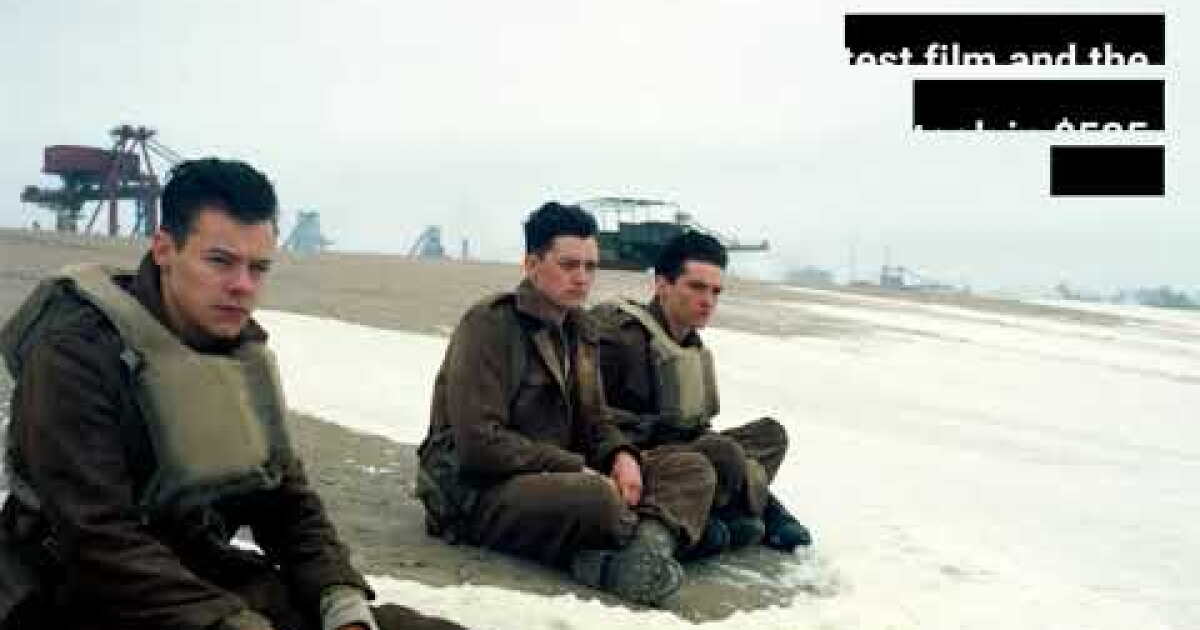
On this subject previously: https://news.ycombinator.com/item?id=15004843 , me Britsplaining the meaning of Dunkirk.
Rarely you will see someone who know the trill of climbing 40m high tree(age of 7). Swimming in lake while thunderstorm rages around you. Grabbing red coal with hand. Eating baked stolen potatoes in middle of forest where you got lost. Making an failure of bow to hunt. Starting a fire, then living the consequences. Giving no shits about drama and other people's feelings. Slicing up toad to see what is inside. Running from crazy animals. Crossing the voltage wires for shits and giggles. No child died in our village from these bullshits, just got smarter.
Movie will do that for you and tell you how to feel. They will provide you with fake imagination and experience.
Said the universally-acclaimed multi-millionaire Hollywood blockbuster director in his interview for LA Times
That said though, I like the message and also respect the man and his work. That just struck me as a little hypocritical :) although as a storyteller I suppose he is in a position to change narratives like that
Either of the last two could conceivably be considered an insult given the difference in jobs, and creativity and control inherent in the task of directing.